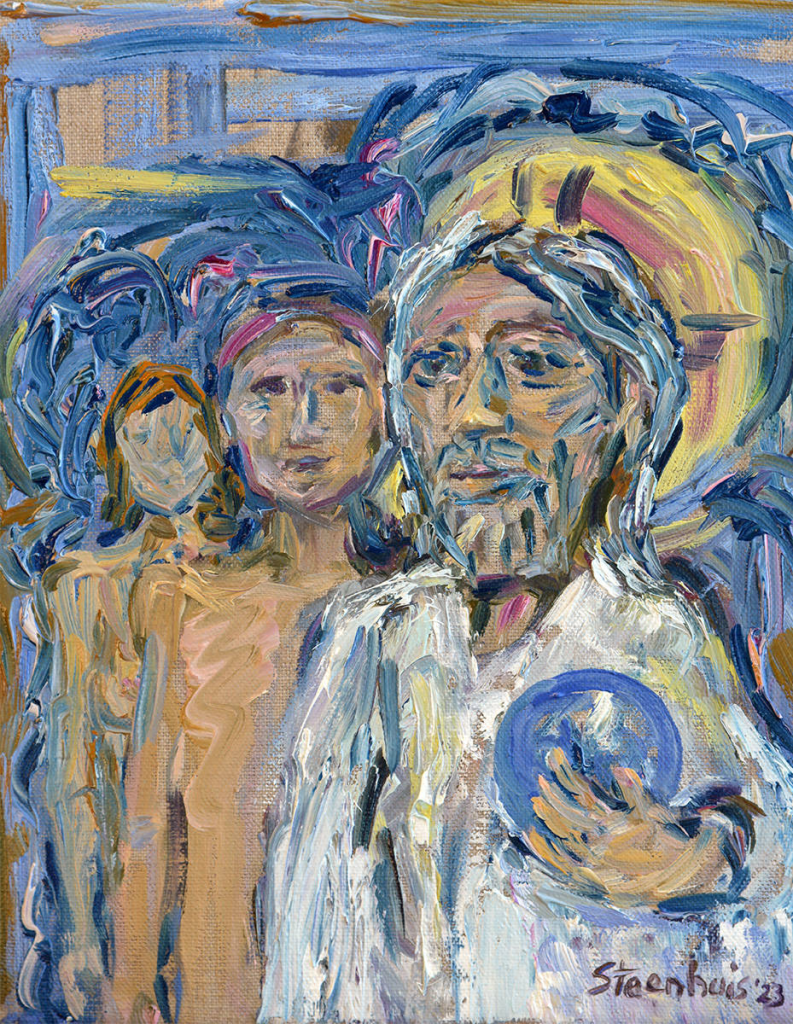
Immortal God and Mortal Humanity (Psalm 90)

Digital artwork by Bruce Butler

Lord, you have been our dwelling place
    in all generations.
Before the mountains were brought forth
    or ever you had formed the earth and the world,
    from everlasting to everlasting you are God.

You turn us back to dust
    and say, “Turn back, you mortals.”
For a thousand years in your sight
    are like yesterday when it is past
    or like a watch in the night.

You sweep them away; they are like a dream,
    like grass that is renewed in the morning;
in the morning it flourishes and is renewed;
    in the evening it fades and withers.

For we are consumed by your anger;
    by your wrath we are overwhelmed.
You have set our iniquities before you,
    our secret sins in the light of your countenance.

For all our days pass away under your wrath;
    our years come to an end like a sigh.
The days of our life are seventy years
    or perhaps eighty, if we are strong;
even then their span is only toil and trouble;
    they are soon gone, and we fly away.

Who considers the power of your anger?
    Your wrath is as great as the fear that is due you.
So teach us to count our days
    that we may gain a wise heart.

Turn, O Lord! How long?
    Have compassion on your servants!
Satisfy us in the morning with your steadfast love,
    so that we may rejoice and be glad all our days.
Make us glad as many days as you have afflicted us
    and as many years as we have seen evil.
Let your work be manifest to your servants
    and your glorious power to their children.
Let the favor of the Lord our God be upon us
    and prosper for us the work of our hands—
    O prosper the work of our hands! (New Revised Standard Version)

All of the psalms are prayers. Most of them are prayers of David. Today’s psalm is a prayer of Moses.

Moses acknowledged and affirmed that God is eternal, and we humans are not. We are frail and in need of God. We are dependent upon God for health, hope, and happiness in life.

There are observations to notice in today’s Psalm lesson, that are then followed by prayerful petitions which arise from those observations.

First Observation: God Is Eternal

God is immortal. God has always been, and will always be. Therefore, the Lord’s rule and reign existed way before this world was ever created, and shall extend way beyond the lifespan of creation. God’s dwelling place is without beginning or end – which means that God isn’t going anywhere. That is a great comfort to me.

Second Observation: Humans Are Finite

Whereas God is immortal, we humans are mortal beings. We are creatures with limited time on this earth. We all eventually die. Everyone returns to the dust from which they came – which isn’t even a blink of an eye when compared to God’s eternal existence.

This isn’t meant to be a downer for us, but rather to help us. It is necessary to work within our limitations while living in this world. To live as if we are immortal has grave consequences (pun intended).

Third Observation: The World Is Broken

Our world is fundamentally messed up. Another way of saying this is that everything in creation is under a curse. Things are not as they should be. And that’s on us, not God. Because of our own human proclivity to sin, our world is beset with a great deal of suffering and toil.

Hopefully, in the best scenario, people learn to understand the brevity of life, and gain wisdom on how to live a humble, just, and good life with one another, and with their God.

Now notice the petitions which Moses offered to God, based upon the observations of God’s nature, human nature, and the world’s situation.

First Petition: Turn, O Lord!

Moses was pleading with God to turn away from divine judgment and wrath, which was more than deserved for a group of people who were chronically complaining and disobedient. Moses was well aware of all Israel’s sins, and was counting on the Lord’s mercy for God’s covenant people.

Second Petition: How long, O Lord?

Moses was asking one of those questions that we ask, knowing that he wasn’t really going to get an answer. Yet, in the asking, there is an understanding that human misery won’t go on forever. Our suffering is temporary.

In this petition of Moses, he was also calling for a change, for God to deal with the people in a different way. Moses wanted gladness to replace affliction, and the sufferings of this life to give way to the joy of living in a good world.

Third Petition: Prosper the work of our hands

This wasn’t a petition for God to simply make everyone healthy and wealthy. It was a focused prayer that God’s work and our human work would be one seamless activity. That is, this is a prayerful longing for what we do in our lives to completely synchronize with God’s law in this world we all inhabit together.

Whenever we sin, we cause damage, not prosperity. Yet, with a divine/human cooperative in which we acknowledge and affirm God’s sovereignty over our lives, and take up our own human responsibility, then humanity thrives and flourishes in the goodness we were meant to enjoy as God’s creatures.

Christian Observations

In Christianity, the immortal and invisible God comes to us in the mortal and visible life of Jesus. In Christ, the sovereignty of God and the responsibility of humanity is not only synchronized; it is perfectly united and harmonized so that there is deliverance from the power of evil and from God’s judgment.

God’s steadfast love is brought to us with skin on.

For the Christian, Jesus is the answer to the prayers and petitions of Moses. Christ is the prophet foretold by Moses who was to come:

I [Yahweh]will raise up for them [the Israelites] a prophet like you [Moses] from among their own people; I will put my words in the mouth of the prophet, who shall speak to them everything that I command. (Deuteronomy 18:18, NRSV)

The incarnation, life, ministry, crucifixion, death, resurrection, ascension, and glorification of Jesus Christ has dealt with the weeds and overgrowth of guilt and shame that has taken over the garden of this world.

In Christ, we can begin to hack through all the stuff, in order to see the beauty underneath all of the spiritual neglect which has occurred for so long.

May the grace of the Lord Jesus Christ, the steadfast love of God the Father, and the encouragement of the Holy Spirit be with you, now and forever. Amen.

I Am Responsible and Accountable (Ezekiel 18:1-32)

The word of the Lord came to me: “What do you people mean by quoting this proverb about the land of Israel:

“‘The parents eat sour grapes,
    and the children’s teeth are set on edge’?

“As surely as I live, declares the Sovereign Lord, you will no longer quote this proverb in Israel. For everyone belongs to me, the parent as well as the child—both alike belong to me. The one who sins is the one who will die.

“Suppose there is a righteous man
    who does what is just and right.
He does not eat at the mountain shrines
    or look to the idols of Israel.
He does not defile his neighbor’s wife
    or have sexual relations with a woman during her period.
He does not oppress anyone,
    but returns what he took in pledge for a loan.
He does not commit robbery
    but gives his food to the hungry
    and provides clothing for the naked.
He does not lend to them at interest
    or take a profit from them.
He withholds his hand from doing wrong
    and judges fairly between two parties.
He follows my decrees
    and faithfully keeps my laws.
That man is righteous;
    he will surely live,
declares the Sovereign Lord.

“Suppose he has a violent son, who sheds blood or does any of these other things (though the father has done none of them):

“He eats at the mountain shrines.
He defiles his neighbor’s wife.
He oppresses the poor and needy.
He commits robbery.
He does not return what he took in pledge.
He looks to the idols.
He does detestable things.
He lends at interest and takes a profit.

Will such a man live? He will not! Because he has done all these detestable things, he is to be put to death; his blood will be on his own head.

“But suppose this son has a son who sees all the sins his father commits, and though he sees them, he does not do such things:

“He does not eat at the mountain shrines
    or look to the idols of Israel.
He does not defile his neighbor’s wife.
He does not oppress anyone
    or require a pledge for a loan.
He does not commit robbery
    but gives his food to the hungry
    and provides clothing for the naked.
He withholds his hand from mistreating the poor
    and takes no interest or profit from them.
He keeps my laws and follows my decrees.

He will not die for his father’s sin; he will surely live. But his father will die for his own sin, because he practiced extortion, robbed his brother and did what was wrong among his people.

“Yet you ask, ‘Why does the son not share the guilt of his father?’ Since the son has done what is just and right and has been careful to keep all my decrees, he will surely live. The one who sins is the one who will die. The child will not share the guilt of the parent, nor will the parent share the guilt of the child. The righteousness of the righteous will be credited to them, and the wickedness of the wicked will be charged against them.

“But if a wicked person turns away from all the sins they have committed and keeps all my decrees and does what is just and right, that person will surely live; they will not die. None of the offenses they have committed will be remembered against them. Because of the righteous things they have done, they will live. Do I take any pleasure in the death of the wicked? declares the Sovereign Lord. Rather, am I not pleased when they turn from their ways and live?

“But if a righteous person turns from their righteousness and commits sin and does the same detestable things the wicked person does, will they live? None of the righteous things that person has done will be remembered. Because of the unfaithfulness they are guilty of and because of the sins they have committed, they will die.

“Yet you say, ‘The way of the Lord is not just.’ Hear, you Israelites: Is my way unjust? Is it not your ways that are unjust? If a righteous person turns from their righteousness and commits sin, they will die for it; because of the sin they have committed they will die. But if a wicked person turns away from the wickedness they have committed and does what is just, and right, they will save their life. Because they consider all the offenses they have committed and turn away from them, that person will surely live; they will not die. Yet the Israelites say, ‘The way of the Lord is not just.’ Are my ways unjust, people of Israel? Is it not your ways that are unjust?

“Therefore, you Israelites, I will judge each of you according to your own ways, declares the Sovereign Lord. Repent! Turn away from all your offenses; then sin will not be your downfall. Rid yourselves of all the offenses you have committed, and get a new heart and a new spirit. Why will you die, people of Israel? For I take no pleasure in the death of anyone, declares the Sovereign Lord. Repent and live! (New International Version)

Every single one of us is accountable to one another for what we say and how we conduct ourselves. Above all, we are accountable to God for our motives, words, and actions in this life.

The flipside to stating that we are accountable, is saying that none of us are responsible for another person’s intentions, words, or actions.

Other people may influence us. We may be either participants in or victims of another’s actions. Some folks might take credit for something another person said or did. Yet, ultimately, we are responsible for our own life.

Whatever I think, say, or do is on me, period.

What’s more, one’s past actions do not replace our current actions. The prophet Ezekiel emphasized individual responsibility and accountability. All of the other Old Testament prophets addressed whole nations, and not individuals. They denounced the social, economic, and political systems and institutions, upholding communal ideals of justice.

Ezekiel communicated that children shall not be punished for their parent’s sins. Only the person who sins will face judgment.

A person ought only to pay for their own sins; punishment should not carry forward to future generations. The prophet also insisted that each individual person has the opportunity to change their behavior, and so, avoid their deserved penalty.

Every individual has the opportunity to change their personal ways of injustice or unrighteousness. For those who refuse, there is a and right and just Judge who knows how to dispense what is needed for each person – whether it is judgment to the arrogant, comfort to a victim, or justice for the underprivileged.

God cares that every person on earth receives what they need to thrive and flourish in this life. And to those who don’t give a wit about others, the Lord gives an opportunity to turn from arrogance and change.

Refusing to change, however, will end badly for the stubborn person.

The prophet Ezekiel calls on individuals to speak and act in ways that are helpful, not harmful. And whenever one harms another, that one must acknowledge the irresponsibility, because I am held accountable for what I say and do.

All words and actions come with consequences. It would do us a lot of good to consider how what we say and do (or fail to say and do) impacts the next generation of people. Everyone leaves a legacy of some sort – whether good or bad – so we need to be aware of how we live.

Each person must take up the mantle to do good, not evil; and to live righteously, not wickedly. Living selfishly with impunity leads to divine judgment. Yet, mercy is always there, if we seek to amend our ways.

Conversely, living righteously, and then resting on my laurels and living however I want, does not inoculate me from divine judgment.

You and I must live one day at a time, trusting God and seeking the welfare of others. And when I mess up, I am to keep a short account with God by admitting my fault and receiving grace.

We humans have quite enough responsibility in our lives without taking on the extra job of exacting judgment on another person. If we live a righteous life to begin with, then there is no need for a new heart and life.

Yet, if I need it, a new existence is there, through a change of direction which humility grants us.

Almighty God, help me to prioritize your values, and put my faith into action. Enable me to use the talents, resources, and time with which I have been blessed. Empower me to serve my community and my world. May I serve you always, and pray with a joyful spirit. Amen.

Divine Sovereignty and Human Responsibility (2 Samuel 8:1-18)

In the course of time, David defeated the Philistines and subdued them, and he took Metheg Ammah from the control of the Philistines.

David also defeated the Moabites. He made them lie down on the ground and measured them off with a length of cord. Every two lengths of them were put to death, and the third length was allowed to live. So the Moabites became subject to David and brought him tribute.

Moreover, David defeated Hadadezer son of Rehob, king of Zobah, when he went to restore his monument at the Euphrates River. David captured a thousand of his chariots, seven thousand charioteers and twenty thousand foot soldiers. He hamstrung all but a hundred of the chariot horses.

When the Arameans of Damascus came to help Hadadezer king of Zobah, David struck down twenty-two thousand of them. He put garrisons in the Aramean kingdom of Damascus, and the Arameans became subject to him and brought tribute. The Lord gave David victory wherever he went.

David took the gold shields that belonged to the officers of Hadadezer and brought them to Jerusalem. From Tebah and Berothai, towns that belonged to Hadadezer, King David took a great quantity of bronze.

When Tou king of Hamath heard that David had defeated the entire army of Hadadezer, he sent his son Joram to King David to greet him and congratulate him on his victory in battle over Hadadezer, who had been at war with Tou. Joram brought with him articles of silver, of gold and of bronze.

King David dedicated these articles to the Lord, as he had done with the silver and gold from all the nations he had subdued:Edom and Moab, the Ammonites and the Philistines, and Amalek. He also dedicated the plunder taken from Hadadezer son of Rehob, king of Zobah.

And David became famous after he returned from striking down eighteen thousand Edomites in the Valley of Salt.

He put garrisons throughout Edom, and all the Edomites became subject to David. The Lord gave David victory wherever he went.

David reigned over all Israel, doing what was just and right for all his people. Joab son of Zeruiah was over the army; Jehoshaphat son of Ahilud was recorder; Zadok son of Ahitub and Ahimelek son of Abiathar were priests; Seraiah was secretary; Benaiah son of Jehoiada was over the Kerethites and Pelethites; and David’s sons were priests.(New International Version)

“God’s sovereignty does not negate our responsibility; it empowers us to live out God’s purposes.”

D. A. Carson

In every biblical story, the real hero is God. That’s because, in each scriptural narrative, God’s sovereignty, power, and authority works on behalf of the people. The secondary characters – if they are good people – take up their mantle of responsibility by working for the people in fulfillment of God’s good promises to them.

Divine sovereignty and human responsibility work together. When that happens, it doesn’t matter what the odds of a situation are, because God’s people will emerge as recipients of God’s gracious promises.

It’s good to always keep in mind that God is working – albeit, mostly behind the scenes where we never see it – and that therefore we must remember to be ourselves continually responsible for acting consistent with God’s revealed will to us.

Up to this point in today’s story, the Ark of the Covenant has been brought to the new national capitol of Jerusalem. The Ark signifies the presence of God, and it’s central placement in the life of the Jewish nation, signifies King David’s desire to be responsible in working on God’s behalf.

So, this is why we have a litany of David’s successes, in order to show us the connection between God’s presence and the national advancement of Israel’s people in the region. King David was able to defeat Jewish enemies in all the geographic places around Israel and Judah.

King David’s Jerusalem, by Julia Goddard

All of the areas mentioned in today’s text fit the boundary promises given to the original Jewish ancestor Abraham, centuries earlier. (Genesis 15:18-21)

David defeated Judah’s main enemy in the West, the Philistines, by capturing their main city, and thus, controlling their entire territory. Philistia had been the major thorn in Judah’s side for a very long time. After David’s victory over them, the Philistines never regained their power again.

David defeated Israel and Judah’s enemies in the East. The Moabites were ancient foes, having tried to put a curse on Israel so that they could enter the Promised Land (Numbers 24:17). But the curse backfired. King David was perhaps merciful to them by not wiping out Moab altogether, but only humbling them with limited violence.

David defeated Israel’s enemies in the North by achieving an overwhelming decisive victory against the Arameans and the city of Damascus, despite insurmountable odds. Yahweh, Israel’s God, clearly outdid Aram’s storm god Hadad – proving to the people once and for all that the Lord is not limited to the geography of Israel.

David defeated Judah’s enemies in the South. The Edomites were always looking to take advantage of their brother Jews, constantly playing out the ancient rivalry between Esau and Jacob. Overcoming the nation of Edom, along with the other surrounding nations, allowed David’s kingdom to more than double in size.

The hallmark description of any good and godly leader is that they do what is right and just for all the people – which is precisely what King David sought to do, and did. And he didn’t do it alone, but had a solid group of good and godly people helping him in his royal administration.

King David acted according to his understanding of God’s will for the Jewish nation, which meant decisively handling the ancient enemies which previous leaders either could not or would not take on. David moved with confidence, believing that God was with him in all his endeavors, based upon divine promises from God’s covenant with Israel.

The God of David is still watching over the nations, and still yet remains sovereign. People are still responsible to act according to their understanding of God’s will – not confusing that responsibility with Israel’s, but knowing what their place is in the kingdom of God with King Jesus as the ultimate Sovereign.

Today, I believe that two significant problems plague us: 1) A lack of knowing God and God’s will for us; and 2) An unwillingness to act confidently in faith and take a risk based on a solid understanding of God. The result of these two problems is pervasive spiritual immaturity and mediocrity.

We have a lot of work to do. And it’s high time we roll up our sleeves and deal with the primary problems in front of us – not with military weapons and shedding blood – but by the means of knowledgeable prayer and loving actions.

May it be so, to the glory of God and for the blessing of the nations. Amen.

Life (Genesis 1:20-2:4a)

The Creation of Heaven and Earth, by Unknown artist, c.18th century

God said, “Let the waters swarm with living things, and let birds fly above the earth up in the dome of the sky.” God created the great sea animals and all the tiny living things that swarm in the waters, each according to its kind, and all the winged birds, each according to its kind. God saw how good it was. Then God blessed them: “Be fertile and multiply and fill the waters in the seas, and let the birds multiply on the earth.”

There was evening and there was morning: the fifth day.

God said, “Let the earth produce every kind of living thing: livestock, crawling things, and wildlife.” And that’s what happened. God made every kind of wildlife, every kind of livestock, and every kind of creature that crawls on the ground. God saw how good it was. Then God said, “Let us make humanity in our image to resemble us so that they may take charge of the fish of the sea, the birds in the sky, the livestock, all the earth, and all the crawling things on earth.”

God created humanity in God’s own image,
        in the divine image God created them,
            male and female God created them.

God blessed them and said to them, “Be fertile and multiply; fill the earth and master it. Take charge of the fish of the sea, the birds in the sky, and everything crawling on the ground.” Then God said, “I now give to you all the plants on the earth that yield seeds and all the trees whose fruit produces its seeds within it. These will be your food. To all wildlife, to all the birds in the sky, and to everything crawling on the ground—to everything that breathes—I give all the green grasses for food.” And that’s what happened. God saw everything he had made; it was supremely good.

There was evening and there was morning: the sixth day.

The heavens and the earth and all who live in them were completed. On the sixth day God completed all the work that he had done, and on the seventh day God rested from all the work that he had done. God blessed the seventh day and made it holy, because on it God rested from all the work of creation. This is the account of the heavens and the earth when they were created. (Common English Bible)

God Created Man in His Image – Male and Female, by Jill Steenhuis

In this Christian season of Eastertide, believers remember and celebrate new life in Jesus Christ. In today’s Old Testament lesson, the lectionary reminds us of original life – when God created the heavens and the earth.

The Beginning of Life

This was the beginning, before there were any words like sin, disobedience, guilt, and shame. This was the time when the original people, Adam and Eve, knew nothing about trying to chase after unconditional love. They had no concept of estrangement or heartache. Everything was fresh and alive and shiny. Disappointment, hurt, and sadness were unknown to them. Everywhere, the earth was teeming with abundant life.

God made it all; and all that was created was very good, supremely reflecting the goodness of the Creator. Life existed everywhere. The predictable and consistent rhythms of the universe were in place. Day and night, work and rest, creation and care, were all woven into the fabric of the world’s sights and seasons. The possibilities for growth were incredible. Life was indeed good.

“New” was simply part of all there was. Without any want or need, every day was an adventure of discovering all the newness which existed.

The Complicated Life

We all, however, know that it did not remain this way. People are now all too familiar with the myriad ways of injustice, and with the film of sin that covers the entire world like a noxious pollutant. And it is this situation, of course, which created the need for a “new” life, because the present life had become a moldy old leftover in the refrigerator of a life that doesn’t keep anything cold nor fresh.

People were created as good human beings. Even though sin has profoundly touched everything in creation, goodness is still within us as God’s image-bearers. The later introduction of human sin into the world in no way whatsoever removes the inherent stamp of the divine image upon us.

Humanity is the only creature who bears this likeness to God. We are related to the animal world, having been created on the same day, and sharing the same blessings of life. Yet, people are distinctive, set above all other creatures.

The Responsible Life

This is why people are given dominion over all other creatures. This is not a claim to privilege; it is, however, very much a claim to responsibility. People have been tasked with being faithful stewards of creation, entrusted with caring for other creatures and the created order.

And humanity was created as both male and female, together expressing the will and character of God in creation as they tend to it and care for it. Together with God, we are relational beings, and not just a race of individuals inhabiting the same earth.

God is a social being, existing as a community within the Godhead. Therefore, to exist as an image-bearer of God means that people are social creatures who need community – with both God and other people.

After God did all the work of creating the world with all its plants and animals and birds and fishes and people, God “rested.” This is why the seventh day is set aside as sacred; its different than the other days, sort of like how people are similar but different from the other creation.

God is clearly separated from the work and the creation itself, that is, God is transcendent and above all things as the Creator. The world is good, but the world is not divine. In the same way, by observing a day of rest, humanity recognizes and affirms and remembers that the work they have done is not divine.

Our human works, good as they may be, are not a thing to be worshiped or equated with God. Therefore, the Sabbath both celebrates the creation and the created order of things, as well as separates us from the idol worship of our hands.

To live into our inherent image of God means that we will work hard and tend to the gardens that are around us. Yet, at the same time, we will understand that in doing our responsible tasks, people are to live in community and love one another, without idolizing any other part of creation or what we creatively build with our own two hands. That is for God alone, who is distinct from all that God has created.

God our Father, you created the world and sent your own Son to live among us, made of the same stuff, breathing the same air, marveling at sunrise and sunset just as we do. Help us to participate in the life around and within us as your life, as you living in us and we living in you and in each other.

God of love and life, restore us to your peace, renew us through your power and teach us to love all that you have created and to care for the earth as your gift and our home. Amen.