A Controversial Christ (Mark 2:23-3:6)

Wheatfield with Crows, by Vincent Van Gogh, 1890

One Sabbath day as Jesus was walking through some grainfields, his disciples began breaking off heads of grain to eat. But the Pharisees said to Jesus, “Look, why are they breaking the law by harvesting grain on the Sabbath?”

Jesus said to them, “Haven’t you ever read in the Scriptures what David did when he and his companions were hungry? He went into the house of God (during the days when Abiathar was high priest) and broke the law by eating the sacred loaves of bread that only the priests are allowed to eat. He also gave some to his companions.”

Then Jesus said to them, “The Sabbath was made to meet the needs of people, and not people to meet the requirements of the Sabbath. So the Son of Man is Lord, even over the Sabbath!”

Jesus went into the synagogue again and noticed a man with a deformed hand. Since it was the Sabbath, Jesus’ enemies watched him closely. If he healed the man’s hand, they planned to accuse him of working on the Sabbath.

Jesus said to the man with the deformed hand, “Come and stand in front of everyone.” Then he turned to his critics and asked, “Does the law permit good deeds on the Sabbath, or is it a day for doing evil? Is this a day to save life or to destroy it?” But they wouldn’t answer him.

He looked around at them angrily and was deeply saddened by their hard hearts. Then he said to the man, “Hold out your hand.” So the man held out his hand, and it was restored! At once the Pharisees went away and met with the supporters of Herod to plot how to kill Jesus. (New Living Translation)

Jesus Heals the Man with the Withered Hand, by Ilyas Basim Khuri Bazzi Rahib, 1684

I am continually amazed whenever good people are surprised by being embroiled in the muck of human controversy. Since we live in a profoundly fallen world, good is often going to buck up against the bad. Besides, Jesus often found himself in a controversy of some kind; and we are not above our Lord.

There are two distinct yet similar controversies in today’s lesson; and they highlight why there were some folk who were all upset about the way Jesus went about things. Such people eventually came to the dark decision that Jesus needed to go away, permanently.

Much of the controversy between Jesus and the religious leaders came down to particular views of God’s law; and, of course, whose view was going to win out over the other. It ended up becoming what almost all controversies are about: Deciding who is really in power and calls the shots.

The Politics of Hunger

It was a Sabbath day. Jesus and his disciples were walking through the fields. And they were hungry. So the disciples took some grain, broke off the heads, and ate them. To any non-Jewish person, there’s no problem here. But the Pharisees were concerned.

First, they observed the disciples walking through grain fields. The Pharisees thought they should be staying put on the Sabbath. Second, and perhaps more significantly, the religious leaders saw Christ’s disciples gleaning – which was working on the Sabbath. To them, any respectable Jew prepared their food the day before. This is a lack of holiness, of not taking the Sabbath seriously. And this was completely unacceptable to the Pharisees.
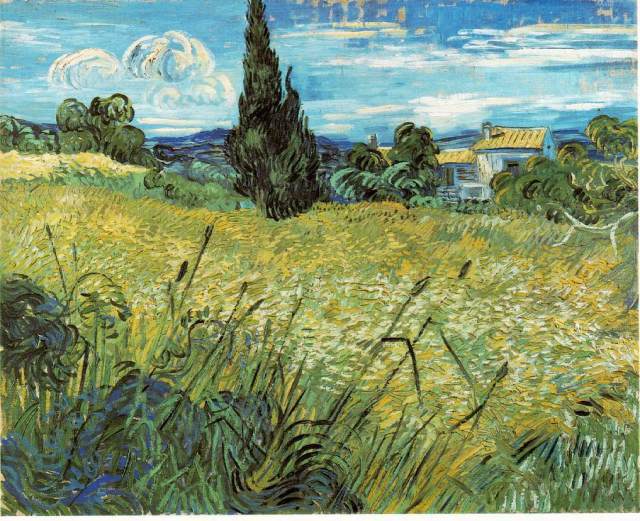
Wheat Field and Cypress by Vincent Van Gogh, 1890

Jesus, however, viewed walking through the fields differently. He did not consider the Sabbath as trivial; Jesus instead stood back and took a big picture perspective of it all. And that view included the ancient story of David, who took the consecrated bread in the tabernacle which was reserved only for Levite priests. (1 Samuel 21:1-6; Leviticus 24:8-9)

The reason David wanted the bread was because he was a fugitive, on the run from King Saul who was trying to take his life. Jesus insisted, on that day, the priest on duty did nothing wrong in giving the special bread to David. Yes, the strict letter of the law was broken; and, no, this was not wrong – because the priest was helping to save a life, and a very important one at that.

Jesus discerned there are times when particular laws come into conflict; so it’s necessary to maintain the spirit of a law in order to maintain a high value and meet a pressing human need. In a sense, Jesus gave a covenant code legal opinion on the subject.

It’s no surprise, to any reader of the New Testament Gospels, that Christ would behave this way; and that it would drive the religious leaders bananas. After all, they, the Pharisees, upheld law and rendered legal decisions – not this upstart wannabe. Jesus took an authoritative stance on what was happening, and the leaders did not at all like their own authority questioned.

This wasn’t some maverick interpretation by Jesus. He simply pointed out that the Sabbath is a gift, given to people to promote life and health – and not a burden that folks are to carry. Any decent Sabbath-keeper knew this.

It appears the leaders didn’t like being reminded of it from Jesus. What’s more, Jesus was much too close to likening himself to David. Yet another reason to despise this uppity teacher.

The Legality of Suffering

A second controversy brought the issue of who is in charge and who gets to arbitrate community values into a greater light. There is perhaps no other place for that conflict to happen than in the synagogue, the meeting place of worshipers. The juiciest things always seem to happen in a place of worship.

In the first story, the religious leaders were caught surprised over the behavior of Jesus and his disciples. They’re determined not to make that mistake again. From this point forward, it seems the Pharisees are continually waiting for a chance to put down Jesus as a lawbreaker and rabblerouser.

Byzantine mosaic of Christ healing the man with a withered hand, Cathedral of Monreale, Palermo, Sicily

For them, the issue wasn’t about the ability to heal, but whether it’s being done on the Sabbath. Much like the grainfield incident, healing is work, and working on the Sabbath is a direct violation of God’s immutable law. The religious leaders wanted to prove that Jesus has no regard for God’s will.

Law, for many Pharisees in Christ’s day, was meant to bring order so that chaos does not rule. Obedience to the law is a pre-condition for blessing. Without a clear demonstration of holy living, the community could be under a curse, much like their ancestors before them who were exiled for disregarding God’s law.

Yet again, Jesus cut through the anxious fear and authoritative posturing and went directly to the intended spirit of the law. The Sabbath, of all days in the week, ought to be a time for doing good, not harm; and to save life, not kill it. Jesus was not doing anything that could be considered work, anymore than his disciples were actually gleaning or harvesting grain.

There is no better day than the Sabbath for restoring a man’s withered and malformed hand, for giving him back his ability to make a living and contribute to the community. Much more was restored to the man than a physical ability; he now had the ability to better his life and his family, not to mention the local economy. It ought to be all good…

Unfortunately, the Pharisees didn’t see it that way, that the man gained his dignity back, his wholeness and his joy. They could only see a threat to their own hegemony.

The Beginning of the End

So, this marks the beginning of the end. The leaders are so upset and angry, they began plotting for Christ’s destruction. Unlikely political allies came together because of a common enemy. To view Jesus as a threat to society is, at the least, messed up. But that’s what happens when people cannot see beyond the end of their nose. They make bad choices.

Even though Jesus came to give life, others want to take his. Despite the fact that Jesus did not reject the law or demean the Sabbath, people with a short-sighted agenda and hard hearts could only see someone upsetting the status quo.

Today, these same things can quickly turn to hostility. The legal implications of one’s values and commitments can get nasty fast. Opinions can harden, resulting in oppression, persecution, and even death.

The most noble of motives can go sour; and the best of intentions, the highly educated, and the most gifted persons among us can become despotic in their leadership. Indeed, absolute power corrupts absolutely.

This is why the gracious and benevolent kingdom of God will win the day. Hard-hearted people become desperately out of touch with what is most important; they are calloused to the human need in front of their faces. I believe that the words and ways of Jesus can dispel those dark forces and impulses.

I’ll take a controversial Christ any day because that is the path to life abundant and everlasting.

Whenever unjust, oppressive, harmful, and fearful systems hold on, the ministry of Jesus exposes them for what they are, and will deliver us from evil.

Thanks be to God!

Are You In Need? (John 7:37-39)

On the last day of the festival, the great day, while Jesus was standing there, he cried out, “Let anyone who is thirsty come to me, and let the one who believes in me drink. As the scripture has said, ‘Out of the believer’s heart shall flow rivers of living water.’ ” Now he said this about the Spirit, which believers in him were to receive, for as yet there was no Spirit because Jesus was not yet glorified. (New Revised Standard Version)

Let’s take Christ’s words at the end of the Jewish Festival of Booths (or Tabernacles) at face value. Jesus said that if anyone is thirsty, they could come to him and drink. This is an unconditional statement with no caveats, qualifications, or fine print to it.

Jesus did not say that if anyone is spiritual enough, strong enough, or committed enough that then they could come to him.

The only qualifications one must have in coming to Jesus is to be needy. To be thirsty and want a drink is it, period. No interviews. No jumping through any hoops. No red tape. No having to go through one of the disciples to get to Jesus. No obstacles whatsoever.

Sheer need and want gets anybody an audience with Jesus.

“Thirsty” is Christ’s simple metaphor for need. Whenever we long to have our needs met, there is always the opportunity and possibility of going to Jesus. And all of us are thirsty because every single person has needs that aren’t getting met. These important and vital words of Jesus are encouraging. They help us admit whatever is going on, and say to him, “I need you, Lord.”

The Lord’s response to such a humble expression of need is this: “Please come here to me and drink till you are full.” No judgment. No condemnation. No big sighs. No snarky comments. No disappointed looks. Our confession of need accesses divine compassion and help.

Who will help us? The Holy Spirit will help.

Christ ascended and gave us the Spirit. On this day before the Christian celebration of Pentecost, we are reminded that Jesus delivered on his promise to give help. There is no better assistance in all the world than having a permanent live-in Guide, Helper, and Advocate who is continually alongside us, even in us.

Ask. Seek. Knock. That’s it. Help is just a call away.

We have a popular commercial figure in my city, a lawyer, whose one-liner is, “One call. That’s all!” And help will come. All we need to do is express our needs and wants.

And yet, that is so awfully hard for so many people. It seems weak or selfish to come right out and say what we need and what we want. Yet, if we are to embrace any sort of Christian discipleship, straight forward asking will be involved.

Believers can state their needs simply. They are breathed on by the Spirit. Then, we have our thirst satiated. If we make it more complicated than that, we lose the incredible simplicity of the gospel – good news for needy people. Yet, we sometimes make it complicated by not coming out and saying what we need.

Why, in tarnation, is it so hard for people to ask for what they need and want?

For many, it’s because they have never been given permission to do so. They were never encouraged to express their needs and wants. However, it is perfectly acceptable to state what you want, and what you really need. Ask for what you want, and you may be surprised at how often you get it.

The lack of asking goes much deeper than this. Our fear of vulnerability and being judged by God (and others) prohibits us from asking for what we really want.

Therefore, we must see and understand that vulnerability is crucial to having our needs met. Only through being open enough to share what you need will relational connection happen. A relationship with Jesus is based on humility and vulnerability. Without it, there is no relationship.

We also might be afraid of not getting what we ask for; so we don’t ask, at all. Or, conversely, we may be afraid of receiving our asking! On some level, it’s more comfortable to stay in a familiar situation. We think we want something different, but we’re worried about the downside of getting it. We fret and wonder about it, not trusting ourselves. So, we become paralyzed, unable to say what we really want or need.

All of this overthinking comes down to our own image of self. It’s as if we don’t believe we deserve to be treated well. But the reality is: This isn’t about whether you deserve to have something; it’s about your needing or wanting it. Plain and simple. There’s no shame, being in want or need.

Some folk are so used to putting others first and meeting another’s need that they become stymied by their own inability to state what they need. So, they try and feel better by meeting everyone else’s need. When they become bitter about being emotionally depleted, and when they are thirsty for someone to meet their needs, they end up not asking for help – because they feel they can’t.

But you can, and you must. Jesus says so. We don’t always get what we want in life. But we won’t get it if we don’t ask. It’s good to focus on what you want or need in life, instead of questioning whether you’re worthy to receive it. Jesus said:

“Keep on asking, and you will receive what you ask for. Keep on seeking, and you will find. Keep on knocking, and the door will be opened to you. For everyone who asks, receives. Everyone who seeks, finds. And to everyone who knocks, the door will be opened.” (Matthew 7:7-8, NLT)

So, what are you waiting for!?

What Do You Long For?

Indeed, what do you long for? Before anything ever came into being, it was dreamed for. Everything that exists, had a beginning in the possibility of longing for it. I think it is inappropriate for me to ask you such a question, without first telling you what it is I long for. And there are so many things that I long for! Yet, I offer just a few of them…

I am a hospital chaplain. I dream of a healthcare system that values its caregivers so much that it does away with hierarchical organization. I imagine and visualize such a system taking psychological safety as seriously as physical safety. I long for healthcare administrations to establish the individual employee’s care – not in cheap talk of self-care – but in actual establishing of policy and procedure to ensure that care is realized.

For only in the consummate care of the caregiver, can care seekers receive what they truly need.

Such caregiver care toward the care seeker will translate into taking all the time needed to listen to the patient, practicing patience themselves in seeking to truly understand. With the caring caregiver full of attentive love, they can and will step back in thoughtful reflection for a gracious and effective care plan for the patient.

And, what’s more, they will follow up with equal motivation and attention in order to provide skillful love, precisely where it is needed and wanted. For all caregivers shall know that a “bedside manner” is not optional, but is as important to healing as the actual care plan which is on paper.

I am a church pastor. I dream of good and effective change and reformation for the Body of Christ, as well as all faith communities everywhere. I imagine churches and church leaders who bathe all things in prayerful conversation with God and others. I long for a church that truly cares for those struggling to make sense of faith, and gives ample and adequate space for faith seekers to express their doubts, feelings, and questions in a safe and supportive environment.

Such pastors, elders, deacons, and denominational leaders will give scant attention to the more secular matters of building needs, budget finances, and butts in the pew (which, of course, often emit the most foul odor, because they originate in the person who is a tedious fart). They will have the sweet smelling incense of mentoring others in the faith, attending to the needs of the community at large, and lifting up emotional and mental needs with equal passion alongside the physical and spiritual needs of people.

For only in the consummate care of the pastors and leaders, attending to their foundational needs of bodily care and exercise, mental and emotional health, and spiritual disciplines, can parishioners receive the holistic care they truly need in order to grow and mature in faith.

Oh, how I dream, imagine, and long for a world that exalts the holistic person – body, mind, feelings, and soul – so that everyone in everyplace on the earth realizes their God-given potential as people gifted to serve the holistic well-being of others.

All of us are but temporary sojourners on this earth. And this world which we inhabit is fundamentally broken. Let us long for better days, imagine those days in our mind’s eye, and dream into existence that which originally had its origin in the heart of God.

Longing is only realized through belonging. If we remain emotionally lonely, bodily disconnected, mentally rootless, and spiritually adrift, we’ll never know the confident hope of belonging to God and community. Until we participate with ancient and universal rhythms of being in this world together, we will continue to experience the things which are nightmares to us.

So, what do you long for? It really is neither an esoteric nor impractical question. It is the vital question of our time.

A Life of Compassion (Matthew 9:35-10:23)

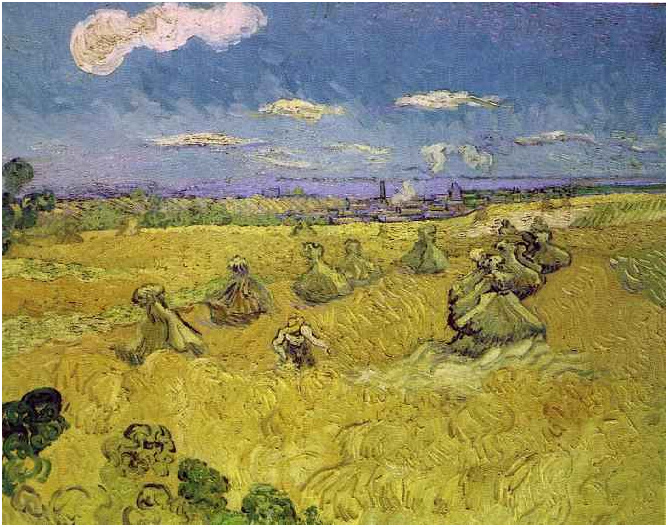
Wheat Stacks with Reaper, by Vincent Van Gogh, 1888

Jesus went through all the towns and villages, teaching in their synagogues, proclaiming the good news of the kingdom and healing every disease and sickness. When he saw the crowds, he had compassion on them, because they were harassed and helpless, like sheep without a shepherd. Then he said to his disciples, “The harvest is plentiful but the workers are few. Ask the Lord of the harvest, therefore, to send out workers into his harvest field.”

Jesus called his twelve disciples to him and gave them authority to drive out impure spirits and to heal every disease and sickness.

These are the names of the twelve apostles: first, Simon (who is called Peter) and his brother Andrew; James son of Zebedee, and his brother John; Philip and Bartholomew; Thomas and Matthew the tax collector; James son of Alphaeus, and Thaddaeus; Simon the Zealot and Judas Iscariot, who betrayed him.

These twelve Jesus sent out with the following instructions: “Do not go among the Gentiles or enter any town of the Samaritans. Go rather to the lost sheep of Israel. As you go, proclaim this message: ‘The kingdom of heaven has come near.’ Heal the sick, raise the dead, cleanse those who have leprosy, drive out demons. Freely you have received; freely give.

“Do not get any gold or silver or copper to take with you in your belts—no bag for the journey or extra shirt or sandals or a staff, for the worker is worth his keep. Whatever town or village you enter, search there for some worthy person and stay at their house until you leave. As you enter the home, give it your greeting. If the home is deserving, let your peace rest on it; if it is not, let your peace return to you. If anyone will not welcome you or listen to your words, leave that home or town and shake the dust off your feet. Truly I tell you, it will be more bearable for Sodom and Gomorrah on the day of judgment than for that town.

“I am sending you out like sheep among wolves. Therefore be as shrewd as snakes and as innocent as doves. Be on your guard; you will be handed over to the local councils and be flogged in the synagogues. On my account you will be brought before governors and kings as witnesses to them and to the Gentiles. But when they arrest you, do not worry about what to say or how to say it. At that time you will be given what to say, for it will not be you speaking, but the Spirit of your Father speaking through you.

“Brother will betray brother to death, and a father his child; children will rebel against their parents and have them put to death. You will be hated by everyone because of me, but the one who stands firm to the end will be saved. When you are persecuted in one place, flee to another. Truly I tell you, you will not finish going through the towns of Israel before the Son of Man comes. (New International Version)

Use your voice for kindness, your ears for compassion, your hands for charity, your mind for truth, and your heart for love.

We need compassion; humanity cannot survive without it.

Compassion is…

  • a concern for the well-being of others
  • the basis for altruism and the most virtuous motive one can possess
  • activated within the human heart when witnessing another person’s suffering
  • helping other people feel seen, heard, and known
  • the bridge that connects us with another in need
  • life

While on this earth, I believe Jesus was the very embodiment of compassion. To reflect on Christ’s compassion helps us to raise our own compassion quotient, and thus, avoid succumbing to the whims of indifference concerning human need.

Compassion responds to human need

In his earthly ministry of preaching, teaching, and healing, Jesus went through all the towns and villages. He neither waited for people to come to him nor wanted anyone to fall through the cracks. Doing this compassionate work, Jesus was moved by the depth of people’s needs.

The word for “compassion” in the Bible means “to be moved in the pit of your gut.” It is to be filled with pity and heartbroken over the unmet needs of people.

So, what moves and stirs compassion deep down in your gut?

Jesus went into towns and was broken-hearted over people who were harassed and helpless, locked into patterns of life that were harmful and damaging. 

Jesus came to this earth to seek and save people, offering forgiveness and a new life. Jesus willingly brought compassion – and his motivation for doing so was neither from duty nor guilt. Compassion is the proper motivation for all things.

Just as Jesus went out and ministered, then was moved by what he saw, so our compassion is aroused whenever we go out and enter people’s lives, seeing first-hand the depth of human need.

Compassion results in prayer

Christ saw the masses of people and told his disciples to ask God to send workers because the harvest is plentiful. Jesus knows there are large numbers of people waiting to hear good news. So, he said to pray earnestly and compassionately.

Compassion brings us to prayer and impels us to pray that workers be sent to people who are ripe for hearing good news. We must not listen to the hellish lie: That certain people don’t really want the good news of the kingdom of God; that my neighbor, or co-worker, or family member is not spiritual and doesn’t care about forgiveness or grace – that there is nothing within them to respond to compassion.

The devil does not want us to have merciful compassion for them, to be moved to intercede for them in prayer, nor to become a harvester in the field of people. Jesus said the harvest is plentiful; and it is through compassionate prayer that the work will be done.

Compassion sends us out

The call to prayer is central, but it’s not everything. As faith without works is dead, so prayer without mission is empty.

The people Jesus authorized for ministry were a collection of twelve motley disciples who thought differently about a great many things. Yet, the compassion of Jesus changes lives and brings people together from diverse backgrounds and viewpoints.

The disciples were told, in their initial mission as followers of Jesus, to go only to the house of Israel. Israel’s house needed to be put in order first before they could ever think of going to Gentiles. We begin by reaching out to people in our own backyard.

“You will be my witnesses in Jerusalem, and in all Judea and Samaria, and to the ends of the earth.” Jesus (Acts 1:8, NIV)

Jesus told the disciples to do exactly what he had been doing: preaching and healing, proclaiming the message that “the kingdom of God is near.” 

The kingdom is not only something in the future; the kingdom of God has already broken into the present time, and the evidence of it is the transformation of people’s lives now. The blessings and promises of kingdom life are presently available.

Jesus sent the disciples out and told them not to take anything with them. They were to leave all their baggage behind. The disciples were to be stripped of everything so that they had the ability to see people and their needs and be moved with compassion as Jesus was.

The kingdom of God was near to them, so they did not need to add anything for the mission. Jesus did not want his disciples assuming they already knew what people needed. Instead, they must be present to people and discover their needs without bias. As compassion is freely received, it is to be freely given.

Cultivating Compassion

Compassion is the appropriate response to human need. Yet, we do not always react with compassion. The following are a few approaches which prevent us from becoming compassionate, along with some ways of cultivating a compassionate life:

  1. A defeating and discouraging environment. Contempt, anger, hatred, and abuse drives out compassion. The environment around us makes a difference. If we find we must check our hearts at the door and avoid compassion to just make it, then we need a change of environment. Life is too short, and the world too compassion-starved, to maintain a situation that drags us down and hinders the kingdom of God within us.
  2. An unhealthy pace of life.  A person cannot have a compassionate heart if they are running too fast to see other people’s needs. When spare moments are used to try and figure out how to keep all the balls in the air and all the plates spinning, there’s no way to dole out compassion to others. So, slow down. No one comes to the end of life and wishes they had logged more hours of work at their job. Develop a plan on how to slow down enough to tune into the needs of others and have emotional energy for them.
  3. Excessive caregiving. Compassion fatigue is a real thing. Resentment can build toward the very people we care for because of constant giving without receiving. When the emotional gas tank is empty, it is possible to become cold-hearted. Yet, some keep going anyway – and ruin their engine. Caring for others must be meticulously balanced with caring for self. There is a time for everything, including rest and recuperation. Jesus regularly practiced the disciplines of solitude and silence. If he needed those restorative practices, so do we.
  4. Objectifying people. Whenever we put adjectives in front of people, compassion is lacking. Referring to “those” people, “lesbian” neighbors, “black” folks at work, my “obnoxious” relative, or, the “poor” family down the street, are all examples of objectifying people and putting them at a distance from ourselves. Your neighbors are your neighbors, your family is your family, and the people in your life are just people, period. Compassion arises as we look for what is common among us, not different. Compassion brings solidarity with others, not separation and division.

May you allow God the time to form a compassionate heart within through being with Jesus. May compassion toward others be the defining characteristic of your life.