Straddling Two Worlds

“You are not far from the kingdom of God.” (Mark 12:34)

It really sucks being sick, no matter what the particular illness is.

I realize those may be strange words coming from a tenured and ordained church pastor and hospital chaplain. Nevertheless, it is a truism which far too many people know about intimately.

Yet, there might be something even worse than the devastating effects of one’s own ill health – whether it be cancer or a cold, epilepsy or constipation – and that is the awful grinding reality that someone you love dearly is suffering beyond what you can do for them. If you could take their place, you’d do it in a heartbeat.

And, honestly, many, if not most, people are in one of those situations right this very minute – either needing care or being the caregiver.

As I was walking through my neighborhood last night, as I often do after the day’s sunset, I couldn’t help thinking about all my neighbors inside those lighted rooms. Every single person, I felt and knew in my bones, was going through some sort of illness that’s impeding the quality of their life; or they’re struggling to know how to pray for that friend or loved one who is profoundly ill, wondering what to do, at all.

Debilitating illness is one of those realities of the human condition that appears to be so devilishly odd in a world where billions of people worship God. If there is such a divine Being, where the hell is he!? Why do I feel so helpless?

There is something else for us to contemplate – that we live in a weird space between two worlds. The first world we are quite familiar with – the tangible reality of our five senses. But this other world is a place we are much more unfamiliar with; it has multiple if not millions of senses which we cannot see, hear, feel, taste, or touch with our physical capabilities.

Something inside of us, besides our literal brains, hearts, and guts, existentially knows that deep within us is a soul. I personally don’t care much what you want to call it – spirit, metaphysical awareness, biological wirings, gut feelings, etc. But there is a special place inside of us that is ready-made to connect with that other ethereal world of the spirit and soul.

Let me ask: What makes a young woman with cancer become driven to make a difference in the world, even though she may die tomorrow? Where does the desire bubble-up for a heart patient who could be gone before the day is out to say something of great value that family and friends will forever remember and record?

And what makes you and I get out of bed in the morning, desiring to impact the world in significant ways that makes things better, not worse?

I confess that far too often, in my own ill health, as well as the debilitations of my dear wife, I throw a daily little pity party complete with doll sized cups along with juicy gossip of how others don’t understand.

I rehearse old wounds from the past, wish things were different in the present, and fear for what is to come in the future. O, my friends, you already know this is no way to live a good life.

If we’re going to live with any sort of faith, hope, and love, we will need to recognize our place in-between these two worlds of earth and spirit.

I wish I could tell you that I have it all worked out, that I could give you some short pithy statements of experiential truth which will transform your life experience.

But I don’t.

So, here is what I try my darndest to do ever single day, as a person who seeks to touch both worlds, and who is devoted to the person of Jesus: I surrender to Love. I give myself to what is most important. And when I fail, I let divine forgiveness wash over me.

I luxuriate in the spiritual world’s reality that if somehow I lose myself, I will find Jesus – or rather that Jesus will find me. Love has its own mysterious ways of making the right connections when they need to happen.

I bask in the profound paradox that in renouncing everything I have and everything I am, I gain the greatest possessions in existence – and they are found on that other side, in the spiritual world.

I freely humble myself and resign myself to the words and ways of Jesus – even when they make no sense in the earthly world. “Love your enemy.” Really!? Okay, I’ll give it a go… and it is amazing to always see the results that happen inside of me, and in the other spiritual world, that have little to do with that other person.

The medieval mystics are not popular with a lot of people. I admit Christian mystics are strange people, and have the sort of demands of the Old Testament prophets. But I love them.

One of my favorites, Thomas à Kempis, is insistent that if you lose yourself, you will find Jesus. To resign oneself completely to Jesus, fully and totally without any wavering, is to find the appropriate sweet spot between the two worlds of physical and spiritual. Writing to his young acolytes, Thomas minces no words:

“Let this be the goal of your striving and the object of your prayer, namely, to desire to be stripped of all your belongings, and once naked, that you may be ready to follow the naked Jesus. You must die to yourself to live eternally with me.” (The Imitation of Christ)

Sometimes this happens intentionally, as one longs to connect with the Christ they sense around them. In other ways, much like C.S. Lewis, other people come kicking and screaming to the place between the worlds.

Yet, by whichever means we get there, a place of grace opens to us. From that awkward vantage point – between health and illness – we discover that binary explanations have no place in this realm. Instead, all of us move between the worlds throughout our lives.

And, I would suggest, that the best and most effective way of navigating those worlds is taking the strong advice of both the medieval Thomas and the ancient Jesus. Little do we know how close we are to finding peace and purpose in our upside-down lives:

Now when Jesus was asked by the Pharisees when the kingdom of God would come, He answered them and said, “The kingdom of God does not come with observation; nor will they say, ‘See here!’ or ‘See there!’ For indeed, the kingdom of God is within you.” (Luke 17:20-21, NKJV)

What we truly want and long for is no further than the hospital bed we’re occupying, or any other place we find ourselves in. And, furthermore, the place to find how to help that dear loved one is to journey within ourselves, not without.

If you are like me, you don’t much like limitations. I like the feeling of handling multiple responsibilities and accomplishing them with care and competence. The last thing I want is anything or anyone getting in my way of fulfilling great and meaningful work.

But I have had to learn that my limitations – which grow every day – are actually the key to knowing how to live the Christian life, as well as just plain old life in general.

The more I become aware of my true abilities, accept them, and move with them, the more I see that the world does not spin on the axis of my ability to accomplish anything. And the more dependent I realize I truly am, the more I observe the Christ who has everything under control – even when it seems God is absent.

It is to be expected that God will eventually put us in places of great limitation. Yes,  it will frustrate us in our seeming inability to effect any sort of change to an unjust situation. We just want whatever the offending circumstance is to be exorcised from this world. Yet, it rarely, if ever, happens.

This is not some demented divine game which God is playing on us – to be caught between worlds, and to struggle with all our might to make the best of our situations as people who are both sinner and saint, sick and well, sinister and full of goodness.

No, the nature of our common human condition of hard circumstances as people of faith is meant to strengthen our allegiance and our hope, so that we may be Christians publicly displaying who God is like, and that there is such a thing as truth in the public square.

“…even though you have to suffer different kinds of trouble for a little while now. The purpose of these troubles is to test your faith as fire tests how genuine gold is. Your faith is more precious than gold, and by passing the test, it gives praise, glory, and honor to God…” (1 Peter 1:6-7, GW)

It is downright hard trying to straddle between the two worlds of spiritual hope and physical adversity. But it’s necessary, even if we are unable to discern this reality for now. Every small decision of faith made in love with a good heart has immense impact in the universe, although we may never see that great and good consequence this side of heaven.

Living between two worlds will always be difficult. And it requires a level of surrender to God that is scary. Yet we can still be safe, strong, and spiritual; because we are all in this human condition together.

Lessons From a Genealogy (Ruth 4:18-22)

Now these are the descendants of Perez: Perez became the father of Hezron, Hezron of Ram, Ram of Amminadab, Amminadab of Nahshon, Nahshon of Salmon, Salmon of Boaz, Boaz of Obed, Obed of Jesse, and Jesse of David. (New Revised Standard Version)

No, I didn’t make a mistake about what the verses are for today from the Revised Common Lectionary. Yes, the Old Testament lesson is a brief genealogy. And yes, there is something to learn from this.

The Bible contains a lot of genealogies. Although they may be boring, with names we have difficulty pronouncing, every genealogy serves the same purpose that it does for your own family history.

Genealogies remind us of our connection with past generations. And this interconnectedness has influenced us in profound ways. You and I are the result of what history has produced. We are who we are, to a significant degree, because of the people who came before us.

By listing someone’s descendants in writing, it indicates an ongoing developing story which has happened, and continues to develop up to the present time, and even into the future.

One aspect about biblical genealogies that must be noted: Ancient compilers of genealogical lists did not often include every single person in the genealogy. They typically listed the more significant persons, and left out persons who barely dented history.

That’s because the biblical writer’s purpose in giving a genealogy was not necessarily to be exact and precise about each individual past actor. Rather, the writer usually has a moral and/or theological reason for providing the list.

For the writer of the Book of Ruth, the reason for this genealogy was to establish the bloodline and pedigree of King David. Perez was a son of the patriarch Judah (and Tamar). Boaz was a descendant of Judah. Boaz married Ruth, and they had a son, Obed, who was the grandfather of David.

I hope that you see the grace in every biblical genealogy. Including in our genealogy for today, we have two women, Tamar and Ruth. Both of them were unlikely candidates for producing a king. And even more unlikely to be included in greatest Christian genealogy of them all, the lineage of Jesus (Matthew 1:1-17)

The Gospel writer Matthew included in his genealogical list a note about Boaz. He was the son of Rahab. Yes, the same Rahab who was the prostitute in Jericho, and became a faithful woman included in God’s covenant community. (Matthew 1:5-6)

Ruth was a “heathen” woman from Moab, a nation which historically was hostile to Judah. Yet, through her own pious actions, Ruth became a worthy member of Judah, and listed as a great mother of the Jewish people.

The brief genealogy we have here is a part of an historical continuity in God’s covenant community. From Abraham to Judah to David to Jesus, and to the Christian Church, this both literal and spiritual heritage is brought about through a daughter-in-law of Naomi the Jew, Ruth.

None of us are truly alone. We are all connected as people. And Christians are spiritually linked to the covenant as God’s people, by faith.

Just as Abraham “believed God, and it was reckoned to him as righteousness,” so, you see, those who believe are the descendants of Abraham. And the scripture, foreseeing that God would reckon as righteous the gentiles by faith, declared the gospel beforehand to Abraham, saying, “All the gentiles shall be blessed in you.” For this reason, those who believe are blessed with Abraham who believed. (Galatians 3:6-9, NRSV)

This connection to the past, prevents us from having an over-individualistic faith in God and relationship to the Lord. We belong to the historical and worldwide communion of saints. We, both personally and communally, belong to God.

For the writer of the Book of Ruth, history is important. Genealogy is significant. God’s covenant matters. The Church’s life is bound up in the person of Christ, in King Jesus, Son of David, Son of Boaz and Ruth, Son of Abraham.

Not only do we belong to God, but we also belong to one another. We belong to ordinary people who showed extraordinary faith.

And it is through ordinary people that God works out divine purposes on this earth for the common good of all people.

We have many grandparents in the faith. We are linked to them by faith. There is a mystical spiritual connection that we enjoy with them. And that connection is shared with others of the faith, as well.

For by the grace given to me I say to everyone among you not to think of yourself more highly than you ought to think but to think with sober judgment, each according to the measure of faith that God has assigned. For as in one body we have many members and not all the members have the same function, so we, who are many, are one body in Christ, and individually we are members one of another. (Romans 12:3-5, NRSV)

Blessed Christ, you do not call us servants, but friends—companions on this mission to see love, peace, and hope made known. You do not leave us to fend for ourselves, but invite us into community with you and others. Draw us closer to you and one another, and help us to become companions and confidants in our collective journey of faith and perseverance. Amen.

Communicate with Clarity and Care (Genesis 35:1-4)

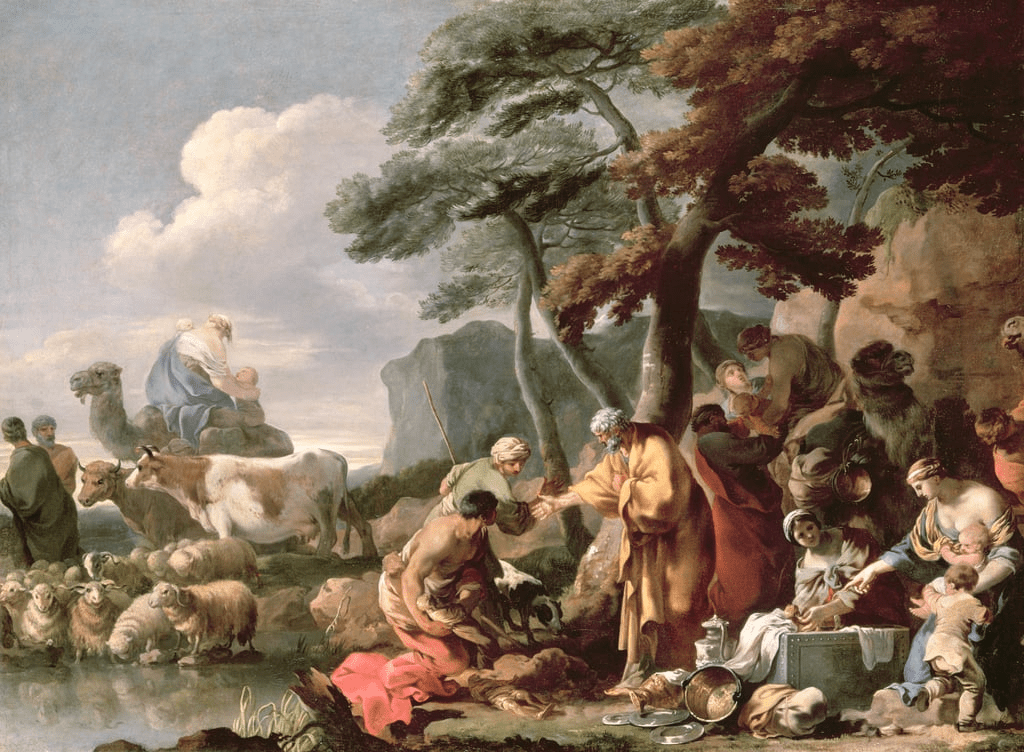
Jacob burying the false gods under the oak by Shechem, by Sébastien Bourdon (1616-1671)

Then God said to Jacob, “Go to Bethel and live there. Make an altar there. I am the God who appeared to you when you were fleeing from your brother Esau.”

So Jacob said to his family and those who were with him, “Get rid of the foreign gods which you have, wash yourselves until you are ritually clean, and change your clothes. Then let’s go to Bethel. I will make an altar there to God, who answered me when I was troubled and who has been with me wherever I’ve gone.” So they gave Jacob all the foreign gods that they had in their possession as well as the earrings that they had on. Jacob buried these things under the oak tree near Shechem. (God’s Word Translation)

Christianity has existed for 2,000 years; Judaism for 4,000 years or more. That’s a long time. On the one hand, this is a tremendous legacy of faith, grounded in several millennia of solid religious tradition. And on the other hand, something existing for so long is bound to accumulate some barnacles that get encrusted on the faith.

And if those barnacles are there for too long, it becomes assumed that they’re just part of the ship of faith. But they’re not; they need to be removed so we can see the real thing and move through life unencumbered and not dragged by extraneous stuff.

The familiar, over time, is taken for granted. And when that happens, we lose sight of what is most important, of what is most needed.

God helped Jacob – the son of Isaac, the son of Abraham – to reconnect with a seminal experience from earlier in his life. That experience was a vison of God, and an assurance that God was with Jacob. He was not alone.

But, years later, after accumulating two wives, twelve sons, and many flocks of sheep and other animals, it was time to move and make a home and an altar elsewhere. Instead of taking the Lord for granted, and forgetting the difficulties of the past, God intervened and called the whole crew to go and live in another place.

The communication from God brought Jacob to a spiritual place of realizing what had happened over the years; slowly and perhaps imperceptibly, the barnacles of idolatry had become encrusted amongst his family. And they were obstacles which needed to be jettisoned before they could move on.

Jacob needed to hear from God. Jacob’s family needed to hear from him. And that communication had to be a helpful way of scraping the barnacles off from decades of misplaced living.

Our world today is marked by unfeeling meanness to strangers, a profound lack of empathy, respect, and basic human kindness toward one another. Individuals, groups, communities, and entire nations don’t know how to talk to each other in a way that is helpful and life-giving.

We need a process which helps us have a way of being with others that is compassionate. It is imperative that we have communication that guides us in both expressing ourselves and listening to others. And that process must focus on what we are observing, feeling, and needing.

It is essential that humanity creates deeper personal relationships and maintains them. If not, we will be overcome by the barnacles of suspicion, hate, distrust of others, as well as distance from God.

Unless we are with each other in helpful ways, we will devolve into judgmental and critical speech directed toward others or even ourselves. Violent words are the main obstacle to having compassion on others.

Comparisons and classifications of people, denial of responsibility for words and behaviors, and making demands, leads to estranged relationships. Instead, we can do better. We can be with one another and talk to each other by communicating observations, feelings, needs, and requests.

Observation

  • Observe, rather than evaluate. Whenever we observe something, and then quickly evaluate it, the other person will tend to hear criticism and resist what we are saying.
  • Be specific, not general. It’s helpful to make a specific observation instead of a general one. For example, God was specific about what Jacob was to do. And Jacob was quite specific about the situation of idolatry and what to do about it before the family could move to Bethel.

Feeling

  • Acknowledge and express your emotion. Clearly and specifically identify and name your emotions because this is the way we connect more easily with others. Jacob told his family of feeling troubled in the past and that God helped him deal with it.
  • Be vulnerable. Expressing our feelings can help resolve conflicts. The old adage is true: People don’t care how much you know until they know how much you care.

Need

  • What do you need? Take responsibility for your feelings. Connect your feeling with your need. Jacob was devoted to God because his emotions were tethered with how God had met his needs throughout his life.
  • Others do not cause our feelings, and they are not responsible for our emotions. Jacob’s family did exactly what Jacob told them to do – and did not buck him or resist him – mainly because he let them know how he was feeling, and why he was telling them to rid themselves of idols and move on with him to Bethel.
  • Listen to yourself. Judgments of others are projections of our own unmet needs; and conversely, being kind to ourselves, listening to our thoughts, and paying attention to how we carry stress in our bodies, allows us to be helpful to others and present to them in whatever they are going through.
  • We are not responsible for other people’s feelings. We can never meet our own needs by trying to make others feel guilt or shame.

Request

  • Ask for what you need and want. We honor ourselves by making requests in clear, positive, and concrete language of what we really need. The clearer we are about what we want, the more likely it is that we’ll get it.
  • The message we send is not always the message which is received by another. Be clear about the response you want so that there is no confusion about what we truly need.

The objective of communication is not to change people and their behavior in order to get our way. Rather, it is to establish relationships based on honesty and empathy that will eventually fulfill everyone’s needs.

There is a need to express honestly and clearly our observations, feelings, needs, and requests, as well as receive another’s communication with focused attention and empathy.

So then, how we talk to and about God, and how we talk to ourselves, becomes a template for how we talk to others. A lack of clear communication is a surefire way of allowing the barnacles of displeasure and disappointment to attach to our souls.

However, clear communication is life-giving and even lifesaving. It’s worth putting significant effort into it.

Blessed Lord, in your infinite wisdom, you created us with the gift of communication. May we use this gift to foster love, understanding, and unity amongst ourselves and with you.

Guide our hearts to speak words of kindness and encouragement. May our tongues be instruments of love, grace and compassion to those around us.

Open our ears, so that we may truly listen and understand the needs and desires of our fellow humanity. Grant us the patience to hear their stories and the wisdom to respond with love and empathy.

Enlighten our minds to be clear and thoughtful in our affect and speech. As we share our thoughts and ideas, may we be ever mindful of your presence, seeking your holy and good will in all we say and do.

Fill our conversations with honesty and vulnerability. May we find the strength and courage to speak our truth while always remaining respectful and considerate of the feelings of others.

Bind us together in unity and love through our shared communication. May our words build bridges and forge bonds that reflect your divine love and mercy. Amen.

Psalm 104:1-9, 24, 35b – God Is Bigger Than Our Fears

Psalm 104:3 by J. Michael Orr

I praise you, Lord God,
    with all my heart.
You are glorious and majestic,
dressed in royal robes
    and surrounded by light.
You spread out the sky
    like a tent,
    and you built your home
    over the mighty ocean.
The clouds are your chariot
    with the wind as its wings.
The winds are your messengers,
    and flames of fire
    are your servants.

You built foundations
for the earth,
    and it
    will never be shaken.
You covered the earth
with the ocean
    that rose
    above the mountains.
Then your voice thundered!
And the water flowed
    down the mountains
    and through the valleys
    to the place you prepared.
Now you have set boundaries,
    so that the water will never
    flood the earth again….

Our Lord, by your wisdom
    you made so many things;
    the whole earth is covered
    with your living creatures….
With all my heart
I praise you, Lord!
    I praise you! (Contemporary English Version)

The world is a gift from God.

When God created the heavens and the earth, Adam and Eve, the first humans, were the apex of God’s creative activity. Their charge, as people created in the image of God, was to steward the earth. And that mandate is still in effect. We are to take good care of this creation we inhabit.

However, due to the fall of humanity, there has always been a bent toward exploiting the earth for our own purposes, rather than carefully maintaining it. Wherever we see abuse of both land and lives, behind it is the fear of not having enough and not being safe enough. Our anxiety gets the best of us.

It seems to me that creation care must begin with ourselves. The lack of self-care inevitably works itself out by neither caring for other creatures nor creation. We need to acknowledge our fears and address them. Then, place those fears in the shining light of our Creator’s glory.

My kids grew up in the ‘90s watching Veggie Tales. The tunes were catchy and full of some solid truth about God. One of their favorites was “God is Bigger.” Here is the chorus:

God is bigger than the boogie man.
He’s bigger than Godzilla or the monsters on TV.
Oh, God is bigger than the boogie man,
And he’s watching out for you and me.

Today’s Psalm expresses the bigness of God – clothed with splendor and majesty, covered with light as with a garment, stretching out the heavens like a tent. Indeed, God is big – bigger than anything and everything. The Lord is sovereign and supreme over all creation, and always does what is right, just, and fair. God sees all and watches over the earth.

Sometimes we get lost in our situations, problems, and screw-ups. We get stuck in our anxiety and fears. We view them as larger than life and can become so overwhelmed and burdened with our inabilities, weaknesses, and lack of handling things well, that we lose sight of the reality that God is bigger than it all. 

Instead of fear and anxiety ruling the day, we can allow sound theology to purge the worry and trouble from our minds and hearts. Using today’s psalm to pray and praise God is a foundational way of beginning to put into perspective the issues and problems of our lives.

Confident living, and mitigating our fears, cannot simply be mentally or emotionally stirred up. Confidence needs a foundation, a basis in truth and reality. The believer’s assurance comes from the firm ground of God’s character and competence. Trust is born when we have a vision of a Divine Being, large and filling the universe with grace and justice.

Tending to our physical, mental, emotional, and spiritual health begins with a sense of divine largeness. Initiative and assertiveness can be freely exercised when we are secure and non-anxious because of God’s immense presence.

Caring for creation, and enjoying our great big world, is the logical action of being peacefully connected to the Creator of it all. We are all bound together as creatures and creation. We’re all made up of the same stuff.

Everything in the universe, including creatures and creation, share 97% percent of the same kind of atoms.

The crucial elements for life on Earth – carbon, hydrogen, nitrogen, oxygen, phosphorus and sulfur – are all found in abundance across the stars of our galaxy.

Our differences make us unique. Our similarities connect us. And we are inextricably connected to every atom in this universe. Just as we carry the DNA of our ancestors within our biological bodies, so we are all holding the same elements of the physical creation.

The ultimate connection, from a Christian perspective, is that Jesus holds it all together – thus making him the supreme Connector.

The Son is the image of the invisible God,
        the one who is first over all creation,

Because all things were created by him:
        both in the heavens and on the earth,
        the things that are visible and the things that are invisible.
            Whether they are thrones or powers,
            or rulers or authorities,
        all things were created through him and for him.

He existed before all things,
        and all things are held together in him.

He is the head of the body, the church,
who is the beginning,
        the one who is firstborn from among the dead
        so that he might occupy the first place in everything. (Colossians 1:15-18, CEB)

Christ is our connection to all things, reconciling us to our fellow creatures, creation, and the Creator. All the bigness of God lives in Jesus. In the face of the Lord, all fears melt away.

Almighty God, you are mighty big! My problems are really small as I glimpse your sheer immensity. Lord God, you are very great! I bless your holy name. Praise the Lord! Hallelujah, Amen.