Beginnings and Endings

Forest Sunset, by James Naughton

I’ve always thought it strange that we have New Year’s celebrations on January 1 at midnight when the year begins. The year hasn’t even happened yet, and we’re celebrating it. I understand celebrating a live birth and all the possibilities of a new baby in a family; but having worldwide blowouts about an upcoming New Year just strikes me as weird.

For some reason, we don’t celebrate the year we’ve just lived. We “take a look back” at the significant events and happenings. But there’s certainly no party around it. I suppose it’s because a lot of terrible things happen in a year. Yet, a lot of good things happen, too, that we could center some joy around.

What I’m getting at, in a round about way, is that we humans don’t do well with endings. And then we quickly become discouraged with our new beginnings – likely because we put little to no thought and preparation into how important and necessary our endings really are.

This is yet another roundabout way of saying that I (and we together) are experiencing something of an ending. For the past 1,750 days, I have provided a daily reflection upon a text from Holy Scripture. And those reflections haven’t been just a few sentences of devotional drivel, nor a measly daily crumb. I’ve written thousand-word-posts which I believe have been thoughtful and truly reflective on the text and our human condition.

However, all things must end. And this is my last post – at least for a while. I won’t be posting every day, as I’ve done for nearly 5 years! Yet, in order for me to have a proper new beginning of my own (one that I neither wanted nor asked for) I must let go of my daily blog posts.

Although I have been blogging for the past 15 years, I started doing the daily reflections at the beginning of COVID, as a way of remaining connected with my then church congregation, and with others. My thought was to give up doing it every day, once things got back to some sort of normalcy – whatever the heck that is.

Yet, when the masks initially came off and we all began seeing one another again, I found that the daily routine of writing biblical reflections had gotten into my spiritual bones. I was no longer simply writing for others; I was writing for myself. It buoyed my own faith to rise early in the morning and put some intentional focus upon crafting some scriptural thoughts on the Bible.

But that is no longer possible. My life can no longer sustain the practice. I intend to keep up the occasional post of maybe once a week. I might not even be able to do that. It might be once or twice a month. I don’t yet know.

Yet, what I do know is that I want to take the opportunity to celebrate the reality that I spent 1,750 straight days writing and posting impactful blog posts! Many of you were gracious to send me private notes of appreciation and encouragement. I especially treasure the ways some of you explained your story of how your own relationship with God has been helped.

When you boil down life to its essence, all any of us really have is our stories. Behind every event, each encounter, and all of the numbers which get crunched and the stuff that gets done and achieved, there is a story.

Stories bring just as much healing to us as modern medicine and surgeries. And they encourage, inspire, and change us in ways we cannot imagine.

The Bible, at its core, is a collection of stories. It seems God has created us as story-driven people, and so, in order to reveal something of God’s personhood and nature, we were given a grand and unfolding story of redemption.

I love reading and meditating on Holy Scripture, mainly because I love the Holy God of whom I belong and gladly serve.

I’ll continue writing the occasional post, but I will miss the daily meetings I’ve had with the Lord and with you in these past few years. Thank you for your faith, and for listening to God’s Word. What’s more, you can always avail yourselves of the nearly 2,700 blog posts on the website.

I pray that we all may learn to end things well, so that we might begin new things with some needed wisdom, humility, and grace.

May you live this day compassionate of heart, gentle in word, gracious in awareness, courageous in thought, and generous in the love of God through Jesus Christ our Lord and in the strength of the Holy Spirit. Amen.

An Advent Message of Suffering and Deliverance (Micah 4:8-13)

The Prophet Micah Exhorts the Israelites, by Gustave Doré, 1866

As for you, Jerusalem,
    the citadel of God’s people,
your royal might and power
    will come back to you again.
The kingship will be restored
    to my precious Jerusalem.

But why are you now screaming in terror?
    Have you no king to lead you?
Have your wise people all died?
    Pain has gripped you like a woman in childbirth.
Writhe and groan like a woman in labor,
    you people of Jerusalem,
for now you must leave this city
    to live in the open country.
You will soon be sent in exile
    to distant Babylon.
But the Lord will rescue you there;
    he will redeem you from the grip of your enemies.

Now many nations have gathered against you.
    “Let her be desecrated,” they say.
    “Let us see the destruction of Jerusalem.”
But they do not know the Lord’s thoughts
    or understand his plan.
These nations don’t know
    that he is gathering them together
to be beaten and trampled
    like sheaves of grain on a threshing floor.
“Rise up and crush the nations, O Jerusalem!”
    says the Lord.
“For I will give you iron horns and bronze hooves,
    so you can trample many nations to pieces.
You will present their stolen riches to the Lord,
    their wealth to the Lord of all the earth.” (New Living Translation)

A lot of people don’t understand much about the Bible, especially many parts of what some call the Old or First Testament of it. It seems to them like it’s all either nonsense or gobbledygook.

I am not exaggerating when I say that I have read the entire Bible not once, but hundreds of times. And there are still many places within Holy Scripture which are an enigma to me.

Part of the reason the Bible can seem so difficult is that, at times, the perspective being written about is so expansive, so large, and so wide that it nearly defies human comprehension.

None of this talk on my part is meant to discourage anyone from reading scripture. Rather, it’s meant to encourage you to keep on reading it, listening to it, talking about it, and exploring its contents.

Instead of a being an impossible puzzle we cannot put together, the Bible is, instead, a deep treasure trove of knowledge, wisdom, and insight into the human condition and the human purpose for being on this earth.

The reason the biblical prophets came along – and included into the canon of Holy Scripture – is that they called people back to their original purpose for being here in the first place.

In every prophetic book, the culture, the society, the religion, and the politics of a people had strayed so far from their reason for existing, that it took what seems to us as extreme language in order to get them back on track.

There were some cases so bad that the prophet’s message to people was inevitable doom. And yet, even then, there was a nugget of grace, showing us that no matter how terrible things may get, the arm of God is not too short to pull the faithful from the brink of annihilation.

Examining the Book of Micah, there is nothing easy about it. The prophet wrote at a time when Assyrian power was dominate, and about to swallow up the northern kingdom of Israel. Yet, he spoke directly to Jerusalem in the southern kingdom of Judah.

Much like a woman in labor and about to give birth, Jerusalem’s cry of suffering will be transformed into a cry of deliverance and freedom.

But we aren’t talking about something that will happen in a few days or even a few years; the prophet was giving the people a panoramic sweep of centuries.

Eventually, the Babylonians come, take the people out of the city into exile to Babylon. It is a cry of pain. Micah was speaking about events which would not occur for another two hundred years.

Yet, at the same time, Micah was talking about his own present generation of people in Israel and Judah. What the people were doing, at that time, was leading to a future of great pain. And there would be a great crying out for salvation from it.

Injustice always creates a state of distress for some, while the ones perpetrating the unjust ways become wealthy on the backs of others who are miserable.

Babylon represented both the place of punishment and of liberation. Out of the exilic darkness, a new age bursts into the light.

Born into a time where many people were longing for God’s deliverance, centuries after the destruction of Jerusalem, after the exile and return to Judea, and after the days of the Maccabees, Jesus subversively entered human history.

Despite all of the human sin, the degradation and oppression of others, the injustice and abuse extant in the world, grace comes in the shape of a baby; mercy enters the world in the form of a child.

The God whom all things depend upon, became dependent, needing a mother to clean him up after a filled first-century diaper. Few people knew at the time that this little baby would be the one to clean up a massive spiritual and metaphorical diaper, full of the world’s nasty stinky injustice.

Presently, it is clear that the nations do not know they will be beaten and trampled – that all who are now in power will be answering to that subversive child born two millennia ago.

How you live makes a difference. How you are, matters.

God of both judgment and grace, we pray for all nations, that they may live in unity, peace, and concord; and that all people may know justice, and enjoy perfect freedom. Embrace the most vulnerable members of our society; end the growing disparity between the rich and poor; and grant us courage to strive for economic justice, so that all might know your mercy, and not your wrath. Amen.

Be Merciful to Me (Psalm 57)

“For thy mercy is great unto the heavens, and thy truth unto the clouds.” (Psalm 57:10, KJV) by Bible Art

Be merciful to me, O God; be merciful to me,
    for in you my soul takes refuge;
in the shadow of your wings I will take refuge,
    until the destroying storms pass by.
I cry to God Most High,
    to God who fulfills his purpose for me.
He will send from heaven and save me;
    he will put to shame those who trample on me.
God will send forth his steadfast love and his faithfulness.

I lie down among lions
    that greedily devour human prey;
their teeth are spears and arrows,
    their tongues sharp swords.

Be exalted, O God, above the heavens.
    Let your glory be over all the earth.

They set a net for my steps;
    my soul was bowed down.
They dug a pit in my path,
    but they have fallen into it themselves.
My heart is steadfast, O God;
    my heart is steadfast.
I will sing and make melody.
    Awake, my soul!
Awake, O harp and lyre!
    I will awake the dawn.
I will give thanks to you, O Lord, among the peoples;
    I will sing praises to you among the nations.
For your steadfast love is as high as the heavens;
    your faithfulness extends to the clouds.

Be exalted, O God, above the heavens.
    Let your glory be over all the earth. (New Revised Standard Version)

The Human Condition

Maybe it’s just me, yet it seems, over the past several years, that our world has become increasingly depressed, jaded, and unkind. Things like appreciation and encouragement of others are found less and less as time goes on. It’s as if we are all in some sort of collective funk, in which everyone has an underlying sullenness and frustration about them.

Humanity has suffered a great deal of change and loss, without a healthy means of grieving and lamenting for what has happened to them. In other words, we simply don’t know what to do with our hurt, so we end up projecting our hurt onto others. *Sigh*

There is something that we all share together about the human experience: Sooner or later, someone or a group of people will let us down. They will hurt us in some way. And that hurt will change us – either for good or for ill.

What’s worse, many have experienced, or will experience, some sort of abuse and victimization from another person or group – leaving them scarred by trauma. And, what’s more, there are those who have had their very lives at risk, because someone intentionally sought to kill them. 

King David’s Condition

That is the company David found himself in when King Saul, and the later when his son Absalom, sought to do away with his life.

To David’s credit, he never retaliated and did not try and turn the tables by putting a hit out on either Saul or Absalom. Instead, David cried out to God. And we get to listen in on the prayer. Today’s psalm is David’s prayerful reliance upon the God in whom he put all his trust and praise. 

The entire basis of prayer is to let God be God. So, how do we exactly do that?

Our Condition

Whenever the storms of life assail us, calloused persons trample on us with impunity, devious individuals set traps for us, and greedy organizations prey upon us, we must refuse to respond in kind.

Instead, let us deliberately praise the Lord, rely on divine protection, and pray to God, so that we might steadfastly hold on to our confidence. Because if God is for us, nothing nor no one, can be against us.

That advice may seem like a sort of pie-in-the-sky rot of ginning up positive thoughts when there is nothing positive to be seen in the experience. Yet, please keep in mind that we must never, and I repeat, never invalidate another’s experience, nor our own, when those experiences are hellish.

There is always hope. There are two unshakable truths which are constant, and are never diminished by any adverse circumstance:

  1. God is present with us
  2. God loves us

If we know nothing else, and everything seems to be descending into the abyss of tragedy, the twin towers of divine presence and divine mercy stand guard as the strongest sentinels over our dilapidated situation, and struggling faith.

Letting God be God means not to try and control things we have no control over. Rather, it means to affirm that the Lord is willing and capable of handling our worst stuff.

It could be that we are stuck in the belly of a whale because, without our knowing it, there are sharks surrounding us, who cannot get to us because of divine attention and protection.

Our perspective of life-circumstances is, at best, severely limited. It is much better to place faith in the God who sees it all, with an expansive eye which misses nothing.

One of the best things, to me, about the psalms is that they are a wonderful collection of prayers we can adopt for our own. Not only can we use them for ourselves, but we are also obliged to do so. 

If anyone has been in an adverse situation, so deep that it feels like having ambled into a pride of lions, it’s quite likely that the experience leaves one with no adequate words to say. There we are – paralyzed with fear, and unable to move. 

So, let the psalm say for you what you cannot even begin to utter yourself. The Word of God is not meant to sit on a coffee table,  or to rest on a shelf; it is meant to be opened and used for prayer. Allow it to do its intended purpose.

Who knows? Perhaps your faith in the mercy of God, and your praises lifted to God, will give rise to a newfound confidence and peace, so that you can rest secure, even when all around you is going to hell.

Be merciful to me, O God, for in you my soul takes refuge. Even though I feel the slash of people with tongues as swords, my heart is steadfast, and I will exalt your name above the heavens. Let your glory be over all the earth! Amen.

Learn a Lesson from Conflict (2 Samuel 10:13-19)

David Attacks the Ammonites, by Gustave Doré, 1866

Then Joab and the troops with him advanced to fight the Arameans, and they fled before him. When the Ammonites realized that the Arameans were fleeing, they fled before Abishai and went inside the city. So Joab returned from fighting the Ammonites and came to Jerusalem.

After the Arameans saw that they had been routed by Israel, they regrouped. Hadadezer had Arameans brought from beyond the Euphrates River; they went to Helam, with Shobak the commander of Hadadezer’s army leading them.

When David was told of this, he gathered all Israel, crossed the Jordan and went to Helam. The Arameans formed their battle lines to meet David and fought against him. But they fled before Israel, and David killed seven hundred of their charioteers and forty thousand of their foot soldiers. He also struck down Shobak the commander of their army, and he died there. When all the kings who were vassals of Hadadezer saw that they had been routed by Israel, they made peace with the Israelites and became subject to them.

So the Arameans were afraid to help the Ammonites anymore. (New International Version)

Outward Conflict with Ammon

You would think that showing basic human kindness to another would always end well… Yet, not always. And King David found that out, the hard way.

David, having become king of Judah and Israel, demonstrated that his reign would be characterized by extending the sort of mercy and kindness that is characteristic of God.

Whereas David’s kindness was most often accepted, when it came to King Hanun and the Ammonites, it was misunderstood and rejected. The Ammonites humiliated King David’s sent ambassadors.

The delegation wanted to express David’s condolences to Hanun in the event of his father’s death. Then, after the Ammonites saw that King David was upset about how his ambassadors were treated, they mobilized a mercenary force of Arameans with Hadadezer leading the charge.

Both the Ammonites and the Arameans underestimated the experience and skill of the Israelite army under their commander Joab. Even though Joab was outnumbered, he conceived of a strategy that evened the odds.

All of this conflict, with preparations for battle and an escalating war, came about because a king wanted to show kindness to another. Indeed, this can be a very messed-up world that we inhabit!

The result of it all is that the Ammonites and the Arameans were soundly defeated by a smaller, yet much stronger, army with King David at the head. The Arameans became subject to Israel, and the Ammonites were left slack-jawed, not knowing what hit them.

Inner Conflict with Oneself

So, here we have David, who like all of us, is a bundle of contradictions. On the one hand, King David had his heart set on showing kindness and reflecting the heart of God in his rule and reign. And on the other hand, David is a soldier and a man of blood, who does an awful lot of killing people in his lifetime.

King David is both a paragon of moral behavior, and an example of immoral living.

He did not lift a finger against his former king who was trying to kill him; and evidenced a tender spirit through musical skill and an ability to write the psalms and songs of Israel.

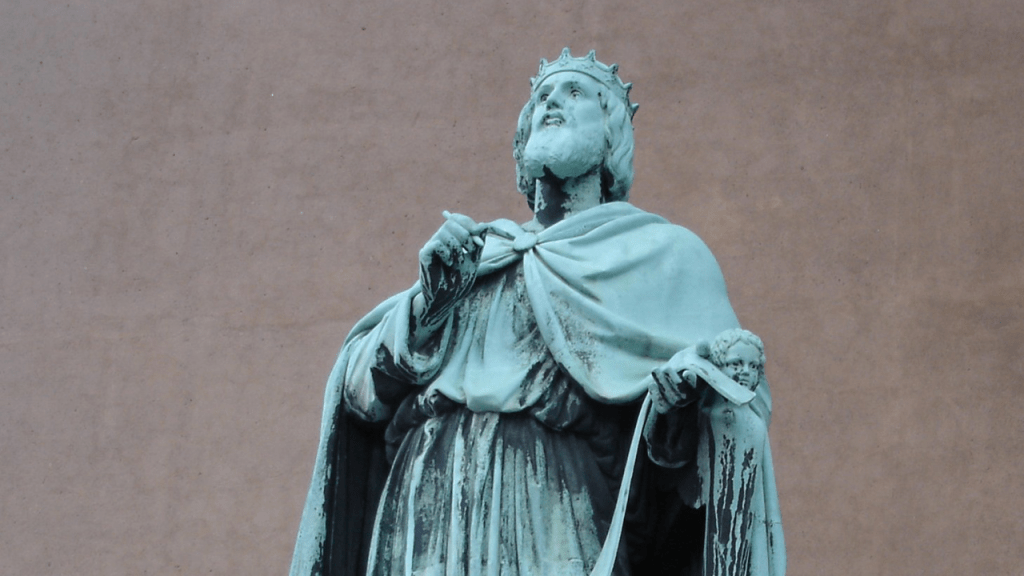
Statue of King David, Copenhagen, Denmark

Yet also, King David demonstrated for us some of the worst immorality, of which is clearly seen in the next few chapters of his story in the book of 2 Samuel. Throughout David’s adult life, he took thousands of human lives in battle.

He came to fame by beheading Goliath; made his mark in Israel by killing Philistines for King Saul; survived in the wilderness while Saul was trying to kill him by killing Amalekites; and secured Israel’s borders through an enormous amount of killing.

I won’t do to simply say that the people David killed had it coming to them, or that he did all the things he did for the sake of the nation. That sort of reductionism smacks of mental laziness and purposeful ignorance.

Coming to Grips with Conflict

At the least, it seems to me that we must accept the biblical narratives as they are, and not as we want them to be, whenever there is difficulty in understanding a story.

We have the human condition in front of us every time we read a scriptural story. Either making it all good, or all bad, just won’t do – because all of us, like David, are a bundle of contradictions and paradoxes that often don’t make sense.

It turns out that, throughout Holy Scripture, we find stories of people who are no better and no worse than we ourselves. The ancient persons, like David, are those for whom a gracious God chose to use and work through – despite either their sinning or their saintliness.

We get a glimpse of how things were and how the Lord operated through the people of the time in their own political, social, economic, and religious contexts.

God comes to us, not merely from the outside by simply mandating commands and imposing control, but enters our lives on the inside, taking us as we are and graciously working with and within us to accomplish good and just purposes on this earth.

And, as it turns out, God uses whomever God wants to use, without doing some sort of divine screening interviews to find out who the most moral candidate is available for the job.

If you are looking for a bottom line in all of this mayhem, then I believe it is this: God loves us. God is with us. And God holds us – all of us, with our maddening combinations of kindness and kookiness – to establish a truly right and benevolent world characterized by humility, gentleness, mercy, purity, and peace.

It’s a rather long and messy process of bringing in such a way of life, but God is patient and will take the centuries and even the millennia needed to accomplish it.

It’s Not All About Human Conflict

Although we are a flawed and fallible people, we are nevertheless God’s people. At the end of it all, we discover that none of this was really a story about Ammonites or Israelites or David or Joab or anyone else; it is actually a story about God – because God is both the object and subject of every biblical narrative.

And what we discover about God is that there are divine initiatives happening all the time which are meant to help us and save us from ourselves. The Lord is sovereign over all creation, and brings salvation despite what we do or don’t do.

God’s kindness – shown and expressed through our own human kindness – will eventually and always win the day.

Almighty and everlasting God, whose will it is to restore all things in your well beloved Son, the King of kings and Lord of lords: Mercifully grant that the peoples of the earth, divided and enslaved by sin, may be freed and brought together under his most gracious rule; who lives and reigns with you and the Holy Spirit, one God, now and forever. Amen.