The Shepherds’ Candle of Joy (Luke 2:8-20)

The Shepherds by Malaysian artist Hanna Varghese (1938-2009)

And there were shepherds living out in the fields nearby, keeping watch over their flocks at night. An angel of the Lord appeared to them, and the glory of the Lord shone around them, and they were terrified. But the angel said to them, “Do not be afraid. I bring you good news that will cause great joy for all the people. Today in the town of David a Savior has been born to you; he is the Messiah, the Lord. This will be a sign to you: You will find a baby wrapped in cloths and lying in a manger.”

Suddenly a great company of the heavenly host appeared with the angel, praising God and saying,

“Glory to God in the highest heaven,
    and on earth peace to those on whom his favor rests.”

When the angels had left them and gone into heaven, the shepherds said to one another, “Let’s go to Bethlehem and see this thing that has happened, which the Lord has told us about.”

So they hurried off and found Mary and Joseph, and the baby, who was lying in the manger. When they had seen him, they spread the word concerning what had been told them about this child, and all who heard it were amazed at what the shepherds said to them. But Mary treasured up all these things and pondered them in her heart. The shepherds returned, glorifying and praising God for all the things they had heard and seen, which were just as they had been told. (New International Version)

We Are Meant For Joy

The past 10-20 years have seen an explosion of understanding concerning the brain. Even though there is so much we still do not know, what we do know is that our brains cannot survive, let alone thrive, without emotions like joy. The frontal lobe of the brain monitors our emotional state, while the thalamus (the information center that regulates consciousness) helps determine how to express our feelings.

We feel joy in our bodies because of the release of the neurotransmitters dopamine and serotonin in the brain. Both of these chemicals are associated with happiness (in fact, people with clinical depression often have lower levels of serotonin).

So, simple activities like going for a walk in nature, petting a dog or cat, kissing a loved one, standing and sitting in a worship service, and yes, even forcing yourself to smile, can help those neurotransmitters do their job and raise your mood.

Neurologists and scientists have also discovered that practices of mindfulness, silence, contemplation, and meditation stimulate the brain’s cortex and create a state of happiness, contentment, and joy. And those practices also enable individuals to become more self-aware, more aware of others and what is happening around them, as well as a heightened awareness of unseen realities, like God and angels.

God with Us

The way that God has wired us means that joy does not come from getting all the presents we want for Christmas or having everything go our way. Instead,  joy is the fruit of meaningful movement of the body and relational interactions with God and others. We do not need to look for joy in a store because joy comes being with God, God’s creation, and God’s people.

The good news of a Savior coming to this earth means God is coming to be with us. This is good news of great joy! We are loved because God is good, not because we are good. And because God is good, and we are a mess of humanity, there is joy that the Lord is coming to save us!

Seeing Shepherds by American painter Daniel Bonnell

The Shepherds

The reason Christ’s birth was good news of great joy to the shepherds is that they were shepherds.  Shepherds in the ancient world were generally looked on with contempt. In fact, the ancient Egyptians refused to eat with Jews because they were mostly shepherds (Genesis 46:31-34). 

  • Shepherds spent most of their time living with their sheep outdoors, to protect the flock. 
  • Shepherds were not dressed well, not culturally refined, and smelled like sheep poop. 
  • Shepherds also had the notoriety of being drinkers. Because they slept with the sheep, many shepherds would pass the time and deal with the chilly air by taking a nip of alcohol. We do not really know whether most shepherds were drunkards, or not; but we do know they had a bad reputation.

So, becoming a shepherd was not a profession any young person aspired to. Nobody took out a student loan to major in shepherding at the University of Jerusalem. King David started out as a shepherd. He was the runt in his family and got stuck with the job nobody else wanted. Out of all the persons and people-groups the heavenly angels could have come to announce the birth of Christ, it was shepherds.

Grace

The good news of great joy for all the people is truly a gospel of grace. The announcement to a bunch of stinky shepherds is profoundly significant and cannot be overstated. It is important because grace is being shown to the lowliest of society. A lowly Savior, born to a lowly family, and placed in a lowly feeding trough, came to reach the lowly, common, ordinary person.

To have this kind of attention from the sovereign almighty God is like the owner of a dog coming home at the end of the day. We, as the common, ordinary mutts of society, are beside ourselves with joy, feeling privileged to be in the same room as Jesus.

It is only the lowly and humble in heart who will see God and enjoy the Lord’s presence. That is because God opposes the proud but gives grace to the humble. It is why the angels came to the shepherds and not the religious leaders. It is good news of great joy for all the people. The gospel is not limited to those who are the most educated, the wealthiest, or from the most prominent of families – it is for everyone.

Worry and Anxiety

Yet, many people still live their lives primarily in fear, worry, and anxiety, instead of joy, not getting the message of joy firmly pressed into their minds and hearts. Even though a Savior is born, we still experience the harshness of a world under the dominion of darkness.  We worry about constant disease, financial difficulties, and the daily stresses of life.  We fret about dealing with ornery people, hard circumstances, family members who go astray, and the little plastic things on our shoelaces coming off leaving the shoestrings frayed! 

Sometimes, we strain to see much joy. Jesus is the son of David, born in the town of David – both were anointed as kings but had to go through a lot of hardship before realizing their kingships. We live in the time between the two advents of Christ in which the kingdom is already here but not yet here. It is a time characterized by a weird mix of sinners and saints, despair and joy, adversity, and comfort.

Joy is not found in having every circumstance go our way and having everyone like us all the time. Joy comes from the gospel of grace, from God coming down and being with us.  Being in the presence of the Master makes all the difference. If joy comes from being with God in Christ, then cultivating and practicing the presence of Jesus in our daily lives is important.

Solitude and Silence

Another reason the angels came to the shepherds is that the shepherds were away from the growing crowd that was swelling in Bethlehem due to the Roman census. The shepherds were out in the sticks, by themselves, experiencing a silent night. And so, they were able to hear the message of God when it came.

Noise comes in various forms, both around us and within us. Sometimes we even create noise on the outside so that the noisy racing thoughts on the inside will get drowned. To be quiet is to be able to listen. To listen is to receive another’s voice. And receiving the voice of the angels, their message, and their praise to God, is the pathway to joy and the way out of unhappy inner noise.

Freedom

We need deliverance primarily from ourselves, from our own brokenness, and from unhealthy ways of coping with hard circumstances. There is far too much unhappiness in this world. For example:

  • One in every two-hundred teenage American girls cut themselves on a regular basis.
  • More than half of people in the United States with serious depression do not receive or will not get adequate help. 
  • Anxiety disorders affect nearly sixty million adults in the United States. 

The coming of Jesus into this world makes a difference. Christ’s incarnation means that God has come to meet the deepest needs of our lives. Our deliverance is realized by eagerly anticipating the Lord, spending time with him, and allowing his loving presence and compassionate voice to transform our hearts, changing us from the inside-out. 

Christianity is not a magic happy pill to swallow; it is a relationship with God that is to be cultivated and which grows over time.

Joy is relational. No amount of positive thinking, buying new stuff, or good situations will create it or sustain it. Christianity offers joy in Jesus – not a cheap sentimental happiness of having every prayer answered or each situation go our way – but the settled joy of God with us.

Neither worry nor fret. Do not be afraid. I bring you good news of great joy that will be for all the people. In the town of David, a Savior has been born to you. He is Christ the Lord. 

What can I give him, poor as I am? If I were a shepherd, I would bring a lamb. If I were a wise man, I would give him frankincense or gold.

Yet, what can I give him? I can give him my heart.

Psalm 73:21-28 – God Is Near

When my thoughts were bitter
    and my feelings were hurt,
I was as stupid as an animal;
    I did not understand you.
Yet I always stay close to you,
    and you hold me by the hand.
You guide me with your instruction
    and at the end you will receive me with honor.
What else do I have in heaven but you?
    Since I have you, what else could I want on earth?
My mind and my body may grow weak,
    but God is my strength;
    he is all I ever need.

Those who abandon you will certainly perish;
    you will destroy those who are unfaithful to you.
But as for me, how wonderful to be near God,
    to find protection with the Sovereign Lord
    and to proclaim all that he has done! (Good News Translation)

Sometimes we put our foot in our mouth. We know how it feels saying rash words that we later regret. And we also know what it feels like to get dumped on by another who has some choice words for us.

The psalmist, Asaph, records an encounter with God. Asaph was upset. He gave God a piece of his mind. Then later, after reflecting on the experience, Asaph admitted that his soul was embittered and let his base nature take over.

The human brain is a complicated organ. We process information in different parts of the brain. The neo-cortex (the rational part of the brain) allows us to engage in logical analysis and complex decision making. 

Another part, the limbic system (sometimes referred to as the “reptilian brain”) processes information very quickly, largely by instinct. When we become scared, surprised, upset, or angry, adrenaline gets pumped into our limbic system so that we can quickly react to the perceived threat, danger, or injustice.

Having our brains flooded with adrenaline when there is real danger is necessary. There are life-threatening circumstances in which we need that quick response. Yet, if our brains remain on high alert and are continually fearful and upset, even when there is no real problem, we don’t calm down, and the result is less than stellar behavior. 

So, what is the answer to this situation? Asaph said God holds his right hand and guides him with wise counsel. Being near to God brings the brain chemistry to appropriate levels so that we can relax and trust.

God is with us always in the person of the Holy Spirit. There is never a time, place, or situation where God is absent. As we learn to rely on God’s presence, and remind ourselves of it on a daily basis, we can restore more rational thoughts to our lives. We can live knowing God is in control and continually vigilant to watch over us.

Gracious God, I have no one in my life like you. My flesh and my heart may fail, my brain might become overwhelmed with irrational fears, but you are my strength and the Rock of my salvation. Thank you for your continual provision and help each day through Jesus Christ, my Lord. Amen.

Psalm 118:1-2, 19-29 – Gratitude Changes Us

O give thanks to the Lord, for he is good;
    his steadfast love endures forever!

Let Israel say,
    “His steadfast love endures forever….”

Open to me the gates of righteousness,
    that I may enter through them
    and give thanks to the Lord.

This is the gate of the Lord;
    the righteous shall enter through it.

I thank you that you have answered me
    and have become my salvation.
The stone that the builders rejected
    has become the chief cornerstone.
This is the Lord’s doing;
    it is marvelous in our eyes.
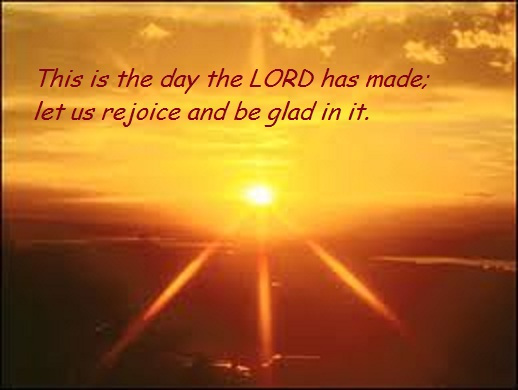
This is the day that the Lord has made;
    let us rejoice and be glad in it.
Save us, we beseech you, O Lord!
    O Lord, we beseech you, give us success!

Blessed is the one who comes in the name of the Lord.
    We bless you from the house of the Lord.
The Lord is God,
    and he has given us light.
Bind the festal procession with branches,
    up to the horns of the altar.

You are my God, and I will give thanks to you;
    you are my God, I will extol you.

O give thanks to the Lord, for he is good,
    for his steadfast love endures forever. (NRSV)

Show me a spiritual sourpuss, and I’ll show you a person who lives without daily gratitude toward God and others. But show me a gracious person who liberally gives thanks, and I will show you a person profoundly in touch with God’s steadfast love.

The psalmist chose to give thanks for God’s goodness and faithful love. I wonder how much different each day would be if we began it with the psalmist’s great call to worship: “This is the day the Lord has made; let us rejoice and be glad in it.” 

There is a misguided notion that only certain people have the attitude of gratitude – that some folks are just naturally ornery, and some are just born happy. But the truth is that gratitude and giving thanks is a practice which needs to be carefully cultivated. As it grows and develops, gratitude bears the fruit of joy. 

Thankfulness is a daily decision of faith to have the kind of attitude which pleases God and blesses others.

We now know so much more about the human brain. Research has discovered that the brain is made up of an estimated 100 billion neurons making a total of 100 trillion neural connections. That’s a lot of neural power! Most of those neural pathways are good and healthy. For example, I didn’t have to think about how to tie my shoes this morning because I have a well-developed neural pathway that automatically makes the connection to do it.

However, some of those neural pathways are not good, even unhealthy. There might be connections in our heads which lead to substance abuse when under stress, or to violently lash out when afraid or hurt, or things like plain old procrastination. If you have ever had the experience of telling yourself that you’re not going to respond a particular way, then end up doing it anyway, it is likely you have a well-worn neural pathway which connects certain events to a set of focused actions.

What this all means is that willpower won’t do the trick in changing behavior. That’s because our brains don’t work that way. The good news is that all those neural connections and pathways, like ruts in a gravel road, can fade away and new ones can be developed. Scientists call this “neural plasticity.”

There are practices which can help unhealthy neural connections go away and create new healthy pathways.

One of those practices is gratitude. Giving thanks changes our brain chemistry! Yet, it doesn’t happen overnight. But if we identify three persons or possessions which we are grateful for and say them out loud at least three times a day over the next three months, then we have developed a new neural pathway in our brain.

So, in the future, when we face a stressful event – whereas in the past we might deal with it in an unhealthy way – now our brains reflexively go to a different place and see the situation in a different way than before. And we choose different actions and behaviors.

Readers of this blog know that I continually encourage reading the psalms out loud as prayers to God. If we make this a practice, it will not only change our brains – it will create new spiritual pathways in our souls which fortify us for those times in life when things are tough and hard.

Spiritual practices have a purpose. And when we use those disciplines, we end up developing connections with the Lord which support us and sustain us for a lifetime – not to mention that we become a delight for others to be around instead of being a tedious fart.

Loving God, this is the day you have made; I rejoice in it and am glad that your steadfast love covers all things. Help me to connect every good thing with your gracious hand upon me so that I will not look and act like I was baptized in pickle juice.  To the glory of Jesus Christ, I pray.  Amen.

Psalm 73:21-28

            We have all had the experience of saying rash words that we later regret; and, of being dumped on by another who had some choice words for us.  In Psalm 73, the psalmist, Asaph, records an encounter with God in which he had some rather upset musings for the Sovereign of the universe.  Later, after some reflection, Asaph said:  “When my soul was embittered, when I was pricked in heart, I was brutish and ignorant; I was like a beast toward you.”
 
            As human beings, we process information in different parts of our brains.  The neo-cortex, the rational part allows us to engage in logical analysis and complex decision making.  Another part, the limbic system, is sometimes known as the “reptilian brain” because it processes information very quickly, largely by instinct.  When we become scared, surprised, upset, or angry, adrenaline gets pumped into our limbic system so that we can react to the perceived threat, danger, or injustice.
 
             Having our brains flooded with adrenaline when there is real danger is a necessary thing.  But when we are continually fearful and upset, even when there is no real problem, our brains never calm down and the result is less than stellar behavior.  So, what is the answer to this situation?  Asaph said that God holds his right hand and guides him with wise counsel.  Being near to God is what brings the levels down so that we can relax and trust.
 
            God is with us always in the person of the Holy Spirit.  There is never a time, place, or situation where God is absent.  As we learn to rely on God’s presence, and remind ourselves of it on a daily basis, we can restore more rational thoughts to our lives so that we can live knowing God is in control.
            Gracious God, I have no one in my life like you.  My flesh and my heart may fail, my brain might become overwhelmed with irrational fears, but you are my strength and the Rock of my salvation.  Thank you for your continual provision and help each and every day through Jesus Christ, my Lord.  Amen.