Acts 4:1-4 – The Message of Resurrection

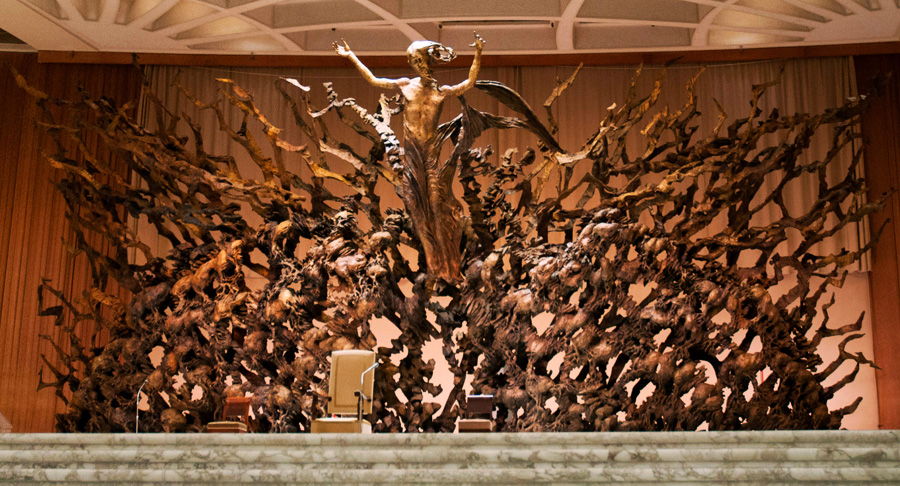
La Resurrezione by Italian sculptor Pericle Fazzini (1913-1987)

The priests and the captain of the temple guard and the Sadducees came up to Peter and John while they were speaking to the people.They were greatly disturbed because the apostles were teaching the people, proclaiming in Jesus the resurrection of the dead. They seized Peter and John and, because it was evening, they put them in jail until the next day. But many who heard the message believed; so, the number of men who believed grew to about five thousand. (NIV)

There’s nothing quite like upsetting the status quo. And that’s exactly what the apostles Peter and John were doing. Creating trouble, causing a stink, disturbing the peace, and making waves. At least, that’s how the ruling authorities saw the upstart Christians’ activity.

At the heart of the disturbance was the authorities’ deep concern of potential social disorder. After all, the Roman Empire with all its great strength was firmly ensconced in Judea. It was already hard enough trying to maintain Jewish customs and religious practices. Now, these rabblerousers come along with their unorthodox teaching and threaten the very social fabric of Jewish life. No! Get them out of here!

So, off to jail Peter and John went. That’s how the politics of fear typically works. Being afraid of change leads to removing the object of fear. Stuff the apostles in the gulag. Shut and lock the door. Maybe if they are out of sight they will be out of mind to the people.

The rulers were too late. So many people heard the message of Christ’s resurrection that the number of believers in Jesus swelled into the thousands. Well, now, everyone’s really in a pickle! Except the church. Each time the Christians get squelched and silenced, more of them show up. Oh, my, goodness. They’re multiplying like roaches!

It doesn’t help the ruling authorities that these religious bugs continue to interpret their own whippings and jailtime as a positive thing – enjoying the solidarity of suffering with their Lord. Ugh. What’s a decent Sadducee to do?

Turns out nothing can stop resurrection. It cannot be chained, bound, or imprisoned. Once life gets into the hearts of people, there’s no getting it out. The message just takes over and consumes the whole person. Then it spreads to another, like some infectious disease.

Before you know it, the entire social order is off kilter. What a bunch of weirdos. Following a dead guy who they say isn’t dead. Walked right out of the grave, they say. Sheesh. Pull yourselves together. So many unhinged delusional people believing in resurrection!

“Here’s to the crazy ones. The misfits. The rebels. The troublemakers. The round pegs in the square holes. The ones who see things differently. They’re not fond of rules. And they have no respect for the status quo. You can quote them, disagree with them, glorify or vilify them. About the only thing you can’t do is ignore them. Because they change things. They push the human race forward. And while some may see them as the crazy ones, we see genius. Because the people who are crazy enough to think they can change the world, are the ones who do.”

Rob Siltanen

It’s easy for some Christians to be hard on non-Christians, just as it was easy for the ancient Jewish rulers to be hard on others leaving their fold. Sometimes we followers of Jesus forget whence we have come. We can get so upset and worked up in fear. Could be our underwear is too tight. More likely, we take the prideful stance of believing our status quo is best for everyone. So, there’s no listening, paying attention, or teachable spirits.

Peter, John, and the other apostles just went about proclaiming good news with joy. And the gospel spread. Jesus became known first to thousands, then tens of thousands, hundreds of thousands, and millions. Today, according to the Pew Research Center, there are 2.5 billion Christians in the world. That’s a lot of people. Christianity has had two thousand years to create their own status quo, some of it good, some of it not so much.

Yet, at the heart of it all, is the resurrection of Jesus Christ from death. It’s a message that still speaks to billions. And it’s a message Christians need to come back to whenever they are fearful of others challenging their hegemony.

All the hopes and expectations of Christians everywhere are realized not in maintaining some Constantinian sort of Christendom but in the resurrection of Jesus Christ the dead. The former does a lot of handwringing over social and cultural issues. The latter has a lot of joy, celebration, and renewal which works itself out in both personal and systemic redemption.

Because the good news of Easter can hardly be contained in a single day’s celebration, it’s message of new life in Christ is like a bright sun of inexhaustible grace to people everywhere – still warming the earth all these centuries later.

The Apostle Peter went on to pen a letter to struggling Christians facing hard circumstances in a world not yet dominated by Christianity, reminding them of the heart of Christian faith:

Praise be to the God and Father of our Lord Jesus Christ! In his great mercy he has given us new birth into a living hope through the resurrection of Jesus Christ from the dead, and into an inheritance that can never perish, spoil or fade. This inheritance is kept in heaven for you, who through faith are shielded by God’s power until the coming of the salvation that is ready to be revealed in the last time. In all this you greatly rejoice, though now for a little while you may have had to suffer grief in all kinds of trials. These have come so that the proven genuineness of your faith—of greater worth than gold, which perishes even though refined by fire—may result in praise, glory and honor when Jesus Christ is revealed. Though you have not seen him, you love him; and even though you do not see him now, you believe in him and are filled with an inexpressible and glorious joy, for you are receiving the result of your faith, the salvation of your souls.

1 Peter 1:3-9, NIV

May we come back repeatedly to Christianity’s message so that our faith is strengthened, the church is edified, and the world is blessed. Amen.

Mark 12:18-27 – Go Ahead, Ask Jesus Anything

Photo by Pixabay on Pexels.com

Then the Sadducees, who say there is no resurrection, came to him with a question. “Teacher,” they said, “Moses wrote for us that if a man’s brother dies and leaves a wife but no children, the man must marry the widow and raise up offspring for his brother. Now there were seven brothers. The first one married and died without leaving any children. The second one married the widow, but he also died, leaving no child. It was the same with the third. In fact, none of the seven left any children. Last of all, the woman died too. At the resurrection, whose wife will she be, since the seven were married to her?”

Jesus replied, “Are you not in error because you do not know the Scriptures or the power of God? When the dead rise, they will neither marry nor be given in marriage; they will be like the angels in heaven. Now about the dead rising—have you not read in the Book of Moses, in the account of the burning bush, how God said to him, ‘I am the God of Abraham, the God of Isaac, and the God of Jacob’? He is not the God of the dead, but of the living. You are sorely mistaken!” (NIV)

Okay, let’s dive in with some observational lessons from today’s Gospel reading:

  • Don’t be a dip-wad and try to trip-up Jesus with philosophically ethereal questions.
  • If you want to be rebuked by Jesus for being ignorant, mistaken, and wrong, just try and control how a conversation with him ought to go.
  • Abraham, Isaac, Jacob, and Jesus are all alive – Sadducees, not so much.
  • Jesus will take the time and attention to listen and give feedback – maybe the kind you weren’t looking for.
  • What we get hung up on, Jesus doesn’t – and what Jesus sticks on, we act like Teflon about.

Do you want to keep going….?

To deny resurrection is to deny Jesus. Christ died. He’s now alive. Hence, there is a resurrection. More than that, because Christ lives, others live. This is the Christian’s hope. 

I fully understand plenty of people don’t believe in resurrection. That’s fine. I would simply point such a person no further than their own mind and heart. “Search your feelings,” as the Jedi would say, “What do they tell you?”  The evidence you need, you already have.

And this was the penultimate lesson of Jesus to the inquisitive Sadducees. They already had the answer to their question for Jesus. It was right under their noses the entire time. They just didn’t see it.

You already have everything you need for life and godliness in this present evil age.

One of the great sages of the last century, Dorothy from The Wizard of Oz, wisely said:

“If I ever go looking for my heart’s desire again, I won’t look any further than my own backyard.  Because if it isn’t there, I never really lost it to begin with.”

Resurrection has always been there because God has always been around – even when we don’t see, perceive, or acknowledge the divine.

It probably wouldn’t be a good idea to procrastinate the inevitable end of life scenario that awaits us all. Anytime is the right time to do a bit of personal funeral planning. Yet, if we mire it all with the esoteric hypothetical questions about what would happen in the most far-fetched of scenarios, methinks God is big and smart enough to see through our puny charade.

Better to ponder what is truly within your own soul, and how Jesus might already be present within and around all things, without us even knowing it. 

A good place to start in peering within is to give a straightforward honest reading of the New Testament Gospels and discover what resonates deeply with you about the person and work of Jesus.

Feel free to question him about anything you want; just brace yourself for what kind of answer you might receive.

Psalm 71:1-14 – Tuesday of Holy Week

O Lord, I have come to you for protection;
    don’t let me be disgraced.
Save me and rescue me,
    for you do what is right.
Turn your ear to listen to me,
    and set me free.
Be my rock of safety
    where I can always hide.
Give the order to save me,
    for you are my rock and my fortress.
My God, rescue me from the power of the wicked,
    from the clutches of cruel oppressors.
O Lord, you alone are my hope.
    I’ve trusted you, O Lord, from childhood.
Yes, you have been with me from birth;
    from my mother’s womb you have cared for me.
    No wonder I am always praising you!

My life is an example to many,
    because you have been my strength and protection.
That is why I can never stop praising you;
    I declare your glory all day long.
And now, in my old age, don’t set me aside.
    Don’t abandon me when my strength is failing.
For my enemies are whispering against me.
    They are plotting together to kill me.
They say, “God has abandoned him.
    Let’s go and get him,
    for no one will help him now.”

O God don’t stay away.
    My God, please hurry to help me.
Bring disgrace and destruction on my accusers.
    Humiliate and shame those who want to harm me.
But I will keep on hoping for your help;
    I will praise you more and more. (NLT)

Today’s psalm is a lament. It is included in Holy Week because the Christian can imagine Jesus saying these very words in the last days of his earthly life and ministry.

Lament is both important and necessary. Without lament our grief comes out sideways, inevitably harming others with our snarky vitriol. Lament gives expression to our deep grief. It enables us to come to grips with what has happened or is happening to us and within us.

  • A lament is an expression of personal grief to any significant change or loss; it is the normal emotional, spiritual, physical, and relational reaction to that loss.
  • Lamenting is an intentional process of letting go of relationships and dreams and living into a new identity after the loss or change.
  • Expressing grief through lament is personal; there is no one-size-fits-all.

Psalms of lament have a typical structure to them, including:

  • Addressing God: Crying out for help. Some psalms of lament expand to include a statement of praise or a recollection of God’s intervention in the past. (Psalm 71:1-3)
  • Complaint: Telling God (said with some flavor!) about our problem or experience through a range and depth of emotional, relational, and spiritual reactions to the change or loss. (Psalm 71:4)
  • Confession of Trust: Remaining confident in God despite the circumstances. Beginning to see problems differently. (Psalm 71:5-8)
  • Petition: Proclaiming confidence in God. Appealing to God for deliverance and intervention. Keep in mind that petitioning is not bargaining with God or a refusal to accept loss. Rather, it is a legitimate seeking of help. (Psalm 71:9-13)
  • Words of Assurance: Expressing certainty that the petition will be heard by God. (Psalm 71:14a)
  • Vow of Praise: Vowing to testify in the future to what God will do with praise. (Psalm 71:14b-24)

I urge you to do the following spiritual practice this Holy Week – set aside some time and craft your own psalm of lament. Choose an event from your past which created grief for you. It can be recent or from years ago. Using the structure of lament psalms, thoughtfully write out each element as I have outlined it. Then, read it aloud to God. Perhaps even take another step by reading your lament aloud to a trusted family member, friend, or Pastor.

Our grief needs the outlet of lament. Grief which is not expressed only sits in the soul and eventually, over time, can easily become putrid and rancid, poisoning our spirit, and compromising our faith. Sharing your story through lament is biblical, practical, and I will insist, necessary. Let me know how it goes…

Psalm 118:1-2, 19-29 – Gratitude Changes Us

O give thanks to the Lord, for he is good;
    his steadfast love endures forever!

Let Israel say,
    “His steadfast love endures forever….”

Open to me the gates of righteousness,
    that I may enter through them
    and give thanks to the Lord.

This is the gate of the Lord;
    the righteous shall enter through it.

I thank you that you have answered me
    and have become my salvation.
The stone that the builders rejected
    has become the chief cornerstone.
This is the Lord’s doing;
    it is marvelous in our eyes.
This is the day that the Lord has made;
    let us rejoice and be glad in it.
Save us, we beseech you, O Lord!
    O Lord, we beseech you, give us success!

Blessed is the one who comes in the name of the Lord.
    We bless you from the house of the Lord.
The Lord is God,
    and he has given us light.
Bind the festal procession with branches,
    up to the horns of the altar.

You are my God, and I will give thanks to you;
    you are my God, I will extol you.

O give thanks to the Lord, for he is good,
    for his steadfast love endures forever. (NRSV)

Show me a spiritual sourpuss, and I’ll show you a person who lives without daily gratitude toward God and others. But show me a gracious person who liberally gives thanks, and I will show you a person profoundly in touch with God’s steadfast love.

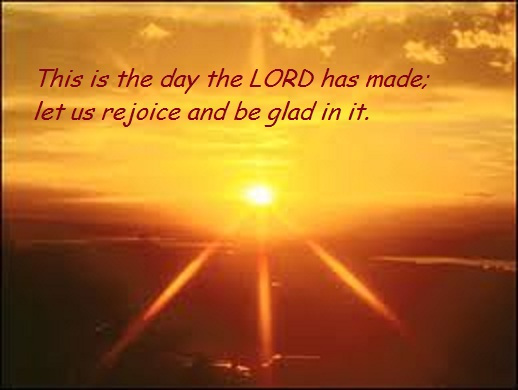
The psalmist chose to give thanks for God’s goodness and faithful love. I wonder how much different each day would be if we began it with the psalmist’s great call to worship: “This is the day the Lord has made; let us rejoice and be glad in it.” 

There is a misguided notion that only certain people have the attitude of gratitude – that some folks are just naturally ornery, and some are just born happy. But the truth is that gratitude and giving thanks is a practice which needs to be carefully cultivated. As it grows and develops, gratitude bears the fruit of joy. 

Thankfulness is a daily decision of faith to have the kind of attitude which pleases God and blesses others.

We now know so much more about the human brain. Research has discovered that the brain is made up of an estimated 100 billion neurons making a total of 100 trillion neural connections. That’s a lot of neural power! Most of those neural pathways are good and healthy. For example, I didn’t have to think about how to tie my shoes this morning because I have a well-developed neural pathway that automatically makes the connection to do it.

However, some of those neural pathways are not good, even unhealthy. There might be connections in our heads which lead to substance abuse when under stress, or to violently lash out when afraid or hurt, or things like plain old procrastination. If you have ever had the experience of telling yourself that you’re not going to respond a particular way, then end up doing it anyway, it is likely you have a well-worn neural pathway which connects certain events to a set of focused actions.

What this all means is that willpower won’t do the trick in changing behavior. That’s because our brains don’t work that way. The good news is that all those neural connections and pathways, like ruts in a gravel road, can fade away and new ones can be developed. Scientists call this “neural plasticity.”

There are practices which can help unhealthy neural connections go away and create new healthy pathways.

One of those practices is gratitude. Giving thanks changes our brain chemistry! Yet, it doesn’t happen overnight. But if we identify three persons or possessions which we are grateful for and say them out loud at least three times a day over the next three months, then we have developed a new neural pathway in our brain.

So, in the future, when we face a stressful event – whereas in the past we might deal with it in an unhealthy way – now our brains reflexively go to a different place and see the situation in a different way than before. And we choose different actions and behaviors.

Readers of this blog know that I continually encourage reading the psalms out loud as prayers to God. If we make this a practice, it will not only change our brains – it will create new spiritual pathways in our souls which fortify us for those times in life when things are tough and hard.

Spiritual practices have a purpose. And when we use those disciplines, we end up developing connections with the Lord which support us and sustain us for a lifetime – not to mention that we become a delight for others to be around instead of being a tedious fart.

Loving God, this is the day you have made; I rejoice in it and am glad that your steadfast love covers all things. Help me to connect every good thing with your gracious hand upon me so that I will not look and act like I was baptized in pickle juice.  To the glory of Jesus Christ, I pray.  Amen.