Hebrews 11:17-22 – Faith Forward

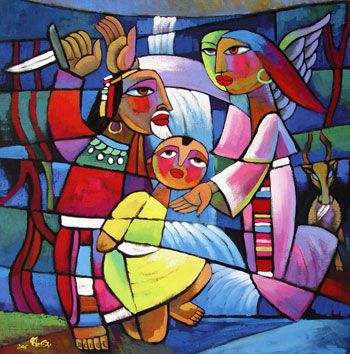
Sacrifice of Abraham by He Qi

By faith Abraham, when God tested him, offered Isaac as a sacrifice. He who had embraced the promises was about to sacrifice his one and only son, even though God had said to him, “It is through Isaac that your offspring will be reckoned.” Abraham reasoned that God could even raise the dead, and so in a manner of speaking he did receive Isaac back from death.

By faith Isaac blessed Jacob and Esau in regard to their future.

By faith Jacob, when he was dying, blessed each of Joseph’s sons, and worshiped as he leaned on the top of his staff.

By faith Joseph, when his end was near, spoke about the exodus of the Israelites from Egypt and gave instructions concerning the burial of his bones. (New International Version)

Life requires faith.

To keep going, to endure and persevere, demands sustained faith over the course of a lifetime.

Faith is confidence in what we hope for and assurance about what we do not see. (Hebrews 11:1)

The biblical character, Abraham, let faith shape his actions. He obeyed God’s call on his life and left his home country to go somewhere he knew nothing about. And he did it with no GPS and no AAA tour books.

Even thought Abraham had a good life in his home city of Ur, he left, believing there was something better ahead.

After reaching the land which God led them to, Abraham, age 100 and his wife, Sarah, age 90, became parents. It happened because of faith. The two of them believed God’s promise of a child, even though it was biologically impossible.

Abraham kept his faith over the long haul of his life. He did it by looking ahead to the eternal city. Because Abraham had looked ahead on this earth and stepped out in faith, he was able to clearly discern that all his faith eggs were not in the earthly basket.

Against all odds, Abraham was convinced God was good for his promises and knew what he was doing.

Trust in the Lord with all your heart,
And lean not on your own understanding;
In all your ways acknowledge Him,
And He shall direct your paths.

Proverbs 3:5-6, NKJV

Isaac was the miracle child, the promised son born to Abraham and Sarah in their old age. One day, God came along and gave Abraham a very strange command: Take your son, the child of the promise, and go to the mountain and sacrifice him there. (Genesis 22:1-19)

“Huh? What the @#$&*!!” we might say. But it only seems perplexing and weird to us. Abraham listened and obeyed. He simply went about the business of saddling up the donkey, chopping some wood for the sacrifice, and took his only son with him on the journey to the mountain – with no questions or talk back to God.

While you and I might try and figure out if we really heard God or not, Abraham had a history of faith with God. He knew God’s voice as well as he knew his own. Abraham was well down the road of relationship with the God he served.

Today’s New Testament lesson gives us an insight into Abraham’s thought process, a line of thinking consistent with a person who has a regular habit of talking with God. Abraham was willing to follow through with sacrificing his beloved son because he was sure that God could raise people to life. Abraham believed death would not have the last word.

Abraham did not try and figure out God’s mind. He didn’t get into a debate with God about the contradiction of ethics he was being asked to do. He just obeyed. Abraham reasoned that it didn’t matter if Isaac were killed because God could raise him from death. This, of course, is not what happened. It was all a test of faith. Abraham knew beyond a shadow of a doubt that God is the Lord who provides.

You and I rarely know why we are facing the unwanted circumstances we are enduring. We don’t always know what in the world God is thinking. Yet, like Abraham, if we have a spiritual history of walking with God and hearing the Lord’s voice, we don’t hesitate to respond. We are convinced God will provide.

Obedience for the follower of Christ is not a burden but a privilege, even when we are being tested beyond our seeming emotional ability to do it.

Grant, O God, that we may never lose our way through self-will, and so end up in the far countries of the soul. May we never abandon the struggle, but endure to the end, and so be saved. May we never drop out of the race but press forward to the goal of our high calling. May we never choose the cheap and temporary path but let go of all but you. May we never take the easy way and never forget that sweat is the price of all things, and that without the cross, there cannot be the crown.

So, keep us and strengthen us by your grace so that no disobedience, weakness, or failure may stop us from entering into the blessedness which awaits those who are faithful in all the changes and chances of life, through Jesus Christ our Lord. Amen

Psalm 144:9-15 – Rescued from Evil

Rescued by Rodney J. Parrott

O God, let me sing a new song to you,
    let me play it on a twelve-string guitar—
A song to the God who saved the king,
    the God who rescued David, his servant.

Rescue me from the enemy sword,
    release me from the grip of those barbarians
Who lie through their teeth,
    who shake your hand
    then knife you in the back.

Make our sons in their prime
    like sturdy oak trees,
Our daughters as shapely and bright
    as fields of wildflowers.
Fill our barns with great harvest,
    fill our fields with huge flocks;
Protect us from invasion and exile—
    eliminate the crime in our streets.

How blessed the people who have all this!
How blessed the people who have God for God! (The Message)

Evil lurks everywhere. It resides in the human heart, hidden in the dark shadows, coming out sideways through shameful lies and guilty actions. Evil is also found throughout the world in every institution, organization, and group, ensconced as systemic injustice – hoarding resources for the powerful at the expense of the powerless.

Since there is wickedness found in all places and with all people, evil needs to be dealt with and expunged from both heinous hearts as well as the hoarding habitations of injustice. Part of the solution is to do away with all obstacles which stand in the way of human flourishing.

To be sure, the heart of humanity must be dealt with and be the focus of change. Yet, if we only focus one-dimensionally on evil, it will persist, and even grow into monstrous proportions, unless we equally direct our right and just efforts on institutional and systemic evil.

People and their institutions need deliverance from the power of evil in the world. And for that to happen, the hindrances and handicaps to human thriving must be eliminated.

Our entire concept of salvation needs a fuller scope. Not only do individuals need personal deliverance from sin, death, and hell, so do entire societies. Complete systemic rescue from oppressive obstacles is a must. Far too many people in this fallen world are weighed down from institutional sin.

Christ obeyed God our Father and gave himself as a sacrifice for our sins to rescue us from this evil world.

Galatians 1:4, CEV

To place this in a different context, the genius of the American experiment was that the founding fathers (and mothers!) of the United States created a political and societal system which sought to eliminate class distinctions and allowed people of lower means to achieve land ownership and business acumen simply through hard work and thrift.

Unfortunately, the experiment only extended largely to white men. Native American and African American people still had huge systemic obstacles to overcome. And the new republic had different expectations for it’s women. It took a Civil War and decades of grueling work to address political and social change (not to mention religious). We are still laboring to truly give liberty and justice to all and achieve the ideal of an egalitarian nation.

We, as both individuals and citizens, need divine intervention through deliverance. Like Gilligan and the crew of the Minnow stranded on a deserted island, we seek to be rescued – knowing we need help beyond ourselves for salvation.

Rescue us from the evil one.

Matthew 6:13, NRSV

The psalmist looked ahead in hope, convinced that a good God will deliver and provide good people with everything they need to thrive and flourish in this life, and in the life to come.

If God doesn’t fight our overwhelming battles for us, we are lost. This present darkness, this ancient and contemporary evil, is an extremely powerful foe. However, the Lord is greater and will have the last word.

Christianity asserts that Jesus is the pioneer of our salvation and the once for all answer to the problem of evil for both the world and the human heart. Christ, in other words, is the fulfillment of the psalmist’s prayers for deliverance, health, and hope.

In his earthly ministry, Jesus did not give explanations for our pain and sorrow. Instead, Jesus comes where our pain is most acute and takes it upon himself – bringing healing and hope. The Lord tackles evil, not by having a Zoom conference on the subject of wickedness, but by allowing evil to do its worst to him. Christ exhausts evil by draining it of its power, emerging resurrected with new life for all.

The good news is this: Jesus is Lord and has defeated the powers of evil. Now, reform can occur. Hearts can change. Systems can be revamped. God’s new world has begun.

God rescued us from the control of darkness and transferred us into the kingdom of the Son he loves. He set us free through the Son and forgave our sins.

Colossians 1:13-14, CEB

I, personally, am a Christian because I believe God is the one who satisfies the passion for justice, the longing for spirituality, the hunger for relationship, and the yearning for beauty. I see God in Jesus of Nazareth, the world’s true Lord.

Hope, like the psalmist expressed, is what you get when you realize a different worldview is possible. Hope springs to life when those experiencing and feeling the brunt of evil in the world become acutely aware that the rich, the powerful, and the unscrupulous are not the ones really in charge.

“Our task as image-bearing, God-loving, Christ-shaped, Spirit-filled Christians, following Christ and shaping our world, is to announce redemption to a world that has discovered its fallenness, to announce healing to a world that has discovered its brokenness, to proclaim love and trust to a world that knows only exploitation, fear and suspicion…”

N. T. Wright

May you know the place and the person of rescue from evil. And may you be buoyant in faith, confident in hope, and overflowing with love.

Psalm 57 – Prayer and Praise in the Middle of Trouble

Above the Heavens by painter Melani Pyke

Be merciful to me, O God, be merciful to me,
    for in you my soul takes refuge;
in the shadow of your wings I will take refuge,
    until the destroying storms pass by.
I cry to God Most High,
    to God who fulfills his purpose for me.
He will send from heaven and save me,
    he will put to shame those who trample on me.
God will send forth his steadfast love and his faithfulness.

I lie down among lions
    that greedily devour human prey;
their teeth are spears and arrows,
    their tongues sharp swords.

Be exalted, O God, above the heavens.
    Let your glory be over all the earth.

They set a net for my steps;
    my soul was bowed down.
They dug a pit in my path,
    but they have fallen into it themselves.
My heart is steadfast, O God,
    my heart is steadfast.
I will sing and make melody.
    Awake, my soul!
Awake, O harp and lyre!
    I will awake the dawn.
I will give thanks to you, O Lord, among the peoples;
    I will sing praises to you among the nations.
For your steadfast love is as high as the heavens;
    your faithfulness extends to the clouds.

Be exalted, O God, above the heavens.
    Let your glory be over all the earth. (New Revised Standard Version)

One thing we all share about the human experience is that, sooner or later, someone or a group of people will let us down. 

On top of that, many have experienced, or will experience, some sort of abuse and victimization from another person or group – leaving one scarred by trauma. What’s more, there are those who have even had their very lives at risk because someone intentionally sought to actually kill them. That is the company David found himself in when King Saul, and when his son Absalom, sought to do away with his life.

To David’s credit, he never retaliated and did not try and turn the tables by putting a hit out on either Saul or Absalom. Instead, David cried out to God. And we get to listen in on the prayer. Today’s psalm is David’s prayerful reliance upon the God in whom he put all his trust and praise. 

The entire basis of prayer is to let God be God. So, how do we exactly do that?

When the storms of life assail us, calloused persons trample on us with impunity, devious individuals set traps for us, and greedy organizations prey upon us, we refuse to respond in kind. Instead, we deliberately praise God and rely on divine protection, praying to the Lord and steadfastly holding to our confidence that if God is for us, nothing can be against us.

That advice may seem like some sort of pie-in-the-sky rot of ginning up positive thoughts when there is nothing positive to be seen in the experience. Indeed, we must never, and I repeat, never invalidate another’s experience nor our own, when those experiences are hellish.

Yet, there is also always hope. There are two unshakable truths which are constant and never diminished by any adverse circumstance: God is present. And God loves.

If we know nothing else, and all else seems to be descending into the abyss of tragedy, the twin towers of divine presence and attention stand tall as the strongest sentinels over our dilapidated situation and struggling faith.

Letting God be God means not trying to exercise control over things we have no control over – but affirming that the Lord is willing and capable of handling our worst. It could be that we are stuck in the belly of whale because, without our knowing, there are sharks surrounding us who cannot get to us.

Our perspective of matters is, at best, severely limited. It is much better to place faith in the God who sees it all with an expansive eye which misses nothing.

One of the best things about the psalms is that they are a wonderful collection of prayers we can adopt for our own. Not only can we use them for ourselves, but we are also obliged to do so. If anyone has been in an adverse situation so deep that it feels like having ambled into a pride of lions, it is quite likely that the experience leaves one with no adequate words to say. It’s as if you are paralyzed with fear. 

So, let the psalm say for you what you cannot even begin to utter yourself. The Word of God is not meant to sit on a coffee table or rest on a shelf; it is meant to be opened and used for prayer. Allow it to do its intended purpose.

Who knows? Perhaps your faith in the mercy of God and your praises lifted to God will give rise to settled confidence and peace so that you can rest secure even when all around you is going to hell.

Be merciful to me, O God, for in you my soul takes refuge.  Even though I feel the slash of people with tongues as swords, my heart is steadfast and will exalt your name above the heavens.  Let your glory be over all the earth!  Amen.

1 Samuel 23:14-18 – Encouraging Others in Hard Times

David stayed in hideouts in the hill country of Ziph Desert. Saul kept searching, but God never let Saul catch him.

One time, David was at Horesh in Ziph Desert. He was afraid because Saul had come to the area to kill him. But Jonathan went to see David, and God helped him encourage David. “Don’t be afraid,” Jonathan said. “My father Saul will never get his hands on you. In fact, you’re going to be the next king of Israel, and I’ll be your highest official. Even my father knows it’s true.”

They both promised the Lord that they would always be loyal to each other. Then Jonathan went home, but David stayed at Horesh. (Contemporary English Version)

Encouraging with Help

There is an old Hasidic story of a rabbi who had a conversation with the Lord about Heaven and Hell.

“I will show you Hell,” said the Lord, and led the rabbi into a room containing a group of famished, desperate people sitting around a large, circular table. In the center of the table rested an enormous pot of stew, more than enough for everyone. The smell of the stew was delicious and made the rabbi’s mouth water. Yet no one ate.

Each diner at the table held a very long-handled spoon – long enough to reach the pot and scoop up a spoonful of stew, but too long to get the food into one’s mouth. The rabbi saw that their suffering was indeed terrible and bowed his head in compassion.

“Now I will show you Heaven,” said the Lord, and they entered another room, identical to the first – same large, round table, same enormous pot of stew, same long-handled spoons. Yet there was gaiety in the air; everyone appeared well nourished, plump, and exuberant.

The rabbi could not understand and looked to the Lord. “It is simple,” said the Lord, “but it requires a certain skill. You see, the people in this room have learned to feed each other!”

We as humans are hard-wired for community. Ideally, we seamlessly move between being providers of help and receivers of help. A healthy life is a balanced life consisting of consistent rhythms of giving and receiving. And where we are all participating together, there is Heaven.

Encouraging through Friendship

For sure, there will be times we become discouraged. To remain optimistic and encouraged, all the time, is difficult. We need help to keep going and not give up hope. Sometimes we just need a darned good friend.

David, a man who seemed fearless, became afraid. And understandably so. I can only imagine what it would be like to be hyper-vigilant, too scared to shut your eyes and go to sleep, wondering if this might be your last day or night on earth. It’s one thing to die. It’s altogether another thing to be hunted like an animal so that another person can snuff out your life.

Of course, David was scared. And in this state of fright, Jonathan enters. The friend par excellence. True friendship is resilient and reliable. Jonathan did what a loyal friend does: encourage. David was emotionally drained and spiritually weak. So, Jonathan came to David’s side, was present with him, and helped him find his faith and strength in God again.

Encouraging by Affirmation

The helpful encouragement came in the form of truth and affirmation. Those are two indispensable elements to encouragement. Real friendship is built upon the solid foundation of truth, with continual overtures of affirming loyalty and commitment.

Two peas in a pod. Fits like a hand in a glove. Littermates. Cut from the same cloth. Whichever way you choose to say it, Jonathan was the warm gravy to David’s cold mashed potatoes. There was no way Jonathan was going to sit on the sidelines, knowing his best friend was on the run from danger. He proactively took action and was there to help feed David when there was nothing but a long-handled spoon to eat from.

Take note of the four encouraging and affirming truths Jonathan told David to help encourage him and strengthen his faith:

  1. Saul will not find you, despite his paranoid persistence. The sovereign God is in control – not King Saul. Your capture is not in the Lord’s plan.
  2. You will be king. You have been anointed as such. It will come.
  3. I will be second to you. I am with you, all the way. I am your humble servant. I am your faithful friend.
  4. Saul himself knows the truth, which is why he’s so zealous to take you out.

Through Jonathan’s encouragement, David gained newfound optimism, fresh hope, with affirmation and confirmation of the truth. And David needed this to face the upcoming cat and mouse games he would be playing with Saul.

Encouraging the Truth

In the New Testament, the verse, Romans 8:28, is still true. Yes, it gets overused by some as a mere platitude which sometimes invalidates a person’s experience and emotions. Yet, it remains nonetheless true:

“And we know that God causes everything to work together for the good of those who love God and are called according to his purpose for them.“

Romans 8:28, NLT

The year, 2020, was a kick in the pants for a lot of people. For some, it felt like the disease was hunting them down, trying to take their life. And it did, as of this writing, for 3.5 million people worldwide. The economic and social toll is inestimable. Add to this grim reality that all the socio-economic problems, political issues, and other diseases and disasters of the world have continued, unabated, throughout the pandemic.

It can be difficult to see how any of this could work for good. Yet, this is when friendship is found to be at its best – giving incredible encouragement while in the teeth of terrible circumstances.

Ultimately, death and disease do not have the last word. No matter what happens, we are and will remain children of the King. Jesus steps in and calls us “friend,” acting on our behalf. And God’s Spirit is forever with us, vigilant to support us when we can no longer stand.

God of all encouragement, when evil darkens our world, give us light. When despair numbs our souls, give us hope. When we stumble and fall, lift us up. When doubts assail us, give us faith. When nothing seems sure, give us trust. When ideals fade, give us vision. When we lose our way, be our guide! May you help us find serenity in your presence, and purpose in doing your will. Amen.