Exiled (Jeremiah 52:12-30)

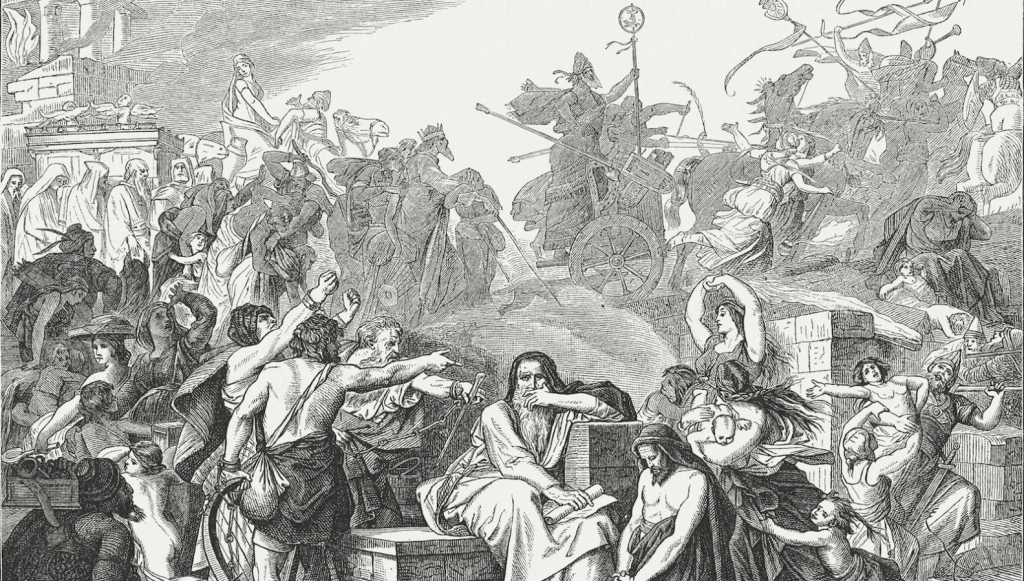
The Babylonian Exile by Jewish-German painter Eduard Bendemann (1811-1889)

In the nineteenth year of Nebuchadnezzar king of Babylon on the seventh day of the fifth month, Nebuzaradan, the king of Babylon’s chief deputy, arrived in Jerusalem. He burned the Temple of God to the ground, went on to the royal palace, and then finished off the city. He burned the whole place down. He put the Babylonian troops he had with him to work knocking down the city walls. Finally, he rounded up everyone left in the city, including those who had earlier deserted to the king of Babylon, and took them off into exile. He left a few poor dirt farmers behind to tend the vineyards and what was left of the fields.

The Babylonians broke up the bronze pillars, the bronze washstands, and the huge bronze basin (the Sea) that were in the Temple of God and hauled the bronze off to Babylon. They also took the various bronze-crafted liturgical accessories, as well as the gold and silver censers and sprinkling bowls, used in the services of Temple worship. The king’s deputy didn’t miss a thing. He took every scrap of precious metal he could find.

The amount of bronze they got from the two pillars, the Sea, the twelve bronze bulls that supported the Sea, and the ten washstands that Solomon had made for the Temple of God was enormous. They couldn’t weigh it all! Each pillar stood twenty-seven feet high with a circumference of eighteen feet. The pillars were hollow, the bronze a little less than an inch thick. Each pillar was topped with an ornate capital of bronze pomegranates and filigree, which added another seven and a half feet to its height. There were ninety-six pomegranates evenly spaced—in all, a hundred pomegranates worked into the filigree.

The king’s deputy took a number of special prisoners: Seraiah the chief priest, Zephaniah the associate priest, three wardens, the chief remaining army officer, seven of the king’s counselors who happened to be in the city, the chief recruiting officer for the army, and sixty men of standing from among the people who were still there. Nebuzaradan the king’s deputy marched them all off to the king of Babylon at Riblah. And there at Riblah, in the land of Hamath, the king of Babylon killed the lot of them in cold blood.

Judah went into exile, orphaned from her land.

3,023 men of Judah were taken into exile by Nebuchadnezzar in the seventh year of his reign.

832 from Jerusalem were taken in the eighteenth year of his reign.

745 men from Judah were taken off by Nebuzaradan, the king’s chief deputy, in Nebuchadnezzar’s twenty-third year.

The total number of exiles was 4,600. (The Message)

The Babylonian Exile by Fahri Aldin, 2017

Eventually, God’s words and decrees happen. It may take minutes. It might take centuries. But it will happen.

God promised destruction. It happened. The temple, the city walls, and the houses of Jerusalem were destroyed.

God decreed deportation of the people. It happened. Thousands of Jews were uprooted and moved to Babylon.

God foretold depression. It happened. The social and economic system of Judah collapsed.

God said there would be an occupation of Gentiles. It happened. The occupying force seized and confiscated the holy temple articles. They violated that which was sacred to Judah.

God repeatedly told the people that there would be a reckoning for the years of social injustice and religious infidelity. It happened. There was not just a deportation of persons; there were waves of removal.

The long prophecy of Jeremiah began with a proclamation of exile. It moved toward that exile. And then, in the end, the exile became reality.

Surely, it must have seemed to the citizens of Jerusalem that the end of the world was at hand. Their very identity as God’s people, as they had understood it for centuries, was now obliterated. Who are they now?

The Jewish exile changed forever their understanding of themselves and of God because they needed to reimagine what being the people of God really means without a place and without a temple.

God is both subject and object of all Holy Scripture, including the book of Jeremiah. Perhaps neglected in all the talk of exile is that the Lord was also cast-off, put away, and exiled. And rather than this being bad news, it becomes the good news that divine presence was right alongside the exiles.

In our darkest times, in the worst of circumstances, when all seems hopeless – there is a God who shows such solidarity with us that he is crucified and put to death so that we might live.

The Lord does not stand afar off from us but is beside us, even within us.

The sheer violation and agony of Good Friday and the depressive silence of Holy Saturday are the means of demonstrating the power of resurrection and new life.

We may be deported, depressed, and destroyed – exiled to a place we do not know and do not want to be. Yet, that is not the end of the story.

Exile is temporary. Mercy is forever. There cannot be a resurrection without a death. There must be suffering before there is glory.

Love wins. Every time.

God is Love. Thus, there is always hope….

Lament Your Losses (Lamentations 3:19-26)

“The Lamentations of Jeremiah,” a woodcut by Julius Schnorr von Carolsfeld (1794-1872)

I remember my affliction and my wandering,
    the bitterness and the gall.
I well remember them,
    and my soul is downcast within me.
Yet this I call to mind
    and therefore I have hope:

Because of the Lord’s great love, we are not consumed,
    for his compassions never fail.
They are new every morning;
    great is your faithfulness.
I say to myself, “The Lord is my portion;
    therefore I will wait for him.”

The Lord is good to those whose hope is in him,
    to the one who seeks him;
it is good to wait quietly
    for the salvation of the Lord. (New International Version)

“Through the prism of my tears I have seen a suffering God. It is said of God that no one can behold his face and live. I always thought this meant that no one could see his splendor and live. But I have come to see that it more likely means that no one can see his sorrow and survive.”

Nicolas Wolterstorff, Lament for a Son

None of us gets off this planet without experiencing terrible grief. It is endemic to the human condition.

Grief attaches itself to any significant change or loss – bereavement, divorce, surgery, losing a job, bankruptcy, and so much more – bring grief to our lives. They are unwanted events we did not ask for. 

The worst response to grief-producing events is to ignore them, minimize them, say they are simply in the past, stuff the feelings down, and just move on.

It’s actually unbiblical to respond that way because Holy Scripture discerns that we need to lament our losses.

Lamentations is an entire book of the Bible given to a single purpose: lamenting a grievous loss.

The prophet Jeremiah was called by God to pronounce judgment against Jerusalem. Not only was Jeremiah commissioned to proclaim an unpopular message, but he was also given a promise that the people would not listen to him. Jerusalem would be destroyed. The people sent into exile. This only compounded Jeremiah’s sadness with complicated grief.

Jeremiah is a melancholy messenger who preached exactly what the Lord wanted him to preach. God’s words came true. The people did not turn from their empty worship and wayward lifestyles. And they persecuted Jeremiah for speaking words of judgment.

The Babylonians came and tore down the walls of Jerusalem, decimated the city and the temple, and carried off the people into exile.

In his terrible grief over the ruined city of Jerusalem, Jeremiah wept and lamented the loss of his hometown and the temple.

It was only after an extended time of grieving that Jeremiah turned his attention toward the love of God. The Lord’s compassions become new every morning. And the renewal will happen without Jerusalem at the center of Jewish life.

Cheap hope tries to circumvent grieving and lamenting of loss. Genuine hope knows the true path of renewal is through the grief, not around it.

There are two popular phrases in Western culture that need to be jettisoned altogether when speaking with people experiencing change or loss. These phrases, at the least, are not helpful; and, at worst, are harmful:

  1. “Get over it!” can short circuit the grief process and puts grieving people in the awkward position of not seeing the power of lament through to its end of acceptance, resolution, and fresh hope. Far too many people in the world, and even the church, remain stuck in some stage of grief, unable to effectively move through it because others expect them to be joyful and victorious; but they really feel downright awful – and now also feel guilty for being sad.
  2. “You have to be strong!” is typically said to people who are in a state of weakness. But they can’t be strong. We would never think of telling someone with broken bones to have the strength to walk or even drive anywhere without assistance. We understand they need to heal. Yet, we tell this to people with broken spirits, and then can’t understand why they don’t just bounce back from their emotional stupor. Broken spirits and broken hearts, like broken bones, need time to heal.

Lament is the pathway to knowing compassion and becoming a compassionate person, like Jesus. Wallpapering over our losses without lamenting them is at the root of many, if not most, emotional problems today. 

“Catastrophic loss by definition precludes recovery.  It will transform us or destroy us, but it will never leave us the same….  I did not get over my loved ones loss; rather I absorbed the loss into my life until it became part of who I am. Sorrow took up permanent residence in my soul and enlarged it.”

Jerry Sittser, A Grace Disguised: How the Soul Grows Through Loss

We all accumulate losses over the course of a lifetime. Many are small losses; some are devastating losses. The death of children, disability, sexual assault, abuse, cancer, infertility, suicide, and betrayal are all examples of crushing loss – losses that need to experience lament. 

All these changes are irreversible; we cannot return to how things once were. We must move through the grief by lamenting each loss. And as we lurch ahead, we cling to the words of Jeremiah. Because of the Lord’s great love, we are not consumed and swallowed whole from grief, for his compassions never fail. They are new every morning. Great is God’s faithfulness.

So, how do we lament our losses in a healthy way?

  1. Remember our afflictions and losses. Avoid superficial responses to significant events. Acknowledge, own, and feel the pain of the loss. This is the path to realizing new life.
  2. Pay attention to faith, hope, and love. This can only be done if we are alert to the grief process. Elizabeth Kubler-Ross identified five stages of grief: denial, anger, bargaining, depression, and resolution or acceptance. We rarely move neatly through each stage. The important thing is that we get to the place of seeing God’s committed love to us, not just in spite of the suffering, but because of it.
  3. Do not minimize your pain and suffering. We must sit with our pain. Do not dismiss your loss by saying others have it worse, or that it’s nothing. Year after year, many Christians do not confront the losses of life, minimizing their failures and disappointments. The result is a profound inability to face pain. And it has led to shallow spirituality and an acute lack of compassion.
  4. Know that Jesus grieved. Messiah is a man of sorrows and acquainted with grief. (Isaiah 53:3) At the tomb of Lazarus, Jesus did not say “Come on everyone, stop all this crying” but wept with the people. (John 11:35) When entering Jerusalem, Jesus did not say “too bad guys, I’m moving on without you” but lamented over the city desiring to gather them as a hen does her chicks. (Luke 13:34) On the cross, Jesus did not say “Lighten up everyone; God is good; he will be victorious!” But instead said, “My God, my God, why have you forsaken me?” (Matthew 27:46) Holy Scripture tells us that Jesus learned obedience from what he suffered. (Hebrews 5:8)

Grief and lament is an indispensable part of a full-orbed spirituality and essential for emotional health.

Life does not always make sense. There is deep mystery to the ways of God. The Lord is doing patient and careful work inside of each one of us. While he is busy within our souls, we will likely feel lost and disconnected, not seeing the full tapestry of what he is creating. Weariness, loneliness, a sense that prayers are not being heard, and a feeling of helplessness are all common experiences of God’s resetting a broken spirit.

John Milton’s classic piece of literature, Paradise Lost, compares the evil of history to a compost pile – a mixture of decaying food, animal manure, dead leaves, and whatever else you put on it. Yet, if you cover the compost with dirt, after a long while it no longer smells. The soil becomes a rich natural fertilizer and is ideal for growing a garden. 

We must be willing to wait, in some cases, years. Milton’s point was that the worst events of history and the evil we experience are compost in God’s overall plan. Out of the greatest wrong ever done, the betrayal, crucifixion, and death of Jesus, came the greatest good – God transformed the stench of evil into good without diminishing the awfulness of that evil.

People who have submitted to grief and lamented their losses are:

  • Patient with others and able to wait on God
  • Kind and compassionate
  • Lack pretense and have no need to impress others
  • Comfortable with mystery and don’t need all the answers
  • Humble, gentle, and meek
  • Able to see God in the mundane, banal, and lowly
  • At home with themselves and with God
  • Equipped to love others as Jesus did

Maybe we are always running, working, and playing because we are constantly trying to keep grief from catching up to us.

Slow down. Let grief catch you. Express lament. Allow grief and lament to do its deep and powerful work within you, to the glory of God. Amen.

Dealing with Grinding Pain (Psalm 79:1-9)

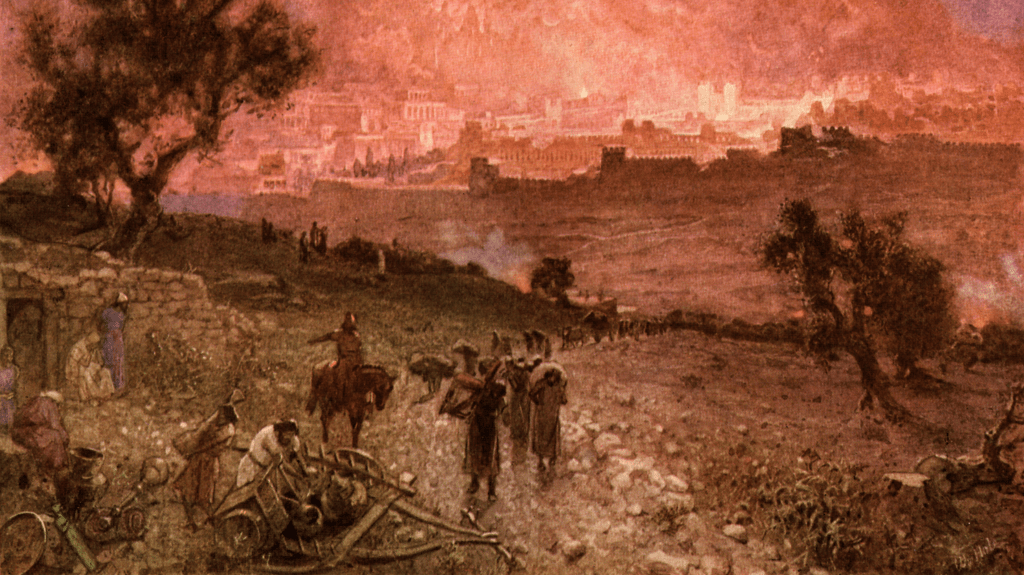
The Babylonian conquest of Jerusalem, by William Hole (1846-1917)

God, nations have come against your chosen people.
    They have ruined your holy Temple.
    They have turned Jerusalem into ruins.
They have given the bodies of your servants as food to the wild birds.
They have given the bodies of those who worship you to the wild animals.
They have spilled blood like water all around Jerusalem.
    No one was left to bury the dead.
We are a joke to the other nations;
    they laugh and make fun of us.

Lord, how long will this last?
    Will you be angry forever?
    How long will your jealousy burn like a fire?
Be angry with the nations that do not know you
    and with the kingdoms that do not honor you.
They have gobbled up the people of Jacob
    and destroyed their land.
Don’t punish us for our past sins.
    Show your mercy to us soon,
    because we are helpless!
God our Savior, help us
    so people will praise you.
Save us and forgive our sins
    so people will honor you. (New Century Version)

I don’t like evil. And I really don’t like arrogant people who want what they want and leave a path of destruction behind them.

The setting behind today’s Psalm is the destruction of the temple. It was razed by a conquering army who proudly gloated over their victory. This psalm, as all psalms, is a prayer. It’s a bitter and angry cry for God to step in and act on behalf of the humiliated people.

The psalm is more than a simple plea for help; it is a deeply passionate appeal. As a child of the 1960’s, my phrase for the psalmist’s entreaty is, “God, stick it to the man!”

There is no polite knock at the side door of God’s house in the face of such evil. This is a pounding on the front door with the demand for God to do something about this terrible trouble. For the psalmist, the incongruence between who God is and what has happened to God’s people is inconceivable and unacceptable.

To profane God’s temple is to profane God; and to kill and maim God’s people is to flip the middle finger at God. The psalmist is beside himself and overwhelmed with emotion.

There is something very instructive here that we ought not miss. When we have been brutalized, victimized, and/or demoralized, we just want someone, especially the Lord we serve, to take notice and feel what we are feeling.

Never underestimate the power of empathy and solidarity. To feel alone and bereft of help is an awful feeling.

Perhaps the psalmist’s prayer offends some sensibilities. I wonder, for those who find the language difficult, have ever had a daughter raped or a house destroyed by fire or seen a person killed without mercy in front of their own eyes. Methinks they have not. The feelings of helpless despair and sheer anger defy human words. These are not casual affronts but malicious destructions of property and people.

We need someone to affirm the raw ruthlessness of it all, to have some understanding of the impossible place we are in with such wanton cruelty. When our very support is ripped from our lives, the madness within is too much to bear.

Who will rescue us from this body of death?

God is big enough to handle our rage and our hurt. The Lord is available and hears our desperate voice of prayer. Yet, God is not always going to directly and immediately answer on the terms we stipulate. God acts out of God’s own providence and justice, and not from our expectations. And that is a good thing, not a bad thing.

God sees, knows, and feels with us. This realization enables us to recenter and reorient ourselves around faith, hope, and love. New life is never a gift in a vacuum; it comes out of agonizing struggle in reckoning with existing evil.

So, when someone goes through a hellish experience, we are to exercise our capacity to listen and witness their horrible spiritual pain. Healing hurts: it is not a pleasant affair. We are to hang in there and walk alongside another in their hour of need, even when their vitriol seems over the top to us.

For only in telling our story to another will any of us find relief and renewed hope.

The psalms permit us to use language appropriate to what has happened to us. They also allow us to move beyond the venom to the God who restores broken lives.

Lord Jesus Christ, by your patience in suffering you hallowed earthly pain and gave us the example of obedience to your Father’ will.

Be near me in my time of weakness and pain; sustain me by your grace, that my strength and courage may not fail; heal me according to you will; and help me always to believe that what happens to me here is of little account if you hold me in eternal life, my Lord and my God.

As the Lord Jesus cried out on the cross, I cry out to you in pain, O God my Creator. Do not forsake me. Grant me relief from this suffering and preserve me in peace, through the power of the Holy Spirit. Amen.

Hebrews 10:32-39 – Don’t Throw Away Your Confidence

Remember those earlier days after you had received the light, when you endured in a great conflict full of suffering. Sometimes you were publicly exposed to insult and persecution; at other times you stood side by side with those who were so treated. You suffered along with those in prison and joyfully accepted the confiscation of your property, because you knew that you yourselves had better and lasting possessions. So, do not throw away your confidence; it will be richly rewarded.

You need to persevere so that when you have done the will of God, you will receive what he has promised. For,

“In just a little while,
    he who is coming will come
    and will not delay.”

And,

“But my righteous one will live by faith.
    And I take no pleasure
    in the one who shrinks back.”

But we do not belong to those who shrink back and are destroyed, but to those who have faith and are saved. (New International Version)

Confidence is necessary for the Christian life. It’s not optional. One can only persevere through trouble with some confident hope.

It’s one thing to bear up under a hard circumstance for a few days or weeks. It’s altogether another thing for that same hardship to continue for months, even years.

Living with such adversity everyday makes one tired… really tired. Feelings of hopelessness slowly creep within. And, after a while, the person or group of people just want the madness to end. So, they simply give up, being lost in their troubles, feeling alone and bereft of options.

Without the confident expectation of better days ahead, while in the throes of difficulty, a failure of faith can too easily happen.

To realize better days, it’s important to remember the earlier days. I’m not talking about living in the past and wishing it were the 1950s again with Beaver Cleaver across the street. This is not about believing that the past was the good old days, and that the present is bad.

Instead, we can recall and remember the ways we endured and persevered with joy in past experiences.

The original Christian recipients of the message of Hebrews needed to recall the various ways they stood firm and tall in their faith, despite the adversity.

In earlier times, they were insulted and persecuted. Yet, they showed solidarity with others in similar situations. The believers were attentive to prisoners and sought to meet their needs. And they responded to the confiscation of their property with joy because they knew there was so much more than this present life and it’s possessions.

But the persecution and the insults continued… day after day… with no apparent end….

The Christians began to lose their grip on faith. They needed to reconnect with their purpose, with why they were Christians to begin with.

Originally, the reason they had such incredible attitudes while enduring hard things is because they were pursuing heavenly treasure. Their earthly possessions were merely temporary things, not of eternal value. They understood that people have eternal value, not stuff, so the believers willingly focused their efforts in helping others.

However, over time, the band of believers lost their focus. All they could see was the pain and the difficulty. They became disconnected with their purpose. And so, they were in danger of losing their faith and becoming utterly hopeless.

What to do? Give up? Renege on faith? Adopt a “whatever will be, will be,” sort of philosophy?

No. Instead,

Remember what God has done for you.

Affirm what is right, just, and true.

Embrace faith and patience.

That’s what the prophet Habakkuk did. And his resilience helped to bring proper perspective to present troubles.

“Nothing that is worth doing can be achieved in a lifetime; therefore, we must be saved by hope.”

Reinhold Niebuhr (1892-1971)

Habakkuk was distressed over the corruption of his fellow Israelites. Things were askew and not right. So, he complained to God about it. 

God responded by informing Habakkuk that judgment was coming to Israel through the Babylonians. This was neither what Habakkuk expected nor wanted. The prophet grumbled even more because the Babylonians were more corrupt than the Israelites. 

The prophet was having a hard time, and it seemed God was only making things worse, not better.

Habakkuk struggled to come to terms with what God was doing, and not doing. Finally, he concluded the matter by reconnecting with his faith: 

Even though the fig trees have no blossoms,
    and there are no grapes on the vines;
even though the olive crop fails,
    and the fields lie empty and barren;
even though the flocks die in the fields,
    and the cattle barns are empty,
yet I will rejoice in the Lord!
    I will be joyful in the God of my salvation!
The Sovereign Lord is my strength!
    He makes me as surefooted as a deer,
    able to tread upon the heights. (Habakkuk 3:17-19, NLT)

Perhaps the most significant faith experience we can have, is to come to the point of complete trust in God so that our happiness is not dependent upon good circumstances. 

The truth we all must eventually come around to is that joy and security is independent of what’s going on around us. 

Even though we face difficulty, and even evil, confidence can still exist and thrive within us. We can still rejoice because we don’t need everything to go our way in order to be happy.

Faith, patience, and joy are neither cheap, nor easy. For them to remain rooted within us, we must affirm our commitment to Christ daily. And that requires remembering.

What’s more, there is a reward ahead if we persevere to the end.

We can remain patient, express faith, kindle hope, and remember necessary things whenever we stop doing unimportant things which do not add value to our ultimate goals.

So, be mindful of the things which are most important to you; and move through life at a pace of hope, not anxiety. Don’t throw away your spiritual confidence, just because things are continually hard.

God, give us grace to accept with serenity
the things that cannot be changed,
Courage to change the things
which should be changed,
and the Wisdom to distinguish
the one from the other.

Living one day at a time,
Enjoying one moment at a time,
Accepting hardship as a pathway to peace,
Taking, as Jesus did,
This sinful world as it is,
Not as I would have it,
Trusting that You will make all things right,
If I surrender to Your will,
So that I may be reasonably happy in this life,
And supremely happy with You forever in the next.

Amen. – The Serenity Prayer by Reinhold Niebuhr