
Take the Long View (Genesis 49:1-33)

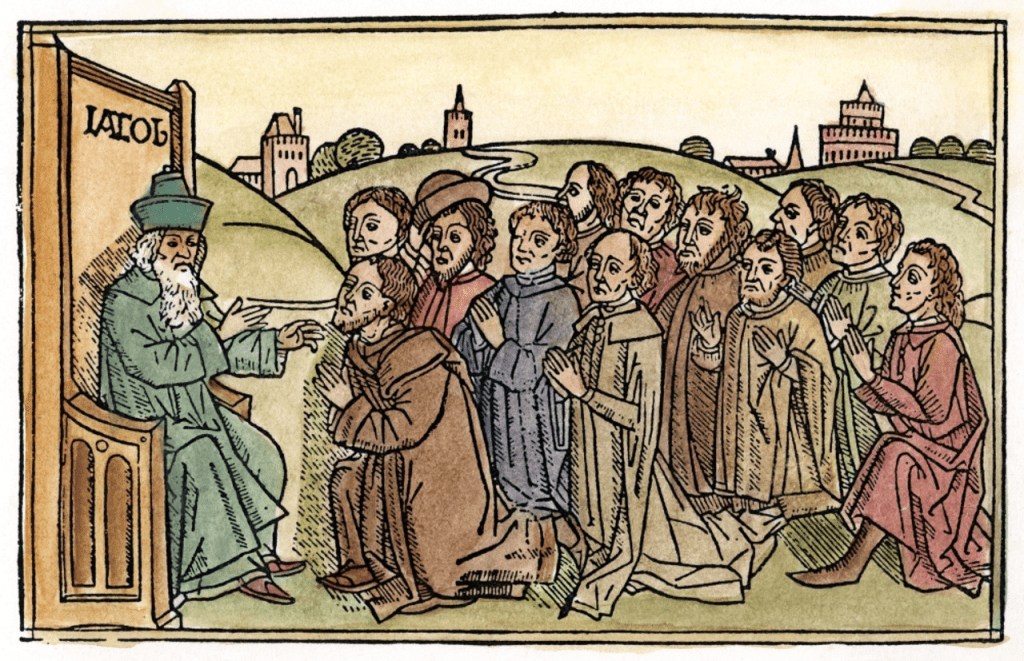
Jacob blesses his twelve sons, a woodcut from the Cologne Bible, c.1479

Then Jacob called together all his sons and said, “Gather around me, and I will tell you what will happen to each of you in the days to come.

“Come and listen, you sons of Jacob;
    listen to Israel, your father.

“Reuben, you are my firstborn, my strength,
    the child of my vigorous youth.
    You are first in rank and first in power.
But you are as unruly as a flood,
    and you will be first no longer.
For you went to bed with my wife;
    you defiled my marriage couch.

“Simeon and Levi are two of a kind;
    their weapons are instruments of violence.
May I never join in their meetings;
    may I never be a party to their plans.
For in their anger they murdered men,
    and they crippled oxen just for sport.
A curse on their anger, for it is fierce;
    a curse on their wrath, for it is cruel.
I will scatter them among the descendants of Jacob;
    I will disperse them throughout Israel.

“Judah, your brothers will praise you.
    You will grasp your enemies by the neck.
    All your relatives will bow before you.
Judah, my son, is a young lion
    that has finished eating its prey.
Like a lion he crouches and lies down;
    like a lioness—who dares to rouse him?
The scepter will not depart from Judah,
    nor the ruler’s staff from his descendants,
until the coming of the one to whom it belongs,
    the one whom all nations will honor.
He ties his foal to a grapevine,
    the colt of his donkey to a choice vine.
He washes his clothes in wine,
    his robes in the blood of grapes.
His eyes are darker than wine,
    and his teeth are whiter than milk.

“Zebulun will settle by the seashore
    and will be a harbor for ships;
    his borders will extend to Sidon.

“Issachar is a sturdy donkey,
    resting between two saddle packs.
When he sees how good the countryside is
    and how pleasant the land,
he will bend his shoulder to the load
    and submit himself to hard labor.

“Dan will govern his people,
    like any other tribe in Israel.
Dan will be a snake beside the road,
    a poisonous viper along the path
that bites the horse’s hooves
    so its rider is thrown off.
I trust in you for salvation, O Lord!

“Gad will be attacked by marauding bands,
    but he will attack them when they retreat.

“Asher will dine on rich foods
    and produce food fit for kings.

“Naphtali is a doe set free
    that bears beautiful fawns.

“Joseph is the foal of a wild donkey,
    the foal of a wild donkey at a spring—
    one of the wild donkeys on the ridge.
Archers attacked him savagely;
    they shot at him and harassed him.
But his bow remained taut,
    and his arms were strengthened
by the hands of the Mighty One of Jacob,
    by the Shepherd, the Rock of Israel.
May the God of your father help you;
    may the Almighty bless you
with the blessings of the heavens above,
    and blessings of the watery depths below,
    and blessings of the breasts and womb.
May my fatherly blessings on you
    surpass the blessings of my ancestors,
    reaching to the heights of the eternal hills.
May these blessings rest on the head of Joseph,
    who is a prince among his brothers.

“Benjamin is a ravenous wolf,
    devouring his enemies in the morning
    and dividing his plunder in the evening.”

These are the twelve tribes of Israel, and this is what their father said as he told his sons good-bye. He blessed each one with an appropriate message.

Then Jacob instructed them, “Soon I will die and join my ancestors. Bury me with my father and grandfather in the cave in the field of Ephron the Hittite. This is the cave in the field of Machpelah, near Mamre in Canaan, that Abraham bought from Ephron the Hittite as a permanent burial site. There Abraham and his wife Sarah are buried. There Isaac and his wife, Rebekah, are buried. And there I buried Leah. It is the plot of land and the cave that my grandfather Abraham bought from the Hittites.”

When Jacob had finished this charge to his sons, he drew his feet into the bed, breathed his last, and joined his ancestors in death. (New Living Translation)

The theme of confidence works its way through the patriarch Jacob’s deathbed prophecies and blessings – a resolute conviction in the promises of God, that he will accomplish what he said he would do.

Jacob expressed the hope and sure belief that God would bring the Israelites out of Egypt and into the land of Canaan as their inheritance – and, ultimately to the City of God, the eternal inheritance.

The Christian will find much in Judah’s blessing as the promise of the coming Christ, Jesus. Mentioning the implements of “staff” and “scepter” are symbols of authority. And, the reference to a donkey communicated a ruler was coming, as donkeys were the preferred mounts of royalty in ancient times.

What’s more, the washing of garments in wine, and eyes darker than wine, are allusions to the future blessing and abundance there will be through the tribe of Judah. In fact, the first miracle of Jesus was turning water into wine – a deliberate attempt by the Apostle John to connect Jesus with Old Testament messianic prophecies of abundance and blessing. (John 2:1-12)

It’s necessary to take a long view of life, keeping in mind that it took eighteen centuries for Jacob’s prophecy of Judah to occur. This long view is what gives us our confidence in life and provides the patience and perseverance we need right now. 

Keeping in mind the big picture of God’s work in this world is important, because if we do not, we will likely become discouraged with the circumstances we face right now.

The reason Jacob makes it into the great Hall of Faith in the New Testament book of Hebrews is not because he was squeaky clean and perfect in how he lived his life, but because he took the long view, the big picture, and saw that God was going to fulfill his promises to Israel:

By an act of faith, Jacob on his deathbed blessed each of Joseph’s sons in turn, blessing them with God’s blessing, not his own—as he bowed worshipfully upon his staff. (Hebrews 11:21, MSG)

Furthermore, when we string the following three verses together across both Testaments, we see the long view of God’s purposes:

It is true that you planned to do something bad to me. But really, God was planning good things. God’s plan was to use me to save the lives of many people. And that is what happened. (Genesis 50:20, ERV)

For I know the plans I have for you,” declares the Lord, “plans to prosper you and not to harm you, plans to give you hope and a future. (Jeremiah 29:11, NIV)       

And we know that all things work together for good to those who love God, to those who are the called according to his purpose. (Romans 8:28, NKJV)

In the Christian faith tradition, all God’s promises come together and are fulfilled in the person and work of Jesus. Christ is our salvation, our inheritance, and our hope. To give our lives to him in complete trust of faith is both our challenge and our privilege.

So, may you and I live by faith, and not by fear.

Be present, O merciful God, and protect us through these anxious times, so that we who are wearied by the changes of this life may rest in your eternal steadiness. Keep watch, dear God, with those who work, or watch, or weep this night, and give your angels charge over those who sleep. Tend the sick, Lord Christ; give rest to the weary, bless the dying, soothe the suffering, pity the afflicted, shield the joyous; and all for your love’s sake. Amen.

All Who Come and Touch are Made Well (Matthew 14:34-36)

They crossed the lake and came to land at Gennesaret, where the people recognized Jesus. So they sent for the sick people in all the surrounding country and brought them to Jesus. They begged him to let the sick at least touch the edge of his cloak; and all who touched it were made well. (Good News Translation)

Jesus showed up. That’s all it took. The very presence of Christ emboldened people to act. And these were not just the religious folk. They were on the other side of the lake – which for us means the other side of the tracks. In other words, the people of Gennesaret were poor and needy with lots of sick persons, as well as spiritually pagan.

This wasn’t a place that pious people visited. It was far from being a destination vacation spot. But it was just the sort of place that Jesus would visit. It was for people like those at Gennesaret that Christ came.

Jesus Recognized

In the previous story of the disciples on the lake during a storm, Jesus walked out on the water to them. When they saw him, they didn’t recognize him. But here, in today’s story, a bunch of people who weren’t following Jesus around, knew who he was straightaway.

One of the great ironies of the New Testament Gospels is that Jesus often got a cool reception of unbelief amongst the religious insiders in his own homeland, while tending to receive faith from spiritual outsiders in heathen places. Christ initiated a seismic shift and a great transfer of replacing the insiders with the outsiders. This sort of activity was so spiritually scandalous and cataclysmic that it eventually got Jesus killed.

“Many who are first will be last, and many who are last will be first.”

Jesus (Matthew 19:30, NIV)

People Respond

The people of Gennesaret demonstrated their faith by acting on the sight of Jesus amongst them. They sent others out into the surrounding countryside to let them know that Jesus was here. That was all it took for the rural folk to not only come but to bring all their sick friends and family with them. Belief abounded, that this man, Jesus, could do the impossible work of curing and healing.

And this is precisely the sort of mentality and heart attitude Jesus was looking for. In telling his parable of the soils, Christ wanted the response of the fourth soil: To not only hear and acknowledge, but to also take the words and ways of God into one’s life in such a way that growth and development happens, fruit matures, and a harvest of righteousness, justice, and peace occurs.

“The seed falling on good soil refers to someone who hears the word and understands it. This is the one who produces a crop, yielding a hundred, sixty or thirty times what was sown.” (Matthew 13:23, NIV)

Jesus Makes All the People Well

The most “touching” thing to me in this short account of Christ encountering the people of Gennesaret is that every single person who came to Jesus was made well, without exception.

Such was the faith of the people, that they neither needed nor expected Jesus to come and lay his hands on them or to even say anything. They simply believed that if they could but touch the fringe of his cloak, healing and wellness would happen.

And the people weren’t just seeking their own betterment, but were concerned for everyone they knew who needed help. Whether there was superstition mingled with the faith is really of no concern; just a smidgeon of faith in Jesus is potent and powerful enough to effect a complete makeover of a person.

Moreover, there wasn’t simply individual and isolated instances of wholeness and healing; there was a mass level miracle, a giant group touch of healing and health.

Jesus welcomed them all, and allowed all the people to touch. Most of us don’t want a bunch of strangers touching us or our clothes, at all. That’s too weird and creepy, and likely makes us uncomfortable. What’s more, no respectable person would ever think of touching a rabbi – especially women. That sort of thing was religiously and culturally unacceptable.

Another irony we see is that the crossing of purity boundaries and laws which made people ritually impure is turned on it’s head. Instead, this kind of activity of people touching Christ made the impure folks pure. As something of a rule-breaker at heart, I find this reality refreshing. We need a lot more of it.

Jesus and People Today

Today’s Gospel lesson might seem a nice story that happened a very long time ago. We may also believe it doesn’t have much to do with me today. After all, Jesus isn’t bodily roaming the countryside today. We don’t see mass healings of people. In some places, we rarely see any healing at all from a direct result of faith. So, why even talk about this? Why bring it up? Do you just want to get my hopes up, only to dash them? Isn’t all this stuff pie-in-the-sky thinking, anyway?

Those are legitimate questions and concerns. And we ought not to disparage or make light of anyone asking them. All of us have likely encountered reaching out in faith without any healing or change of circumstance. Rather than going to one of two extremes, by either berating ourselves for a supposed failure of faith, or of discounting God altogether as a figment of the unenlightened mind, we can take a different approach.

The very nature of faith is contact, connection, and care. Faith is up close, relational, and involves touch. Faith is free, yet it is not cheap. Faith always involves a cost: vulnerability and intimacy. If we ever look for faith from afar and have no intention of getting up close and personal – so close as to touch the hem of a garment – then that which we seek will forever be elusive to us.

I’m not talking about a process or a plan that you can predictably access to get the result you want. Rather, I’m referring to real human contact and relationship that can only happen with being open about needs and wants, and is willing to expose one’s inner person to the outside world. I’m talking about putting away the false front we put up for others to see, and let the true self come out. Yes, it’s risky. Yes, it most likely will hurt. And yes, it will lead to healing.

When a person goes to a doctor for a pain they cannot get rid of, and get a diagnosis of needing surgery to deal with the hurt, we willingly allow the surgeon to create more pain for us by cutting into our body. We allow it because we understand that more pain leads to less pain.

And the same is true for our soul. Our broken hearts, our damaged emotions, our racing thoughts, and our hurting spirits need to experience the invisible scalpel of God. Divine intervention is often unpleasant – at least at first – but then later results in wellness for all who invite it’s touch.

May you come with vulnerable faith, confident hope, and active love, to the One who can help you realize your most intimate longings. Amen.

Divine Providence (Genesis 30:37-43)

Jacob with Laban’s flock, by Jusepe de Ribera, 1632

Then Jacob took some fresh branches from poplar, almond, and plane trees and peeled off strips of bark, making white streaks on them. Then he placed these peeled branches in the watering troughs where the flocks came to drink, for that was where they mated. And when they mated in front of the white-streaked branches, they gave birth to young that were streaked, speckled, and spotted. Jacob separated those lambs from Laban’s flock. And at mating time he turned the flock to face Laban’s animals that were streaked or black. This is how he built his own flock instead of increasing Laban’s.

Whenever the stronger females were ready to mate, Jacob would place the peeled branches in the watering troughs in front of them. Then they would mate in front of the branches. But he didn’t do this with the weaker ones, so the weaker lambs belonged to Laban, and the stronger ones were Jacob’s. As a result, Jacob became very wealthy, with large flocks of sheep and goats, female and male servants, and many camels and donkeys. (New Living Translation)

Jacob had been working for his father-in-law Laban for years. During that time, they both contested with each other in a chess match of trying to gain the upper hand. Mostly, Jacob had been outmaneuvered by Laban. But now he achieves a sort of coup de grace, a checkmate.

Having agreed between them that Jacob’s wages would be only the speckled and spotted sheep and goats, as well as every black lamb, Laban proceeded to remove all those animals from his flock and sent them off away from Jacob. This was yet another unfair practice in the chess game of his life.

Even if Jacob wanted to retaliate, he really had no means to do it – which is why Laban kept taking advantage of him. But Laban underestimated who he was playing against and dealing with.

Using an unusual method, something akin to sympathetic magic – a ritual using an object that resembles the sheep over which Jacob sought influence – he systematically grew his own flock of many strong sheep and goats. Jacob then separated these stronger animals from Laban’s flock. In doing this, Jacob became exceedingly wealthy.

It’s an incredible story, almost like achieving the modern day American dream of rags to riches in the face of adversity. Yet, behind all the success of Jacob, we as the readers know that this happens because God is working out divine promises to the family of Abraham, Isaac, and now Jacob.

The power, sovereignty, providence, and grace of God stand behind every good thing people have in this life. The Lord is the One who is not flummoxed by the impending moves in the chess game; God has the ability to rearrange the chess board, reorder the future, and make restoration possible.

Although separated by more than three millennia from the family of Jacob, we can relate to the ever-present human condition, the personal struggles of overcoming the past, and the wonderings of what will happen in the future.

In whatever way we want the future to shake-out, it ultimately is in the hands of God. We would like to live in a universally closed system where there is predictability with no trickery, posturing, manipulating, or anxiety about what’s next. Many people long for a life free from an uncertain and shadowy future.

But none of us can have the precise future we may wish for. So, some people despair that we are in a closed system in which nothing can change – that systemic evil, broken institutions, fragmented families, and wounded spirits are just the way it is.

There are lots of folks who continually feel the awkward push and pull of both hope and dread – wanting to believe that things can be better, but having a sinking sense that the other shoe is about to drop.

In truth, we do not live in a closed universal system; history is not yet finalized and the Lord has a few tricks up the divine sleeve. We actually live in an open system, where we can find both surety and hope. The future, although appearing bleak for some, shall be shaped and bent by God according to divine promises and good purposes.

And when we take the time to observe this grand open system, we begin to discern that no scheming of humanity nor any human machinations can do anything more than slightly delay the inevitable Day of the Lord. Justice will have its day, and it’s way on this earth; injustice shall not last forever.

In the meantime, we do the best we can with the resources we have, at this present moment. Today is all we have. God’s gracious provision for this day is enough. Tomorrow has enough worries of its own.

An open system says that there is a spiritual force outside of social interaction. A a closed system says there is no outside force influencing our actions and outcomes.

In a closed system, we have the illusion (and delusion) that control is possible because the number of variables remains static. People in this system long for simplicity and sameness – to be able to predict what will happen next. So, they focus on structures and processes that sustain control over organizations and people.

But in an open system, dynamics from other systems impact us, creating and expanding the number of variables. It’s a complex and fluid situation, but folks learn to focus on influence rather than control, knowing there are forces at play which impact the chessboard. That’s because ultimate control belongs to God; we, as people, are called to self-control.

Almighty God, Creator and Sustainer of all things: You uphold, direct, and govern all creatures, actions and objects, from the least to the greatest. Nothing escapes your sovereign and benevolent rule—not the most powerful institution or ruler imaginable, nor the least significant speck just biding its time. You sustain all things by your powerful word.

Help me to see your hand in my life specifically and in history worldwide. Although there is much that remains a mystery in your providence, there is much that is already revealed. Your providence reveals your infinite wisdom, power, justice, goodness, and mercy. To you be all glory and praise, through Jesus Christ our Lord, who with you and the Holy Spirit are one God, now and forever. Amen.

Endure Patiently to the End (Revelation 14:12-20)

God’s holy people must endure persecution patiently, obeying his commands and maintaining their faith in Jesus.

And I heard a voice from heaven saying, “Write this down: Blessed are those who die in the Lord from now on. Yes, says the Spirit, they are blessed indeed, for they will rest from their hard work; for their good deeds follow them!”

Then I saw a white cloud, and seated on the cloud was someone like the Son of Man. He had a gold crown on his head and a sharp sickle in his hand.

Then another angel came from the Temple and shouted to the one sitting on the cloud, “Swing the sickle, for the time of harvest has come; the crop on earth is ripe.” So the one sitting on the cloud swung his sickle over the earth, and the whole earth was harvested.

After that, another angel came from the Temple in heaven, and he also had a sharp sickle. Then another angel, who had power to destroy with fire, came from the altar. He shouted to the angel with the sharp sickle, “Swing your sickle now to gather the clusters of grapes from the vines of the earth, for they are ripe for judgment.” So the angel swung his sickle over the earth and loaded the grapes into the great winepress of God’s wrath. The grapes were trampled in the winepress outside the city, and blood flowed from the winepress in a stream about 180 miles long and as high as a horse’s bridle. (New Living Translation)

The Scripture meditations I offer each day are based in the daily readings of the Revised Common Lectionary. The readings are designed to move us through the whole of the Bible in a three year cycle. And they are arranged so that Thursday, Friday, and Saturday readings anticipate the Sunday scriptures, and the Monday, Tuesday, and Wednesday readings reflect on Sunday’s texts. Today’s New Testament lesson is such a reflection on Sunday’s Gospel reading of Christ’s Parable of the Weeds (Parable of the Wheat and Tares).

Jesus made it clear in the parable that it is not our job to weed out evil. This will be done by the angels at the end of the age. In Revelation, we look forward into the future as to what happens with the plants and the weeds. As you can readily see, it is a grim picture. Those who are visual learners, and picture the words in their minds, their stomachs might be turning after the reading of today’s text.

The entire book of Revelation was originally meant to encourage believers in Jesus to persevere, endure, and keep going in their commitment to Christ. As they were undergoing difficulty and even persecution for their faith, this apocalyptic vision of the Apostle John was to instill hope: It will not always be this way.

There is a time coming soon in which the problem of evil is taken care of, once and for all. Until that final day of judgment comes, we are to hold fast to our faith, and continue to keep the commandments of Christ.

The wrath of God has always been an issue with various people throughout history. In contemporary theology, it is common to have groups of folks polarized between either making God out to be constantly angry and looking to zap people; or dismissing God’s wrath altogether as some outdated and antiquated idea. Neither of these approaches will do.

God’s anger and wrath exist, yet is never divorced from God’s love. Rather than viewing wrath and love as two sides of the same coin, I believe a healthier and more biblical understanding is to discern God’s wrath as an expression of God’s love. I will explain….

When God bends to observe us in the world and sees injustice, war, poverty, oppression, trauma, and abuse from narcissistic people who exalt themselves above others and use them for selfish purposes, God is not okay with this!

Whenever God looks at the world and sees governments, institutions, corporations, and even churches which maintain structures that keep others from becoming all that God intends for them to become, divine compassion is stirred up, along with a determination to bring about justice and righteousness.

Only God has the combination of willingness, power, and ability to handle the evil of this world, in a way which is both just and loving.

I realize there are many times when we wonder if God is really watching, or not, and are curious if the Lord is aloof and uncaring to our plight. There is a day when the dramatic will happen, but that day is not today. For now, God is patiently and carefully working divine love into the fabric of this world, in such a way that it will not destroy the innocent and compromise the integrity of the righteous.

Until the time is ripe for God to act in a more decisive manner by equipping angels with scythes and bringing in the final harvest, we experience pain and hurt.

We sometimes are misjudged and misunderstood by others. We often get shafted by systems which are supposed to be helping us. We can, however, be assured that God is working behind the scenes, planting seeds of love and grace. The Lord is pastorally tending to our growth, till the time is right to gather the abundant crop.

Acting too soon, and going off half-cocked without enough information, is what we humans tend to do. Not so with God.

The fact of the matter is: Justice and injustice will co-exist side-by-side for a while. Righteousness and evil will be found together everywhere we go, including our own hearts – holding both our altruistic motives and our evil inclinations.

Sisters and brothers, let us endure, persevere, and be patient. God is good, and will not forget your deeds done in faith; your actions inspired by hope; and your work animated by love.

Lord Christ, you came into the world as one of us, and suffered as we do. As I go through the trials of life, help me to realize that you are with me at all times and in all things; that I have no secrets from you; and that your loving grace enfolds me for eternity. In the security of your embrace I pray. Amen.