The Gospel Is For Everyone (Acts 11:1-18)

The Preaching of St. Peter In Jerusalem, by Charles Poërson, 1642

The apostles and the believers throughout Judea heard that the Gentiles also had received the word of God. So when Peter went up to Jerusalem, the circumcised believers criticized him and said, “You went into the house of uncircumcised men and ate with them.”

Starting from the beginning, Peter told them the whole story:“I was in the city of Joppa praying, and in a trance I saw a vision. I saw something like a large sheet being let down from heaven by its four corners, and it came down to where I was. I looked into it and saw four-footed animals of the earth, wild beasts, reptiles and birds. Then I heard a voice telling me, ‘Get up, Peter. Kill and eat.’

“I replied, ‘Surely not, Lord! Nothing impure or unclean has ever entered my mouth.’

“The voice spoke from heaven a second time, ‘Do not call anything impure that God has made clean.’ This happened three times, and then it was all pulled up to heaven again.

“Right then three men who had been sent to me from Caesarea stopped at the house where I was staying. The Spirit told me to have no hesitation about going with them. These six brothers also went with me, and we entered the man’s house. He told us how he had seen an angel appear in his house and say, ‘Send to Joppa for Simon who is called Peter. He will bring you a message through which you and all your household will be saved.’

“As I began to speak, the Holy Spirit came on them as he had come on us at the beginning. Then I remembered what the Lord had said: ‘John baptized with water, but you will be baptized with the Holy Spirit.’ So if God gave them the same gift he gave us who believed in the Lord Jesus Christ, who was I to think that I could stand in God’s way?”

When they heard this, they had no further objections and praised God, saying, “So then, even to Gentiles God has granted repentance that leads to life.” (New International Version)

In this Advent season, the Revised Common Lectionary Daily Readings for Year C direct us toward the good news that Christ’s incarnation is not only for Jewish people; it is also for everyone.

But Peter needed some remedial teaching about this gospel. He had to get the reality that God grants repentance leading to new life for Gentiles, firmly into his Jewish head and heart.

The first advent of Jesus Christ – his incarnation as the God-Man on this earth – was meant for the world, and not exclusively for the Jewish people. Sometimes, however, it takes a vision or a dream to really get the message across.

And God is gracious to do whatever it takes in order to gain our attention and bring us to a point of changing our minds about things we are in error about.

The Gospel is for everyone.

The Gospel is Jews and Gentiles. The Gospel is for you and for me. It’s for your grumpy neighbor and your crazy uncle. It’s for that obnoxious co-worker and the persnickety church lady. It’s for the Grinches and Scrooges of this world, as well as for the already convinced.

Yes, indeed, the good news of Jesus Christ is for everyone, without exception.

I do so hope that you don’t have to learn that truth the hard way. I do rather hope that you have a wonderful experience of discovering a Cornelius of whom you had no idea even existed, until the mercy of God led you otherwise.

It is my prayer that you have (or will have) a story to tell, much like Peter’s, in which you found that the grace of God has no limits, that there is plenty of Christ to go around for everyone.

There is no need to stand in God’s way, because no one can stop God’s grace. When the mercy of God starts moving, it becomes a giant snowball gaining speed and strength and size going downhill. And when it hits, you’re going to feel it!

Grace overcomes and overwhelms everything. 

One of the most scandalous truths of Christianity is that God graces common ordinary people who seem as dead as a bowling ball with the Holy Spirit and gives them life. 

The Apostle Peter had to learn this with some difficulty, but he embraced the work of God among the non-Jewish Gentiles. “The Holy Spirit fell on them just as on us at the beginning” was Peter’s plain account and confession of the reality that God grants repentance that leads to life for all kinds of people no matter what their race, ethnicity, gender, class, or background. 

It is a wondrous and astounding spiritual truth that God’s gracious concern is not limited to a certain type of person.

Along with Peter and the other believers so long ago, let us rejoice in the work of God that brings deliverance and transformation. 

Grace is and ought to be the guiding factor in how we interact with people. 

Losing sight of grace leads to being critical and defensive. Whereas, embracing grace leads to the humility of seeing the image of God in people very different from ourselves. 

Grace tears down barriers and causes us to do away with unnecessary distinctions between others. Our appropriate response to such a grace is to glorify God for his marvelous and amazing work. 

The Gospel is not only a gift to receive; it is also a wonderful gift to give.

Gracious God, just as you brought deliverance and salvation that leads to life for people from ancient times, and gifted them with your Holy Spirit, so today continue your mighty work of transformation in the hearts of people that I share the good news of Jesus with. Amen.

What Should We Do? (Acts 2:37-42)

Apostle Peter Preaching, by Lorenzo Veneziano, c.1370

When the crowd heard this, they were deeply troubled. They said to Peter and the other apostles, “Brothers, what should we do?”

Peter replied, “Change your hearts and lives. Each of you must be baptized in the name of Jesus Christ for the forgiveness of your sins. Then you will receive the gift of the Holy Spirit. This promise is for you, your children, and for all who are far away—as many as the Lord our God invites.” With many other words he testified to them and encouraged them, saying, “Be saved from this perverse generation.” Those who accepted Peter’s message were baptized. God brought about three thousand people into the community on that day.

The believers devoted themselves to the apostles’ teaching, to the community, to their shared meals, and to their prayers. (Common English Bible)

The Apostle Peter, follower of Jesus, had a fire in his belly and fresh wind in his lungs.

Pentecost will do that to a person.

The promised Holy Spirit came – the Spirit of fire and wind – and the result was an impassioned, reasoned, and convicting message from Peter.

The crowd of people listening to Peter understood clearly that he was saying the person and work of Jesus was the activity of God.

And Christ was killed because of his presence and ministry. But three days later, he was raised from death. And then, ascended to heaven, promising the Spirit’s continual involvement.

The people listening to Peter were cut to the heart, convicted in the depths of their soul, and beside themselves as to their culpability in Christ’s situation. They cried out to Peter and asked him what they should do, how they could possibly be a part of what God is doing in the world.

Peter’s response to the crowd was to change – to repent and be baptized, receiving the gift of the Holy Spirit. The Apostle was telling them to turn away from the old way, and turn toward the new coming kingdom of God.

Baptism assures people that God has received their repentance, and has forgiven them. It initiates the believer into the new community of the redeemed, the church.

This was not only for Jewish people, but also for Gentiles; and for everyone, both far and near.

Celebration, by John August Swanson (1938-2021)

The four qualities which characterized the earliest church were these:

  1. The new community followed apostolic teaching (the story of Jesus)
  2. The church continually engaged in fellowship (mutual encouragement and working together in unity)
  3. The believers broke bread together (kept meeting together in shared meals to remember the person and work of Jesus)
  4. They prayed (as the Lord had taught them to pray – for God’s gracious and benevolent kingdom to come, and God’s ethical and moral will to be done, right now on this earth, as it is always done in God’s heaven)

For those who are established in the faith of Christianity, all of this material raises several questions to reflect upon in how our life together as Christians is going:

How do Christians understand the word “repentance?”

Because this determines a great deal of how we live as believers. If we discern repentance as following the rules – both written and unwritten – then we are likely behaving more in the old ways that the earliest believers were to repent of.

But if we see repentance as a way of life, of continually offering prayers of confession to God, and seeking to align our life with the words and ways of Jesus, then we are living more into the spirit of Peter’s original exhortation to the people.

Is the Church living as the baptized community of the redeemed?

Again, how do we understand the word “baptism?” If baptism is nothing more than a personal decision to outwardly show one’s faith, then we have severely truncated Peter’s meaning of the word.

Baptism is the outward sign that we belong to God. And belonging to God is something God does, not us.

One good way of understanding the whole of the Christian life is that we are to ‘live into our baptism,’ that is, we are to daily live our lives cognizant that our life is not our own.

We belong to God. Long before we happened to choose God, God chose us. And we must always remember that.

Are believers in Jesus living in the Spirit?

The Spirit has been given as the continuing presence of Jesus on this earth. The Spirit reminds us of Christ’s words and ways, his person and work. To live in the Spirit is to be continually reminded that what is important to Jesus, needs to be important to us.

“You’re blessed when you’re at the end of your rope. With less of you there is more of God and his rule.

“You’re blessed when you feel you’ve lost what is most dear to you. Only then can you be embraced by the One most dear to you.

“You’re blessed when you’re content with just who you are—no more, no less. That’s the moment you find yourselves proud owners of everything that can’t be bought.

“You’re blessed when you’ve worked up a good appetite for God. He’s food and drink in the best meal you’ll ever eat.

“You’re blessed when you care. At the moment of being ‘care-full,’ you find yourselves cared for.

“You’re blessed when you get your inside world—your mind and heart—put right. Then you can see God in the outside world.

“You’re blessed when you can show people how to cooperate instead of competing or fighting. That’s when you discover who you really are, and your place in God’s family.

“You’re blessed when your commitment to God provokes persecution. The persecution drives you even deeper into God’s kingdom. (Matthew 5:3-10, MSG)

Are individual Christians and the Church communicating the promise to those who are far away? In other words, are we seeking to include others in the community?

Too many churches are closed groups who have a lot of extraneous rules and ancillary beliefs in order to truly be a part of their local church.

This does not mean we are to have no rules or guidelines or any teaching about our particular Christian tradition. However, it does mean that make sure we are proclaiming good news (which is what the word “gospel” means) because the gospel is radically inclusive, not exclusive.

Therefore, to have a community of people who genuinely love one another by spiritually changing and growing, serving and helping, sharing and encouraging, praying and opening up, is to have a group of redeemed persons who give a compelling proclamation of good news through both their gracious words and their loving actions.

If we have little Christ’s walking about this world and living according to his words and ways, and being full of the Spirit, then we give other people a big reason for faith, hope, and love in a world that is too often characterized by being overwhelmed, jaded, and hopeless.

One can never go wrong with living a blessed life as Jesus has defined it; and as the early apostles and believers lived it.

May it be so, to the glory of God, and for the blessing of the church and the world. Amen.

Waiting with Hope (Romans 8:22-25)

Art depicting cracked earth, a dry riverbed, white plastic shapes, a lack of life and the red glow of fire. The figures are separated, lacking any real connection. By artist Chris De Hoog

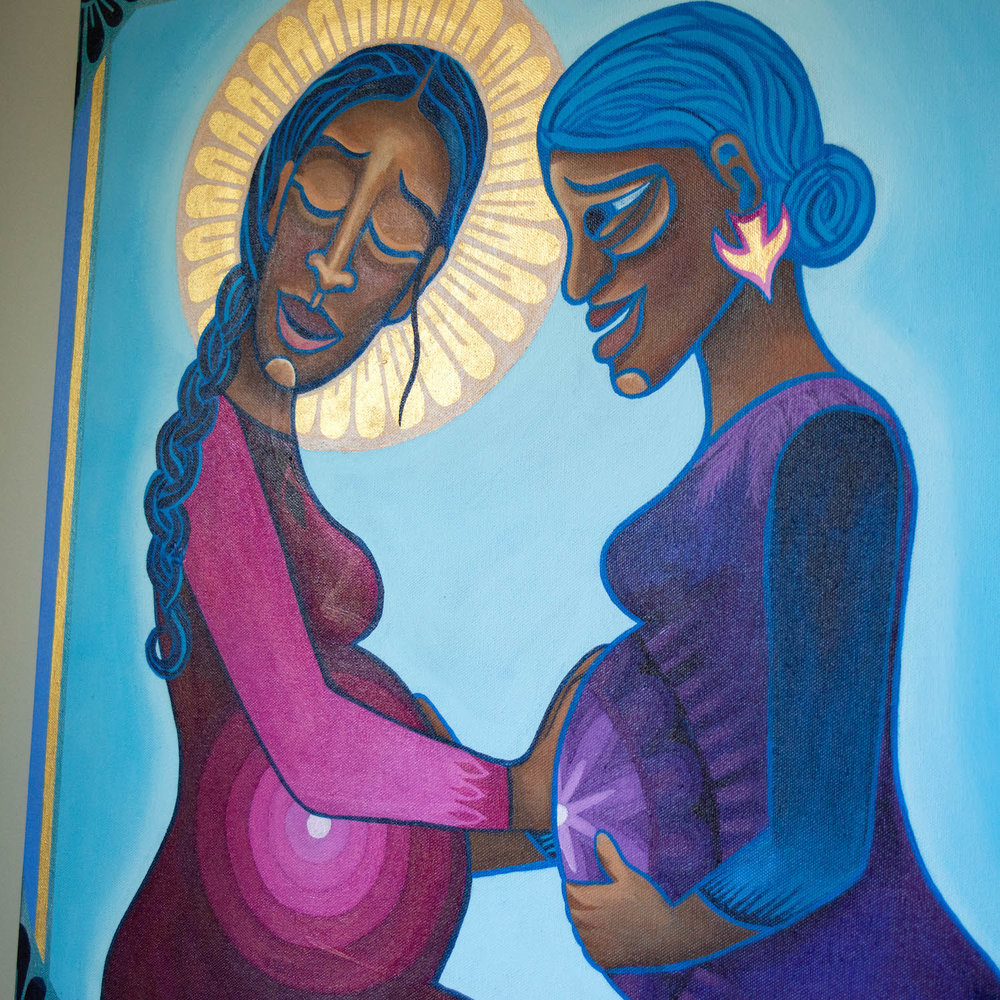
For we know that all creation has been groaning as in the pains of childbirth right up to the present time. And we believers also groan, even though we have the Holy Spirit within us as a foretaste of future glory, for we long for our bodies to be released from sin and suffering.

We, too, wait with eager hope for the day when God will give us our full rights as his adopted children, including the new bodies he has promised us. We were given this hope when we were saved. (If we already have something, we don’t need to hope for it. But if we look forward to something we don’t yet have, we must wait patiently and confidently.) (New Living Translation)

Salvation is not only personal; it’s also cosmic.

That is, freedom from the power of sin, death, and hell is not only for an individual person, but this deliverance is for all of creation, for the entire earth.

So then, all of creation – not just people – long for and groan for the advent of Christ. My oak tree in the backyard longs for it. My dog whines for it. When it rains, the sky is wondering how long it will have to keep up its tears.

Together with the entire cosmos, we look forward to the complete fulfillment of our inheritance as God’s creation, as God’s creatures.

Since that is true, it is Christians who need to see the privilege and responsibility of conducting ourselves with unity, harmony, and non-violence. We are to live this way because we are foreshadowing the end of the world’s story.

There is a day coming when there will be no more malevolent and selfish posturing for power and control. No more oppression and victimization. No more injustice.

And we have the chance to begin living that way now, and not only in a future time. We get to do this because of Christ.

But that doesn’t mean we don’t suffer anymore. Presently, along with all creation, we have pain like that of a woman in childbirth. This is no papercut inconvenient pain; this is “I hurt like hell” pain. That sort of pain has us awaiting the redemption of our bodies.

I work as a hospital chaplain. Every day, I see suffering, some of it unimaginable. I listen to stories of people longing for healing, and grasping at hope. And I hear plenty of groaning (both the actual physical groans, as well as the more quiet internal sighs and groans).

I say to you: The human body is not meant to be destroyed. Our physical selves are not destined for elimination. No, our bodies are meant to be redeemed; they are meant for salvation. It will not always be this way!

So, we hope.

The Christian has the confident expectation that not only is the soul redeemed, but the body, as well. We can enjoy spiritual salvation now. But we must wait for the physical deliverance. There must be patience on our part until Resurrection Day.

The Apostle Paul was calling on believers to hope. Five times he said it in only two verses. Paul was emphasizing the need for spiritual endurance because we have not yet arrived.

In case you haven’t noticed, we aren’t in heaven; this isn’t a renewed earth; people around the globe are not all presently singing kumbaya together.

Therefore, it is imperative that we live with the tension between the “now” and the “not yet.” It’s a weird existence, this Christian life. But, in reality, we exist in the paradox of being saved now, and not yet being saved.

Another way of putting this is that God’s adopted children have not yet received their inheritance.

But that doesn’t mean we’ve been left to ourselves. We have the first fruits of our salvation: the Holy Spirit.

We presently, right now, enjoy a real and significant portion of God’s freedom and deliverance. We have God’s gift of presence. There is the continuing presence of Jesus Christ with us, the blessed Holy Spirit.

And this divine presence is what today helps us to endure and hold onto hope. By holding this future hope, we learn to accept, cope, and transcend our circumstances through love.

Therefore, since we have been made right in God’s sight by faith, we have peace with God because of what Jesus Christ our Lord has done for us. Because of our faith, Christ has brought us into this place of undeserved privilege where we now stand, and we confidently and joyfully look forward to sharing God’s glory.

We can rejoice, too, when we run into problems and trials, for we know that they help us develop endurance. And endurance develops strength of character, and character strengthens our confident hope of salvation. And this hope will not lead to disappointment. For we know how dearly God loves us, because he has given us the Holy Spirit to fill our hearts with his love. (Romans 5:1-5, NLT)

The very suffering which we so often try to avoid and get out of, becomes the means of connecting us with Christ and with others.

The problem becomes the answer.

The Spirit groans with our own spirit, and we all become connected together.

I point out, however, that not everyone wants this sort of connection. There are many people who want nothing to do with solidarity.

Some folks want to remain in their own little huddle or small world; and they take offense at anyone outside of their group who seeks to understand and connect with that group’s suffering.

Although everyone’s pain and suffering is unique – and no one can fully know another’s sorrow – that does not mean solidarity and connection are impossible, or undesirable.

I don’t need to have cancer in order to connect with a cancer patient. I don’t have to become victimized to show genuine empathy and extend competent comfort. Yet, sadly, some persons only want connection and consolation from a certain person or group.

But I say to that: Who are you to tell God whom God can love you through?

To suffer is one thing, because we all must suffer in some way. But to compound your suffering by your own volition is another thing altogether.

You deserve better than harming yourself through cutting off help.

It could be that today is the day you reach out to that person you know will be there for you. Or, perhaps now is the time to quite putting off making space for prayer and reflection.

Whatever it is that you need to do, it’s okay to do it, without putting it off until tomorrow.

Lord Jesus Christ, by your patience in suffering you hallowed earthly pain and gave us the example of obedience to your Father’s will: Be near me in my time of weakness and pain; and sustain me by your grace, so that my strength and courage may not fail. Heal me according to you will; and help me always to believe that whatever happens to me here is of little account if you hold me in eternal life. Amen.

Spiritual Wisdom and Power (1 Corinthians 2:1-5)

By Bible Art

When I came to you, brothers and sisters, I did not come proclaiming the testimony of God to you with superior speech or wisdom. For I decided to know nothing among you except Jesus Christ and him crucified. And I came to you in weakness and in fear and in much trembling. My speech and my proclamation were made not with persuasive words of wisdom but with a demonstration of the Spirit and of power, so that your faith might rest not on human wisdom but on the power of God. (New Revised Standard Version)

When it comes to proclaiming the gospel – the good news of Christ’s person and work – both the message and the messenger are important.

The Apostle Paul was dialed in and focused on the Cross of Jesus Christ. Although he could have used various methods of persuasion, he was determined to set aside all other means of proclamation, and declare Christ’s Cross as the message and method itself.

This means that Paul also deliberately faded himself into the background, in order to have the Cross of Christ in the foreground. He emphasized his own weakness, his fear and trembling, in order to highlight the strength and majesty of God.

Paul wanted the messenger to point to the message – which meant that all of his speaking allowed God’s Spirit and power to show itself through him, rather than in spite of him.

The Corinthians came to believe the message not because of a big showy demonstration of Paul’s strength, intellect, and wisdom. Instead, they embraced Christian belief because of spiritual power and effort.

If it is spiritual wisdom and power centered in the message of Christ’s Cross which saves us, then it is also more than good enough to sanctify us, as well, and be the core from which all of the Christian life emanates from.

The Apostle understood that he is God’s agent, God’s ambassador, but that God alone is the One who saves humanity and delivers them from sin, death, and hell.

Christ Carrying the Cross, by Martin Schongauer, c. 1480 C.E.

Paul’s argument doesn’t have anything to do with making sure that the word “cross” is said in every sermon and conversation, or that Christians have only one thing to talk about.

Instead, the Apostle wanted the Corinthian Church to distance themselves from their typical of use of worldly philosophical wisdom, in favor of a distinctly spiritual wisdom which demands a certain kind of ministry:

The cross of Jesus Christ is to be the central event in which all of Christian life and ministry revolves around. In other words, the shape of Christianity is cruciform.

And since the cruciform nature of Christianity is our reality, our wisdom is to be received and flow from the Cross of Christ. To do less is to rely upon a different power other than the distinctive spiritual power of Christ’s death.

It isn’t any one of us which breaks through to another’s spirit; the power of God compels a person to listen, receive the message, and be given faith to believe, grow, and spiritually mature.

When the good news of Christ’s person and work takes root and develops within us, then what comes out of us is spiritual power, and not our own homespun worldly human wisdom.

“Wisdom” is the ability to take a body of knowledge and apply it to concrete situations in life.

So, when it comes to spiritual wisdom, Christians mature in the grace and knowledge of the Lord Jesus; then, they learn to take this important body of knowledge and apply it to all of the various circumstances and situations they are faced with every day.

This isn’t to say that worldly wisdom has no merit or significance, or that it is misguided. Rather, it means that this sort of wisdom doesn’t have the ability, the strength, or the power to move and change us, or others, toward deliverance and new life. We need the wisdom of the Spirit for that. And Paul insisted that this wisdom comes from the Cross of Christ.

The crucifixion of Christ is the wise guide for all of the Apostle Paul’s theology, message, and ministry. That singular event was like a massive meteor hitting the ocean of humanity, with a powerful tsunami of spiritual power and grace still making waves up to this very day.

Indeed, the Cross of Christ impacts all of creation, the entire universe. The person and work of Jesus Christ has cosmic implications for the salvation and deliverance of everything from the grip of evil.

On the practical daily level of things, none of this is about trying to do or be better, to somehow work harder at being a Christian or doing Christian mission and ministry. The fact of the matter is that we can only give to others what we have received from God. This means that:

  • The Holy Scriptures are to be received with reverence and fear, as a message given for us to learn and know so well that it becomes as familiar to you as the backdoor of your house.
  • The Christian life is about dying to self, taking up one’s cross and following Christ. If we desire the power of the resurrection, then this will first require embracing and allowing the powerful suffering of the cross to do its work.
  • Faithfulness is at the heart of living. Our task is to show up, pay attention, and speak the truth in love, and let God use this to accomplish the Divine holy will. Being married to outcomes and consequences will likely lead to reliance upon worldly wisdom, and eventually disappointment.
  • The Cross of Christ is what everything and everyone hinges upon. The world does not revolve around you nor me. So, let’s get in sync with the Spirit of God and rely upon the cruciform power provided for us by means of Christ’s death.

O God, who for our redemption gave your only-begotten Son to the death of the cross, and by his glorious resurrection delivered us from the power of our enemy: Grant us so to die daily to sin, that we may evermore live with him in the joy of his resurrection; who lives and reigns now and forever. Amen.