Romans 8:18-30 – Anticipating Hope

I consider that the sufferings of this present time are not worth comparing with the glory about to be revealed to us. For the creation waits with eager longing for the revealing of the children of God; for the creation was subjected to futility, not of its own will but by the will of the one who subjected it, in hopethat the creation itself will be set free from its bondage to decay and will obtain the freedom of the glory of the children of God. We know that the whole creation has been groaning in labor pains until now; and not only the creation, but we ourselves, who have the first fruits of the Spirit, groan inwardly while we wait for adoption, the redemption of our bodies. For in hope, we were saved. Now hope that is seen is not hope. For who hopes for what is seen? But if we hope for what we do not see, we wait for it with patience.

Likewise, the Spirit helps us in our weakness; for we do not know how to pray as we ought, but that very Spirit intercedes with sighs too deep for words. And God, who searches the heart, knows what the mind of the Spirit is, because the Spirit intercedes for the saints according to the will of God.

We know that all things work together for good for those who love God, who are called according to his purpose.For those whom he foreknew he also predestined to be conformed to the image of his Son, in order that he might be the firstborn within a large family. And those whom he predestined he also called; and those whom he called he also justified; and those whom he justified he also glorified. (New Revised Standard Version)

Christians everywhere are presently anticipating the Nativity of the Lord, the birth of the Christ child. Not only Christians, but all people anticipate better days, hoping that during this season of goodwill that basic human kindness will be prolific and extend into the new year.

The brokenness of the world is dominated by disease and dissent. As of this writing, well over five million people have died worldwide due to COVID-19. I myself have attended dozens of those deaths. The grief, not only of losing a loved one, but many of them dying alone, is palpable.

If that weren’t bad enough, disease has become a political game. While there are currently two-hundred fifty million people infected with some strain of the coronavirus, far too many without the disease are using it to posture and position for their shortsighted rights.

And I haven’t even mentioned the hundreds of other world and national problems, beset with such a cacophony of dissenting voices bickering at one another, that innocent lives get ruined or lost. Who will rescue us from this body of death?

“The celebration of Advent is possible only to those who are troubled in soul, who know themselves to be poor and imperfect, and who look forward to something greater to come.”

Dietrich Bonhoeffer

Thanks be to God. There is an intervention. Hope is imminent. A star rises in the east. A leader is to be born – one who is deeply concerned for the common good of all people – one who will rule with equity and justice.

The believer’s salvation, in a gestation period of anticipation, is nearly full term. Expectation, patience, joy, and pain are part of the experience while we wait. Meanwhile, we must remain encouraged and healthy, keeping our future hope always in front of us so that we will not lose heart.

When injustice runs amok, and we are limited in what we can do about it, we pray. And then, there are times when we are flat on our backs, overwhelmed with our circumstances, not even able to utter any words in prayer.

Christians are awaiting their redemption. So, perseverance is needed. While waiting, it does no good to be like Eeyore and feel sorry for ourselves. Yet, on the other hand, it also does no good to always be smiling, positive, and upbeat as if nothing is worth grieving over. 

Grief and lament, hope and joy, must all be held together at the same time. Without the simultaneous embrace, we will live in abject denial – tightly gripping one hand while ignoring the other, as if we don’t have two of them.

Indeed, we live in an awkward time. Nothing is as it was, and nothing is as it should be… yet. This time of spiritual pregnancy, in which we possess salvation but do not yet possess it in all its fullness, is a weird liminal space in which we often don’t quite know what to do.

There is so much groaning going on because we realize there is such a large gap between where we are and where we want to be. If women could have babies without nine months of struggle, limitation, and pain I think they would opt for that instead of the way it is now. There is a time coming when every tear will be wiped away and unending joy will rule. No more disease. No more dissent. No more death.

All of creation groans because where it is now and where it will be seems like such a long time in coming.  Every creature and every living thing will experience decay and death. The world is not yet redeemed from its cursed bondage. So, the earth vomits disasters and diseases because we live in this fallen world that is not yet redeemed.

Humanity groans because we fall victim to circumstances beyond our control. We also groan because of our own poor choices that give us grief. Although we have been delivered from sin, death, and hell and experience spiritual power… we still must wait eagerly for the redemption of our bodies.

Yes, we are keenly aware of the terrible disconnect between where we are as people and where we want to be. It is something of feeling like Pinocchio, not yet a real boy who has to deal with strings and other puppeteers who do not care about him; and, who feels the need to lie because of his situation and pays the consequence of his nose growing.

Yet, a deeper thing is happening under the surface: Our frustrations, longings, lusts, jealousies, and escapist daydreams, things we might be ashamed of to take to prayer, are in fact already lifting our hearts and minds to God in more honest ways than we ever do consciously.

Take courage. The time is at hand.

“Do not be afraid; for see—I am bringing you good news of great joy for all the people: to you is born this day in the city of David a Savior, who is the Messiah, the Lord.” (Luke 2:10-11, NRSV)

Glory to God in the highest, and on earth peace, goodwill toward humanity.

John 3:31-36 – Believe the Son

The Trinity by Alex Rapoport, 1994

God’s Son comes from heaven and is above all others. Everyone who comes from the earth belongs to the earth and speaks about earthly things. The one who comes from heaven is above all others. He speaks about what he has seen and heard, and yet no one believes him. But everyone who does believe him has shown that God is truthful. The Son was sent to speak God’s message, and he has been given the full power of God’s Spirit.

The Father loves the Son and has given him everything. Everyone who has faith in the Son has eternal life. But no one who rejects him will ever share in that life, and God will be angry with them forever. (Contemporary English Version)

When Jesus ascended to heaven, he left instructions to his disciples to pray and to witness (Acts 1:1-11). Jesus asks of us what he himself does or has already done. The life and ministry of Christ on this earth was marked continually with prayer and bearing witness. Just as Jesus bore witness to what he saw and heard as the Divine Word, so his followers are to do likewise. The evidence and the veracity of Christ’s witness is the giving of God’s Spirit – the One whom confirms this testimony to us.

I, personally, have found Jesus to be precisely whom he claims to be. I have come to accept his testimony as gracious, truthful, and life-giving. I have wholeheartedly embraced the New Testament Gospel accounts of his birth, life, teaching, death, resurrection, and ascension. This belief came neither quickly nor easily for me – it resulted from an honest straightforward reading of the Bible, along with the gracious wooing of the Holy Spirit.

It really isn’t my job to convince you of Jesus Christ’s authenticity and trustworthiness. That is the work of the Holy Spirit. Instead, it is my task to bear witness of the things I have seen and heard concerning Jesus. 

My life has been thoroughly turned upside-down because of Jesus. With Jesus, I have been invited into the life of God. By the wounds of Jesus, I have experienced healing of damaged emotions and recovery from spiritual hurts inflicted by others. Through union with Christ, I have grace and forgiveness of things I have done and left undone. With Brother Jesus as my friend and companion, I enjoy loving attention and am never dismissed by him.

The Trinity by Jyoti Sahi

For those who have not read the Gospel accounts and refuse Christ, then, for honesty’s sake, please have the integrity to give Jesus a hearing before you dismiss him with a slight of hand. It is one thing to genuinely no little about Jesus, and it is quite another thing to ignore him when you have knowledge about how to discover him.

For those of us who have read the New Testament Gospels and accept the testimony of Jesus, we come back again and again to his life-giving words and seek continually to follow him in his way of mercy, purity, and peace. We bear witness to how Jesus has changed our lives and offers a life worth living.

Everyone with faith in Jesus has a life-giving connection with God. Those who don’t, don’t. If you disagree with this, then contend with Jesus himself. Give him a hearing. Watch him in action. Observe how he deals with people. See if he lives up to his words. Then, bear witness to what you have seen and heard.

Christian faith is a complete trust in the person and work of Jesus Christ as Lord and Savior. Because God has been revealed as faithful through steadfast love, the Lord gifts people with faith to know the Divine.

Faith, a noun, is closely accompanied by it’s verb, believe. Together, as identical twin sisters, they let us know that both knowledge and action are needed. We need information in knowing what step to take, and an active commitment to actually take that step.

Others’ faith in Jesus led to a man’s healing of both body and soul:

And behold, some people brought to him a paralytic, lying on a bed. And when Jesus saw their faith, he said to the paralytic, “Take heart, my son; your sins are forgiven.” (Matthew 9:2, ESV)

The size of faith is irrelevant; even a smidge of Jesus has incredible power:

“I [Jesus] assure you that if you have faith the size of a mustard seed, you could say to this mountain, ‘Go from here to there,’ and it will go. There will be nothing that you can’t do.” (Matthew 17:20, CEV)

Human weakness and inability is no problem because of faith in Christ:

Everyone who believes has God’s approval through faith in Jesus Christ…. We conclude that a person has God’s approval by faith, not by his own efforts.

Romans 3:22, 28, GW

A person acts upon knowledge of Jesus with total trust in Christ’s finished work of deliverance from all which is evil:

It’s the word of faith that welcomes God to go to work and set things right for us. This is the core of our preaching. Say the welcoming word to God — “Jesus is my Master”— embracing, body and soul, God’s work of doing in us what he did in raising Jesus from the dead. That’s it. You’re not “doing” anything; you’re simply calling out to God, trusting him to do it for you. That’s salvation. With your whole being you embrace God setting things right, and then you say it, right out loud: “God has set everything right between him and me!” (Romans 10:9-12, MSG)

Faith is not an event; it is continual trust in the person and work of Christ for practical living and compassionate serving:

I have been crucified with Christ; and it is no longer I who live, but it is Christ who lives in me. And the life I now live in the flesh I live by faith in the Son of God, who loved me and gave himself for me. (Galatians 2:19b-20, NRSV)

Outward rituals only have their proper place as they help inform belief in order to engage in loving actions:

For in Christ Jesus, neither circumcision nor uncircumcision counts for anything, but only faith working through love. (Galatians 5:6, NAB)

You are saved by God’s grace because of your faith. This salvation is God’s gift. It’s not something you possessed. It’s not something you did that you can be proud of. Instead, we are God’s accomplishment, created in Christ Jesus to do good things. God planned for these good things to be the way that we live our lives. (Ephesians 2:8-10, CEB)

Understanding and experience go together like a hand in a glove:

I keep hearing about your faith in the Lord Jesus and your love for all of God’s people.  And I am praying that you will put into action the generosity that comes from your faith as you understand and experience all the good things we have in Christ. (Philemon 5-6, NLT)

Absolute certainty isn’t in the realm of Christian spirituality – there’s always more information one could obtain. Faith discerns, intuits, and knows God is there, and orders it’s steps accordingly with faithful activity:

And without faith it is impossible to please God, for whoever would approach him must believe that he exists and that he rewards those who seek him. (Hebrews 11:6, NRSV)

My brothers and sisters, if people say they have faith, but do nothing, their faith is worth nothing. Can faith like that save them?… Just as a person’s body that does not have a spirit is dead, so faith that does nothing is dead! (James 2:14, 26, NCV)

In the power of the Spirit and in union with Christ, I pray to you, the God and Father of all:

For empowerment by the Spirit, that I may be a faithful witness

For those who wait on You, that they may find renewal

For all people, that they may acknowledge the kingdom of the ascended Christ

For all who are struggling with broken relationships

I commend myself and all for whom I pray, to Your mercy and protection through Jesus Christ, my Lord and Savior. Amen.

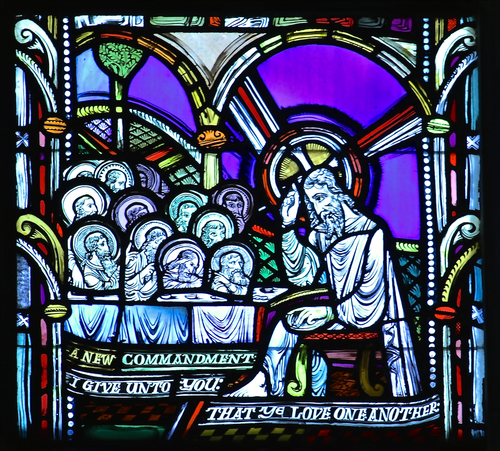
John 13:31-35 – Love One Another

Stained glass by Edgar Miller (1899-1993)

When he was gone, Jesus said, “Now the Son of Man is glorified, and God is glorified in him. If God is glorified in him, God will glorify the Son in himself, and will glorify him at once.

“My children, I will be with you only a little longer. You will look for me, and just as I told the Jews, so I tell you now: Where I am going, you cannot come.

“A new command I give you: Love one another. As I have loved you, so you must love one another. By this everyone will know that you are my disciples if you love one another.” (New International Version)

The Church was formed to represent Christ on earth. The Church is a new community of believers in Jesus, called and empowered by the Holy Spirit for mission.

Christianity was never intended to be just a personal faith; it was designed by God to be the community of the redeemed. Christian community is vital to every individual’s faith.

“No one can have God for his Father who does not have the Church for his Mother.”

John Calvin (1509-1564)

Loyalty and commitment to God translates to having a dedicated and devoted spirit to one another in the church. 

One of the last commands Jesus gave to his disciples before he went to the cross was to “love one another.” The Old Testament instructed the Israelites to love each other (Leviticus 19:18). Yet, Jesus gives new meaning to the command through four distinctions of loving one another.

A New Model of Love: Jesus

Our Lord’s life and teaching gave new meaning to the command to love each other. Notice what Jesus did in the Upper Room just before giving the command to love one another:

It was almost time for the Jewish Passover festival. Jesus knew that the time had come for him to leave this world and go back to the Father. Jesus had always loved the people in the world who were his. Now was the time he showed them his love the most.

Jesus and his followers were at the evening meal. The devil had already persuaded Judas Iscariot to hand Jesus over to his enemies. (Judas was the son of Simon.) The Father had given Jesus power over everything. Jesus knew this. He also knew that he had come from God. And he knew that he was going back to God. So while they were eating, Jesus stood up and took off his robe. He got a towel and wrapped it around his waist. Then he poured water into a bowl and began to wash the followers’ feet. He dried their feet with the towel that was wrapped around his waist. (John 13:1-5, ERV)

Jesus modeled a service-oriented love of compassionately meeting the need of another, regardless of who that person is. It is instructive to us that Jesus washed the feet of Judas Iscariot, along with all the other disciples. 

Christ died for us while we were still sinners. This demonstrates God’s love for us.

Romans 5:8, GW

We are to love everyone in the community of saints, and not just our friends or the ones we like. Loving one another also means we will be realistic in understanding that community is messy and downright hard work.  

A New Motive: Christ First Loved Me

Jesus has loved us with a love that took care of our brokenness once for all. Because of that love, we are now motivated to love each other. John would later say in his first epistle: 

God showed his love for us by sending his only Son into the world, so that we might have life through him. This is what love is: it is not that we have loved God, but that he loved us and sent his Son to be the means by which our sins are forgiven. Dear friends, if this is how God loved us, then we should love one another. (1 John 4:9-11, GNT)

Love is an attitude and a frame of mind. The motivation for the Christian is different than anyone else’s motive:  We are so thankful for Christ’s love to us, that we cannot help but extend that same love to one another in the church. 

This kind of love transcends human willpower. This is love as a grateful response for the grace shown us in Christ.

A New Motivator: The Holy Spirit

The Spirit energizes and enables us to love each other. Jesus also said in the Upper Room: 

If you love me, you will do as I command. Then I will ask the Father to send you the Holy Spirit who will help you and always be with you. (John 14:15-16, CEV)

There are times when we may lack the ability or spiritual energy needed for the work of loving each other. It is in those times that we need to check our spiritual electrical box to make sure we haven’t tripped a breaker by trying to live the Christian life on our own strength. 

We need the Spirit. The Spirit gives us the zeal we need to love one another. 

We typically don’t do anything in life unless we have the motivation for it. The Spirit is like the Christian’s personal trainer – encouraging, exhorting, getting in our face, comforting, and spurring us – toward the new way of love. 

A New Mission: World Evangelization

All people will know we are Christ’s disciples if we love one another. The way we treat each other in the church is foundational and fundamental to the mission of loving our neighbors who don’t know Jesus.

“Mission is putting love where love is not.”

St. John of the Cross (1542-1591)

When the church has a healthy and even supernatural dynamic of loving one another, they joyfully proclaim the good news to every person that Jesus is the answer to the terrible brokenness of this world.

Community is necessary to mission. Lesslie Newbigin (1909-1998) was a British missionary to India for forty years. After retiring and returning to Britain, he found his homeland was very different than when he left. He was astounded to find Britain had become very less Christian and was now predominantly un-Christian. It was clearly a post-Christian society. What to do about it? Here is Newbigin’s response:

“I have come to feel that the primary reality of which we have to take account in seeking for a Christian impact on public life is the Christian congregation.  How is it possible that the gospel should be credible, that people should come to believe that the power which has the last word in human affairs is represented by a man hanging on a cross? 

I am suggesting that the only answer, the only hermeneutic of the gospel [the only way society can discern who Jesus is] is a congregation of men and women who believe it and live by it. I am, of course, not denying the importance of the many activities by which we seek to challenge public life with the gospel – evangelistic campaigns, distribution of Bibles and Christian literature, conferences, and even books such as this one. But I am saying that these are all secondary, and that they have power to accomplish their purpose only as they are rooted in and lead back to a believing community.”

Conclusion

The implications of community for our faith are significant. If we keep other Christians at a distance and give them the stiff arm, we are really giving God the stiff arm. Jesus identifies so closely in love to his people, that to love them is to love him.

The late African-American preacher E.V. Hill told the following story about an experience with a white Christian leader in the 1950s:

“As a freshman at Prairie View College (part of the Texas A&M system) I was actively involved and was one of two students selected to go to our denomination’s annual meeting in Memphis. The trip through the South was by car—three whites and two blacks traveling together. I had no idea how we’d eat or how we’d sleep. So great was my anxiety and hatred over how the trip might turn out that I almost backed out entirely …. In all my experience I had never seen a white man stand up for a black man and never felt I would. 

But then Dr. Howard, the director of our trip and a white man spoke up. ‘We’ll be traveling together,’ he said. ‘If there isn’t a place where all of us can eat—none of us will eat. If there’s not a place all of us can sleep—none of us will sleep.’ That was all he said, but it was enough! For the first time in my life, I had met a white man who was Christian enough to take a stand with a Christian black man.” 

May the Spirit give us the courage together to love one another.

Gracious Lord, I pray for those who will believe in you through the good news of forgiveness in Christ. I pray that all of them may be one just as you are one. May they be brought to complete unity to let the world know that you sent the Son, Jesus, and have loved them even as you have loved us. Righteous God, may you help us make you known in the world so that the love you have for us may be in them through the cross of Christ. Amen.

Galatians 6:1-10 – Fulfill the Law of Christ

Brothers and sisters, if someone is caught in a sin, you who live by the Spirit should restore that person gently. But watch yourselves, or you also may be tempted. Carry each other’s burdens, and in this way you will fulfill the law of Christ. If anyone thinks they are something when they are not, they deceive themselves. Each one should test their own actions. Then they can take pride in themselves alone, without comparing themselves to someone else, for each one should carry their own load. Nevertheless, the one who receives instruction in the word should share all good things with their instructor.

Do not be deceived: God cannot be mocked. A man reaps what he sows. Whoever sows to please their flesh, from the flesh will reap destruction; whoever sows to please the Spirit, from the Spirit will reap eternal life. Let us not become weary in doing good, for at the proper time we will reap a harvest if we do not give up. Therefore, as we have opportunity, let us do good to all people, especially to those who belong to the family of believers. (New International Version)

Its all about grace. God’s grace. In Christ, lived by means of the Holy Spirit. Its not about hard black-and-white lists of rules or principles to live by. The Law of Christ is to help each other in our troubles, no matter what.

Overwhelming physical, mental, emotional, and/or spiritual burdens can become even more heavy through failing to live up to someone’s or some group’s or a church’s unwritten list of rules. “Keep a stiff upper lip.” “Everything is possible for those who love God.” “Stay positive.” “Just have faith and trust God.” Or worse, silence…. These and hundred other phrases communicate to people with crushing loads that they will have to carry them alone.

The letter to the Galatian believers spells out what is to truly characterize Christian interactions, and what it means to walk in the Spirit. Believers in Jesus are to emulate the behavior of Christ, the ultimate burden-bearer, who came to restore sinners, not condemn them.

We have a responsibility to rescue, renew, and revitalize persons who have lost their way. We are our brother’s and our sister’s keeper.

Someone caught in the crosshairs of a bad decision, or ensnared by making a wrong step, who is now in over their heads, needs help. In such a case, we are to restore, not punish. The person’s wound needs spiritual cauterizing. The broken spirit needs to be set back into place to heal properly.

The tone and the attitude which we do this important work of restoring people is through gentleness (meekness). We are to have a mindset and heart stance which understands there is no moral superiority with me. I could easily be the person in need of restoration.

When we have a gentle spirit, then we discern we are not above falling into the same trouble. We, too, are ethically and morally vulnerable. So, the church has a corporate responsibility to bear one another’s burdens.

There are other people who, through no fault of their own, find themselves in over their heads, too. Their health and mental health challenges, the emotional weight of hard circumstances, and their broken spirits require others to help shoulder the load so that the weighted-down person is not crushed.

Nobody in any faith community is above doing this work of burden-bearing. And it isn’t appropriate for an individual to boast about the burden-bearing work of others, as if it were theirs. You and I are to take responsibility for our own actions and attitudes without taking credit for someone else’s efforts.

A mature spiritual community of people are able to distinguish those loads which individuals must bear for themselves, and those burdens where help is sorely needed. We are accountable to carry our own backpack. And we are also accountable before Christ to share our load with others when it becomes too heavy for us.

If we choose not to allow others to assist us when we need it, then we will reap what we sow – we’ll feel the full weight and consequences of our silence. The planting and harvesting metaphor isn’t just for those who have engaged in wrongdoing. It is also for those who don’t put any seeds in the ground to begin with. They shouldn’t expect a harvest, at all.

Grace lived out in real experiences knows when to get under a load and help carry it. And grace also knows when to be kind to self and share the heavy burden with others who can help shoulder it for a bit. This is Christianity which relies on the enablement of the Spirit, made possible by Christ, who carried our crushing weight of guilt and shame for us.

Our Christian freedom in Jesus is to be stewarded wisely through carrying one another’s burdens, and so, fulfilling the Law of Christ.

God of all comfort, our help in time of need: We humbly pray to relieve and restore persons in need, people for whom are tired, sick, weary, or unable to continue as they are. Look upon them with the eyes of your mercy; comfort them with a sense of your goodness; preserve them from the temptations of the enemy; and give them patience under their affliction. In your good time, restore them to holistic health, and enable them to live their lives to your glory; and may they dwell with you in life everlasting; through Jesus Christ our Lord. Amen.