The Age of the Spirit (Joel 2:18-29)

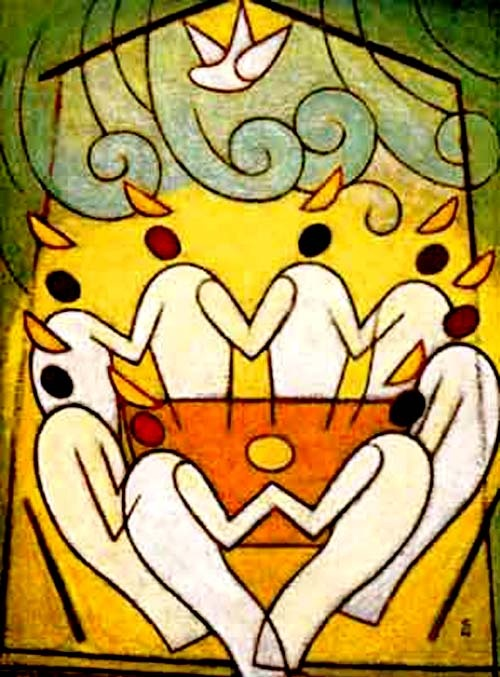
“Come, Holy Spirit,” by Mary Anne Durnin

The Lord was deeply concerned
about his land
    and had pity on his people.
In answer to their prayers
    he said,
“I will give you enough grain,
wine, and olive oil
    to satisfy your needs.
No longer will I let you
    be insulted by the nations.
An army attacked from the north,
but I will chase it
    into a scorching desert.
There it will rot and stink
from the Dead Sea
    to the Mediterranean.”

The Lord works wonders
    and does great things.
So tell the soil to celebrate
and wild animals
    to stop being afraid.
Grasslands are green again;
fruit trees and fig trees
    are loaded with fruit.
Grapevines are covered
    with grapes.

People of Zion,
celebrate in honor
    of the Lord your God!
He is generous and has sent
the autumn and spring rains
    in the proper seasons.
Grain will cover
    your threshing places;
jars will overflow
    with wine and olive oil.

I, the Lord your God,
will make up for the losses
    caused by those swarms
and swarms of locusts
    I sent to attack you.
My people, you will eat
    until you are satisfied.
Then you will praise me
for the wonderful things
    I have done.
Never again will you
    be put to shame.

Israel, you will know
    that I stand at your side.
I am the Lord your God—
    there are no other gods.
Never again will you
    be put to shame.

Later, I will give my Spirit
    to everyone.
Your sons and daughters
    will prophesy.
Your old men
    will have dreams,
and your young men
    will see visions.
In those days I will even give
my Spirit to my servants,
    both men and women. (Contemporary English Version)
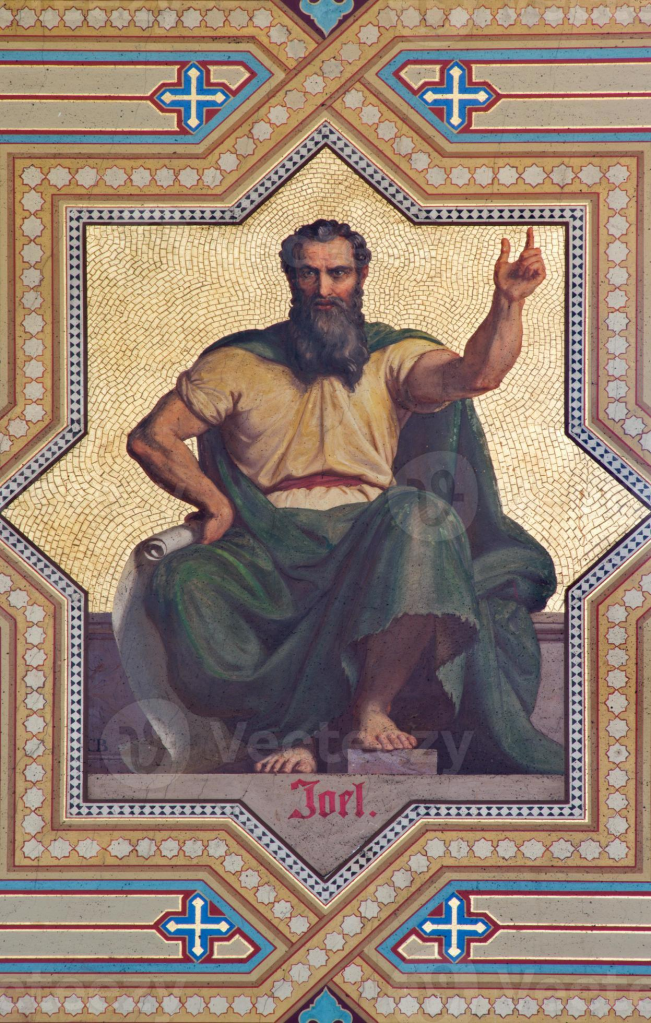
Fresco of the prophet Joel in the Altlerchenfelder Church, Vienna, Austria

We are in the wake of Pentecost Day. But it ought not to have come as a surprise. There were prophetic rumblings of the Spirit’s future tornadic activity, long before the time of Jesus.

The prophet Joel, along with all the Old Testament prophets, had both a message of grace and of judgment. And so, this prophetic book falls naturally into those two parts.

Within the first part of the prophecy, Joel speaks of a terrible locust plague that came over Israel as a judgment from God. The people had strayed from their spiritual and religious ways of covenant with God. The locusts, destroying every plant in their path, reflected the people’s lack of spiritually thriving and growing in grace. They, too, were vulnerable to destruction. They needed to repent and to return to their God.

Yet, the Lord’s anger lasts only a moment, but God’s mercy and blessing endure forever. So, words of grace were offered to the people. There is a time coming, Joel insisted, when God will pour out the divine Spirit far and wide to bless the people and contend with the nations who oppose the covenant community.

Put another way, the first part of the prophecy describes how God fought against God’s own people, to bring them back to their spiritual senses. And the second part of the prophecy describes how the Lord will fight against the nations who fight against God and God’s people.

The people’s affections and allegiance became attached to other things rather than God. So, the Lord sent an army of locusts to oppose them, to challenge their milquetoast and half-hearted attempts at following divine instructions.

Joel foresaw two things coming as the great Day of the Lord approaches: a great outpouring of the Holy Spirit; and a terrible time of divine judgment. 

Let’s take a few things to heart as a response to Joel’s prophecy:

Be aware of God’s purpose in history

From grasshopper swarms to world-wide judgment, to the dissolving of sun and moon—God’s purpose is to reveal divine glory to all the world.

“You will know that I am in the midst of Israel,
        and that I am the Lord your God—no other exists;
        never again will my people be put to shame.” (Joel 2:27, CEB)

“Father, the hour has come; glorify your Son so that the Son may glorify you.” Jesus (John 17:1, NRSV)

Stay close to the Lord

Don’t wander from God. But, if you do, the Lord will spend all kinds of energy in bringing us back and restoring us.

“But even now,” declares the Lord,
“return to me with all your heart—
with fasting, crying, and mourning.” (Joel 2:12, GW)

And the God of all grace, who called you to his eternal glory in Christ, after you have suffered a little while, will himself restore you and make you strong, firm and steadfast. (1 Peter 5:10, NIV)

Change the inside, not the outside

Repentance and faith are to be a way of life, and not simply a one time event. The way we present ourselves on the outside is a projection of what we want others to see. But God sees the heart, so we must go there and focus on the inner person.

Don’t rip your clothes
    to show your sorrow.
Instead, turn back to me
    with broken hearts.
I am merciful, kind, and caring.
I don’t easily lose my temper,
    and I don’t like to punish. (Joel 2:13, CEV)

Endure what you suffer as being a father’s punishment; your suffering shows that God is treating you as his children. Was there ever a child who was not punished by his father? If you are not punished, as all his children are, it means you are not real children, but bastards. In the case of our human fathers, they punished us and we respected them.

How much more, then, should we submit to our spiritual Father and live! Our human fathers punished us for a short time, as it seemed right to them; but God does it for our own good, so that we may share his holiness. When we are punished, it seems to us at the time something to make us sad, not glad. Later, however, those who have been disciplined by such punishment reap the peaceful reward of a righteous life. (Hebrews 12:7-11, GNT)

Earnestly seek the outpouring of the Holy Spirit

On the Day of Pentecost, the Apostle Peter said that the coming of the Holy Spirit was a fulfillment of Joel’s prophecy (Acts 2:16). That was just the beginning of the blessing. The Holy Spirit is still operative and active in the church and the world. The prophecy is far from complete.

In reply to those who were concerned about others prophesying and thereby possibly challenging authority, Moses said:

“Are you concerned what this might do to me? I wish the Lord would give his Spirit to all his people so everyone could be a prophet.” (Numbers 11:29, CEV)

And those who observed and heard the Spirit being poured out, exclaimed with slack jawed amazement:

“Aren’t these all Galileans? How come we’re hearing them talk in our various mother tongues?

Parthians, Medes, and Elamites;
Visitors from Mesopotamia, Judea, and Cappadocia,
    Pontus and Asia, Phrygia and Pamphylia,
    Egypt and the parts of Libya belonging to Cyrene;
Immigrants from Rome, both Jews and proselytes;
Even Cretans and Arabs!

“They’re speaking our languages, describing God’s mighty works!” (Acts 2:7-11, MSG)

The age of the Spirit is here. It hasn’t gone away. So, let’s pursue the spiritual life with all the energy given us, to the glory and praise of God. Amen.

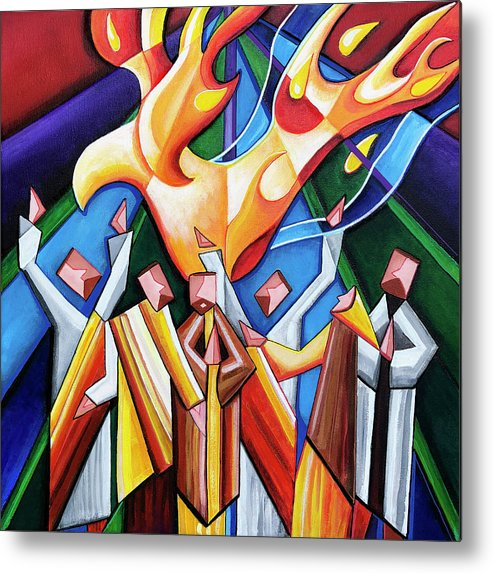
The Day of Pentecost (Acts 2:1-21)

Pentecost, by Jennifer Allison

Now when the day of Pentecost had come, they were all together in one place. Suddenly a sound like a violent wind blowing came from heaven and filled the entire house where they were sitting. And tongues spreading out like a fire appeared to them and came to rest on each one of them. All of them were filled with the Holy Spirit, and they began to speak in other languages as the Spirit enabled them.

Now there were devout Jews from every nation under heaven residing in Jerusalem. When this sound occurred, a crowd gathered and was in confusion, because each one heard them speaking in his own language. 

Completely baffled, they said, “Aren’t all these who are speaking Galileans? And how is it that each one of us hears them in our own native language? Parthians, Medes, Elamites, and residents of Mesopotamia, Judea and Cappadocia, Pontus and the province of Asia, Phrygia and Pamphylia, Egypt and the parts of Libya near Cyrene, and visitors from Rome, both Jews and proselytes, Cretans and Arabs—we hear them speaking in our own languages about the great deeds God has done!”

All were astounded and greatly confused, saying to one another, “What does this mean?” But others jeered at the speakers, saying, “They are drunk on new wine!”

But Peter stood up with the eleven, raised his voice, and addressed them: “You men of Judea and all you who live in Jerusalem, know this and listen carefully to what I say. In spite of what you think, these men are not drunk, for it is only nine o’clock in the morning. But this is what was spoken about through the prophet Joel:

And in the last days it will be,’ God says,
that I will pour out my Spirit on all people,
and your sons and your daughters will prophesy,
and your young men will see visions,
and your old men will dream dreams.

Even on my servants, both men and women,
I will pour out my Spirit in those days, and they will prophesy.
And I will perform wonders in the sky above
and miraculous signs on the earth below,
blood and fire and clouds of smoke.

The sun will be changed to darkness
and the moon to blood
before the great and glorious day of the Lord comes.
And then everyone who calls on the name of the Lord will be saved.’ (New English Translation)

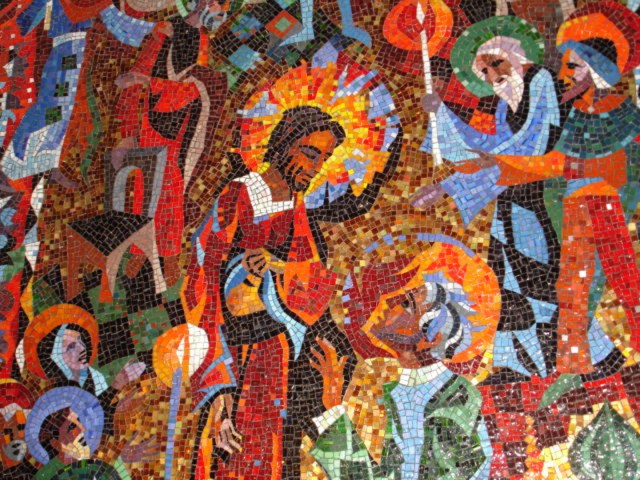
The Coming of the Holy Spirit, by Soichi Watanabe, 1996

Tornadoes are powerful. So is fire. They both have an immense potential for awe and destruction.  It’s interesting that when the little band of Christ’s followers experienced the Holy Spirit for the very first time, they likened what they encountered as wind and as fire. 

There is power in the Spirit – for both life and in destruction. It is the Spirit of God who dismantles and rearranges lives to make something different or new altogether. Most certainly, when the Spirit gets involved, nothing is going to be the same again.

On the Day of Pentecost, the Spirit upset the status quo and formed a new band of believers into the community of the redeemed (the Church). The presence of God’s Holy Spirit brings energy, strength, and ability to spread the good news of Jesus, heal broken lives, and bring an egalitarian way of life that sees no distinction based on race, class, gender, or ethnicity. 

The giving of the Spirit to the people of God is a whole lot more than a day set aside on a calendar, or a by-gone ancient thing that happened and has no significance for today. In fact, it is more than true to say that an authentic follower of Jesus Christ is a Pentecostal believer.  The New Testament knows nothing of a Christian who isn’t given the Spirit to accomplish the will of God on this earth.

Therefore, this time of the year is hugely significant when we attune ourselves to Holy Time because it is the age of the Spirit, the time of Pentecostal life and power. 

Ten days after recognizing Christ’s Ascension, and fifty days after our Lord’s resurrection from death, the Christian Calendar observes the day of Pentecost (which literally means “fifty” in Greek).  The day coincides with an established Jewish festival, the Feast of Weeks. Back in the day, Jerusalem would be filled with all kinds of different nationalities and ethnicities during the festival.

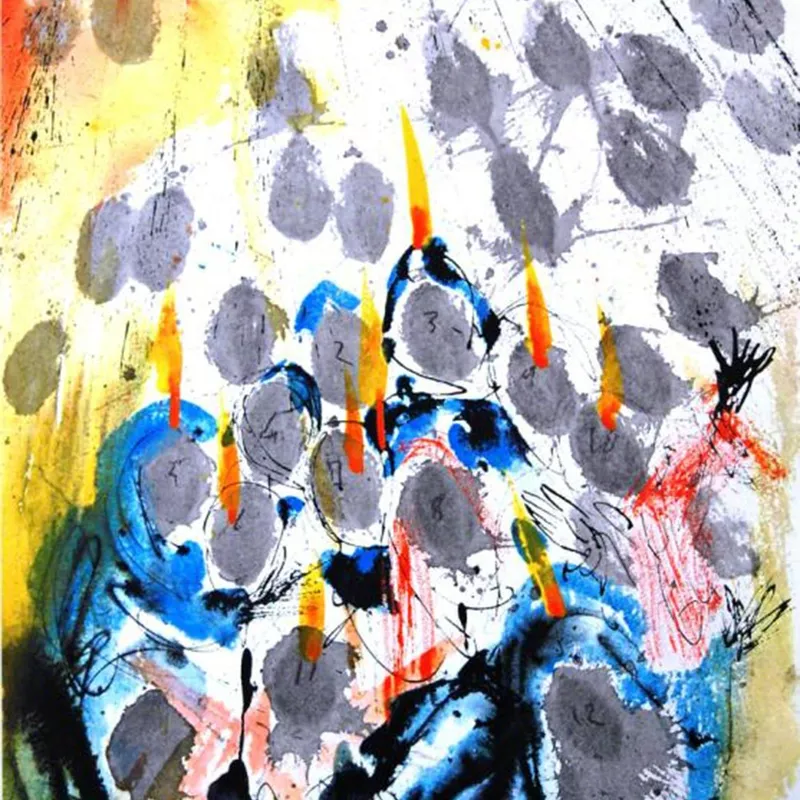
“There Appeared To Them Separated Tongues,” by Salvador Dali, 1967

Pentecost is often known as the birthday of the Church. It marks the time when the Holy Spirit came upon the fledgling believers in power. The disciple Peter, once a flaky up-and-down follower, was filled with the Spirit and spoke the Word of God boldly. His bold proclamation of repentance and faith in Jesus led directly to three-thousand persons added to the little band of one-hundred twenty.

And it didn’t stop there.

We live in an age where all believers in Jesus have the same Holy Spirit as our spiritual ancestors did. It’s an era of spiritual empowerment. The Church is called to reach the world with good news of forgiveness and grace through the person and work of Christ. 

So, then, the Church possesses confidence and security in knowing that the Spirit’s enablement and power is available for mission and spiritual care to the nations. It’s an immense calling that befits the bigness of God.

There are a wide range of Christian celebrations of Pentecost. Some churches do not recognize the holiday at all. Most churches at least mention it in prayer, song, or sermon. Other churches go all out, with worship focused on remembering the first Pentecost and praying for a similar outpouring of divine power. Churches that employ liturgical colors generally use red on Pentecost as a symbol of fiery spiritual power.

Pentecost reminds us that Christians are meant to live in the presence and power of the Holy Spirit, all the time. This day is a chance to confess our shortcomings and failures because of fear, apathy, and selfishness; and to ask for a fresh infusing and infilling of God’s wonderful Spirit. 

The Day of Pentecost flings every single believer into a congregational whole, the Church, and lets us know that we are not to be rugged individualists acting alone but are part of the Body of Christ. Therefore, we must renew our commitment to the Church for whom Christ died. 

The Spirit is ready to use us in forging spiritual bonds of kinship and solidarity. Pentecost throws disparate people together in a unified whole, made up of every kind of language, nationality, ethnicity, gender, and race.  We are all to use the gifts of the Spirit given to us for the benefit of building up one another.

We exist because of the Holy Spirit. Without the Spirit, there is no power source because the Spirit is the battery, the generator of the Christian life. We are to do all life and ministry through the power of the Spirit, equipping and encouraging each other, displaying the fruit of the Spirit, and worshiping the person of the Spirit in always being present with us.

Pentecost was (and is!) a watershed event. Worship, community, and outreach are the logical and collective responsibilities of each believer and every church around the globe.

Let us, then, recognize Pentecost and observe this day with heartfelt thanksgiving and a renewed impulse to exercise our spiritual abilities – graciously given to us by the Holy Spirit. Amen.

The Spirit of Faith, Not Fear (Romans 8:14-17)

Come Holy Spirit, by Ed de Guzman, 2014

For those who are led by the Spirit of God are the children of God. The Spirit you received does not make you slaves, so that you live in fear again; rather, the Spirit you received brought about your adoption to sonship. And by him we cry, “Abba, Father.” The Spirit himself testifies with our spirit that we are God’s children. Now if we are children, then we are heirs—heirs of God and co-heirs with Christ, if indeed we share in his sufferings in order that we may also share in his glory. (New International Version)

The distinguishing mark of the believer in Jesus Christ is the presence and power of the Holy Spirit. The Spirit is the sine qua non – the indispensable and most essential element – of the Christian life.

Christians are spiritual people, that is, people of the Spirit. Christianity is a religion dependent upon spiritual resources for life and godliness.

There is nothing more practical, beneficial, and enjoyable than the application of biblical truth to our lives each and every day.  

The Spirit’s work is to point us to Christ. The application of biblical truth is an experience of getting to know Jesus Christ better, and becoming ever more aware and involved with God. This involvement, characterized by faith, hope, and love, increasingly transforms every area of the Christian’s character and life. And it is the Spirit who helps us do it.

It is not God’s will that we fail in living the Christian life by succumbing to fear.  

Rather, it is God’s intention that believers have a robust faith which sings with gusto, connects meaningfully and vulnerably with other Christians, and a boldness to embody the good news of grace and forgiveness in Christ. To love God, and love the world, is to have a life of faith, not fear.

The successful Christian life is characterized by:

  • Experiencing inner transformation through suffering
  • Enjoying ministry and worship with others
  • Progressive deliverance from the power of sin
  • Continual enablement to live a holy life
  • Being an effective witness to the person and work of Jesus

Living this kind of life keeps believers from yielding to temptation. Life in the Spirit motivates us to read the Bible and pray; and to live above criticism and pretense.

The spiritual life helps others discern and understand what Christianity is all about. And, perhaps most importantly, life in the Spirit glorifies God, because we are then reflecting the joy and beauty of the Lord in all we do and say.

So, why don’t more Christians experience this kind of life-giving knowledge and joy? 

It is possible, even with the best of intentions in living a faithful and spiritually rich life, to be stonewalled or crippled with fear and anxiety. And in our fearful state, we almost always produce incorrect actions. These mistakes end up becoming barriers to living an enjoyable and productive Christian life. 

Here are just a few of the fearful and/or erroneous statements I have heard as a pastor over the years:

  1. It’s the pastor’s job to do all that stuff (as if parishioners can live vicariously through their pastor and not have to face their fears of failure)
  2. I don’t need to be a part of a church (as if it’s optional for Christians; and as if I can do it myself)
  3. I don’t like reading (as if this gets us off the hook to personally learn Holy Scripture)
  4. I think (or feel) _____ (as if my thoughts and opinions are the final authority concerning what I should do or not do).
  5. That’s nice advice (as if what is heard in a sermon or read in the Bible does not really need to be followed)
  6. God will lead people to Jesus (as if I have no responsibility for involvement with unbelievers)
  7. I sincerely believe ______ (as if sincerity makes something true)
  8. If I can’t do it 100% I won’t do it at all (as if service depends on my effort, and not on the Spirit’s power)
  9. I might screw it up; others can do it better than me (as if the word “grace” doesn’t exist in Christianity)
  10. That might work for you, but it doesn’t work for me (as if certain people are exceptions to the a spiritually successful life)

      What might you add to this list? 

      What are some of the hindrances which keep you from enjoying the Lord and living in faith?  

Fear disconnects us from the God of grace, that is, unless we acknowledge we are afraid and drink deeply from the fount of Scripture, letting the Holy Spirit be our divine mentor in leading us to Jesus, who is the way, the truth, and the life.

I sought the Lord, and he answered me
    and delivered me from all my fears.
Look to him, and be radiant,
    so your faces shall never be ashamed. (Psalm 34:4-5, NRSV)

Mighty and merciful God, I humble myself before you, trusting that you shall exalt me in due time. Therefore, I cast all my anxiety on you because you care for me. May the grace of the Lord Jesus be with all your people, along with the presence and power of the Holy Spirit. And may you conspire within yourself – Father, Son, and Spirit – to alleviate our fears and bolster our faith. Amen.

Jesus Shows Up (John 20:19-31)

Jesus shows himself to Thomas, by Rowan and Irene LeCompte

On the evening of that first day of the week, when the disciples were together, with the doors locked for fear of the Jewish leaders, Jesus came and stood among them and said, “Peace be with you!” After he said this, he showed them his hands and side. The disciples were overjoyed when they saw the Lord.

Again Jesus said, “Peace be with you! As the Father has sent me, I am sending you.” And with that he breathed on them and said, “Receive the Holy Spirit. If you forgive anyone’s sins, their sins are forgiven; if you do not forgive them, they are not forgiven.”

Now Thomas (also known as Didymus), one of the Twelve, was not with the disciples when Jesus came. So the other disciples told him, “We have seen the Lord!”

But he said to them, “Unless I see the nail marks in his hands and put my finger where the nails were, and put my hand into his side, I will not believe.”

A week later his disciples were in the house again, and Thomas was with them. Though the doors were locked, Jesus came and stood among them and said, “Peace be with you!” Then he said to Thomas, “Put your finger here; see my hands. Reach out your hand and put it into my side. Stop doubting and believe.”

Thomas said to him, “My Lord and my God!”

Then Jesus told him, “Because you have seen me, you have believed; blessed are those who have not seen and yet have believed.”

Jesus performed many other signs in the presence of his disciples, which are not recorded in this book. But these are written that you may believe that Jesus is the Messiah, the Son of God, and that by believing you may have life in his name. (New International Version)

When Jesus shows up, there is peace. Wherever Jesus goes, the Spirit of God is there. When Jesus appears, people believe.

The Meeting

After the crucifixion of Christ, the disciples were huddled together, mostly in fear of being found out and put out by the religious authorities. Out of nowhere, Jesus showed up, smack in the middle of the anxious group of men.

Christ in the center makes all the difference. From this central place, Jesus bestowed to the disciples his peace. The very first word the risen Christ spoke to his disciples was neither a command to stop being afraid, nor a rebuke for sitting around and doing nothing, or disappointment that they all ran away in the final hour of need at the crucifixion; instead, the first word of Christ was a gift of peace.

The presence and peace of Christ melted the disciples’ fear. Christ-centered peace is graciously given; so let us gratefully receive it.

The Reality

Jesus showed up, then showed off his hands and his side. He was not fabricated out of the disciples’ imagination; he was not some ghostly apparition. Rather, Christ was standing in the middle of them, very real, very physical, and very alive.

Christ gave his disciples real truth: actual wounded hands and side on a real body. Christ is risen and alive – not just spiritually, but physically. Since the resurrection of Jesus really happened, then nothing else matters; our joy is complete. We have what we need.

The Mission

As Jesus was sent by the Father, so Jesus sent his disciples; and is still sending us out into the world. And as Jesus came not to condemn the world but to save it, so we go out with words of grace and peace. The church exists for the life of the world – to bless it with the presence and peace of Christ.

“Whoever believes in me does not believe in me only, but in the one who sent me. The one who looks at me is seeing the one who sent me. I have come into the world as a light, so that no one who believes in me should stay in darkness.” (John 12:44-46, NIV)

Our spiritual DNA makes us little Christ’s walking around, doing the will of God, for the benefit of a world in darkness. We bear the name of Christ: Christians, proclaiming a message of life, delighting in God and creation; and not destroying the earth and its inhabitants.

The Gift

Right now, we are not alone. The Holy Spirit has been graciously given to us by Jesus. Although our mission is a big one, our resource for accomplishing it is even bigger. Jesus gives the Spirit in the same way he gives himself – as a sheer gift with no strings attached. Just as God breathed life into the very first people on earth, so Jesus breathes on the disciples and gives them new life and a new heart.

I will give you a new heart and put a new spirit in you; I will remove from you your heart of stone and give you a heart of flesh. And I will put my Spirit in you and move you to follow my decrees and be careful to keep my laws… and you will be my people, and I will be your God. (Ezekiel 36:26-28, NIV)

The Privilege

Christ has redeemed us, forgave us of our guilt and shame. Now, we have the privilege of passing the forgiveness to others. The special mission of the Church is giving Jesus to others with grace and peace, so that they may believe he is truly the risen Lord; and so, receive Jesus, the Spirit, forgiveness, and purpose in life, with Christ at the center of all things.

For the one whom God has sent speaks the words of God, for God gives the Spirit without limit. The Father loves the Son and has placed everything in his hands. Whoever believes in the Son has eternal life, but whoever rejects the Son will not see life, for God’s wrath remains on them.” (John 3:34-36, NIV)

The Risen Lord, by He Qi

The Appearance

When Jesus appears, its good if we also show up to see him. It seems Thomas was late for church and missed the beginning of the service. He wasn’t with the other gathered disciples. Nobody knows where he was or what he was doing. But the important thing is that he did eventually show up, because showing up is the beginning of a changed life.

The Witness

After Jesus showed up, the disciples bore witness to what they saw and heard to Thomas. Yet Thomas, bless his doubting heart, wasn’t having it. He’s a realist. He wants proof, some actual physical evidence. Thomas was clearly a tactile learner because he needs some touch to believe any of this crazy talk of his disciple brothers.

Sometimes Thomas gets a bad rap, but he is really our Everyman. Doubt and skepticism are an important part of a full-orbed and honest faith. Jesus gave Thomas some space, time, and respect to begin wrapping his head and heart around this new reality of resurrection. I wonder if we all can do the same with others.

The Middle

A second time, Jesus shows up in the middle of the disciples. The Word became flesh and dwelt among us – and didn’t become a ghost and hang out in secret places. Once again, peace is given by Jesus to his followers.

Both appearances happen on a Sunday (which is why Christians have always worshiped on Sundays); and both meetings are literally Christ-centered (which every Christian meeting is supposed to be). Every Sunday. Christ always in the middle. Keep those two, and keep them together, and you can’t go wrong.

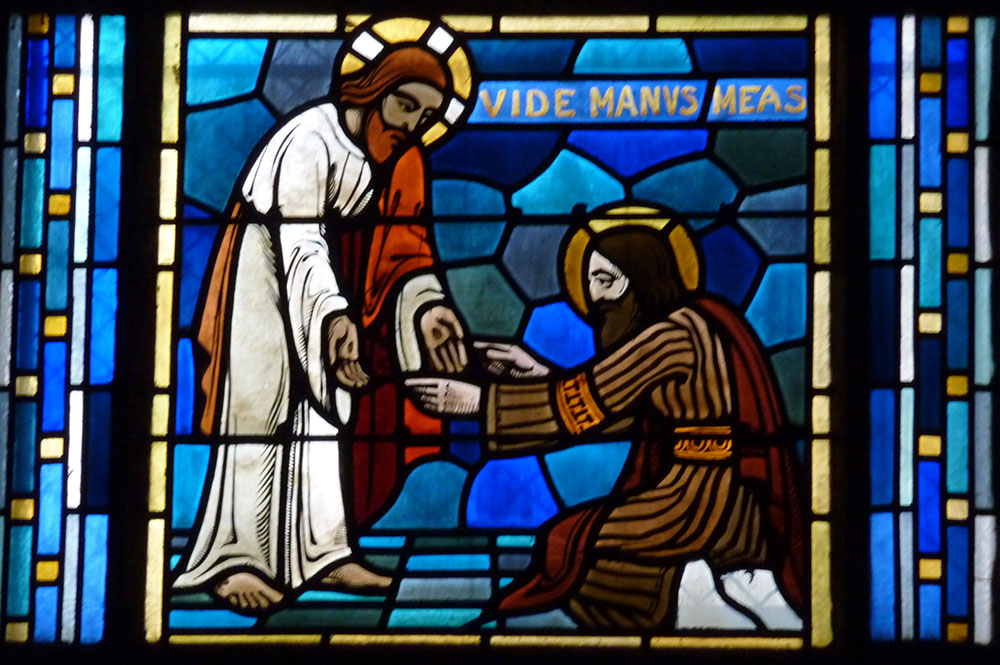
Jesus appears to Thomas with the Latin words, “See my hands,” in Notre-Dame-du-Rosaire Church, Saint-Ouen, France 

The Invitation

There’s no beating around the bush with Jesus. He immediately engaged Thomas and invited him to touch the wounds on his very real body. Christ knew Thomas’ hang-up, and went right to it. Thomas wanted evidence; Jesus offered it. If we get anything out of this encounter, it is that risen Christ honors honest doubt.

The evidence is here. Now believe it, and stop disbelieving. We have documentary evidence of the Old and New Testaments; the Church’s witness in Creeds, Confessions, and contemporary narratives of changed lives; and the internal testimony of the Holy Spirit. Therefore, look into them carefully and draw a sound conclusion.

The Confession

“My Lord and my God!” That’s the confession and the conclusion Thomas drew from the evidence – not only that Jesus is real, alive, existed, a good teacher; or other people’s Lord and God – but that he is my Lord and my God.

Jesus cared enough for Thomas to specifically meet him personally at his point of need. The grace of God keeps coming and never runs out. Jesus is filled up to the full in both grace and truth.

The Believer

Thomas had the physical evidence. But it doesn’t take that to truly believe. God blesses those who’ve never seen nor touched, but still believe. Jesus was thinking of you and me, and not only the people in front of him at the time. The Lord Jesus blesses us with the gift of peace, grace, and faith.

Though you have not seen him, you love him; and even though you do not see him now, you believe in him and are filled with an inexpressible and glorious joy, for you are receiving the end result of your faith, the salvation of your souls. (1 Peter 1:8-9, NIV)

The Conclusion

All this is for our benefit, so that we, too, may believe that Jesus is the Christ, the Son of the living God. Since Jesus is alive, he continues to bless us with his presence, power, and peace.

Jesus is with us:

  • through the Word of God, giving us his peace, showing up and meeting needs people.
  • at the Table in the sacrament of communion, bringing grace and forgiveness
  • in the person of the Holy Spirit, enabling and energizing us for mission and ministry to the world

It’s a life worth living, a Christ-centered life, full of God’s blessing.

O God and Father of our Lord Jesus Christ, in whom we receive the legacy of a living hope, born again not only from his death but also from his resurrection. May we who have received forgiveness of sins, set others free, until we enter the inheritance that is imperishable and unfading, where Christ lives and reigns with you and the Holy Spirit, one God, now and forever. Amen.