Psalm 119:97-104 – God the Teacher

I deeply love your Law!
    I think about it all day.
Your laws never leave my mind,
    and they make me much wiser
    than my enemies.
Thinking about your teachings
    gives me better understanding
    than my teachers,
and obeying your laws
makes me wiser
    than those
    who have lived a long time.
I obey your word
    instead of following a way
    that leads to trouble.
You have been my teacher,
    and I won’t reject
    your instructions.
Your teachings are sweeter
    than honey.
    They give me understanding
    and make me hate all lies. (CEV)

We live in a wonderful, complex, beautiful, broken, and upside-down world. The information we access, the choices we make, and the networking we engage in all require a great deal of wisdom.  Throw into the mix the reality that most things rarely go as we plan, and you have a recipe for disappointment and/or frustrating anger.  So, is there a path, a way of approaching this world that can help us navigate all its twists and trials?  Yes, there is a light through it all. Today’s psalm informs us how to proceed.

Wisdom in the Old Testament is the ability to take revealed truth and put it into concrete daily practice. So then, a life marked by the love and study of God’s Word brings both right living and enjoyment. God is our teacher and faithfully guides us into grateful living through his promises and commands. We can put ourselves in a position to sit at the master’s feet and receive gracious instruction for life.

Lectio Divina is one way of doing just that: allowing God to teach us through his Holy Word. Lectio Divina is an ancient Latin term which means “spiritual reading.”  It means to read Holy Scripture not just to know its contents, but to experience its power to restore, heal, transform, provide wisdom, and draw close to God. 

Lectio Divina is a simple way to prayerfully read the Bible, meditate on its message, and listen for what God may be saying for us to do.  It can be done privately, or with a small group of people.  The goal for the Christian is to become more Christ-like.

Lectio Divina is based upon reading a selected text of Scripture three times. Each reading is followed by a period of silence after which each person is given the opportunity to briefly share what they are hearing as they listen to God (if done in a group).

First Reading

During the first reading, read the text aloud twice. Read slowly and carefully. The purpose of the first reading is for each person to hear the text and to listen for a word, phrase or idea that captures their attention. As group members recognize a word, phrase, or idea, they are to focus their attention on it, repeating it within their minds several times.

Second Reading

During the second reading, read the text again. This time, listeners are to focus their attention on how the selected word, phrase or idea speaks to their life that day. What does it mean for you today? How is Christ, the Word, speaking to you about your life through this word, phrase, or idea? What is Christ, the Word, speaking to you about your life through this word, phrase, or idea? After the reading, a brief period of silence is observed and then group members share briefly what they have heard.

Third Reading

Read the text again. This time, listeners are to focus on what God is calling them to do or to become. Experiencing God’s presence changes us. It calls us to something. During this final reading, focus on what God is calling you to do or to be.  After the third reading, there is a period of silence, then group members share what they are being called to do or to be.

The psalms, especially Psalm 119, are meant to be read over-and-over again, to be used for prayer, worship, and study. Devoting ourselves to the psalms and grafting them into our lives is one of the best practices we can do to live a healthy and happy spiritual life.

Almighty God extend your goodness to me according to your Holy Word. Teach me knowledge and good judgment because I trust your commands. I seek to obey your wondrous Word. You are good, and what you do is always good. Teach me your decrees through Jesus Christ my Lord in the wisdom of your Holy Spirit. Amen.

Hebrews 2:1-9 – Paying Attention

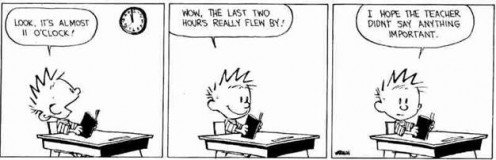
Calvin and Hobbes - paying attention

We must pay the most careful attention, therefore, to what we have heard, so that we do not drift away. For since the message spoken through angels was binding, and every violation and disobedience received its just punishment, how shall we escape if we ignore so great a salvation? This salvation, which was first announced by the Lord, was confirmed to us by those who heard him. God also testified to it by signs, wonders, and various miracles, and by gifts of the Holy Spirit distributed according to his will.

It is not to angels that he has subjected the world to come, about which we are speaking. But there is a place where someone has testified:

“What is mankind that you are mindful of them,
a son of man that you care for him?
You made them a little lower than the angels;
you crowned them with glory and honor
     and put everything under their feet.”

In putting everything under them, God left nothing that is not subject to them. Yet at present we do not see everything subject to them. But we do see Jesus, who was made lower than the angels for a little while, now crowned with glory and honor because he suffered death, so that by the grace of God he might taste death for everyone. (NIV)

My wife and three daughters all have attention deficit disorder (A.D.D.). Although many people believe this to be a disadvantage, I have noticed that since their brain chemistry doesn’t have a good filter for filtering all the stimuli they hear each day, each of them are much more intentional about picking out the voice they want to hear and engaging with it.  Whereas you and I might take this for granted, the women in my life know the value of creating the skills to pay attention.

The ability to pay attention and listen is necessary for a sustainable Christian life. The consequence of not developing such competency is that we will drift away – our minds will wander and allow other competing voices to overwhelm the singular voice of Jesus.  Taking salvation for granted may be setting us up for spiritual failure. That is, we think we already know about Christ’s person and work, so we neglect to really pay attention. Bad idea.

Assuming we are paying attention is not the same thing as actually doing it. Assumptions lead to drifting away from truth.  We are meant to have continual reminders of Christ’s redemptive events. We are to avoid the precarious position of being lost in a sea of competing voices. We need an intentional plan for paying attention without assuming we will be focused. Along with paying attention to our physical health and being vigilant about keeping the coronavirus at bay, here are a few ways of daily being mindful of our spiritual health:

  • Read the Scripture each day with a combination of standing and sitting, reading silently and out loud.
  • Hold a cross or other Christian reminder in your hand and feel free to fidget with it.
  • Journal your thoughts in a notebook.
  • Set a consistent time and place for bible reading and prayer.
  • Use different translations and versions of the Bible to read.
  • Go outside occasionally and pray while walking.
  • Focus on your breathing, and consider using breath prayers, i.e. Breathe out: “Speak Lord.” Breathe in: “I am listening.”
  • Drink some coffee, tea, or something soothing, and picture the comfort of Christ coming into your life.
  • Be aware of distractions and acknowledge them without judging yourself.
  • Observe the Christian Year and the Daily Lectionary.

While some might argue that observing Lectionaries, the Church Calendar, Christian seasons, and worship liturgies are vain repetition, I insist otherwise: We are in grave danger of not paying attention to what we have heard, lest we drift away from it.  Like a beach goer on the lake drifting on her flotation device far out from shore, we can be unaware of how far we have strayed from our spiritual moorings.  If the passion and death of Jesus can only get a shoulder shrug and a “meh” out of us, there is a real problem.

Forming habits of worship, fellowship, service, and piety are essential to deliberately maintaining attention to Jesus. Perhaps if we all had spiritual A.D.D. we would be more intentional about grafting reminders and practices into our lives.

Ignorance does not come from a lack of education; it comes from a failure to pay attention to the most important things in life.

God pays attention to us in a special way, different from all other creation. As the only creatures for whom the image and likeness of God resides, we have an innate sense of connection with the divine. Paying attention to things, especially to what Christ has secured for us through the cross, reflects the God who is continually observing humanity.

May your contemplation of Christ and his redemptive events of incarnation, holy life, teaching, death, resurrection, and ascension be always fresh and continually meaningful.

Soli Deo Gloria.

Psalm 119:105-112 – Light for the Journey

Your Word is a Light

Your word is a lamp to guide my feet 
    and a light for my path. 
I’ve promised it once, and I’ll promise it again: 
    I will obey your righteous regulations. 
I have suffered much, O Lord; 
    restore my life again as you promised. 
Lord, accept my offering of praise, 
    and teach me your regulations. 
My life constantly hangs in the balance, 
    but I will not stop obeying your instructions. 
The wicked have set their traps for me, 
    but I will not turn from your commandments. 
Your laws are my treasure; 
    they are my heart’s delight. 
I am determined to keep your decrees 
    to the very end. (NLT) 

Two qualities which stand out to me in these verses are the psalmist’s attitude and affection. This is a person who is determined to hold onto God’s Word because it is his heart’s delight. Yes, our attitudes and our affections are meant to be like a hand in a glove. It is our attitudes which help us to push through the pain to realize better days. And it is our affections which drive us forward, allowing us to experience joy in the present moment as we await our hope of ultimate deliverance. 

Commitments are fluid, always moving – which means they need to be continually rehearsed and refreshed. We are constantly either fulfilling our promises or reneging on them. There is really no such thing as a one-time vow. Commitments must have reinforcement from our attitudes and our affections. Otherwise, they languish on the trash heap of good intentions. This is one reason why the psalms are designed for constant use. 

It is important to have spiritually healthy habits ensconced in our lives well before any suffering and hard times roll in. If we have been nourished and supported by a daily sustenance of God’s Word, then we have both a breadth and a depth of robust theology to draw upon when the going gets rough. In addition, the sheer force of habit brings us back again and again to the treasure chest of divine instruction which informs our decisions and illuminates the treacherous road ahead. 

All the psalms are designed to reframe our own difficult situations. Even and especially when a person’s life hangs in the balance, we have the opportunity of viewing such hard and awkward circumstances through the window of the psalmist. Although circumstances change and we never quite know what to expect, God’s Word remains as our ballast and our rock. Divine love and morality are unchanging. Jesus Christ is the same yesterday, today, and forever. The Spirit is always with us, through each wave of hardship. 

Life is a continual journey, an exploration into the unknown of the future. The path is shadowy and unclear. We are unsure of what is just around the bend. Yet, God’s Word is like a never-ending flashlight helping us navigate forward. Maybe Jesus had this psalm in mind when he said:  

“I am the light of the world. Whoever follows me will never walk in darkness but will have the light of life.” (John 8:12, NRSV) 

In the Christian tradition, the Word is embodied in Jesus Christ so that he is both example and fulfillment of all God’s promises. Within today’s psalm, a sequence of four metaphors runs through these verses: my feet (light for my feet to walk in the way of God); my mouth (deliberate verbal commitment to God’s words); my hands (doing God’s will despite the circumstances); and my heart (desiring God’s decrees and commands).

With Jesus as Word and Light we have a constant companion walking alongside us for the journey; we have an intercessor who takes our wordy or malformed prayers and presents them before our heavenly Father; we use our hands by observing the Master who washed the feet of others; and, our hearts find their rest in the One who loved us and gave himself for us. 

In sum, our attitudes and affections are transformed into sustainable faith for the long journey; our hope is made sure through the promises of God; and, our love finds a resting place in the person of Jesus. Faith, hope, and love are the shoes which enable us to walk the long hard road uphill, as well as absorbing the shock as we run with abandon downhill – into the loving arms of God. 

soap

Let us come to Holy Scripture and liberally digest its life-giving message. I encourage you to find what works best for you in developing helpful spiritual habits. In reading the Bible, I often take the following approach using the acronym S.O.A.P…. 

Scripture 

  • Open your Bible and slowly, meditatively, read the portion of Scripture in your reading plan for today.
  • Write the reference of what you read in a journal along with the date.
  • As you read, ask God’s Spirit to highlight the verse(s) that speak to your life and write it in your journal.

Observation 

  • Make observations about what you just read and write them in your journal.
  • Think about: What is going on? What is the context?  Who are the people being spoken to? What is the background or setting for this verse?
  • Paraphrase and write this scripture down in your journal, in your own words.
  • What do you think God is saying to you in this scripture?

Application 

  • Personalize what you have read by asking yourself how it relates to your life right now.
  • Ask yourself how you can apply what you just read to your own life and write it in your journal.
  • Ask yourself how your life will be different or changed as a result of God speaking to you in this Scripture.

Prayer 

  • Write out a prayer to God in your journal.
  • Your prayer should relate to the verse that you highlighted. It could be asking for help, thanking God, etc. Write down what your heart desires to say to God in response to his Word.

May the words of your mouth, the meditations of your heart, the work of your hands, and the movement of your feet be to the glory of Jesus Christ. Amen.