
Pray with Persistence (Luke 11:1-13)

He [Jesus] was praying in a certain place, and after he had finished, one of his disciples said to him, “Lord, teach us to pray, as John taught his disciples.” So he said to them, “When you pray, say:

Father, may your name be revered as holy.
    May your kingdom come.
    Give us each day our daily bread.
    And forgive us our sins,
        for we ourselves forgive everyone indebted to us.
    And do not bring us to the time of trial.”

And he said to them, “Suppose one of you has a friend, and you go to him at midnight and say to him, ‘Friend, lend me three loaves of bread, for a friend of mine has arrived, and I have nothing to set before him.’ And he answers from within, ‘Do not bother me; the door has already been locked, and my children are with me in bed; I cannot get up and give you anything.’ I tell you, even though he will not get up and give him anything out of friendship, at least because of his persistence he will get up and give him whatever he needs.

“So I say to you, Ask, and it will be given to you; search, and you will find; knock, and the door will be opened for you. For everyone who asks receives, and everyone who searches finds, and for everyone who knocks, the door will be opened. Is there anyone among you who, if your child asked for a fish, would give a snake instead of a fish? Or if the child asked for an egg, would give a scorpion? If you, then, who are evil, know how to give good gifts to your children, how much more will the heavenly Father give the Holy Spirit to those who ask him!” (New Revised Standard Version)

If we desire to see the power of prayer become a reality in our lives, we will have to avoid drive-by prayers in favor of sustained and focused prayers taught to us from the Lord Jesus.

Prayer empowered Jesus in his earthly ministry. His disciples saw this, and wanted it, too. So, Christ encouraged them in what to pray, and to keep persistently praying, despite the circumstances.

We are instructed by Jesus to approach the heavenly Father just as he himself did – in a straightforward and intimate manner. The content of our prayers ought to encompass the following five petitions:

  • Let God’s name be made holy. In other words, we are to let the Lord’s name be seen by others as holy within us in our daily lives. This is a petition for God to establish divine sovereignty and holiness in the heart of the believer. When this happens, the name of God is exalted and set apart as holy before a watching world.
  • Let God’s kingdom come. This is a prayer that asks for the reign of God to extend over the entire earth in a very practical way – to have God’s rule draw near to everyone and everything, including ourselves.
  • Let us have our daily bread. That is, pray that God will give us everything we need for life and godliness in this present evil age, including physical sustenance, mental acuity, emotional intelligence, and spiritual food. None of us lives by bread alone, but by every word that proceeds from the mouth of God.
  • Let forgiveness come. Sin is a reality. Therefore, every one of us needs forgiveness; and everyone needs to forgive others. Forgiveness is powerful; it releases us to freedom. And thus, we have the power to release others through the act of forgiving the egregious sins of others. The failure to do this is why the kingdom of God is so disestablished in this world.
  • Let us not become victims of the cosmic conflict. There is a continual struggle of unseen powers on this earth that no human is armed to deal with. Apart from God’s intervention, humanity gets caught in the crosshairs of the conflict. We are to pray that this trial does not overcome us.

These prayers are to be consistently and persistently prayed every day. Christ wants us to keep asking, seeking, and knocking.

Jesus, in his teaching ministry on earth, often used the lesser-to-greater argument in getting his point across. And that is precisely what he was doing with his disciples in today’s Gospel lesson by instructing them about the nature and motivation of prayer.

The lesser-to-greater argument implies a comparison of values. It’s grounded on a common sense and logical convention that if this lesser thing is true, then, of course, how much more is this greater thing!

If something less likely to happen is true, then something more likely to happen will probably be true as well. The technical phrase for this is an argument a fortiori – a Latin term meaning, “for a still stronger reason.”

Jesus wanted his followers to understand that prayer has value because God is a loving Father, not a begrudging friend. Whereas the friend in the story was badgered just so the person could get some real necessities, God needs no badgering to generously give good gifts that may or may not be considered as necessities by us.

Jesus desired to highlight that prayer has veracity because of whom those prayers are directed.

In the ancient world, it was common understanding you needed to get the local gods attention if you wanted something. Which is why, for example, in the prophet Elijah’s showdown with the prophets of Baal, that Baal’s worshipers were yelling, gesticulating, and even cutting themselves for hours. They fully expected to put a lot of work into getting Baal’s attention, maybe even needing to convince him of intervening in their ancient version of a wild West shootout.

In contrast to four-hundred prophets of Baal, a single prophet of the Lord utters one simple prayer, then fire comes rushing down from heaven. Much like the person who badgered the friend for bread, the prophets pestered Baal for hours. (1 Kings 18)

In Christ’s story, it all comes down to who really cares. The friend? Not enough to jump out of bed right away and meet a need. Baal? Not so much. God? Now we’re talking.

We typically don’t ask, seek, or knock, if we believe we will not get a response – or if it will take a lot of energy, time, and effort we don’t have. Yet, if we are confident of being heard and our requests taken seriously with care, then we are likely to have a habit of asking, seeking, and knocking.

If a friend begrudgingly gives to you because of persistent knocking, how much more will God graciously, generously, and with gaiety give you goodness when you ask?

Because God is good, God gives. The largess of the Lord is willing and ready to dispense grace from an infinite storehouse of mercy.

This is why Jesus encouraged people to not pray like those who don’t know God, babbling on because they think they’ll be heard because of the sheer volume of words. (Matthew 6:7-8)

Two misconceptions of prayer existed in Christ’s day (and today); they come from non-Christian sources:

  1. There must be a lot of prayer before prayer “works.” Although I believe repetition is important for forming good habits, praying the same prayers over and over again so as to be heard betrays an ignorance of God, not to mention an actual lack of faith. Many ancient religions were based in learning how to manipulate the spiritual forces out there to get what we need. It’s kind of like a divine version of hustling for love in all the wrong places. Christians need to know they don’t need to have thousands of people praying in order to get God’s attention to answer prayer.
  2. I must convince God of the need to answer my prayer. God is not a reluctant listener. The reason the Lord already knows what we need before we ask is because God has been paying close attention to us well before we got around to asking, seeking, and knocking on the divine door. God’s ear is already inclined to hear us – expectantly and anxiously awaiting our petitions. This is a tremendously freeing idea, that I can come to God openly and honestly, without drudgery, and without wondering if I am heard, or not.

May we be encouraged to pray, to truly connect with God, because the Lord is available without appointment, and is waiting for us to ask with bended ear.

Eternal God, by whose power we are created and by whose love we are redeemed: Guide and strengthen us by your Spirit so that we may give ourselves to your service and live today and every day in love to one another and to you, through Jesus Christ our Lord, in the strength of the Holy Spirit. Amen.

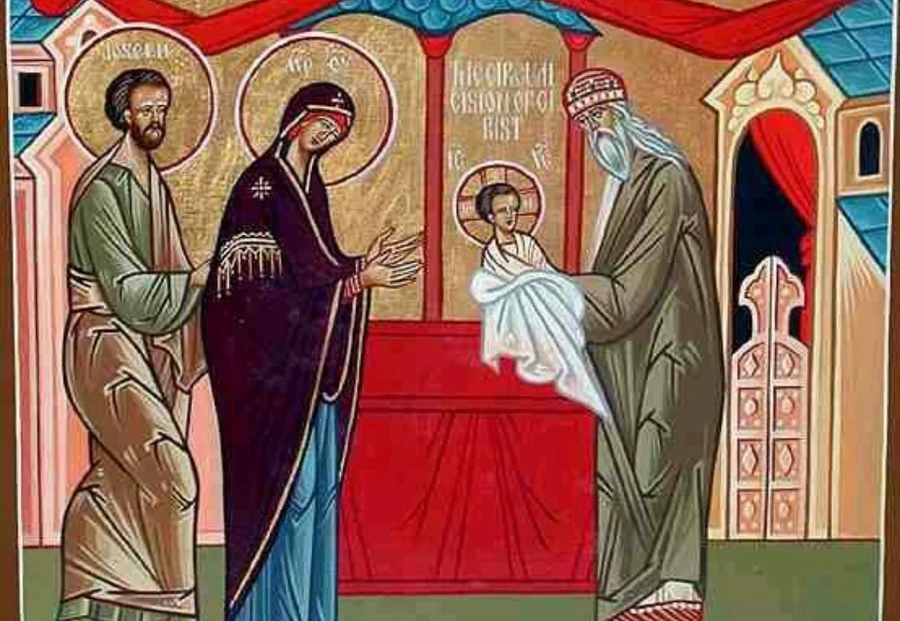
The Holy Name of Jesus (Luke 2:15-21)

Orthodox depiction of the circumcision and naming of Jesus

When the angels had left them and gone into heaven, the shepherds said to one another, “Let us go now to Bethlehem and see this thing that has taken place, which the Lord has made known to us.” So they went with haste and found Mary and Joseph and the child lying in the manger. When they saw this, they made known what had been told them about this child, and all who heard it were amazed at what the shepherds told them, and Mary treasured all these words and pondered them in her heart. The shepherds returned, glorifying and praising God for all they had heard and seen, just as it had been told them.

When the eighth day came, it was time to circumcise the child, and he was called Jesus, the name given by the angel before he was conceived in the womb. (New Revised Standard Version)

“The Holy Name of Jesus” is a celebration, observed by some Christian traditions, each year on January 1 – which is the eighth day after the birth of Jesus, when he was named and circumcised at the temple in Jerusalem.

An angel of the Lord appeared to him in a dream and said, “Joseph, son of David, do not be afraid to take Mary as your wife, for the child conceived in her is from the Holy Spirit. She will bear a son, and you are to name him Jesus, for he will save his people from their sins.” (Matthew 1:20-21, NRSV)

In the Law of Moses, all male infants are to be circumcised on the eighth day after their birth (Leviticus 12:3). Throughout most of the history of the Christian Church, January 1 has been celebrated as a feast day devoted to the naming of Jesus.

The name “Jesus” comes from the Hebrew Yeshuah (Joshua) which means “Yahweh will save.” It is a name fitting for the person and work of Christ.

Therefore God exalted him even more highly
    and gave him the name
    that is above every other name,
so that at the name given to Jesus
    every knee should bend,
    in heaven and on earth and under the earth,
and every tongue should confess
    that Jesus Christ is Lord,
    to the glory of God the Father. (Philippians 2:9-11, NRSV)

Faith is always followed by obedience. So, the faith of Joseph and Mary in believing the words of the angel Gabriel, translated into the obedient naming of their son as “Jesus.” (Luke 1:31-32)

Jesus, bearing the name of savior, is holy in every way. Not only does the name of Jesus point to his divinity – because of his miraculous conception by the Holy Spirit – but it also directs us toward the special mission for which he entered this world.

Jesus Christ, the Son of God, and Son of Humanity, is God’s agent of deliverance for both Israel and the whole world.

“Do not be afraid, for see, I am bringing you good news of great joy for all the people: to you is born this day in the city of David a Savior, who is the Messiah, the Lord….” (Luke 2:10-11, NRSV)

The Gospel writer Luke provides us with a birth narrative “pregnant” with theological information and importance:

  • Jesus has divine sonship, and possesses the status of king (Luke 1:31-35)
  • Jesus comes from the city of David, which is Bethlehem, not Jerusalem (Luke 2:4, 11)
  • Jesus is described by the angel Gabriel as Son of the Most High, Son of God, Savior, Messiah, and Lord; each of these titles direct us to his identity and mission (Luke 1:32, 35; 2:11)

I like the collective response of the shepherds, after they received heavenly good news from a group of angels.

They could have dismissed the entire thing as having drunk too much brandy on a brisk winter night. They could have kept the whole affair to themselves, reasoning that nobody would believe a bunch of stinky shepherds.

Instead, much like Mary who hurried off to Elizabeth after receiving the angelic message, the shepherds dropped everything to go and see the feeding trough with a newborn baby wrapped in swaddling cloth.

In other words, the shepherds belief in what they heard and experienced, quickly translated into action. It was only appropriate that it was shepherds who discovered the newborn king, the Son of David, himself a shepherd who was anointed by God.

The shepherds went and followed the signs given to them by the angel. And they believed. A motley group of shepherds returned to their fields, kicking up their heels, praising and glorifying God. They knew that things would never be the same again.

The name of Jesus is holy, simply because the Lord Jesus Christ is the Holy One. Christians recognize Jesus as Savior, the fulfillment of all God’s promises. His singular birth, life, death, resurrection, and ascension is exactly, I believe, what this old fallen world is most in need of.

It is never too late to resolve knowing Jesus. At the beginning of this year, there is perhaps no better resolution to make, again and again, of knowing Jesus Christ and honoring his holy name.

Eternal Father, you gave to your incarnate Son the holy name of Jesus to be the sign of our salvation. Plant in our hearts the love of Jesus, truly God and truly human, and grant that we may praise and bless your Holy Name with our whole mind, heart, body, and spirit, that we may know your boundless compassion and mercy. In Christ’s name, we pray. Amen.

Wise Living Is Clean Living (Proverbs 15:1-17)

A gentle answer quiets anger, but a harsh one stirs it up.

When wise people speak, they make knowledge attractive, but stupid people spout nonsense.

The Lord sees what happens everywhere; he is watching us, whether we do good or evil.

Kind words bring life, but cruel words crush your spirit.

It is foolish to ignore what your parents taught you; it is wise to accept their correction.

Righteous people keep their wealth, but the wicked lose theirs when hard times come.

Knowledge is spread by people who are wise, not by fools.

The Lord is pleased when good people pray, but hates the sacrifices that the wicked bring him.

The Lord hates the ways of evil people, but loves those who do what is right.

If you do what is wrong, you will be severely punished; you will die if you do not let yourself be corrected.

Not even the world of the dead can keep the Lord from knowing what is there; how then can we hide our thoughts from God?

Conceited people do not like to be corrected; they never ask for advice from those who are wiser.

When people are happy, they smile, but when they are sad, they look depressed.

Intelligent people want to learn, but stupid people are satisfied with ignorance.

The life of the poor is a constant struggle, but happy people always enjoy life.

Better to be poor and fear the Lord than to be rich and in trouble.

Better to eat vegetables with people you love than to eat the finest meat where there is hate. (Good News Translation)

Here is today’s Proverbs lesson in my own colloquial words:

A calm and kind response sucks the anger out of the room, but hot-headed words set the place on hellfire.

A level-headed person gives helpful answers, but a know-it-all only keeps on babbling nonsense.

Just because you cannot see God, doesn’t mean that God cannot see you, both the good and the bad.

Kind words given to another person are life-giving, but unkind words catapulted at a person ends up crushing their spirit.

You can tell a fool by how their refusal to accept counsel from their parents, but a wise person freely receives parental instruction.

Wise folk understand they need to save for a rainy day, but fools spend everything they have, then wonder why they’re in dire straits.

Wisdom and common sense are akin to one another; foolishness and nonsense are two peas in a pod.

The Lord perks up when the righteous pray, but does a face palm when the wicked offer up anything.

The ways of evil people make the Lord nauseous, but the way of the righteous is delightful to God.

A stupid dog doesn’t live very long, because he won’t heed his training or learn from any natural consequences.

If God can see everything that goes on with death and destruction, why would not the Lord see all things within your own heart?

Prickly people won’t listen to advice, and they refuse to consult anyone when making decisions.

Truthful persons smile when they’re happy and frown when they’re sad, but falsehood smiles when it’s sad and frowns when it’s happy.

Learners are curious about life, but ignorant folk only feed on tabloid information.

Once in survival mode, it’s hard to ever get out of it; but those who thrive have learned how to be content in any circumstance.

It’s a whole lot better to be poor and right with God, than to be rich and on the wrong side of the Lord.

Peanut butter sandwiches eaten on the floor with love are much more delicious than eating a filet mignon with hatred around the table.

Our words reflect what is truly the attitude of our heart. And our attitudes betray what we actually think about God and others.

If you drop a foolish person into a roomful of people, it’s like putting a rotten egg in with the rest of the eggs when making an omelet. Or, to put it according to an old adage, “One bad apple spoils the whole bushel basket of them.”

This is why it’s the responsibility of everyone to develop wisdom and a virtuous life. A faith community, a neighborhood, a workplace, a family, or any group of people are adversely affected whenever there’s one arrogant fool amongst them.

But just as he who called you is holy, so be holy in all you do; for it is written: “Be holy, because I am holy.” (1 Peter 1:15-16, NIV)

It only takes one drop of arsenic to ruin a gallon of water and make it undrinkable. And if you choose to drink it anyway, well, you’ll suffer the consequences.

And this is why purity of heart, righteousness, justice, and goodness are so very important. It’s also why holiness is placed as a premium in Holy Scripture, because impurity ruins the community and defiles any group of people.

For where you have envy and selfish ambition, there you find disorder and every evil practice. But the wisdom that comes from heaven is first of all pure; then peace-loving, considerate, submissive, full of mercy and good fruit, impartial and sincere. Peacemakers who sow in peace reap a harvest of righteousness. (James 3:16-18, NIV)

Wise living is clean living, in every sense of a person’s complete self – in body, mind, emotions, and spirit. The Book of Proverbs can help us with that.

O God, by whom the meek are guided in judgment, and light rises up in darkness for the godly: Grant us, in all our doubts and uncertainties, the grace to ask what you would have us to do, so that the Spirit of wisdom may save us from all false choices, and that in your light we may see light, and in your straight path may not stumble. Amen.

Jesus Prays For Us (John 17:6-19)

Word of Life, by Millard Sheets

“I have made your name known to those whom you gave me from the world. They were yours, and you gave them to me, and they have kept your word. Now they know that everything you have given me is from you, for the words that you gave to me I have given to them, and they have received them and know in truth that I came from you, and they have believed that you sent me.

I am asking on their behalf; I am not asking on behalf of the world but on behalf of those whom you gave me, because they are yours. All mine are yours, and yours are mine, and I have been glorified in them. And now I am no longer in the world, but they are in the world, and I am coming to you.

“Holy Father, protect them in your name that you have given me, so that they may be one, as we are one. While I was with them, I protected them in your name that you have given me. I guarded them, and not one of them was lost except the one destined to be lost, so that the scripture might be fulfilled. 

But now I am coming to you, and I speak these things in the world so that they may have my joy made complete in themselves. I have given them your word, and the world has hated them because they do not belong to the world, just as I do not belong to the world. 

“I am not asking you to take them out of the world, but I ask you to protect them from the evil one. They do not belong to the world, just as I do not belong to the world. Sanctify them in the truth; your word is truth. As you have sent me into the world, so I have sent them into the world. And for their sakes I sanctify myself, so that they also may be sanctified in truth. (New Revised Standard Version)

It seems to me only fitting that Jesus concluded his time with the disciples in the Upper Room before his betrayal, crucifixion, and death with prayer. It also seems to me that if you really want to know the heart of a person, listen to them pray.

The prayer of Jesus was thoroughly oriented toward the spiritual needs of his followers – even potential believers who will follow him in the future. And it was a prayer completely devoted toward honoring the heavenly Father through praying consistent with God’s will for this world.

Without the physical presence of Jesus – which would soon be gone – his followers would have to rely on prayer. And Christ was intent on instilling within his disciples the confidence and hope they needed for a solid life of prayer.

For post-resurrection Christians living in an ever-expanding world of oppression, greed, and indifference, we can be encouraged not to settle into despair or loneliness. Why? Because believers can have a solid hope and an abiding trust in the continuing presence of Jesus by means of the Holy Spirit.

God Gives

God gives. Jesus gives. Both the Father and the Son are givers. This is a major reason and motivation for prayer because God is not a reluctant giver. In the act of giving, the Father and the Son are fully on the same page; God is ready and willing to give. The Holy Trinity – Father, Son, and Spirit – are in complete unity, and act as One, in giving to us what we need.

“Those who drink of the water that I will give them will never be thirsty. The water that I will give will become in them a spring of water gushing up to eternal life.” (John 4:14, NRSV)

“Do not work for the food that perishes but for the food that endures for eternal life, which the Son of Man will give you.” (John 6:27, NRSV)

“I give them eternal life, and they will never perish. No one will snatch them out of my hand.” (John 10:28, NRSV)

We Belong

Through giving we are included. Believers and followers of Jesus – having been given the grace of faith – know that they belong to God. Christians are in union with Christ. The redemption which Jesus has secured is a million billion times stronger, and bonds us closer, than any sort of Gorilla glue. And, what’s more, once we belong, we are never forgotten, but always remembered by God.

“The Father knows me, and I know the Father. And I lay down my life for the sheep. I have other sheep that do not belong to this fold. I must bring them also, and they will listen to my voice. So there will be one flock, one shepherd.” (John 10:15-16, NRSV)

Christ the King, statue in Swiebodzin, Poland

The Name of Jesus

Because we belong, we know God’s name. The divine name stands for all that God is and all that God has done. It’s all focused in Christ. In the name of Jesus, through the person and work of Jesus Christ, we have everlasting life, spiritual power, and eternal security.

Now Jesus did many other signs in the presence of his disciples that are not written in this book. But these are written so that you may continue to believe that Jesus is the Messiah, the Son of God, and that through believing you may have life in his name. (John 20:30-31, NRSV)

We Have the Word

The Word became flesh and dwelt among us (John 1:14). Jesus has given to his disciples only those words which he first received from the Father. Those who accept the enfleshed Word and his words have been given power to become God’s children (John 1:12). Because believers belong to God, they know the truth and that truth has set them free.

It is the Christian’s mission to live into the words and ways of Jesus, to follow Christ in thought, word, and deed. The very glory of Jesus in his cross and resurrection is focused within the believing community, who is in union with Christ and belongs to God.

In his prayer, Jesus claimed an intimate oneness in the sharing of concern for people who are the objects of the Father’s gracious giving of love through the Son. All who belong to Christ belong to God, and vice versa. All the love that went into the cross was poured out upon us.

Those who believe in the name of Jesus Christ are the very glory of Jesus, and thus, the glory of God.

Sent Into the World

Because of the Father’s name—because of who the Father is and what the Father has given in love to the Son—we are set apart for truth; the words of God are truth.

Since we belong to God and bear the name of Christ, we don’t belong to the world’s systems of guilt, shame, injustice, and evil. And yet, we are separated from the world for precisely the reason of immersing ourselves in the world. In other words, Christianity is meant for the life of the world, and not as a religion that’s only concerned for itself.

To reach the world, we must be different from it. To reach the world, we need to have boots-on-the-ground in it. To reach the world, Christians are to be both far from the world, and near to the world.

As the Father sent the Son, so the Son sends us into the world – not to be like the world, but to embody the words and ways of Jesus to and for the world.

Just as the world rejected Jesus in his suffering and death, so the world, too, will reject his followers. Which means we will need to pray, a lot! And there is no better scriptural prayer to emulate than the very words of the Lord Jesus, who loved us and gave himself for us.

Holy Father, guard our hearts and minds in Jesus, as we pursue this Christian life which you gave as a gift through Christ, so that we can be united, just as the Father and the Son are one. Although we long for heaven, don’t take us out of the world until we have fulfilled our sacred mission to carry the words and ways of our Lord to the world. Make us holy, and give us everything we need for life in this present evil age; through Jesus Christ your Son, our Lord, who with you and the Holy Spirit are one God, now and forever. Amen.