Work, Love, and Dignity (Proverbs 27:1-27)

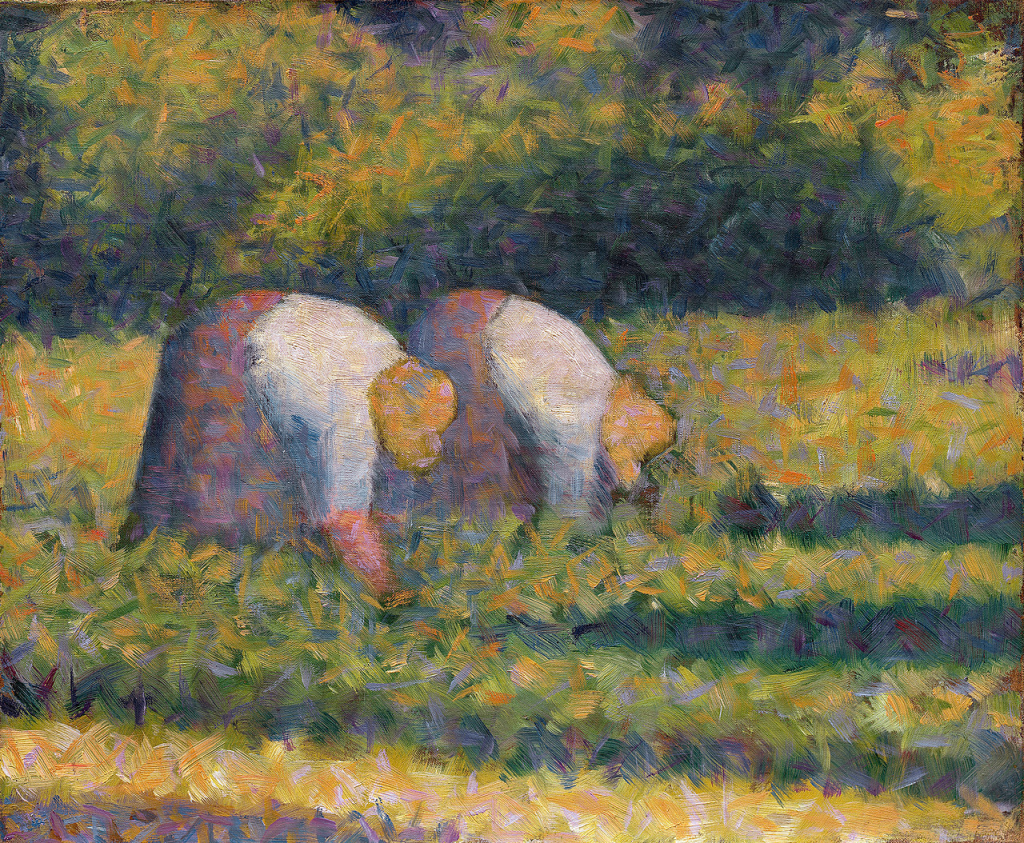
Farm Women at Work, by Georges Seurat (1859-1891)

Do not boast about tomorrow,
    for you do not know what a day may bring.

Let someone else praise you, and not your own mouth;
    an outsider, and not your own lips.

Stone is heavy and sand a burden,
    but a fool’s provocation is heavier than both.

Anger is cruel and fury overwhelming,
    but who can stand before jealousy?

Better is open rebuke
    than hidden love.

Wounds from a friend can be trusted,
    but an enemy multiplies kisses.

One who is full loathes honey from the comb,
    but to the hungry even what is bitter tastes sweet.

Like a bird that flees its nest
    is anyone who flees from home.

Perfume and incense bring joy to the heart,
    and the pleasantness of a friend
    springs from their heartfelt advice.

Do not forsake your friend or a friend of your family,
    and do not go to your relative’s house when disaster strikes you—
    better a neighbor nearby than a relative far away.

Be wise, my son, and bring joy to my heart;
    then I can answer anyone who treats me with contempt.

The prudent see danger and take refuge,
    but the simple keep going and pay the penalty.

Take the garment of one who puts up security for a stranger;
    hold it in pledge if it is done for an outsider.

If anyone loudly blesses their neighbor early in the morning,
    it will be taken as a curse.

A quarrelsome wife is like the dripping
    of a leaky roof in a rainstorm;
restraining her is like restraining the wind
    or grasping oil with the hand.

As iron sharpens iron,
    so one person sharpens another.

The one who guards a fig tree will eat its fruit,
    and whoever protects their master will be honored.

As water reflects the face,
    so one’s life reflects the heart.

Death and Destruction are never satisfied,
    and neither are human eyes.

The crucible for silver and the furnace for gold,
    but people are tested by their praise.

Though you grind a fool in a mortar,
    grinding them like grain with a pestle,
    you will not remove their folly from them.

Be sure you know the condition of your flocks,
    give careful attention to your herds;
for riches do not endure forever,
    and a crown is not secure for all generations.
When the hay is removed and new growth appears
    and the grass from the hills is gathered in,
the lambs will provide you with clothing,
    and the goats with the price of a field.
You will have plenty of goats’ milk to feed your family
    and to nourish your female servants. (New International Version)

Hard Work

The Lord God took the man and put him in the Garden of Eden to work it and take care of it. (Genesis 2:15, NIV)

Work itself is not a result of humanity’s fall. Before Adam and Eve disobeyed God, they were tasked to work and take care of the Garden of Eden. Therefore, work is inherently good. Yet, hard labor is certainly a result of the fall.

What we humans ought to have done through our created nature, now because of the fall into sin and disobedience, we have to work with focused deliberate intention. And even then, we often don’t perform our work as we would like.

“Cursed is the ground because of you;
    through painful toil you will eat food from it
    all the days of your life.
It will produce thorns and thistles for you,
    and you will eat the plants of the field.
By the sweat of your brow
    you will eat your food
until you return to the ground,
    since from it you were taken;
for dust you are
    and to dust you will return.” (Genesis 3:17-19, NIV)

This is why wise persons throughout the ages have given priority to hard work, and branded laziness as detrimental to our human welfare.

Much of our labor is menial and mundane, no matter what the work is. Yet, through vision and persistence, the fruit of our labor eventually breaks through. It is important for us to keep our nose to the grindstone, namely, because this is what it takes to produce, and to keep ourselves out of trouble!

Like a shepherd who cares for the sheep, we are to be present, pay attention, do whatever it takes to help the sheep flourish, and hang in there through the thick and thin of the job.

Diligence and consistency are vital to our hard work. The temptation of get-rich-quick schemes and other supposedly easy paths to success and wealth sometimes rear their heads to lure us away from our daily chores.

Well-kept sheep will produce wool and milk for several years. Riches and achievements and accolades, however, do not necessarily last for long.

Affectionate Love

Hard work and relationships nurtured by affectionate love are meant to go hand-in-hand. In other words, ideally, the duty and diligence of our daily tasks, and the consistency of establishing relational well-being with others, is well-balanced and works seamlessly together.

Loving another entails both encouragement and correction, heartfelt words as well as open words of rebuke. That is, we continually think of what another needs, and what is best for the community as a whole.

Our love must entail what is good for the one being loved, for the one doing the loving, and for the whole community to which both belong. Love leaves angry speeches and jealous motives behind and doesn’t utilize them, because they are tools of hate and hurt.

Gracious Dignity

Everyone is responsible to extend basic human kindness to one another, without exception. We are to listen to and honor our parents and elders; practice self-control and patience with all; and use gentle words in every communication.

Poise under pressure, and motivation to do what is right and good helps to lift the worth and dignity of others. We extend this to people for no other reason than that it is another human being who is in front of us; this is a person in God’s image.

God created mankind in his own image,
    in the image of God he created them;
    male and female he created them. (Genesis 1:27, NIV)

All persons have inherent worth as image-bearers of God. The wise person amongst us knows this and continually applies it in all their words and actions toward others.

Wise people also understand the value of hard work, and the intrinsic worth of work itself. Furthermore, they discern that love is to be the motivation and animating principle in doing work and working with others.

The bottom line of all the proverbial wise saying in today’s lesson is that we are to help and encourage others through both our words and our working actions. Our individual lives are to benefit the whole community, so that we are a blessing to others, as well as to receive blessings from those around us.

In engaging a healthy rhythm of giving and receiving, we reverse the curse, and enable the world to return to Eden.

Almighty God, we pray that You will bless all of our various labor and work in the world. Help us to pray fervently, diligently work hard, and give liberally. In all that we do, enable us to do it with all the love You provide. Amen.

What Do You Long For?

Indeed, what do you long for? Before anything ever came into being, it was dreamed for. Everything that exists, had a beginning in the possibility of longing for it. I think it is inappropriate for me to ask you such a question, without first telling you what it is I long for. And there are so many things that I long for! Yet, I offer just a few of them…

I am a hospital chaplain. I dream of a healthcare system that values its caregivers so much that it does away with hierarchical organization. I imagine and visualize such a system taking psychological safety as seriously as physical safety. I long for healthcare administrations to establish the individual employee’s care – not in cheap talk of self-care – but in actual establishing of policy and procedure to ensure that care is realized.

For only in the consummate care of the caregiver, can care seekers receive what they truly need.

Such caregiver care toward the care seeker will translate into taking all the time needed to listen to the patient, practicing patience themselves in seeking to truly understand. With the caring caregiver full of attentive love, they can and will step back in thoughtful reflection for a gracious and effective care plan for the patient.

And, what’s more, they will follow up with equal motivation and attention in order to provide skillful love, precisely where it is needed and wanted. For all caregivers shall know that a “bedside manner” is not optional, but is as important to healing as the actual care plan which is on paper.

I am a church pastor. I dream of good and effective change and reformation for the Body of Christ, as well as all faith communities everywhere. I imagine churches and church leaders who bathe all things in prayerful conversation with God and others. I long for a church that truly cares for those struggling to make sense of faith, and gives ample and adequate space for faith seekers to express their doubts, feelings, and questions in a safe and supportive environment.

Such pastors, elders, deacons, and denominational leaders will give scant attention to the more secular matters of building needs, budget finances, and butts in the pew (which, of course, often emit the most foul odor, because they originate in the person who is a tedious fart). They will have the sweet smelling incense of mentoring others in the faith, attending to the needs of the community at large, and lifting up emotional and mental needs with equal passion alongside the physical and spiritual needs of people.

For only in the consummate care of the pastors and leaders, attending to their foundational needs of bodily care and exercise, mental and emotional health, and spiritual disciplines, can parishioners receive the holistic care they truly need in order to grow and mature in faith.

Oh, how I dream, imagine, and long for a world that exalts the holistic person – body, mind, feelings, and soul – so that everyone in everyplace on the earth realizes their God-given potential as people gifted to serve the holistic well-being of others.

All of us are but temporary sojourners on this earth. And this world which we inhabit is fundamentally broken. Let us long for better days, imagine those days in our mind’s eye, and dream into existence that which originally had its origin in the heart of God.

Longing is only realized through belonging. If we remain emotionally lonely, bodily disconnected, mentally rootless, and spiritually adrift, we’ll never know the confident hope of belonging to God and community. Until we participate with ancient and universal rhythms of being in this world together, we will continue to experience the things which are nightmares to us.

So, what do you long for? It really is neither an esoteric nor impractical question. It is the vital question of our time.

Whole Person Love (1 Thessalonians 4:1-12)

As for other matters, brothers and sisters, we instructed you how to live in order to please God, as in fact you are living. Now we ask you and urge you in the Lord Jesus to do this more and more. For you know what instructions we gave you by the authority of the Lord Jesus.

It is God’s will that you should be sanctified: that you should avoid sexual immorality; that each of you should learn to control your own body in a way that is holy and honorable, not in passionate lust like the pagans, who do not know God; and that in this matter no one should wrong or take advantage of a brother or sister. The Lord will punish all those who commit such sins, as we told you and warned you before. For God did not call us to be impure, but to live a holy life. Therefore, anyone who rejects this instruction does not reject a human being but God, the very God who gives you his Holy Spirit.

Now about your love for one another we do not need to write to you, for you yourselves have been taught by God to love each other. And in fact, you do love all of God’s family throughout Macedonia. Yet we urge you, brothers and sisters, to do so more and more, and to make it your ambition to lead a quiet life: You should mind your own business and work with your hands, just as we told you, so that your daily life may win the respect of outsiders and so that you will not be dependent on anybody. (New International Version)

Everyone intuitively knows that love is supremely important. Yet, what some may not realize is that love is designed to effect the entire person – body, mind, emotions, and spirit.

Love is spiritual. It involves receiving love from a spiritual source and using it to give love to others. (Matthew 22:37-40; Mark 12:29-31)

Love is emotional. It is a matter of the heart and must felt deeply. (1 Peter 1:22, 4:8)

Love is thoughtful. The human brain requires love in order to mentally mature and operate with efficiency. (Philippians 2:2; 1 Peter 3:8)

Love is physical. The body is our means of putting hands and feet to love. (1 John 3:17-18)

A true Christian spirituality is an embodied spirituality which puts both mental and emotional energy into loving God and one another.

Consider for a moment some of the things you have done today… For me, I arose early, had a workout, ate breakfast, showered, went to work, etc. Yeah, typical stuff we are familiar with. These things I just mentioned all have to do with the body – and those things are good and holy.

Sometimes we may get a misguided notion that purity and holiness only has to do with activities that take place in a church building; or special works like serving at a homeless shelter; or, that the meeting of physical needs is merely a means to reach the soul.

Yet, there is neither a secular/sacred dichotomy nor a dualism of body and soul anywhere in Holy Scripture. Love demands the whole person, not part of the person.

We in the western world have inherited a long tradition of Platonic thinking. It undergirds a lot about how we think of the body. Plato (c.427-327 B.C.E.) embraced a dualistic nature of people – an existence of body and soul in which the spirit is trapped within physical flesh. Plato considered the soul to be the true nature of a person and tended to denigrate the body as an earthen vessel which will eventually be discarded. Our physical existence was nothing more than a necessary evil for Plato.

The problem with Plato’s anthropology is that it fails to discern the holistic nature of body and soul and the need for integrity with these human dimensions. Historically, Plato’s view has tended to come out sideways through lack of care for the body and seeing bodily actions as insignificant.

Thus, sexual immorality is common with a dualistic idea because our physical selves are less significant, temporary, and disposable. In all fairness to Plato, he did not encourage misuse of the body or sexual immorality, yet his philosophy opened-up to generations of people in neglecting their own bodies and inflicting harm on other bodies.

When we exalt the soul as supreme over the body, we are living out platonic thought, and not biblical love.

All of life is sacramental – the body is sacred, and, so, ought to be treated as holy – with great care and careful attention to breath, movement, exercise, eating, sleeping, playing, and, yes, even sex. The body is to be celebrated as our means of glorifying God on this earth.

And, at the end of the age when Christ returns, we will be reunited with our bodies to live forever as embodied creatures. So, what we do with our bodies now matters to God.

Inattention to the body God has given us will inevitably lead to a lack of boundaries in which others are open to violate us and we are unaware of violating others. We end up running roughshod over each other, spiritually and physically.

In other words, disregard for the body creates a disregard for love. An embodied and grounded spirituality helps us clarify what holiness and sanctification looks like in relationships and everyday life.

God has called us to holiness in all of life, in every physical activity we do. We have been designed by our Creator to walk the road of purity and peace. 

The way in which we use our minds, wills, emotions, and bodies – aligned and in agreement with the whole person – are of much interest and great concern and interest to almighty God. 

God cares about:

  • Food and whether I eat to his glory and give thanks; or, whether I have no interest in those that are hungry but just stuff as many groceries as I can in my distended stomach. 
  • Rest and Sabbath; or whether I compulsively work every waking moment of my life. 
  • Vocal chords and the content of my conversations with my family and friends – whether I am using my tongue for encouraging and building-up others, or whether it is slanderous, gossipy, and unhelpful.

Everything in all creation belongs to God – including me, you, and everything we do. God cares about all of life’s activities and leisure time because God is the Lord of Love.  

Whether tying our shoes or teaching a Sunday School class, it is all to be done with a sense of holiness and connection to the God that makes it all possible. 

Christian spirituality is an embodied spirituality. So, let us engage in all kinds of good loving works for the benefit of the body, whether little or large, with the time and talents God has graciously given us. 

Lord God, I belong to you – set apart and sanctified so that I may always walk in holiness and please you in everything I do. Help my life today to reflect the purity you have given me through your Son, the Lord Jesus.  May he be glorified through me now and always.  Amen.