Pray with Persistence (Luke 11:1-13)

He [Jesus] was praying in a certain place, and after he had finished, one of his disciples said to him, “Lord, teach us to pray, as John taught his disciples.” So he said to them, “When you pray, say:

Father, may your name be revered as holy.
    May your kingdom come.
    Give us each day our daily bread.
    And forgive us our sins,
        for we ourselves forgive everyone indebted to us.
    And do not bring us to the time of trial.”

And he said to them, “Suppose one of you has a friend, and you go to him at midnight and say to him, ‘Friend, lend me three loaves of bread, for a friend of mine has arrived, and I have nothing to set before him.’ And he answers from within, ‘Do not bother me; the door has already been locked, and my children are with me in bed; I cannot get up and give you anything.’ I tell you, even though he will not get up and give him anything out of friendship, at least because of his persistence he will get up and give him whatever he needs.

“So I say to you, Ask, and it will be given to you; search, and you will find; knock, and the door will be opened for you. For everyone who asks receives, and everyone who searches finds, and for everyone who knocks, the door will be opened. Is there anyone among you who, if your child asked for a fish, would give a snake instead of a fish? Or if the child asked for an egg, would give a scorpion? If you, then, who are evil, know how to give good gifts to your children, how much more will the heavenly Father give the Holy Spirit to those who ask him!” (New Revised Standard Version)

If we desire to see the power of prayer become a reality in our lives, we will have to avoid drive-by prayers in favor of sustained and focused prayers taught to us from the Lord Jesus.

Prayer empowered Jesus in his earthly ministry. His disciples saw this, and wanted it, too. So, Christ encouraged them in what to pray, and to keep persistently praying, despite the circumstances.

We are instructed by Jesus to approach the heavenly Father just as he himself did – in a straightforward and intimate manner. The content of our prayers ought to encompass the following five petitions:

  • Let God’s name be made holy. In other words, we are to let the Lord’s name be seen by others as holy within us in our daily lives. This is a petition for God to establish divine sovereignty and holiness in the heart of the believer. When this happens, the name of God is exalted and set apart as holy before a watching world.
  • Let God’s kingdom come. This is a prayer that asks for the reign of God to extend over the entire earth in a very practical way – to have God’s rule draw near to everyone and everything, including ourselves.
  • Let us have our daily bread. That is, pray that God will give us everything we need for life and godliness in this present evil age, including physical sustenance, mental acuity, emotional intelligence, and spiritual food. None of us lives by bread alone, but by every word that proceeds from the mouth of God.
  • Let forgiveness come. Sin is a reality. Therefore, every one of us needs forgiveness; and everyone needs to forgive others. Forgiveness is powerful; it releases us to freedom. And thus, we have the power to release others through the act of forgiving the egregious sins of others. The failure to do this is why the kingdom of God is so disestablished in this world.
  • Let us not become victims of the cosmic conflict. There is a continual struggle of unseen powers on this earth that no human is armed to deal with. Apart from God’s intervention, humanity gets caught in the crosshairs of the conflict. We are to pray that this trial does not overcome us.

These prayers are to be consistently and persistently prayed every day. Christ wants us to keep asking, seeking, and knocking.

Jesus, in his teaching ministry on earth, often used the lesser-to-greater argument in getting his point across. And that is precisely what he was doing with his disciples in today’s Gospel lesson by instructing them about the nature and motivation of prayer.

The lesser-to-greater argument implies a comparison of values. It’s grounded on a common sense and logical convention that if this lesser thing is true, then, of course, how much more is this greater thing!

If something less likely to happen is true, then something more likely to happen will probably be true as well. The technical phrase for this is an argument a fortiori – a Latin term meaning, “for a still stronger reason.”

Jesus wanted his followers to understand that prayer has value because God is a loving Father, not a begrudging friend. Whereas the friend in the story was badgered just so the person could get some real necessities, God needs no badgering to generously give good gifts that may or may not be considered as necessities by us.

Jesus desired to highlight that prayer has veracity because of whom those prayers are directed.

In the ancient world, it was common understanding you needed to get the local gods attention if you wanted something. Which is why, for example, in the prophet Elijah’s showdown with the prophets of Baal, that Baal’s worshipers were yelling, gesticulating, and even cutting themselves for hours. They fully expected to put a lot of work into getting Baal’s attention, maybe even needing to convince him of intervening in their ancient version of a wild West shootout.

In contrast to four-hundred prophets of Baal, a single prophet of the Lord utters one simple prayer, then fire comes rushing down from heaven. Much like the person who badgered the friend for bread, the prophets pestered Baal for hours. (1 Kings 18)

In Christ’s story, it all comes down to who really cares. The friend? Not enough to jump out of bed right away and meet a need. Baal? Not so much. God? Now we’re talking.

We typically don’t ask, seek, or knock, if we believe we will not get a response – or if it will take a lot of energy, time, and effort we don’t have. Yet, if we are confident of being heard and our requests taken seriously with care, then we are likely to have a habit of asking, seeking, and knocking.

If a friend begrudgingly gives to you because of persistent knocking, how much more will God graciously, generously, and with gaiety give you goodness when you ask?

Because God is good, God gives. The largess of the Lord is willing and ready to dispense grace from an infinite storehouse of mercy.

This is why Jesus encouraged people to not pray like those who don’t know God, babbling on because they think they’ll be heard because of the sheer volume of words. (Matthew 6:7-8)

Two misconceptions of prayer existed in Christ’s day (and today); they come from non-Christian sources:

  1. There must be a lot of prayer before prayer “works.” Although I believe repetition is important for forming good habits, praying the same prayers over and over again so as to be heard betrays an ignorance of God, not to mention an actual lack of faith. Many ancient religions were based in learning how to manipulate the spiritual forces out there to get what we need. It’s kind of like a divine version of hustling for love in all the wrong places. Christians need to know they don’t need to have thousands of people praying in order to get God’s attention to answer prayer.
  2. I must convince God of the need to answer my prayer. God is not a reluctant listener. The reason the Lord already knows what we need before we ask is because God has been paying close attention to us well before we got around to asking, seeking, and knocking on the divine door. God’s ear is already inclined to hear us – expectantly and anxiously awaiting our petitions. This is a tremendously freeing idea, that I can come to God openly and honestly, without drudgery, and without wondering if I am heard, or not.

May we be encouraged to pray, to truly connect with God, because the Lord is available without appointment, and is waiting for us to ask with bended ear.

Eternal God, by whose power we are created and by whose love we are redeemed: Guide and strengthen us by your Spirit so that we may give ourselves to your service and live today and every day in love to one another and to you, through Jesus Christ our Lord, in the strength of the Holy Spirit. Amen.

Wise Living Is Clean Living (Proverbs 15:1-17)

A gentle answer quiets anger, but a harsh one stirs it up.

When wise people speak, they make knowledge attractive, but stupid people spout nonsense.

The Lord sees what happens everywhere; he is watching us, whether we do good or evil.

Kind words bring life, but cruel words crush your spirit.

It is foolish to ignore what your parents taught you; it is wise to accept their correction.

Righteous people keep their wealth, but the wicked lose theirs when hard times come.

Knowledge is spread by people who are wise, not by fools.

The Lord is pleased when good people pray, but hates the sacrifices that the wicked bring him.

The Lord hates the ways of evil people, but loves those who do what is right.

If you do what is wrong, you will be severely punished; you will die if you do not let yourself be corrected.

Not even the world of the dead can keep the Lord from knowing what is there; how then can we hide our thoughts from God?

Conceited people do not like to be corrected; they never ask for advice from those who are wiser.

When people are happy, they smile, but when they are sad, they look depressed.

Intelligent people want to learn, but stupid people are satisfied with ignorance.

The life of the poor is a constant struggle, but happy people always enjoy life.

Better to be poor and fear the Lord than to be rich and in trouble.

Better to eat vegetables with people you love than to eat the finest meat where there is hate. (Good News Translation)

Here is today’s Proverbs lesson in my own colloquial words:

A calm and kind response sucks the anger out of the room, but hot-headed words set the place on hellfire.

A level-headed person gives helpful answers, but a know-it-all only keeps on babbling nonsense.

Just because you cannot see God, doesn’t mean that God cannot see you, both the good and the bad.

Kind words given to another person are life-giving, but unkind words catapulted at a person ends up crushing their spirit.

You can tell a fool by how their refusal to accept counsel from their parents, but a wise person freely receives parental instruction.

Wise folk understand they need to save for a rainy day, but fools spend everything they have, then wonder why they’re in dire straits.

Wisdom and common sense are akin to one another; foolishness and nonsense are two peas in a pod.

The Lord perks up when the righteous pray, but does a face palm when the wicked offer up anything.

The ways of evil people make the Lord nauseous, but the way of the righteous is delightful to God.

A stupid dog doesn’t live very long, because he won’t heed his training or learn from any natural consequences.

If God can see everything that goes on with death and destruction, why would not the Lord see all things within your own heart?

Prickly people won’t listen to advice, and they refuse to consult anyone when making decisions.

Truthful persons smile when they’re happy and frown when they’re sad, but falsehood smiles when it’s sad and frowns when it’s happy.

Learners are curious about life, but ignorant folk only feed on tabloid information.

Once in survival mode, it’s hard to ever get out of it; but those who thrive have learned how to be content in any circumstance.

It’s a whole lot better to be poor and right with God, than to be rich and on the wrong side of the Lord.

Peanut butter sandwiches eaten on the floor with love are much more delicious than eating a filet mignon with hatred around the table.

Our words reflect what is truly the attitude of our heart. And our attitudes betray what we actually think about God and others.

If you drop a foolish person into a roomful of people, it’s like putting a rotten egg in with the rest of the eggs when making an omelet. Or, to put it according to an old adage, “One bad apple spoils the whole bushel basket of them.”

This is why it’s the responsibility of everyone to develop wisdom and a virtuous life. A faith community, a neighborhood, a workplace, a family, or any group of people are adversely affected whenever there’s one arrogant fool amongst them.

But just as he who called you is holy, so be holy in all you do; for it is written: “Be holy, because I am holy.” (1 Peter 1:15-16, NIV)

It only takes one drop of arsenic to ruin a gallon of water and make it undrinkable. And if you choose to drink it anyway, well, you’ll suffer the consequences.

And this is why purity of heart, righteousness, justice, and goodness are so very important. It’s also why holiness is placed as a premium in Holy Scripture, because impurity ruins the community and defiles any group of people.

For where you have envy and selfish ambition, there you find disorder and every evil practice. But the wisdom that comes from heaven is first of all pure; then peace-loving, considerate, submissive, full of mercy and good fruit, impartial and sincere. Peacemakers who sow in peace reap a harvest of righteousness. (James 3:16-18, NIV)

Wise living is clean living, in every sense of a person’s complete self – in body, mind, emotions, and spirit. The Book of Proverbs can help us with that.

O God, by whom the meek are guided in judgment, and light rises up in darkness for the godly: Grant us, in all our doubts and uncertainties, the grace to ask what you would have us to do, so that the Spirit of wisdom may save us from all false choices, and that in your light we may see light, and in your straight path may not stumble. Amen.

A Controversial Christ (Mark 2:23-3:6)

Wheatfield with Crows, by Vincent Van Gogh, 1890

One Sabbath day as Jesus was walking through some grainfields, his disciples began breaking off heads of grain to eat. But the Pharisees said to Jesus, “Look, why are they breaking the law by harvesting grain on the Sabbath?”

Jesus said to them, “Haven’t you ever read in the Scriptures what David did when he and his companions were hungry? He went into the house of God (during the days when Abiathar was high priest) and broke the law by eating the sacred loaves of bread that only the priests are allowed to eat. He also gave some to his companions.”

Then Jesus said to them, “The Sabbath was made to meet the needs of people, and not people to meet the requirements of the Sabbath. So the Son of Man is Lord, even over the Sabbath!”

Jesus went into the synagogue again and noticed a man with a deformed hand. Since it was the Sabbath, Jesus’ enemies watched him closely. If he healed the man’s hand, they planned to accuse him of working on the Sabbath.

Jesus said to the man with the deformed hand, “Come and stand in front of everyone.” Then he turned to his critics and asked, “Does the law permit good deeds on the Sabbath, or is it a day for doing evil? Is this a day to save life or to destroy it?” But they wouldn’t answer him.

He looked around at them angrily and was deeply saddened by their hard hearts. Then he said to the man, “Hold out your hand.” So the man held out his hand, and it was restored! At once the Pharisees went away and met with the supporters of Herod to plot how to kill Jesus. (New Living Translation)

Jesus Heals the Man with the Withered Hand, by Ilyas Basim Khuri Bazzi Rahib, 1684

I am continually amazed whenever good people are surprised by being embroiled in the muck of human controversy. Since we live in a profoundly fallen world, good is often going to buck up against the bad. Besides, Jesus often found himself in a controversy of some kind; and we are not above our Lord.

There are two distinct yet similar controversies in today’s lesson; and they highlight why there were some folk who were all upset about the way Jesus went about things. Such people eventually came to the dark decision that Jesus needed to go away, permanently.

Much of the controversy between Jesus and the religious leaders came down to particular views of God’s law; and, of course, whose view was going to win out over the other. It ended up becoming what almost all controversies are about: Deciding who is really in power and calls the shots.

The Politics of Hunger

It was a Sabbath day. Jesus and his disciples were walking through the fields. And they were hungry. So the disciples took some grain, broke off the heads, and ate them. To any non-Jewish person, there’s no problem here. But the Pharisees were concerned.

First, they observed the disciples walking through grain fields. The Pharisees thought they should be staying put on the Sabbath. Second, and perhaps more significantly, the religious leaders saw Christ’s disciples gleaning – which was working on the Sabbath. To them, any respectable Jew prepared their food the day before. This is a lack of holiness, of not taking the Sabbath seriously. And this was completely unacceptable to the Pharisees.

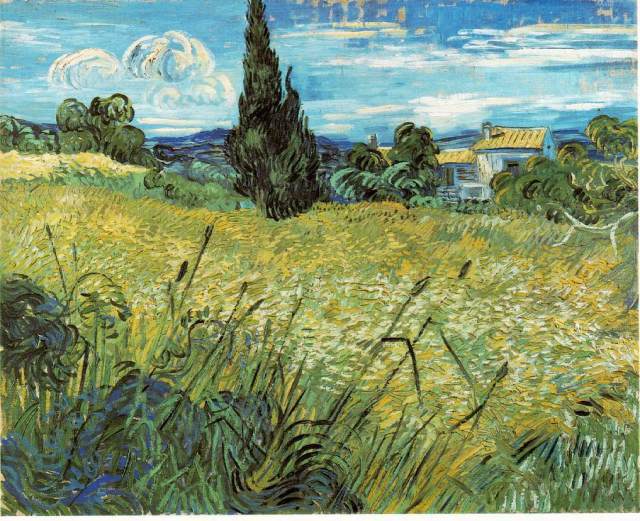
Wheat Field and Cypress by Vincent Van Gogh, 1890

Jesus, however, viewed walking through the fields differently. He did not consider the Sabbath as trivial; Jesus instead stood back and took a big picture perspective of it all. And that view included the ancient story of David, who took the consecrated bread in the tabernacle which was reserved only for Levite priests. (1 Samuel 21:1-6; Leviticus 24:8-9)

The reason David wanted the bread was because he was a fugitive, on the run from King Saul who was trying to take his life. Jesus insisted, on that day, the priest on duty did nothing wrong in giving the special bread to David. Yes, the strict letter of the law was broken; and, no, this was not wrong – because the priest was helping to save a life, and a very important one at that.

Jesus discerned there are times when particular laws come into conflict; so it’s necessary to maintain the spirit of a law in order to maintain a high value and meet a pressing human need. In a sense, Jesus gave a covenant code legal opinion on the subject.

It’s no surprise, to any reader of the New Testament Gospels, that Christ would behave this way; and that it would drive the religious leaders bananas. After all, they, the Pharisees, upheld law and rendered legal decisions – not this upstart wannabe. Jesus took an authoritative stance on what was happening, and the leaders did not at all like their own authority questioned.

This wasn’t some maverick interpretation by Jesus. He simply pointed out that the Sabbath is a gift, given to people to promote life and health – and not a burden that folks are to carry. Any decent Sabbath-keeper knew this.

It appears the leaders didn’t like being reminded of it from Jesus. What’s more, Jesus was much too close to likening himself to David. Yet another reason to despise this uppity teacher.

The Legality of Suffering

A second controversy brought the issue of who is in charge and who gets to arbitrate community values into a greater light. There is perhaps no other place for that conflict to happen than in the synagogue, the meeting place of worshipers. The juiciest things always seem to happen in a place of worship.

In the first story, the religious leaders were caught surprised over the behavior of Jesus and his disciples. They’re determined not to make that mistake again. From this point forward, it seems the Pharisees are continually waiting for a chance to put down Jesus as a lawbreaker and rabblerouser.

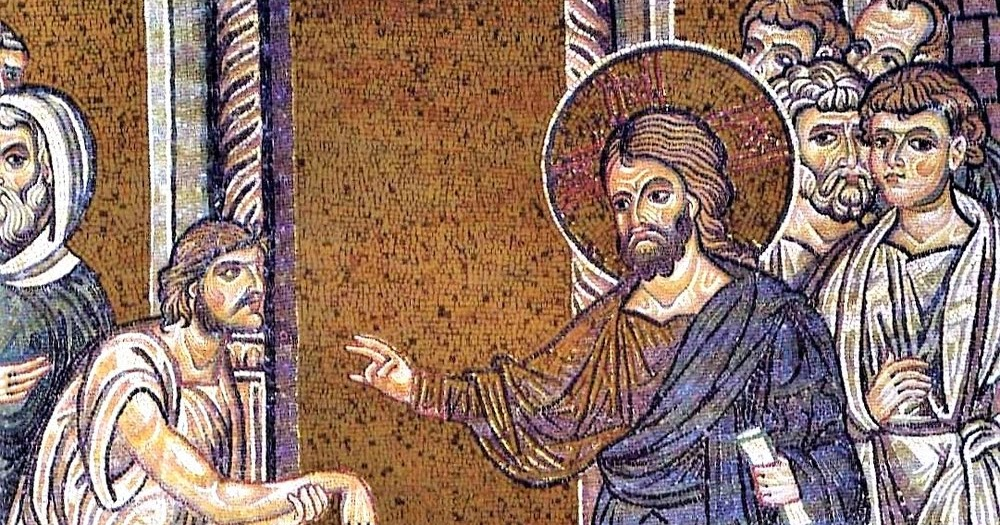
Byzantine mosaic of Christ healing the man with a withered hand, Cathedral of Monreale, Palermo, Sicily

For them, the issue wasn’t about the ability to heal, but whether it’s being done on the Sabbath. Much like the grainfield incident, healing is work, and working on the Sabbath is a direct violation of God’s immutable law. The religious leaders wanted to prove that Jesus has no regard for God’s will.

Law, for many Pharisees in Christ’s day, was meant to bring order so that chaos does not rule. Obedience to the law is a pre-condition for blessing. Without a clear demonstration of holy living, the community could be under a curse, much like their ancestors before them who were exiled for disregarding God’s law.

Yet again, Jesus cut through the anxious fear and authoritative posturing and went directly to the intended spirit of the law. The Sabbath, of all days in the week, ought to be a time for doing good, not harm; and to save life, not kill it. Jesus was not doing anything that could be considered work, anymore than his disciples were actually gleaning or harvesting grain.

There is no better day than the Sabbath for restoring a man’s withered and malformed hand, for giving him back his ability to make a living and contribute to the community. Much more was restored to the man than a physical ability; he now had the ability to better his life and his family, not to mention the local economy. It ought to be all good…

Unfortunately, the Pharisees didn’t see it that way, that the man gained his dignity back, his wholeness and his joy. They could only see a threat to their own hegemony.

The Beginning of the End

So, this marks the beginning of the end. The leaders are so upset and angry, they began plotting for Christ’s destruction. Unlikely political allies came together because of a common enemy. To view Jesus as a threat to society is, at the least, messed up. But that’s what happens when people cannot see beyond the end of their nose. They make bad choices.

Even though Jesus came to give life, others want to take his. Despite the fact that Jesus did not reject the law or demean the Sabbath, people with a short-sighted agenda and hard hearts could only see someone upsetting the status quo.

Today, these same things can quickly turn to hostility. The legal implications of one’s values and commitments can get nasty fast. Opinions can harden, resulting in oppression, persecution, and even death.

The most noble of motives can go sour; and the best of intentions, the highly educated, and the most gifted persons among us can become despotic in their leadership. Indeed, absolute power corrupts absolutely.

This is why the gracious and benevolent kingdom of God will win the day. Hard-hearted people become desperately out of touch with what is most important; they are calloused to the human need in front of their faces. I believe that the words and ways of Jesus can dispel those dark forces and impulses.

I’ll take a controversial Christ any day because that is the path to life abundant and everlasting.

Whenever unjust, oppressive, harmful, and fearful systems hold on, the ministry of Jesus exposes them for what they are, and will deliver us from evil.

Thanks be to God!

Set Apart for the Lord (Numbers 8:5-22)

Consecration of the Levites, by Dutch artist Jan Luyken (1649-1712)

The Lord said to Moses: “Take the Levites from among all the Israelites and make them ceremonially clean. To purify them, do this: Sprinkle the water of cleansing on them; then have them shave their whole bodies and wash their clothes. And so they will purify themselves. Have them take a young bull with its grain offering of the finest flour mixed with olive oil; then you are to take a second young bull for a sin offering.

“Bring the Levites to the front of the tent of meeting and assemble the whole Israelite community. You are to bring the Levites before the Lord, and the Israelites are to lay their hands on them. Aaron is to present the Levites before the Lord as a wave offering from the Israelites, so that they may be ready to do the work of the Lord.

“Then the Levites are to lay their hands on the heads of the bulls, using one for a sin offering to the Lord and the other for a burnt offering, to make atonement for the Levites. Have the Levites stand in front of Aaron and his sons and then present them as a wave offering to the Lord. In this way you are to set the Levites apart from the other Israelites, and the Levites will be mine.

“After you have purified the Levites and presented them as a wave offering, they are to come to do their work at the tent of meeting. They are the Israelites who are to be given wholly to me. I have taken them as my own in place of the firstborn, the first male offspring from every Israelite woman. Every firstborn male in Israel, whether human or animal, is mine. When I struck down all the firstborn in Egypt, I set them apart for myself. And I have taken the Levites in place of all the firstborn sons in Israel. 

“From among all the Israelites, I have given the Levites as gifts to Aaron and his sons to do the work at the tent of meeting on behalf of the Israelites and to make atonement for them so that no plague will strike the Israelites when they go near the sanctuary.”

Moses, Aaron and the whole Israelite community did with the Levites just as the Lord commanded Moses. The Levites purified themselves and washed their clothes. Then Aaron presented them as a wave offering before the Lord and made atonement for them to purify them. After that, the Levites came to do their work at the tent of meeting under the supervision of Aaron and his sons. They did with the Levites just as the Lord commanded Moses. (New International Version)

Levite priests, by Sefira Lightstone

Holiness is very important to God; therefore, people are to be properly set apart for special divine work.

Perhaps we might think about this in the context of a professional vocation – which requires a good deal of training and development. The process, as well as the participants, need to be certified by a certification body. Without a specialized training, their work may hurt others, and even harm themselves.

Setting apart the Levites for the special work of caring for all the aspects of worship required a particular sort of calling, initiation, and ritual in order to have them ready – without harming themselves, or others. Because God is holy, things must be done in a way that helps, not harms.

The ritual for preparation essentially involved de-sinning the Levites, and purifying them from any ceremonial uncleanness. The community was to lay their hands on them, setting them apart for service as representatives of the people.

The Levites served before the Lord in a vicarious position, that is, all Israel came to God through them. They performed the needed sacrifices, handled the worship symbols and implements, and protected the sacred objects in the tent of God’s presence, the tabernacle.

With the Levites in their sacred role, they were near to the people, but distinct from them. They acted as a conduit between God and the people. Levites were something like the sunglasses protecting the people from the bright sun of the Lord’s presence; and like the workers laboring to make people thrive and flourish before God.

In the holiness of worship, the Levites were living sacrifices, offered to God for sacred purposes. So, as such, they understood their need to be continually pure of heart and free from anything that would defile them.

Sacrificial service was literally the job description of the Levites. They absolved themselves of any self-assertive ambitions, and pursued God’s will for the lives without question. This is, of course, the expected ideal, which would soon become deflated in the lives of the two older sons of Aaron the high priest.

Nevertheless, the descendants of Levi were a permanent visual aid and a daily reminder for God’s people of their unique status before Yahweh, as well as the redemption secured for them from Egyptian slavery. Whenever the people saw a Levite – consecrated to God – they knew that the Lord was with them.

God had said that the Levites belonged to him, were completely given over to the Lord, and set apart for dedicated holy and divine work. Moving into the New Testament, every Christian belongs to God, and those who labor for Christ and maintain holiness of life, demonstrate God’s ownership and special relationship to them.

Self-surrender and commitment to the common good of everyone in the community is supposed to be a hallmark of every Christian person. Whereas others may give themselves to self-discovery and self-fulfillment, followers of Jesus are to wholly dedicate themselves to self-sacrifice.

All believers, much like the ancient Levites, are called to a different life, with Christ as their constant mentor and model.

Loving God and Father of our Lord Jesus Christ, may the holy sacrifice of your Son cleanse my soul, strengthen my heart, pardon my past, and restore me in your peace. May I always adore you through my sacrificial service, fueled by your divine love. May I learn to sacrifice my own comfort, plans, and dreams, if it is not for your glory and the good of others. Amen.