Telling a Story of Faith (Deuteronomy 26:5-10)

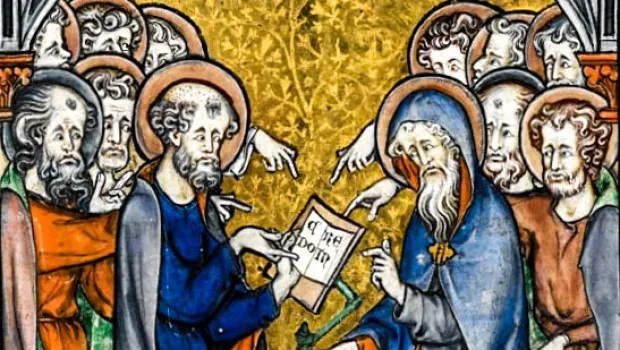
A 13th century artwork depicting the Apostles writing the Creed

Then, standing there in front of the place of worship, you must pray:

My ancestor was homeless,
an Aramean who went to live
    in Egypt.
There were only a few
    in his family then,
but they became great
and powerful,
    a nation of many people.

The Egyptians were cruel
    and had no pity on us.
They mistreated our people
    and forced us into slavery.
We called out for help
to you, the Lord God
    of our ancestors.
You heard our cries;
you knew we were in trouble
    and abused.
Then you terrified the Egyptians
with your mighty miracles
    and rescued us from Egypt.
You brought us here
and gave us this land
    rich with milk and honey.
Now, Lord, I bring to you
the best of the crops
    that you have given me.

After you say these things, place the basket in front of the Lord’s altar and bow down to worship him. (Contemporary English Version)

Forty years of wandering throughout the desert, in the backside of the wilderness. Having been delivered out of Egypt by the mighty hand of God, the Israelites were on a very circuitous journey to the Promised Land.

The Book of Deuteronomy is a restatement of the people’s history and God’s law for the generation about to enter the land of Canaan. Moses told the people that when they enter the land and have their first harvest of crops, they are to remember and give thanks for all their blessings.

People need to be reminded of important things. Sometimes, in the middle of success and good fortune, we can forget to savor the moment, neglect to appreciate what it took to get to this place, and fail to celebrate with others the God who has made good things happen.

Interestingly, in appreciation for the abundance of a harvest, Moses did not tell the people to give thanks for the weather or the crops themselves. Rather, they were exhorted to recall and retell the story of Israel and their ancestors.

Through historical narrative, the Israelites tethered themselves to their present reality. They located themselves in the past, as contemporary links in a holy chain that stretched generations, all the way back to the patriarch Jacob.

This sort of relational and generational gratitude is in stark contrast to what current cultural appreciation and thanksgiving is, for cars, homes, jobs, resources, and stuff. Although thankfulness is appropriate and necessary for those things, none of it is lasting and sustainable.

Beneath all of the purchased things and electronic devices is a longing for connection, a desire to know who we are, where we came from, and what our true roots are.

Greater emotional health comes from knowing where we came from. Our connections to family, friends, church, and community are a vital and essential piece of living a good life with satisfaction and contentment.

Healthy roots enable us to respond well to the challenges of life with strength and resilience.

One way to recall and remember is to recite a creed. Sadly, many churches today recoil at reciting creeds and confessions, as if this were a bad thing. But there is significance and power to a group of people who stand and recite an ancient creed together.

The Christian ecumenical church creeds, including the Apostles’ Creed, Nicene Creed, and Athanasian Creed, capture the settled convictions of early believers in Jesus as they struggled to express their faith in the church and the world.

Those creeds are a part of us, and of our collective spiritual history as the people of God. There are yet other kinds of creeds, as well. We have an even more ancient creed expressed in today’s Old Testament lesson – the sort of creed that tells a story.

Moses gave the Israelites some parting instructions to follow for their future worship in the Promised Land. When they enter the land a bring in their harvest, they were to bring the first-fruits of their crops to the priest, and then profess a creed, which is really a story, a historical narrative of God’s people.

Every Jewish farmer and worshiper who brought their crop to the priest would recite the creed about their ancestors suffering in Egypt and being redeemed by God through a great deliverance. God granted them the gift of land, a promised place to call their own.

We as the people of God must discern the importance of embracing the story of redemption, of crying out and being delivered from the shackles of sin, death, and hell. We receive this salvation with thanksgiving and joy.

Christians tell their story of deliverance not only through the ancient ecumenical creeds, but also through the sacramental means of communion. The Table proclaims the life and death of Christ, given for us, and for our salvation. It is a story with deep roots in the life of Israel.

Believers in Jesus are invited to participate is something bigger than themselves. The Christian’s story begins not at Pentecost in the New Testament, but in the promise to Abraham way back in the Old Testament.

The blessing given to Abraham was a blessing for all nations, not just Israel (Genesis 12:1-3). Knowing the roots of our spiritual life and Christian faith helps inform us how we are to live out that faith and life in this present time.

Within Christianity, our history and story is much bigger than Europe and Western civilization. The earliest church began in the Middle East. Ancient Christian traditions and churches still exist, and worship today in places like Egypt and Ethiopia. There are presently large numbers of Christians in every part of the world, especially in Latin America, Asia, and Africa.

Essentially, we are the lost, the last, the forgotten, the outsiders who cried out to God. And the Lord rescued us, blessed us with every spiritual blessing in Christ, and gave us the privilege of being ambassadors for Christ in the world.

We belong to God. Along with believers throughout the ages, and across the world, we declare:

I believe in God, the Father almighty,
creator of heaven and earth.

I believe in Jesus Christ, his only Son, our Lord.
He was conceived by the power of the Holy Spirit
and born of the Virgin Mary.
He suffered under Pontius Pilate,
was crucified, died, and was buried.
He descended to the dead.
On the third day he rose again.
He ascended into heaven,
and is seated at the right hand of the Father.
He will come again to judge the living and the dead.

I believe in the Holy Spirit,
the holy catholic Church,
the communion of saints,
the forgiveness of sins,
the resurrection of the body,
and the life everlasting. Amen.

Remember and Listen to History (Deuteronomy 32:1-10)

Listen, heaven, and I will speak.

Earth, hear the words from my mouth.

Let my teachings come down like raindrops.
Let my words drip like dew,
like gentle rain on grass,
like showers on green plants.
I will proclaim the name of the Lord.
Give our God the greatness he deserves!
He is a rock.
What he does is perfect.
All his ways are fair.
He is a faithful God, who does no wrong.
He is honorable and reliable.

He recognizes that his people are corrupt.
To their shame they are no longer his children.
They are devious and scheming.
Is this how you repay the Lord,
you foolish and silly people?
Isn’t he your Father and Owner,
who made you and formed you?

Remember a time long ago.
Think about all the past generations.
Ask your fathers to remind you,
and your leaders to tell you.
When the Most High gave nations their land,
when he divided the descendants of Adam,
he set up borders for the tribes
corresponding to the number of the sons of Israel.

But the Lord’s people were his property.
Jacob was his own possession.
He found his people in a desert land,
in a barren place where animals howl.
He guarded them, took care of them,
and protected them because they were helpless. (God’s Word Translation)

In addition to being a church pastor and a hospital chaplain, I hold two academic history degrees. I firmly believe the past is important. Having an historical perspective on just about everything is helpful in order to negotiate present circumstances.

Another way of saying this is that it’s imperative that we remember times from long ago, and think about all the past generations – what they faced, why they faced it, and how they dealt with it – because it all influences us right now, whether we are aware of it, or not.

Listening to others is important. Hearing and responding to the voice of God is necessary. And listening to voices of the past is just as crucial. After all, Holy Scripture is ancient, containing the voices of hundreds of people, as well as the voice of the Lord. The faithful throughout the ages have encountered all sorts of situations related to their religious tradition; and they remain as a great cloud of witnesses testifying to us and encouraging us in the way we ought to go.

In today’s Old Testament lesson, the Lord exhorted the people to remember, simply because they had forgotten. And whenever a people forget where they have come from, they forget who they are; and if they forget who they are, their very identity is in jeopardy of being hijacked by corruption, guilt, and shame.

Israel needed to recall their own history, because they were in danger of failing to tell their stories to the next generation, who in turn, would not then have anything to remember.

The great redemptive events of God in calling their father, Abraham, out of Chaldea, promising divine presence and property to the descendants of Abraham, Isaac, and Jacob; the miraculous deliverance from Egyptian slavery; and the wandering in the wilderness had to be lifted up and recognized, not forgotten.

In fact, every generation of believers needs to not only affirm their faith, but also restate that faith for the next generation.

And that is precisely what Moses did for the people. He restated Israel’s history and the giving of God’s Law for a new generation about to enter the Promised Land. Only with this collective memory of divine help and revelation would the people be able to make it in in the place they were going.

There is, I believe, a great collective ignorance of history. Many Westerners know very little of their own genealogy beyond a generation or two. Folks have little to no recollection of seminal events which have shaped the places where they live and work. It’s as if there is no foundation under their feet from which to stand firm.

For example, this is one reason why so many people of color get treated as if they do not belong – because the white folk in the room don’t even know their own history, let alone the background and challenges of those who look different than them.

“Every true history must force us to remember that the past was once as real as the present and as uncertain as the future.”

George Macaulay Trevelyan, Professor of History, Cambridge University, 1898-1943

History is about people, and not so much about dates and facts. And so, to be indifferent about history is to be disinterested, even calloused, toward other people. Conversely, to engage history and learn from it is to be transformed by it.

Historians are people tasked with describing and interpreting the past. They take the many historical facts and responsibly interpret those facts and events in a coherent narrative for the benefit of those in the present. That’s exactly what Moses did. He told Israel’s story.

Moses recalled the past, then retold it and revised it for his contemporary generation. All history is revisionist – and that’s a good thing. It just means that we faithfully tell the story of our past by clearly understanding that history within the historical actors own time and terms, as well as possessing an equally discerning grasp of the people who hear it.

An attention to history can guide us, and help heal us of our narcissistic ways. It can help dethrone us from the misguided belief that we are the center of the universe. History provides us with the tools necessary to hear and understand the other, enabling us to reconcile with one another. 

As we learn from reading and listening to historical narratives, we find resources that can bring transformation of our own lives and the communities in which we live. So, what are you waiting for? Read the Bible. Read history. Read the contemporary culture. Perhaps you will have a compelling, challenging, and coherent voice that will rise above all the other competing contemporary voices of contempt and corruption.

Great God of all history, thank you for the many faithful people who, through the centuries, have made a positive impact in this world.

Thank you for the godly men and women who, by your grace, have rewritten history books by their actions; who have heard your call to go into the world. We praise you for the good example they have shown and the difference they have made.

May you enable each of us to leave an imprint and legacy of your love and mercy in our spheres of influence, so that those who come after us will look back one day and say, “They made a difference.” Amen.

How You Are Matters (Ruth 4:13-17)

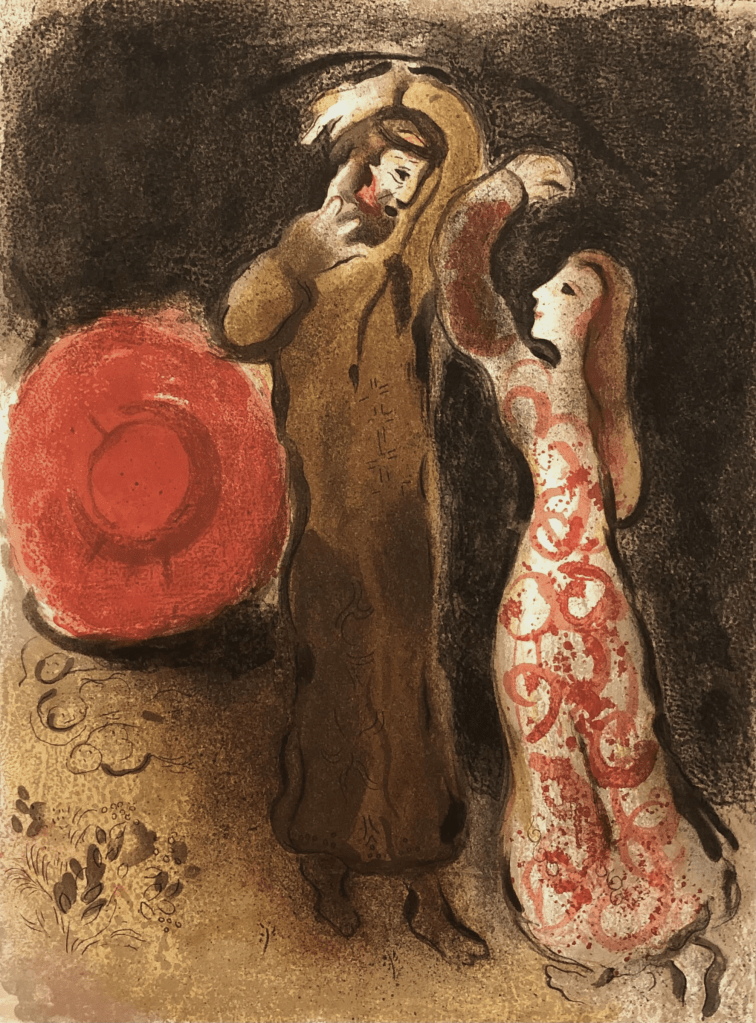
The Meeting of Ruth and Boaz by Marc Chagall, 1960

So Boaz took Ruth home as his wife. The Lord blessed her, and she became pregnant and had a son. The women said to Naomi, “Praise the Lord! He has given you a grandson today to take care of you. May the boy become famous in Israel! Your daughter-in-law loves you and has done more for you than seven sons. And now she has given you a grandson, who will bring new life to you and give you security in your old age.” Naomi took the child, held him close, and took care of him.

The women of the neighborhood named the boy Obed. They told everyone, “A son has been born to Naomi!”

Obed became the father of Jesse, who was the father of David. (Good News Translation)

Your Commitment Matters

Ruth, although not a Jew, committed herself fully to her Jewish mother-in-law and to the Jewish people. Her faithfulness mattered and eventually realized the blessing of family and community.

It wasn’t an easy path for Ruth to enjoy such blessing. She and her mother-in-law, Naomi, came to Bethlehem as two poor widows. Even though Bethlehem today is known around the world, back then there wasn’t much to it – just a small non-descript village in Judah a few miles south of Jerusalem.

Your History Matters

The Bible contains a lot of genealogies. Bible readers often skip over those portions of Holy Scripture to get to the more meaty and interesting stuff. But there’s a lot there.

Genealogies serve to remind us of who we are, where we have come from, and thus, what direction we are headed. Each and every human life has an historical context, a past which informs the present and can help guide for the future.

Naomi had a long history as part of the Jewish community. Ruth was a Moabite. Moab was an ancient kingdom which was located in the present day nation of Jordan. The original ancestor of the Moabites was Moab, a son of Lot. Lot was a nephew of the Jewish patriarch Abraham.

Moabites and Israelites didn’t get along. Moab had their own god, Chemosh, and did not serve Israel’s Yahweh. The person, Moab, was conceived under difficult and dubious circumstances – and it seems this context set the tone for the entire nation of people. (Genesis 19:30-38)

Our genealogical histories can bog us down or they can inspire us. Yet, the unseemly parts of our past family can actually serve to reveal something wonderful.

Your Receiving of Grace Matters

All genealogies are filled with less than stellar characters. But they’re also testaments to grace.

Both Ruth and her husband Boaz were recipients of the Lord’s grace.

Boaz, having a long history of the covenant as a Jew, nonetheless also had a difficult family past. Much like the conception of the ancient character of Moab, one of the ancestors of Boaz, Tamar, and one of the Jewish patriarchs, Judah, had a rather twisted experience. (Genesis 38:1-30)

Both Boaz and Ruth became great grandparents to King David. And they both are listed together in the opening genealogy of Matthew’s Gospel as ancestors to Jesus the Messiah, known as the son of David.

Grace changes history. If Jesus can have a genealogy, much like us, filled with both faithful committed people and dubious characters, then I believe we can give ourselves, and each other, a bit of slack on our shared human condition.

Your Spiritual Family Matters

For the Christian, there is an historical continuity across the millennia with our ancient spiritual forebears. The drama of redemption unveiled throughout the whole of Scripture connects us with Father Abraham, to the deliverance out of Egyptian slavery, to the saving events of Christ’s life, death, resurrection, and ascension, and beyond into the union of Christ and the Church.

A Moabite widow is redeemed into a new community. She marries a Jewish man and conceives a child in grace, born in the humble village of Bethlehem. Centuries later, another woman, Mary, experiences a conception of grace and gives birth to a child in the very same place – Christ the Lord, our Immanuel, God with us.

Jesus was born of David’s genealogical line, from ordinary people, just like Ruth and Boaz. Because it is only from humility that greatness can arise.

Your Faith Matters

Your faith and my faith grows in the context of an ordinary life. We live and move and have our being within the grace and providential care of God. Our faith is rooted in the soil of grace, anchored and moored in the deep of faithful servants who have gone before us.

Like Ruth, we humbly attach ourselves to a larger community and seek to give ourselves for the life of the world. Like Mary, we willingly confess to the angelic messenger:

“I am the Lord’s servant. May your word to me be fulfilled.” (Luke 1:38)

Our Father in heaven, you hold all that you have made within your gracious and merciful hand. Help us in all things to see your loving providence working out a good plan for the earth. Just as Ruth from Moab became one of your people, so you call us by name and hospitably invite us to your Table.

In Jesus Christ, our Redeemer, you meet us in the ordinary routines of our lives. You have graciously taken our pains, fears, sorrows, bitterness, guilt, shame, and sins upon yourself and given us a new life and a new community.Turn our suffering to glory, and our tears into joy.

Holy Spirit, giver of life, you guide us into grace and truth through generous love. As Boaz went out of his way to provide abundance for a poor widow, let us be generous with both our speech and our actions. Teach us to be alert to the needs of others so that everyone may have their daily bread.

Blessed Holy Trinity – Father, Son, and Spirit – the God whom we serve, you are our past, present, and future. We give you praise and commit ourselves to the words and ways of Jesus, in whose name we are bold to pray. Amen.