Straddling Two Worlds

“You are not far from the kingdom of God.” (Mark 12:34)

It really sucks being sick, no matter what the particular illness is.

I realize those may be strange words coming from a tenured and ordained church pastor and hospital chaplain. Nevertheless, it is a truism which far too many people know about intimately.

Yet, there might be something even worse than the devastating effects of one’s own ill health – whether it be cancer or a cold, epilepsy or constipation – and that is the awful grinding reality that someone you love dearly is suffering beyond what you can do for them. If you could take their place, you’d do it in a heartbeat.

And, honestly, many, if not most, people are in one of those situations right this very minute – either needing care or being the caregiver.

As I was walking through my neighborhood last night, as I often do after the day’s sunset, I couldn’t help thinking about all my neighbors inside those lighted rooms. Every single person, I felt and knew in my bones, was going through some sort of illness that’s impeding the quality of their life; or they’re struggling to know how to pray for that friend or loved one who is profoundly ill, wondering what to do, at all.

Debilitating illness is one of those realities of the human condition that appears to be so devilishly odd in a world where billions of people worship God. If there is such a divine Being, where the hell is he!? Why do I feel so helpless?

There is something else for us to contemplate – that we live in a weird space between two worlds. The first world we are quite familiar with – the tangible reality of our five senses. But this other world is a place we are much more unfamiliar with; it has multiple if not millions of senses which we cannot see, hear, feel, taste, or touch with our physical capabilities.

Something inside of us, besides our literal brains, hearts, and guts, existentially knows that deep within us is a soul. I personally don’t care much what you want to call it – spirit, metaphysical awareness, biological wirings, gut feelings, etc. But there is a special place inside of us that is ready-made to connect with that other ethereal world of the spirit and soul.

Let me ask: What makes a young woman with cancer become driven to make a difference in the world, even though she may die tomorrow? Where does the desire bubble-up for a heart patient who could be gone before the day is out to say something of great value that family and friends will forever remember and record?

And what makes you and I get out of bed in the morning, desiring to impact the world in significant ways that makes things better, not worse?

I confess that far too often, in my own ill health, as well as the debilitations of my dear wife, I throw a daily little pity party complete with doll sized cups along with juicy gossip of how others don’t understand.

I rehearse old wounds from the past, wish things were different in the present, and fear for what is to come in the future. O, my friends, you already know this is no way to live a good life.

If we’re going to live with any sort of faith, hope, and love, we will need to recognize our place in-between these two worlds of earth and spirit.

I wish I could tell you that I have it all worked out, that I could give you some short pithy statements of experiential truth which will transform your life experience.

But I don’t.

So, here is what I try my darndest to do ever single day, as a person who seeks to touch both worlds, and who is devoted to the person of Jesus: I surrender to Love. I give myself to what is most important. And when I fail, I let divine forgiveness wash over me.

I luxuriate in the spiritual world’s reality that if somehow I lose myself, I will find Jesus – or rather that Jesus will find me. Love has its own mysterious ways of making the right connections when they need to happen.

I bask in the profound paradox that in renouncing everything I have and everything I am, I gain the greatest possessions in existence – and they are found on that other side, in the spiritual world.

I freely humble myself and resign myself to the words and ways of Jesus – even when they make no sense in the earthly world. “Love your enemy.” Really!? Okay, I’ll give it a go… and it is amazing to always see the results that happen inside of me, and in the other spiritual world, that have little to do with that other person.

The medieval mystics are not popular with a lot of people. I admit Christian mystics are strange people, and have the sort of demands of the Old Testament prophets. But I love them.

One of my favorites, Thomas à Kempis, is insistent that if you lose yourself, you will find Jesus. To resign oneself completely to Jesus, fully and totally without any wavering, is to find the appropriate sweet spot between the two worlds of physical and spiritual. Writing to his young acolytes, Thomas minces no words:

“Let this be the goal of your striving and the object of your prayer, namely, to desire to be stripped of all your belongings, and once naked, that you may be ready to follow the naked Jesus. You must die to yourself to live eternally with me.” (The Imitation of Christ)

Sometimes this happens intentionally, as one longs to connect with the Christ they sense around them. In other ways, much like C.S. Lewis, other people come kicking and screaming to the place between the worlds.

Yet, by whichever means we get there, a place of grace opens to us. From that awkward vantage point – between health and illness – we discover that binary explanations have no place in this realm. Instead, all of us move between the worlds throughout our lives.

And, I would suggest, that the best and most effective way of navigating those worlds is taking the strong advice of both the medieval Thomas and the ancient Jesus. Little do we know how close we are to finding peace and purpose in our upside-down lives:

Now when Jesus was asked by the Pharisees when the kingdom of God would come, He answered them and said, “The kingdom of God does not come with observation; nor will they say, ‘See here!’ or ‘See there!’ For indeed, the kingdom of God is within you.” (Luke 17:20-21, NKJV)

What we truly want and long for is no further than the hospital bed we’re occupying, or any other place we find ourselves in. And, furthermore, the place to find how to help that dear loved one is to journey within ourselves, not without.

If you are like me, you don’t much like limitations. I like the feeling of handling multiple responsibilities and accomplishing them with care and competence. The last thing I want is anything or anyone getting in my way of fulfilling great and meaningful work.

But I have had to learn that my limitations – which grow every day – are actually the key to knowing how to live the Christian life, as well as just plain old life in general.

The more I become aware of my true abilities, accept them, and move with them, the more I see that the world does not spin on the axis of my ability to accomplish anything. And the more dependent I realize I truly am, the more I observe the Christ who has everything under control – even when it seems God is absent.

It is to be expected that God will eventually put us in places of great limitation. Yes,  it will frustrate us in our seeming inability to effect any sort of change to an unjust situation. We just want whatever the offending circumstance is to be exorcised from this world. Yet, it rarely, if ever, happens.

This is not some demented divine game which God is playing on us – to be caught between worlds, and to struggle with all our might to make the best of our situations as people who are both sinner and saint, sick and well, sinister and full of goodness.

No, the nature of our common human condition of hard circumstances as people of faith is meant to strengthen our allegiance and our hope, so that we may be Christians publicly displaying who God is like, and that there is such a thing as truth in the public square.

“…even though you have to suffer different kinds of trouble for a little while now. The purpose of these troubles is to test your faith as fire tests how genuine gold is. Your faith is more precious than gold, and by passing the test, it gives praise, glory, and honor to God…” (1 Peter 1:6-7, GW)

It is downright hard trying to straddle between the two worlds of spiritual hope and physical adversity. But it’s necessary, even if we are unable to discern this reality for now. Every small decision of faith made in love with a good heart has immense impact in the universe, although we may never see that great and good consequence this side of heaven.

Living between two worlds will always be difficult. And it requires a level of surrender to God that is scary. Yet we can still be safe, strong, and spiritual; because we are all in this human condition together.

Blessings or Woes?

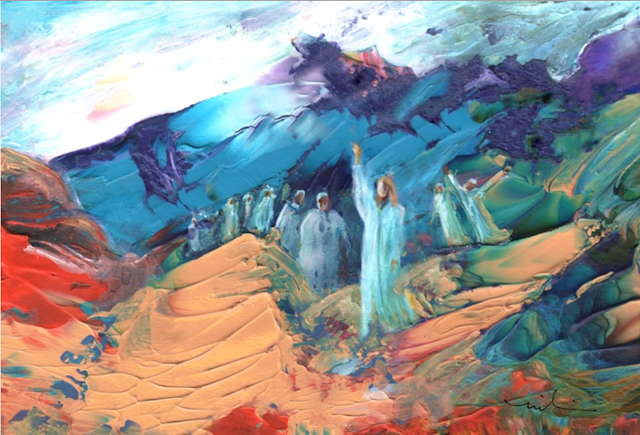
The Sermon on the Mount, by Miki de Goodaboom

There are many persons who currently feel angry and powerless in the face of recent and contemporary political events. All of this has large implications, especially for workers.

I admit to being one who is frustrated and saddened by the U.S. government’s unwillingness and inability to simply care about all of its citizens (as well as the citizens of the world). Along with their spirit of the age, they are failing to ensure the common good of everyone.

What’s more, there are large swaths of American Christianity who are either complicit or actively involved in establishing and perpetuating a system of governance which is fundamentally out of sync with biblical norms.

The Church and the Christian have a responsibility and a call, based in the words and ways of Jesus, of whom we purport to follow. In some of the first words uttered to his disciples, establishing what is of upmost importance for us to know, Jesus said:

“Blessed are you who are poor,
    for yours is the kingdom of God.
“Blessed are you who are hungry now,
    for you will be filled.
“Blessed are you who weep now,
    for you will laugh…

“But woe to you who are rich,
    for you have received your consolation.
“Woe to you who are full now,
    for you will be hungry.
“Woe to you who are laughing now,
    for you will mourn and weep.” (Luke 6:20-21, 24-25, NRSV)

Jesus was building and upholding an alternative kingdom to the political systems of the time. Christ came to this earth to set things right amidst a corrupt world whose authority was held in the hands of evil.

But change would not come through the typical means of worldly power such as coups, revolutions, or economic exploitation of some persons over others.

For those who feel helpless and without power, Christ brings a liberation which transcends all other powers and authorities. He brings blessing.

What this means for those who are enamored with worldly aspects of power (money, wealth, resources, political authority, etc.) the words and actions of Jesus brings woe.

An evil grip of the world cannot be loosened with practices and responses of hate, class warfare, verbal and physical violence, and economic takeovers. For those with spiritual eyes to see, and ears to hear, the sandy and shifting foundations of this present government administration are being, and will be, washed away. (Luke 6:49)

It’s important that people of faith participate with what is good, right, and just – that they are concerned with the public good of everyone; and are attuned to a social and economic vision for humanity that is concerned for all citizens, and not just some or a few of them.

For the past few hundred years, much of the church has made spiritual deliverance and socio-economic freedom a matter of only the individual. As long as one embraces a personal salvation in Christ, well then, all is well, right!?

Wrong. Holy Scripture is filled with concerns for the whole of humanity because of the exploitive powers of this world. We have stories in the Bible replete with such powers as the Pharaoh who enslaved and exploited workers for his and Egypt’s own wealth, power, and benefit.

Jesus came not to the religious leaders and the kings of the earth, but instead made it his purpose to spend time amongst the least in society, those for whom the rich and powerful had no inclination to pay attention to and help.

“We have for much too long settled for a gospel of private other-worldly possibility.”

Walter Brueggemann

Even amongst God’s own ancient people, King Solomon built an empire on the driving force of both slavery and cheap labor, exploiting a large class of persons in order to feed the behemoth of structural wealth.

Economic systems which exploit workers do it so that they can maintain cheap labor. They seek to keep those persons invisible and outside of any safety net of security which might cost the system money.

Unfortunately, there are extremely rich persons who rely upon workers remaining on the underbelly of their companies and of society. Embracing unrestrained individualism and unbridled capitalistic practices make for a permanent class of exploited workers who remain poor on purpose by those wishing them to remain there.

Such extremely rich individuals become political players only because of their wealth. They know little about statecraft and how a politics concerned for the common good really works. And, frankly, they don’t seem to care.

I bring up these things because many Christians have been complicit in the injustice and exploitation; and because many churches and church leaders try to operate like the super-rich, instead of trying to follow the words and ways of the Lord Jesus, whom they purport to follow.

The Apostle James minced no words in addressing the rich within the church:

Come now, you rich people, weep and wail for the miseries that are coming to you. Your riches have rotted, and your clothes are moth-eaten. Your gold and silver have rusted, and their rust will be evidence against you, and it will eat your flesh like fire. You have laid up treasure during the last days. Listen! The wages of the laborers who mowed your fields, which you kept back by fraud, cry out, and the cries of the harvesters have reached the ears of the Lord of hosts. You have lived on the earth in luxury and in pleasure; you have nourished your hearts in a day of slaughter. You have condemned and murdered the righteous one, who does not resist you. (James 5:1-6, NRSV)

Meanwhile, the poor and exploited are suffering. Christians are not to kiss-up to those in power, nor try to be like them. And, for God’s sake, we are never to get into the game of systemic evil, like those who mistreat us.

Instead, we learn to practice patience and endurance in the face of suffering, while we work toward a better society. We strengthen one another’s hearts through faith. We do not grumble and turn against each other, like a pack of wild dogs, but pray continually and practice forgiveness, so that we can be compassionate and merciful.

Since we are all connected on this planet, any time an individual shows unmitigated kindness toward another, chooses to love the enemy, expresses gratitude, or offers sincere forgiveness to someone who doesn’t deserve it, we shift the balance of the world back toward the axis of grace.

Unless we all work together to embrace our collective poverty of spirit and acknowledge our grinding emotions (and sit with them), we will eventually go the way of the already condemned who spend, eat, and laugh with sinister abandon.

Life is not a 100 meter sprint; life is a marathon. We are in the long haul of life, and do not live for the pleasures of the moment. So then, let us live up to who we are in Christ, created in the image and likeness of God, and possessing divine light and living water which will nourish us through our time of need.

For humanity does not live on bread alone, but by every word that comes from the mouth of God. I, for one, want to be blessed by Jesus, and not experience a woe from him. That means paying attention to the people and the matters of importance to Christ.

Wednesday of Holy Week (Psalm 70)

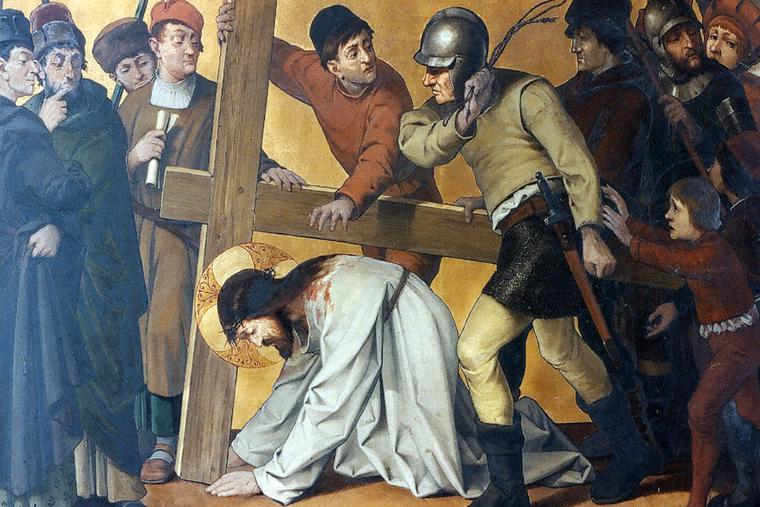
Ninth Station of the Cross, Jesus falls the third time, by Théophile Marie François Lybaert, c.1886

Be pleased, O God, to deliver me.
    O Lord, make haste to help me!
Let those be put to shame and confusion
    who seek my life.
Let those be turned back and brought to dishonor
    who desire to hurt me.
Let those who say, “Aha, Aha!”
    turn back because of their shame.

Let all who seek you
    rejoice and be glad in you.
Let those who love your salvation
    say evermore, “God is great!”
But I am poor and needy;
    hasten to me, O God!
You are my help and my deliverer;
    O Lord, do not delay! (New Revised Standard Version)

We all need help. Even Jesus.

As we journey with Jesus, and walk with him along the Via Dolorosa, we learn to set aside our illusions and delusions of radical independence, and to adopt his sense of dependence upon the heavenly Father. We come around to saying that we need divine help.

Continuing with a deliberate Christological view of the psalms, we are reminded that there was a time that Jesus felt desperation, just like we do. We go with him to the Garden of Gethsemane. And even though, in our own stressed out souls, we end up falling asleep and failing to pray as we ought, nevertheless we remember that the Lord Jesus sweat great drops of blood and agonized over what he was about to face.

There are times when the help we need isn’t for next week or tomorrow, but immediately, now!

I don’t know if you have ever been in such a stressful and dangerous situation in which all you could say is “Help, help me!” The abject feeling is helplessness is palpable and just plain awful. The sense there is nothing you can do to improve your circumstance other than some sort of merciful divine intervention is more than unnerving. It’s downright hard to breathe, let alone cry-out to be rescued.

In today’s psalm, it seems there were people getting a twisted sense of joy over the misfortune of others. It’s as if they were delighting in the confusion and vulnerability of those unable to stop what is happening.

In the throes of such stress and danger, the help we need is to have the evil turned back on the wicked. The psalmist wants such persons off his back – to have God hunt them like they are hunting the poor and needy who have no ability to resist.

It makes sense this psalm is short, just a few verses. Long prayers aren’t necessarily better than short ones, especially when it’s a frantic cry for God’s help. There is nothing in Holy Scripture that dictates how long or short prayer ought to be.

“Help!” just might be one of the best prayers we can pray. One little word. That’s all it takes.

It makes sense to me that this is an honest prayer. When in the throes of some horrible situation, all pretension goes out the window. Honest heartfelt prayers are the best kind of prayer.

If we are hurting badly enough, boldness comes quickly to the tip of our tongues. I once had a kidney stone and walked, doubled over in pain, into the Emergency Department of a hospital. I yelled at the first staff person I encountered, saying, “I need help, NOW!

To confess our great need to a God who listens might just be the best kind of theology we could ever express.

In such a terrible place of agony – of either body, soul, or both – there’s no thought to keeping up appearances, but only an unfiltered expression of need. Our prayers can, and need to be, earnest and urgent.

Prayer can be short, honest, and urgent because emergent situations require it. So, what do you do when you feel desperate? How do you handle your emotions? Where do you go for help?

In this Holy Week we are reminded that Jesus looked to the Father for help. In the worst of circumstances – facing ridicule, torture, and a horrible death – the Lord Jesus let the psalms shape his own prayers of desperation while under severe stress and duress:

“The one who ate my bread has lifted his heel against me.” (John 13:18; Psalm 41:9)

“They hated me without a cause.” (John 15:24; Psalm 69:4)

“I am deeply grieved, even to death; remain here, and stay awake with me.” (Matthew 26:38; Psalm 42:5-6)

“My God, my God, why have you forsaken me?”

Jesus (Matthew 27:46; Psalm 22:1)

Then Jesus, crying with a loud voice, said, “Father, into your hands I commend my spirit.” Having said this, he breathed his last. (Luke 23:46; Psalm 31:16)

There is a God who understands our plight. Jesus, the pioneer of our salvation, has gone before us in the way of suffering. He knows what it’s like to experience the agony and anguish of evil’s weight. He is our great high priest, the one who can intercede effectively and compassionately for us in our great times of need:

Now that we know what we have—Jesus, this great High Priest with ready access to God—let’s not let it slip through our fingers. We don’t have a priest who is out of touch with our reality. He’s been through weakness and testing, experienced it all—all but the sin. So, let’s walk right up to him and get what he is so ready to give. Take the mercy, accept the help. (Hebrews 4:14-16, MSG)

May you find in Jesus the help you so desperately need. Amen.