I Will Yet Again Praise God (Psalms 42 & 43)

Solitude, by Winslow Homer, 1889

As a deer longs for flowing streams,
    so my soul longs for you, O God.
My soul thirsts for God,
    for the living God.
When shall I come and behold
    the face of God?
My tears have been my food
    day and night,
while people say to me continually,
    “Where is your God?”

These things I remember,
    as I pour out my soul:
how I went with the throng
    and led them in procession to the house of God,
with glad shouts and songs of thanksgiving,
    a multitude keeping festival.
Why are you cast down, O my soul,
    and why are you disquieted within me?
Hope in God, for I shall again praise him,
my help and my God.

My soul is cast down within me;
    therefore I remember you
from the land of Jordan and of Hermon,
    from Mount Mizar.
Deep calls to deep
    at the thunder of your torrents;
all your waves and your billows
    have gone over me.
By day the Lord commands his steadfast love,
    and at night his song is with me,
    a prayer to the God of my life.

I say to God, my rock,
    “Why have you forgotten me?
Why must I walk about mournfully
    because the enemy oppresses me?”
As with a deadly wound in my body,
    my adversaries taunt me,
while they say to me continually,
    “Where is your God?”

Why are you cast down, O my soul,
    and why are you disquieted within me?
Hope in God, for I shall again praise him,
    my help and my God.

Vindicate me, O God, and defend my cause
    against an ungodly people;
from those who are deceitful and unjust,
    deliver me!
For you are the God in whom I take refuge;
    why have you cast me off?
Why must I walk about mournfully
    because of the oppression of the enemy?

O send out your light and your truth;
    let them lead me;
let them bring me to your holy hill
    and to your dwelling.
Then I will go to the altar of God,
    to God my exceeding joy,
and I will praise you with the harp,
    O God, my God.

Why are you cast down, O my soul,
    and why are you disquieted within me?
Hope in God, for I shall again praise him,
    my help and my God. (New Revised Standard Version)

I often get asked why God allows such hard things in our lives. There is likely no complete answer to that question; at least not on this side of heaven. Yet, I believe we can respond to the query in part: Facing hard circumstances, difficulty, and  adversity drives us to seek our help in God.

For those committed to knowing God, the desire for help through hardship becomes a deep longing not just to cope with and transcend troubles, but also to experience God like never before.

Every believer is familiar with becoming forlorn, even with crying themselves to sleep at night because of what is happening in their life. And the experience is further exacerbated by calloused others who mock us for our belief in a divine transcendent being.

Much like Christ on the cross, those who care nothing for us stroll by, see our agony, and respond with a “Humph! Let’s see your ‘God’ save you now!” (Matthew 27:42; Mark 15:31; Luke 23:35)

It’s in such times we remember back, when God felt very near to us, and seemed to answer every prayer. Yet now, the silence of God is palpable. This awkward quietness puts one in a position to hope. And when hope reawakens, a new resolve toward perseverance through the trouble comes.

For in hope we were saved. Now hope that is seen is not hope, for who hopes for what one already sees? But if we hope for what we do not see, we wait for it with patience. (Romans 8:24-25, NRSV)

Somehow, deep in our soul, we know that we will yet praise God again for a great deliverance. We remember that we were helped in the past; and now, in the present, that we will be helped again. Praise arises as an organic response to what we know will happen, even though it hasn’t yet happened.

Fresh prayers come to us, smack in the midst of our adverse situations. We pray, not only for our own help and deliverance, but also for the justice of God to have it’s way in the world.

We think of all the other believers who, like us, are facing hardship for no fault of their own. In a wonderful sense of solidarity in spirit, we lift up our sisters and brothers in the faith before the God for whom we are convinced will help them, as well as us.

All we want to do is somehow maintain our integrity of relationship with God and others, to remain in the cradle of truth – keeping our little light shining in the darkness that surrounds us.

It is not a sin to be troubled and to feel alone in the middle of a stressful and difficult circumstance. What we do with ourselves when we are in such a situation is what makes all the difference.

I suggest we flee to the Book of Psalms. In those times when tears become our food and drink, and we don’t know how to pray, let’s let the psalmist pray for us by adopting his prayers as our very own.

O God, our refuge and hope: When despondency and despair haunt and afflict us, comfort us with the stillness of your divine presence, so that we might confess all you have done, through Christ to whom we belong and in whom we are one. Amen.

Our Help Is In the Name of the Lord (Psalm 124)

If it had not been the Lord who was on our side
    —let Israel now say—
if it had not been the Lord who was on our side,
    when our enemies attacked us,
then they would have swallowed us up alive,
    when their anger was kindled against us;
then the flood would have swept us away;
    the torrent would have gone over us;
then over us would have gone
    the raging waters.

Blessed be the Lord,
    who has not given us
    as prey to their teeth.
We have escaped like a bird
    from the snare of the hunters;
the snare is broken,
    and we have escaped.

Our help is in the name of the Lord,
    who made heaven and earth. (New Revised Standard Version)

Today’s Psalm reminds believers of God’s deliverance in the past, so that we will not forget it in the present. If it were not for God, we would be toast. If not for God, none of us would be here; we’d be swallowed up by injustice and death.

Left on our own, and to our own devices, we don’t stand a chance against the oppressive flood of sinful sewage. But with God, there is hope; with God there is deliverance.

The ancient Israelites – and all the Jewish people throughout history – know a great deal of what it feels like to be overwhelmed by their enemies. Antisemitism is nothing new. Unfortunately, it has been around as long as Jews have existed. If some groups had their way, Israel would be wiped off the map.

The psalmist reminds Israel, as well as all of God’s people, of what the Lord has done in the past. Exhibit A of divine deliverance is the Exodus event and passing through the Red Sea to safety. The mighty Egyptians were no match for the God of Israel.

Each year, ever since that seminal deliverance from Israel’s enemies, Jews celebrate Passover, remembering and rehearsing this event of deliverance from the hand of Pharaoh. As pilgrims made their way to Jerusalem for the great Passover feast, they would sing Psalm 124, along with the other Songs of Ascent, giving praise to God for being attentive to their plight of slavery and oppression.

It is more than appropriate to give thanks and bless the Lord for the divine work of deliverance from enemies. God’s people are freed. For the Christian, God in Christ has delivered us from sin, death, and hell; and has made us joint heirs with Jesus.

When this perishable body puts on imperishability and this mortal body puts on immortality, then the saying that is written will be fulfilled:

“Death has been swallowed up in victory.”
“Where, O death, is your victory?
    Where, O death, is your sting?”

The sting of death is sin, and the power of sin is the law. But thanks be to God, who gives us the victory through our Lord Jesus Christ.

Therefore, my beloved brothers and sisters, be steadfast, immovable, always excelling in the work of the Lord because you know that in the Lord your labor is not in vain. (1 Corinthians 15:54-58, NRSV)

Recalling what God has done for us is a powerful part of the believer’s identity. The very Maker of heaven and earth, the Lord God almighty, is our help. It is God who prevails against those who seek to destroy and do harm. The Lord is the One who conquers enemies and makes things right.

The believer puts no trust in the power of weapons or in being the strongest. God is acknowledged as the true Deliverer from even the most formidable of foes, despite any power of the unjust.

In Christianity, Christ’s redemptive events of cross and resurrection has triumphed and won the victory over the powerful enemies of death, destruction, and the devil. Praising and singing to God is helpful and needed.

We all need help – not just sometimes but all the time. If we feel as if things are going pretty well for us, that only means we have just come out of a difficult time, or that we are about to undergo some enemy vitriol.

I wish we didn’t have to contend with selfish boneheads who only think of themselves all the time. But we do. And I wish we never needed to go through such hard times that grind us into the ground. Yet it happens.

However, we are not alone. We have a Champion, an Advocate, and One who has gone before us as the Pioneer of our salvation.

He has raised up a mighty savior for us
    in the house of his child David,
as he spoke through the mouth of his holy prophets from of old,
    that we would be saved from our enemies and from the hand of all who hate us. (Luke 1:69-71, NRSV)

Jesus did for us what we could do for ourselves. He willingly and deliberately let all evil exhaust itself on him, so that there is no enemy left to condemn us.

Enemies may still be around, but they are toothless. We may yet be like birds vulnerable to a trap, but the snare has been broken. All our enemies are powerless. We are free. Thanks be to God!

Our help is in the name of the Lord who made heaven and earth. Amen.

Waiting with Hope (Romans 8:22-25)

Art depicting cracked earth, a dry riverbed, white plastic shapes, a lack of life and the red glow of fire. The figures are separated, lacking any real connection. By artist Chris De Hoog

For we know that all creation has been groaning as in the pains of childbirth right up to the present time. And we believers also groan, even though we have the Holy Spirit within us as a foretaste of future glory, for we long for our bodies to be released from sin and suffering.

We, too, wait with eager hope for the day when God will give us our full rights as his adopted children, including the new bodies he has promised us. We were given this hope when we were saved. (If we already have something, we don’t need to hope for it. But if we look forward to something we don’t yet have, we must wait patiently and confidently.) (New Living Translation)

Salvation is not only personal; it’s also cosmic.

That is, freedom from the power of sin, death, and hell is not only for an individual person, but this deliverance is for all of creation, for the entire earth.

So then, all of creation – not just people – long for and groan for the advent of Christ. My oak tree in the backyard longs for it. My dog whines for it. When it rains, the sky is wondering how long it will have to keep up its tears.

Together with the entire cosmos, we look forward to the complete fulfillment of our inheritance as God’s creation, as God’s creatures.

Since that is true, it is Christians who need to see the privilege and responsibility of conducting ourselves with unity, harmony, and non-violence. We are to live this way because we are foreshadowing the end of the world’s story.

There is a day coming when there will be no more malevolent and selfish posturing for power and control. No more oppression and victimization. No more injustice.

And we have the chance to begin living that way now, and not only in a future time. We get to do this because of Christ.

But that doesn’t mean we don’t suffer anymore. Presently, along with all creation, we have pain like that of a woman in childbirth. This is no papercut inconvenient pain; this is “I hurt like hell” pain. That sort of pain has us awaiting the redemption of our bodies.

I work as a hospital chaplain. Every day, I see suffering, some of it unimaginable. I listen to stories of people longing for healing, and grasping at hope. And I hear plenty of groaning (both the actual physical groans, as well as the more quiet internal sighs and groans).

I say to you: The human body is not meant to be destroyed. Our physical selves are not destined for elimination. No, our bodies are meant to be redeemed; they are meant for salvation. It will not always be this way!

So, we hope.

The Christian has the confident expectation that not only is the soul redeemed, but the body, as well. We can enjoy spiritual salvation now. But we must wait for the physical deliverance. There must be patience on our part until Resurrection Day.

The Apostle Paul was calling on believers to hope. Five times he said it in only two verses. Paul was emphasizing the need for spiritual endurance because we have not yet arrived.

In case you haven’t noticed, we aren’t in heaven; this isn’t a renewed earth; people around the globe are not all presently singing kumbaya together.

Therefore, it is imperative that we live with the tension between the “now” and the “not yet.” It’s a weird existence, this Christian life. But, in reality, we exist in the paradox of being saved now, and not yet being saved.

Another way of putting this is that God’s adopted children have not yet received their inheritance.

But that doesn’t mean we’ve been left to ourselves. We have the first fruits of our salvation: the Holy Spirit.

We presently, right now, enjoy a real and significant portion of God’s freedom and deliverance. We have God’s gift of presence. There is the continuing presence of Jesus Christ with us, the blessed Holy Spirit.

And this divine presence is what today helps us to endure and hold onto hope. By holding this future hope, we learn to accept, cope, and transcend our circumstances through love.

Therefore, since we have been made right in God’s sight by faith, we have peace with God because of what Jesus Christ our Lord has done for us. Because of our faith, Christ has brought us into this place of undeserved privilege where we now stand, and we confidently and joyfully look forward to sharing God’s glory.

We can rejoice, too, when we run into problems and trials, for we know that they help us develop endurance. And endurance develops strength of character, and character strengthens our confident hope of salvation. And this hope will not lead to disappointment. For we know how dearly God loves us, because he has given us the Holy Spirit to fill our hearts with his love. (Romans 5:1-5, NLT)

The very suffering which we so often try to avoid and get out of, becomes the means of connecting us with Christ and with others.

The problem becomes the answer.

The Spirit groans with our own spirit, and we all become connected together.

I point out, however, that not everyone wants this sort of connection. There are many people who want nothing to do with solidarity.

Some folks want to remain in their own little huddle or small world; and they take offense at anyone outside of their group who seeks to understand and connect with that group’s suffering.

Although everyone’s pain and suffering is unique – and no one can fully know another’s sorrow – that does not mean solidarity and connection are impossible, or undesirable.

I don’t need to have cancer in order to connect with a cancer patient. I don’t have to become victimized to show genuine empathy and extend competent comfort. Yet, sadly, some persons only want connection and consolation from a certain person or group.

But I say to that: Who are you to tell God whom God can love you through?

To suffer is one thing, because we all must suffer in some way. But to compound your suffering by your own volition is another thing altogether.

You deserve better than harming yourself through cutting off help.

It could be that today is the day you reach out to that person you know will be there for you. Or, perhaps now is the time to quite putting off making space for prayer and reflection.

Whatever it is that you need to do, it’s okay to do it, without putting it off until tomorrow.

Lord Jesus Christ, by your patience in suffering you hallowed earthly pain and gave us the example of obedience to your Father’s will: Be near me in my time of weakness and pain; and sustain me by your grace, so that my strength and courage may not fail. Heal me according to you will; and help me always to believe that whatever happens to me here is of little account if you hold me in eternal life. Amen.

Work and Family (Psalm 127)

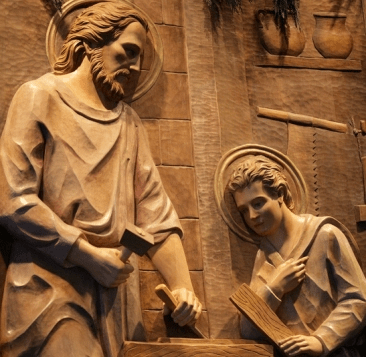
The Carpenter’s Son, Holy Cross Chapel, Houston, Texas

Unless the Lord builds the house,
    those who build it labor in vain.
Unless the Lord guards the city,
    the guard keeps watch in vain.
It is in vain that you rise up early
    and go late to rest,
eating the bread of anxious toil,
    for he gives sleep to his beloved.

Sons are indeed a heritage from the Lord,
    the fruit of the womb a reward.
Like arrows in the hand of a warrior
    are the sons of one’s youth.
Happy is the man who has
    his quiver full of them.
He shall not be put to shame
    when he speaks with his enemies in the gate. (New Revised Standard Version)

God is the Creator. We humans are creatures, created in the image and likeness of God. Therefore, we are inextricably tied to God, and quite dependent upon the Lord.

For the activities of our daily human life, we need God. When it comes to establishing a home, protecting our community, daily work, and raising children, we very much need God’s help to do all of this in a way that is successful and good.

Unless God is with us, in the center of all that we do, then our work in building a good life shall be in vain. How we go about living our lives with work and family, and who we look to as role models, makes a significant difference in the quality and effectiveness of our labor and relationships.

When my wife was growing up, her family had a prominent portrait of John Wayne in the living room above the television. That picture spoke volumes about the family ethos. They had horses and loved to ride and enjoy the outdoors. Hard work was a daily reality of life, as well as a rugged individualism that often suppressed all else in order to engage in work. 

Doing your best, striving for excellence, and learning responsibility are good things that mature people do every day. Yet, there is a fine line between hard work that provides and enriches, and lonely work that is frenetic and fueled by anxiety about the future.

The motives behind why we burn the candle at both ends are just as important to the Lord as the work itself. The psalm for today is a wake-up call for us to consider the frenetic pace of work and family life.

If we independently believe that our life is in our own hands, and we work with a worry that animates our every task, then we have lost touch with the understanding that it is God who ultimately provides us with every good thing in life. 

However, if we begin to relax and let go of our stubborn independent streak, then we work hard with the strength God gives. We let the Lord watch over us.

Trusting God in our work is connected to children being a heritage from the Lord. In the ancient world, children worked alongside their parents. Fathers and mothers did not go it alone – work was a family affair, as well as a community endeavor. 

Whenever we slip into a groove of worshiping individualism, rather than simply taking personal responsibility, then we must come back to the inter-dependence we were designed for as created human beings. 

The ethos the psalmist espoused is trust in God, reliance on others, and working together for the common good of all. 

Here are a few ways of working together and not carrying the load of work on our own:

Ask for what you want and need to accomplish the task. Whenever we don’t ask, we inevitably go the route of hustling for help through manipulation, guilt, and shaming others.

If someone says, “no,” simply ask another person or persons. Asking once just won’t do. And neither is commanding others to get things done. We have the ability to ask calmly, confidently, and compassionately. Accept the “no” which you might get, without retreating back to manipulation. This is especially needful when it comes to asking family members.

Ask God to help you in your work. Each day as I enter the hospital for which I am a Chaplain, I say a prayer, “God almighty, blessed Father, Son, and Spirit, please go before me, with me, and after me to each patient, their family members, and every team member I encounter today, with the love and compassion of Jesus Christ.”

Delegate, if possible. This is not the same thing as barking orders. Delegating is a realization that we are finite creatures with limitations of time, energy, and resources. It’s okay to share the load with others. In fact, most people are more than willing to help, if we but ask. It enables them to feel needed and important.

Be vulnerable and gracious. We all mess up our work, at times. And it’s important to own mistakes without heaping unnecessary criticism on ourselves, or others. Offering an apology, recognizing that you’ve bit off more than you can chew, and admitting your lack of energy are healthy, not sinful. Also, whenever others fall short of their responsibilities, it’s our job to handle it with grace – seeking to understand and help, rather than criticize and judge.

Working together, consulting, collaborating, and engaging in fellowship enable us to speak with those who may oppose, misunderstand, or misinterpret us. It’s also a more joyful way to live.

Sovereign God, you created all things and in you everything holds together. Preserve me with your mighty power that I may not fall into disconnection with you and others, nor be overcome by anxiety. In all I do direct me to the fulfilling of your purpose, through Jesus Christ my Lord. Amen.