A Solemn Pledge of Hope (Hebrews 6:13-20)

When God gave Abraham his promise, he swore by himself since he couldn’t swear by anyone greater. He said, “I will certainly bless you and multiply your descendants.” So Abraham obtained the promise by showing patience. People pledge by something greater than themselves. A solemn pledge guarantees what they say and shuts down any argument.When God wanted to further demonstrate to the heirs of the promise that his purpose doesn’t change, he guaranteed it with a solemn pledge. So these are two things that don’t change, because it’s impossible for God to lie.

He did this so that we, who have taken refuge in him, can be encouraged to grasp the hope that is lying in front of us. This hope, which is a safe and secure anchor for our whole being, enters the sanctuary behind the curtain. That’s where Jesus went in advance and entered for us, since he became a high priest according to the order of Melchizedek. (Common English Bible)

“We must accept finite disappointment, but never lose infinite hope.”

Martin Luther King, Jr.

Humanity needs hope. We all require a confident expectation that things will be different or better. Hope is what our ancestors in the faith possessed in abundance.

How did Abraham receive what was promised by God?

Abraham latched onto hope. He believed God’s promise of having a place to belong. His faith caused him to make a major move from the city where he had always lived. What’s more, Abraham understood that the promises of God don’t end in this life. He looked forward to being a permanent resident in the eternal city.

By faith Abraham obeyed when he was called to go out to a place that he was going to receive as an inheritance. He went out without knowing where he was going. By faith he lived in the land he had been promised as a stranger. He lived in tents along with Isaac and Jacob, who were coheirs of the same promise. He was looking forward to a city that has foundations, whose architect and builder is God. (Hebrews 11:8-10, CEB)

Why did God make a solemn pledge, a sacred oath, to Abraham?

The Lord wanted to reinforce Abraham’s faith and encourage him. God desired to convincingly show that divine promises are sure.

The Lord spoke to Abram in a vision and said to him, “Do not be afraid, Abram, for I will protect you, and your reward will be great.” But Abram replied, “O Sovereign Lord, what good are all your blessings when I don’t even have a son?…. You have given me no descendants of my own, so one of my servants will be my heir.”

Then the Lord said to him, “No, your servant will not be your heir, for you will have a son of your own who will be your heir.” Then the Lord took Abram outside and said to him, “Look up into the sky and count the stars if you can. That’s how many descendants you will have!” And Abram believed the Lord, and the Lord counted him as righteous because of his faith. (Genesis 15:1-6, NLT)

What are two things that do not change?

God’s promise and God’s solemn pledge. God promised Abraham:

“I will make you into a great nation,
    and I will bless you;
I will make your name great,
    and you will be a blessing.
I will bless those who bless you,
    and whoever curses you I will curse;
and all peoples on earth
    will be blessed through you.”(Genesis 12:2-3, NIV)

God confirmed the promise with a sacred oath:

“I swear by myself, declares the Lord, that because you have done this and have not withheld your son, your only son, I will surely bless you and make your descendants as numerous as the stars in the sky and as the sand on the seashore. Your descendants will take possession of the cities of their enemies, and through your offspring all nations on earth will be blessed, because you have obeyed me.” (Genesis 22:16-18, NIV)

Is there a way to be motivated and encouraged in the Christian life?

Yes. Hope in God’s promises. Confidence that our efforts to live for Christ are being seen. Knowledge that our labor in the Lord is not in vain.

To remain encouraged, and to keep persevering in faith and hope, we need one another. So, it is important to maintain significant relationships with other believers so that we will not lose our spiritual vitality and become discouraged. The author of Hebrews stated:

We should keep on encouraging each other to be thoughtful and to do helpful things. Some people have gotten out of the habit of meeting for worship, but we must not do that. We should keep on encouraging each other, especially since you know that the day of the Lord’s coming is getting closer. (Hebrews 10:24-25, CEV)

Faith and patience, fueled by an unshakable hope, has always been the way believers have lived their lives. For the Christian, we have a promised inheritance. And that promise is focused on the person and work of Christ – because all of God’s good promises are fulfilled in Jesus.

Our energy, resources, time, and work are finite. Yet God is infinite. God has always been and always will be. And Jesus is the same yesterday, today, and forever. As we tether ourselves to these unchangeable realities, we have a sure foundation of hope in which to build a solid life of confidence.

God of hope, in these times of change, unite us and encourage us with your promise and oath. Help us overcome our fears and enable us to build a future in which all may prosper and share, through Jesus Christ our Lord. Amen.

Final Exhortations on the Christian Life (Hebrews 13:1-16)

Forever Hebrews, by Anthony Falbo

Keep on loving one another as brothers and sisters. Do not forget to show hospitality to strangers, for by so doing some people have shown hospitality to angels without knowing it. Continue to remember those in prison as if you were together with them in prison, and those who are mistreated as if you yourselves were suffering.

Marriage should be honored by all, and the marriage bed kept pure, for God will judge the adulterer and all the sexually immoral. Keep your lives free from the love of money and be content with what you have, because God has said,

“Never will I leave you;
    never will I forsake you.”

So we say with confidence,

“The Lord is my helper; I will not be afraid.
    What can mere mortals do to me?”

Remember your leaders, who spoke the word of God to you. Consider the outcome of their way of life and imitate their faith. Jesus Christ is the same yesterday and today and forever.

Do not be carried away by all kinds of strange teachings. It is good for our hearts to be strengthened by grace, not by eating ceremonial foods, which is of no benefit to those who do so. We have an altar from which those who minister at the tabernacle have no right to eat.

The high priest carries the blood of animals into the Most Holy Place as a sin offering, but the bodies are burned outside the camp. And so Jesus also suffered outside the city gate to make the people holy through his own blood. Let us, then, go to him outside the camp, bearing the disgrace he bore. For here we do not have an enduring city, but we are looking for the city that is to come.

Through Jesus, therefore, let us continually offer to God a sacrifice of praise—the fruit of lips that openly profess his name. And do not forget to do good and to share with others, for with such sacrifices God is pleased. (New International Version)

Whenever I read this final chapter in the New Testament book of Hebrews, it gives me the feel of a parent blurting out a bunch of loving exhortations before the kids leave.

Throughout this incredible letter to a group of struggling Jewish Christians, the author of Hebrews offered a mix of pastoral encouragement along with pointed spiritual warnings. Now, after doing his best to demonstrate that Jesus is worth holding on to, the author exhorts the people with several practical instructions to help focus them for a life of guidance and direction in the ways of Christianity.

Keep on Loving Each Other

Love is the distinguishing characteristic of a Christian. A group of people can only persevere if they encourage one another daily with a combination of cheerleading and rebuke. The big idea is that everyone must hold each other accountable for living the Christian life.

Show Hospitality to Strangers

The word for hospitality literally means “love of stranger.” It’s the opposite of xenophobia (fear of the other). Hospitality is an expression of love for Christ in meeting the needs of people we don’t even know. Why do it? One good reason is that they just might be angels.

Remember Prisoners and Mistreated Persons

In the ancient world, there was no state-supported prison system. Incarcerated persons were completely dependent upon the mercy of their family and friends for food and relational connection. In the case of those who were truly alone, the church extended needed benevolence to them. Otherwise, prisoners would languish and eventually die.

Furthermore, we are to be observant of those who endure suffering from mistreatment. Why? Because the believers were in that position, too. Instead of “looking out for number one,” the church was to engage the community and not be isolated from its needs.

Honor the Institution of Marriage

God cares about how we honor our commitments. Ideally, couples are to keep their relationship pure without adulterating themselves with others. They submit to one another out of reverence for Christ. And they keep their promises to each other, no matter what circumstances they find themselves in.

In God’s economy, there’s no such thing as “free love” in the sense that we can have multiple partners without any sort of consequence or fallout. Friends with benefits is a misnomer. Random sex is oxymoronic. And casual lovers are in huge denial. There is a high cost to it all.

Don’t Love Money

This, of course, is a tricky one. We need money. Everyone must use money. But the love of money sets us on a dark path from which few are able to return. The best way (and really the only way) of avoiding the money pit is to be content with what you have.

Gratitude and thanksgiving has the power to grant us a happy life, even though it may be a very simple one. The only permanent things in the universe are relationships – everything else will burn.

Remember Your Leaders

Recall those persons who were good examples in both their speech and action. And imitate their faith. I wonder how many of us could say that to another person – to mimic our own life. If you’re like me, one of the things which stick out to you about respected leaders in your life, is their passion and desire in living for Christ. And, like Jesus, they were never fickle, but were always consistent and unwavering in their commitments.

Don’t Be Carried Away by Different Teachings

The basic message of the gospel has not changed: There is still good news of great joy for all who believe, because Jesus has taken care of the sin issue once for all through his singular sacrifice. And Jesus will sustain us by means of the Holy Spirit graciously given us. There’s no need to look elsewhere for our needs to be met.

Bear Christ’s Disgrace

Go to Jesus outside the camp – or in other words – live a holy life. Live into the words and ways of Christ. In doing so, we will actually end up being ridiculed, even abused. In concluding the Beatitudes in the Sermon on the Mount, Jesus promised that living a holy life of humility, righteousness, mercy, purity and peacemaking will result in persecution. (Matthew 5:10-12)

So, why live this way? Because it is the path to our eternal inheritance. The broad road leads to destruction, but the narrow way of holiness brings us to eternal life.

Continually Offer to God a Sacrifice of Praise

Praise comes from a heart full of gratitude for deliverance from sin, death, and hell – for salvation from all the guilt and shame of things done and things left undone. Praise is our sacrifice, not animals. In a world where many people want followers of Jesus to keep their mouths shut, those devoted to Christ find themselves incessantly chattering about Jesus because of their union with him.

Be Benevolent

Part of offering a sacrifice of praise is using our time and resources for the benefit of blessing the church and the world. We aren’t simply consumers who receive salvation and blessing from God; we are also producers who thoughtfully and compassionately give of our gifts, talents, time, and money for those in need of grace and love.

Conclusion

Why are we to obey these various exhortations from the author of Hebrews? Because we were purchased at a price – the precious blood of Jesus Christ. And as a result of receiving such a grace from God, the believer willingly gives themselves to becoming holy, serving faithfully, and offering compassionate spiritual care in the name of Christ.

For love is always the true litmus test of every genuine follower of Jesus, and the thing which gives motivation and shape to each exhortation.

Amen. May it be so, to the glory of God.

Faith Helps Us Take the Long View of Life (Hebrews 11:23-28)

Moses is saved from the water by Pharaoh’s daughter, by Marc Chagall, 1966

It was by faith that Moses’ parents hid him for three months when he was born. They saw that God had given them an unusual child, and they were not afraid to disobey the king’s command.

It was by faith that Moses, when he grew up, refused to be called the son of Pharaoh’s daughter. He chose to share the oppression of God’s people instead of enjoying the fleeting pleasures of sin. He thought it was better to suffer for the sake of Christ than to own the treasures of Egypt, for he was looking ahead to his great reward. It was by faith that Moses left the land of Egypt, not fearing the king’s anger. He kept right on going because he kept his eyes on the one who is invisible. It was by faith that Moses commanded the people of Israel to keep the Passover and to sprinkle blood on the doorposts so that the angel of death would not kill their firstborn sons. (New Living Translation)

Sometimes we can’t see beyond the end of our nose. We get lost in the here-and-now worries of the moment. We need a better view.

Taking a long view of life happens whenever we place our faith in permanent and ultimate realities, and not merely live by what feels good or drives our anxiety in the temporal moment.

To have faith is to possess an indefatigable and unflagging trust in someone’s ability to achieve a desired outcome. The author of Hebrews describes it this way:

No one can please God without faith, for whoever comes to God must have faith that God exists and rewards those who seek him.

Hebrews 11:6, GNT

Faith looks ahead and sees as clearly as whatever is right now in front of your face. People of faith have the ability to take the long view of life, knowing that God has their backs. The mature person of faith can set aside temporary pleasure to attain a future hope. 

Moses, held up by the writer of Hebrews as an example of such faith, refused to identify himself as the daughter of Pharaoh. He chose to be mistreated in solidarity with his fellow Israelites, instead of having a good time with his high position in the most powerful empire of its day. Moses knew that the treasures of Egypt were not as wonderful as what he would receive from suffering for the sake of Messiah, and he looked forward to his reward.

It’s an understatement to say that our contemporary society embraces instant gratification. We want to feel good, and we want it now. Impulse control may just be one of the best life skills that kids (and adults!) need to learn in society. And one of the most effective ways to distract ourselves from a tempting pleasure we don’t want to indulge, is by focusing on another pleasure.

For the Christian who desires to follow Jesus in all things, looking ahead to better days is a confidence booster, namely because Jesus is better and superior to all things. This isn’t some wistful fanciful notion of positive thinking; this faith is based in the person and work of Christ. Spiritual endurance and perseverance through difficulty will have a reward – and it will be shared along with all of God’s people. 

But if we only consider today and what’s in it for me right now, there are scant resources for responding to the temptations and fluctuations of life. We must put some planning and energy into clarifying and embracing our most cherished values. Then, those values shall inform everything we do, or not do. In the scope of eternity, suffering a bit now is nothing compared to what Christ has yet in store for his people.

Deferred gratification causes us to live differently. In a twist of irony, folks who orient themselves toward the unseen world to come are able to effectively impact and change the visible world they currently reside within – whereas those who focus solely on this present world find themselves falling woefully short with their truncated view of life. We need the wisdom which faith provides us:

We are always confident, because we know that while we are living in the body, we are away from our home with the Lord. We live by faith and not by sight. We are confident, and we would prefer to leave the body and to be at home with the Lord. So, our goal is to be acceptable to him, whether we are at home or away from home. We all must appear before Christ in court so that each person can be paid back for the things that were done while in the body, whether they were good or bad. (2 Corinthians 5:6-10, CEB)

Future hope, fueled by faith, gives shape to how we live today. It enables us to live in solidarity with those who suffer and are mistreated. It ennobles us to live above short-sighted desires and act on behalf of the common good of all persons in the here-and-now.

Lord God Almighty, the One who is and was and is to come, may we, along with your servant Moses, see the plight of all those who suffer in our midst. Give us courage and compassion to live in solidarity with the poor, the oppressed, the forgotten, and all who live with misfortune and misery. May our hearts, burning with love, bear the burdens of all in our care. And may our loving example ignite the hearts of others to accompany the vulnerable in their affliction. We ask this in the gracious name of Jesus through the power of your Holy Spirit. Amen.

Jesus Is Better (Hebrews 8:1-7)

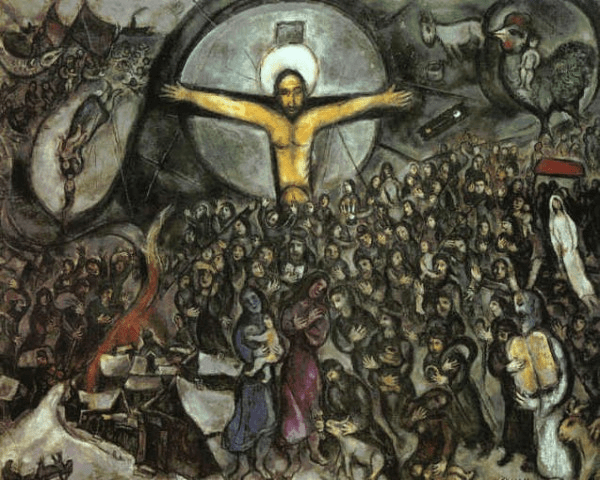
Exodus by Marc Chagall, 1952

Now the main point of what we are saying is this: We do have such a high priest, who sat down at the right hand of the throne of the Majesty in heaven, and who serves in the sanctuary, the true tabernacle set up by the Lord, not by a mere human being.

Every high priest is appointed to offer both gifts and sacrifices, and so it was necessary for this one also to have something to offer. If he were on earth, he would not be a priest, for there are already priests who offer the gifts prescribed by the law. They serve at a sanctuary that is a copy and shadow of what is in heaven. This is why Moses was warned when he was about to build the tabernacle: “See to it that you make everything according to the pattern shown you on the mountain.” But in fact the ministry Jesus has received is as superior to theirs as the covenant of which he is mediator is superior to the old one, since the new covenant is established on better promises.

For if there had been nothing wrong with that first covenant, no place would have been sought for another. (New International Version)

Jesus Christ is superior to everyone and everything – that is the overarching theme of the New Testament book of Hebrews. Jesus is above the angels, over Moses, and the great high priest of a new covenant. In Christ, the sin issue has been taken care of, once and for all.

Through Jesus, every good promise of God is fulfilled. Christ’s priesthood and intercessory ministry is permanent. His sacrifice for sin is thorough and complete. Jesus lives forever. He saves completely. Christ meets our need. He has been made perfect forever. (Hebrews 7:23-28). 

Frankly, these bold statements from the author of Hebrews are some audacious claims. In fact, they’re downright radical. And yet, say any of those statements in the typical church, and hardly an eyebrow gets raised – they almost seem ho-hum. Our blank affect testifies that we have lost a great deal of the original force and impact of Christianity.

In the first century, to have one sacrifice to end all sacrifices was unthinkable. Every ancient person understood that sacrifices were temporary; you had to keep offering them over and over again. 

Christianity, however, asked the world to have a new understanding of sacrifice. No longer would there be any sacrifice – no grain sacrifice; no offerings of first fruits; no animal sacrifices; no sacrifices, period. There was no longer any need for them because Jesus himself is the sacrifice to end all sacrifices. 

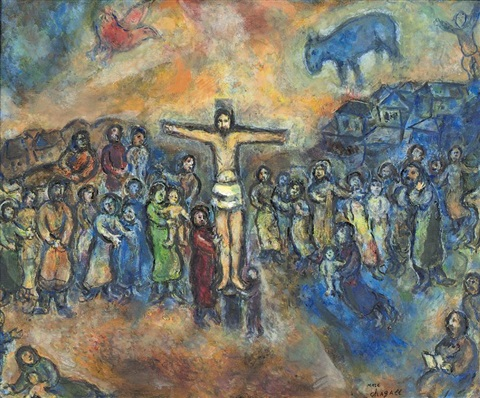
Crucifixion by Marc Chagall, 1966

This was such a ridiculous notion for so many people that they mocked Christians for it. Both Jews and pagans could barely wrap their minds around such a progressive idea. It would be like saying to us today that there is no longer any need for money because somebody just became the underwriter for everything everybody does.

Despite this incredible spiritual reality, we in the contemporary church sometimes go back to the old sacrificial system, not by physically offering animal sacrifices, but treating Christ’s finished work as if it were just too good to be true. 

We reason that we need to do something to help save ourselves. However, Jesus has not just saved us partially, but fully. Grace has always been scandalous, and so, we try to tone it down a bit, mitigate it’s actual force:

  • Church attendance can subtly be looked upon as a sacrifice to appease God, as if he needed to be soothed into not becoming angry at us. 
  • Giving can become a non-bloody sacrifice that is meant to satisfy God’s furrowed brow against us. 
  • Service can degenerate into a sacrifice to assuage our guilty conscience. 

In all these kinds of instances, and more, we go back to an old sacrificial system that is obsolete. Nonetheless, the biblical and theological truth is that Jesus has thoroughly saved us from our sin, and, so, has cleansed us from all guilt, including a guilty conscience. 

Jesus meets our need and has completely satisfied God’s wrath against the power and deceit of sin. 

Jesus is our mediator and intercedes for us as we come to God’s throne of grace. That means we do not need to try and get God’s attention with performing spiritual cartwheels or some incredible sacrifice that will somehow obligate him to take notice of us. That’s because there is never a time in which we lack attention from God.

Since we have been justified by faith in Jesus, we need not worry anymore about being good enough. Since Jesus is perfect, his work is made complete in us. A constant anxiety of feeling like we don’t measure-up does not come from God. Jesus is sufficient and has taken our place so that we can live in the freedom and joy of a complete deliverance from sin, death, and hell. There is no longer any necessary sacrifice to make!

“Well,” I have been told by some, “if everybody in the church believed that then nobody would ever do anything!” No, it is just the opposite. When we feel like we don’t measure up, we do less, not more. A low level discouragement sets in and we do nothing because we intuitively know it will never be enough. We do just enough to squeak by, never quite knowing if it is doing anything. 

In such a state, we may consider giving up because Christianity doesn’t work for us (which was the state of the believers in the book of Hebrews). But when we grasp the New Covenant of Christ’s sacrifice to end all sacrifices, and are overwhelmed by grace, then everything we do in the Christian life is a “thank you” with our life and our lips. 

It is the grace, and not the wrath, of God that teaches us to say “no” to ungodliness and worldly passions and to live upright and godly lives (Titus 2:11-12).

We are justified and made right by faith in Jesus Christ, and not by our own accomplishments, pedigree, or effort.  Trusting in our heritage, relying on our family’s faith, or believing our hard work gives us a leg-up toward heaven will only end in despair. 

But if we trust in Christ’s perfect sacrifice, then a whole new world of mercy opens before us. Because the grace of God in Christ is superior to everything.

Soli Deo Gloria