Hebrews 2:1-4 – Learning to Pay Attention

We must give our full attention to what we were told, so that we won’t drift away. The message spoken by angels proved to be true, and all who disobeyed or rejected it were punished as they deserved. So, if we refuse this great way of being saved, how can we hope to escape? The Lord himself was the first to tell about it, and people who heard the message proved to us that it was true. God himself showed that his message was true by working all kinds of powerful miracles and wonders. He also gave his Holy Spirit to anyone he chose to. (CEV)

My three girls all have attention deficit disorder (A.D.D.). You might think this is a disadvantage. Rather, since the biology of their brains do not have good filters for sifting out all the stimuli which they hear each day, each of them are much more intentional about picking out the voice they want to hear and engaging with it. Whereas you and I might take this for granted, my girls know the value of creating the skills to pay attention.

We stand at the cusp of Lent, just two days from now. A healthy way of looking at this important season in the Christian Year is that it is a time to listen. It is the opportunity and privilege of giving our complete attention to Jesus as we plod along the 40-day path to Easter. And we need to develop some solid skills in paying attention, whether we have A.D.D. or not.

The cost of not developing such skills is that we will drift away. Taking for granted that we are Christians, that we know something about salvation, and are basically good people, might only be setting us up for spiritual failure. That is, we think we already know about Christ’s person and work of salvation, so we fail to really pay attention. Bad idea.

Assuming we are paying attention is not the same thing as actually doing it. Assumptions lead to drifting away from truth. We are meant to have continual and constant reminders of Christ and his redemptive events. This is what Lent intends for us. To ignore the wisdom of two-thousand years of church practice puts us in a precarious position of being lost at sea.

For the next six weeks, make the choice that you will pay attention to Christ each day through the following:

  • Reading Scripture every day with a combination of standing and sitting, reading silently and out loud.
  • Holding a cross or other Christian reminder in your hand and feeling free to fidget with it.
  • Journaling your thoughts in a notebook.
  • Imposing time limits on yourself each day for the next 40 days.
  • Using different versions of the Bible to read throughout Lent.
  • Going outside occasionally and praying while walking.
  • Focusing on your breathing. Breathe out: “Speak Lord.” Breathe in: “I am listening.”
  • Drinking some coffee, tea, or something soothing.
  • Being mindful of distractions and acknowledging them without judging yourself.

The point is to have an intentional plan for paying attention. Do not assume you will be focused. May your journey with Jesus this season be a fresh experience in knowing him better.

Lord God, the world is rushing by. The days are sometimes a blur. But in those moments when I stop, time almost stands still. Keep my heart open to the simplicity of the day – to virtual interactions and connections with others without being distracted – and paying attention. Help me, Lord. Open my eyes. Open my ears. Open my heart to know you are with me, if I just pay attention. Amen.  

Psalm 110 – The Priest King

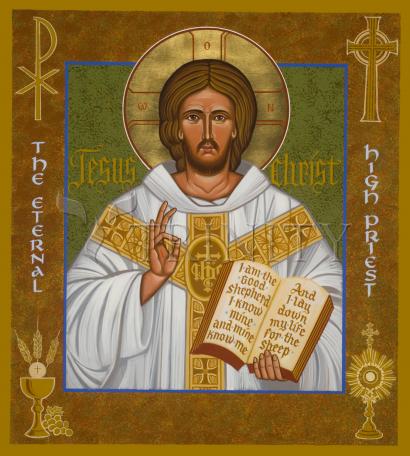
Jesus Christ – Eternal High Priest by American painter Joan Cole

The Lord says to my lord:

“Sit at my right hand
    until I make your enemies
    a footstool for your feet.”

The Lord will extend your mighty scepter from Zion, saying,
    “Rule in the midst of your enemies!”
Your troops will be willing
    on your day of battle.
Arrayed in holy splendor,
    your young men will come to you
    like dew from the morning’s womb.

The Lord has sworn
    and will not change his mind:
“You are a priest forever,
    in the order of Melchizedek.”

The Lord is at your right hand;
    he will crush kings on the day of his wrath.
He will judge the nations, heaping up the dead
    and crushing the rulers of the whole earth.
He will drink from a brook along the way,
    and so he will lift his head high. (NIV)

Today’s reading is the most quoted psalm in the New Testament (twenty-four times) and is mentioned in the Apostle’s Creed. The reason for this is, of course, because Christ’s apostles discerned Jesus as the messianic ruler of the psalm. The writer of Hebrews had the purpose of emphasizing the superiority of Jesus Christ over all others, and so, lifted this psalm, along with other psalms, and placed it in the beginning of his argument:

In the past God spoke to our ancestors through the prophets at many times and in various ways, but in these last days he has spoken to us by his Son, whom he appointed heir of all things, and through whom also he made the universe. The Son is the radiance of God’s glory and the exact representation of his being, sustaining all things by his powerful word. After he had provided purification for sins, he sat down at the right hand of the Majesty in heaven. So, he became as much superior to the angels as the name he has inherited is superior to theirs….

But about the Son he says,

“Your throne, O God, will last for ever and ever;
    a scepter of justice will be the scepter of your kingdom.
You have loved righteousness and hated wickedness;
    therefore God, your God, has set you above your companions
    by anointing you with the oil of joy.”

He also says,

“In the beginning, Lord, you laid the foundations of the earth,
    and the heavens are the work of your hands.
They will perish, but you remain;
    they will all wear out like a garment.
You will roll them up like a robe;
    like a garment they will be changed.
But you remain the same,
    and your years will never end.”

To which of the angels did God ever say,

“Sit at my right hand
    until I make your enemies
    a footstool for your feet”? (Hebrews 1:1-13, NIV)

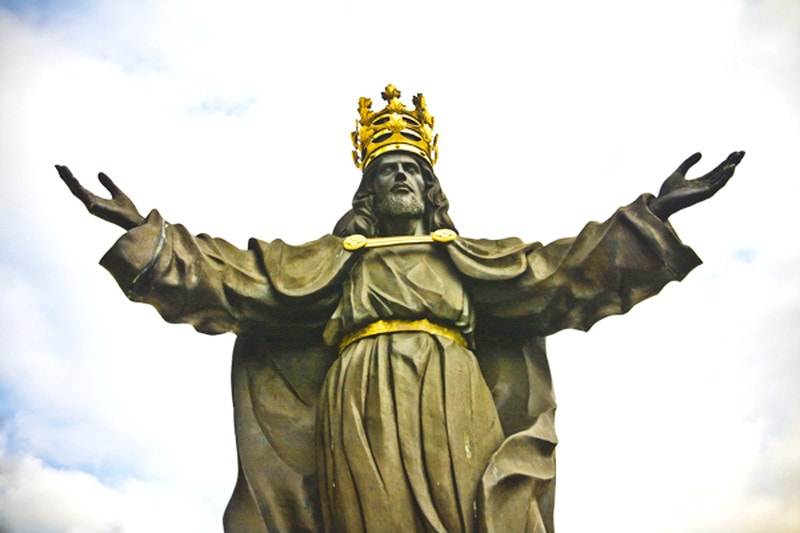
Jesus the King of the World in Czestochowa, Poland

In Christianity, Jesus is the ultimate Mediator between God and people. Neither angel nor any human can fill such a role. The author of Hebrews wanted to make it clear that Jesus is the rightful Ruler of all creation. Christ’s authority is far and above all others. So, Christians are never defenseless in this world. Believers have a sovereign Mediator and King to willingly submit to, knowing that Jesus has the power and authority to back up his words of love and assurance.

Jesus has the unique combination of being both King and Priest, the One who intercedes for us and leads us with compassionate leadership. Again, the author of Hebrews uses Psalm 110 to emphasize this:

Every high priest is selected from among the people and is appointed to represent the people in matters related to God, to offer gifts and sacrifices for sins. He can deal gently with those who are ignorant and are going astray, since he himself is subject to weakness. Therefore, he has to offer sacrifices for his own sins, as well as for the sins of the people. And no one takes this honor on himself, but he receives it when called by God, just as Aaron was.

In the same way, Christ did not take on himself the glory of becoming a high priest. But God said to him,

“You are my Son;
    today I have become your Father.”

And he says in another place,

“You are a priest forever,
    in the order of Melchizedek.”

During the days of Jesus’ life on earth, he offered up prayers and petitions with fervent cries and tears to the one who could save him from death, and he was heard because of his reverent submission. Son though he was, he learned obedience from what he suffered and once made perfect, he became the source of eternal salvation for all who obey him and was designated by God to be high priest in the order of Melchizedek. (Hebrews 5:1-10, NIV)

Jesus Christ demonstrated and proved he is qualified to be the rightful Priest and King through obedient suffering. That means he is perfectly suited and able to help us. Christ is no detached and aloof King and Priest. He knows exactly what it is like to be a human in this broken and fallen world. Such divine empathy translates into solid emotional and spiritual support because, as the Christian tradition holds, Jesus has taken care of the sin issue once for all through the Cross.

The Messiah’s enemies, whose final defeat is certain, are not Gentile kingdoms or human institutions. The ultimate foes are the hostile and evil principalities and powers of this dark world, including death itself. The universal reign of Jesus, the exalted Son of David, brings deliverance from guilt, shame, and injustice as the unique God-Man.

In this unabashed Christian view of Psalm 110, Jesus is our perfected high priest who is able for all time to save those who approach God, since he always lives to make intercession for us. (Hebrews 7:25)

The appropriate response to such a great King and Priest is submissive loyalty and eternal praise.

May it be so to the glory of God.

O Lord our God: Reign in power over us, through your Son, Jesus Christ – for he is exalted over all governments and authorities, all ideologies and creeds, and all human hearts and souls. King Jesus: Be enthroned in our lives, in all people everywhere, as our mediator and atoning sacrifice. Spirit of God: Reign in power over us through Jesus Christ and give us the victory over all the enemies of our souls, within and without, for the glory of your Name. Amen.

Hebrews 8:1-13 – Deliverance through a Manger

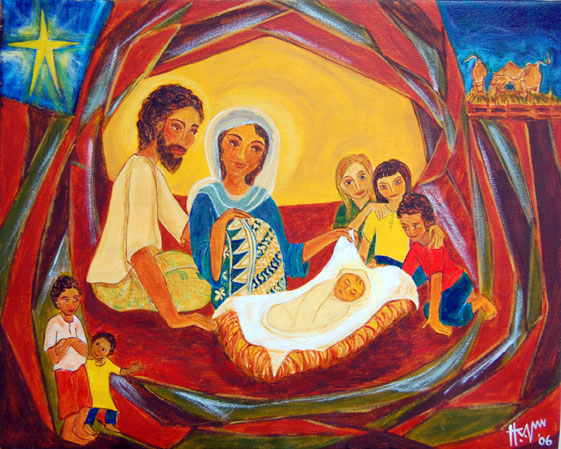
God Is With Us, by Malaysian artist Hanna Varghese, 2006

Now the main point of what we are saying is this: We do have such a high priest, who sat down at the right hand of the throne of the Majesty in heaven, and who serves in the sanctuary, the true tabernacle set up by the Lord, not by a mere human being.

Every high priest is appointed to offer both gifts and sacrifices, and so it was necessary for this one also to have something to offer. If he were on earth, he would not be a priest, for there are already priests who offer the gifts prescribed by the law. They serve at a sanctuary that is a copy and shadow of what is in heaven. Therefore, Moses was warned when he was about to build the tabernacle: “See to it that you make everything according to the pattern shown you on the mountain.” But in fact, the ministry Jesus has received is as superior to theirs as the covenant of which he is mediator is superior to the old one, since the new covenant is established on better promises.

For if there had been nothing wrong with that first covenant, no place would have been sought for another. But God found fault with the people and said:

“The days are coming, declares the Lord,
    when I will make a new covenant
with the people of Israel
    and with the people of Judah.
It will not be like the covenant
    I made with their ancestors
when I took them by the hand
    to lead them out of Egypt,
because they did not remain faithful to my covenant,
    and I turned away from them,
declares the Lord.
This is the covenant I will establish with the people of Israel
    after that time, declares the Lord.
I will put my laws in their minds
    and write them on their hearts.
I will be their God,
    and they will be my people.
No longer will they teach their neighbor,
    or say to one another, ‘Know the Lord,’
because they will all know me,
    from the least of them to the greatest.
For I will forgive their wickedness
    and will remember their sins no more.”

By calling this covenant “new,” he has made the first one obsolete; and what is obsolete and outdated will soon disappear. (NIV)

Our wait is nearly over. Christmas Day is almost here. The Messiah is coming. I genuinely believe that Jesus is the mid-point of history; everything for all time hinges upon Christ’s incarnation. The most cataclysmic event in the history of the world is a birth. The hopes of humanity are focused, of all things, in a stinky old feeding trough for animals – a manger.

Yes, Christians put a lot of focus on the cross and resurrection. Yet, the incarnation was the signature event of God’s breaking into this world. The inconceivable was conceived. God became human. Nothing would ever be the same again….

Nativity by African artist Joseph Mulamba-Mandangi, 2001

Jesus is our great high priest, the nexus between heaven and earth. All else are only mere shadows of the real Savior. Christ is the hinge upon which our own personal lives turn. The old system of law fades and gives way to the person for whom it all pointed. For the law, as important as it was, has never been able to save. In Christ there is a new covenant established by grace, taking care of the sin issue once for all.

Through the Christ child, all other means of deliverance have become obsolete. No matter how much he washed his hands, Pilate could not wash away his guilt. Despite all our efforts to hide or undo our shame, it will not go away. It is through Jesus that all guilt and shame have been banished. Human iniquity is taken away. All that we have done and left undone is forgiven – our sin is purged forever.

A new age has dawned. A new era has been inaugurated. The miracle of the Nativity explodes with continuing effect throughout history. Its continuing effects can still be felt, two-thousand years later. Nothing will ever undo the power of love and grace which was unleashed in the little town of Bethlehem.

Here is a clear and confident declaration to any and all in despondency or despair, no matter the reasons why: We may feel crushed, dejected, confused, or broken because of this past year’s events; but our salvation depends not on our mood or the constant changing of circumstances. Christ has offered himself once for all. The work is finished. Our faithful high priest is even now interceding for you and me in heaven.

Our faith is grounded not in our pedigree, our position, or our ability to produce but forever in what Christ has done in becoming human on our behalf. See the manger where he lies. Know that salvation is before us. Believe the promise of God.

May this eternal truth be always on our hearts:
That the God who breathed this world into being
Placed stars into the heavens
And designed a butterfly’s wing
Is the God who entrusted his life
to the care of ordinary people
became vulnerable that we might know
how strong is the power of Love
A mystery so deep it is impossible to grasp
A mystery so beautiful it is impossible to ignore.

Hebrews 11:23-29 – Taking the Long View

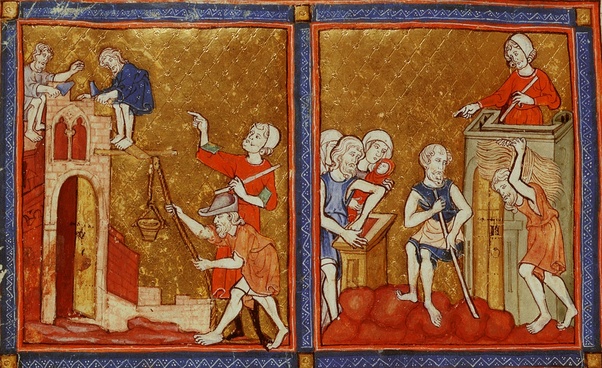
Enslavement of the Israelites

By faith Moses’ parents hid him for three months after he was born, because they saw he was no ordinary child, and they were not afraid of the king’s edict.

By faith Moses, when he had grown up, refused to be known as the son of Pharaoh’s daughter. He chose to be mistreated along with the people of God rather than to enjoy the fleeting pleasures of sin. He regarded disgrace for the sake of Christ as of greater value than the treasures of Egypt because he was looking ahead to his reward. By faith he left Egypt, not fearing the king’s anger; he persevered because he saw him who is invisible. By faith he kept the Passover and the application of blood, so that the destroyer of the firstborn would not touch the firstborn of Israel.

By faith the people passed through the Red Sea as on dry land; but when the Egyptians tried to do so, they were drowned. (NIV)

Faith looks ahead and sees as clearly as is right now in front of your face. Taking the long view of life, the mature person of faith can set aside temporary pleasure to attain a future hope. Moses, held up as such an example, refused to identify himself as the daughter of Pharaoh. He chose to be mistreated in solidarity with his fellow Israelites, instead of having a good time with his high position in the most powerful empire of its day. Moses knew that the treasures of Egypt were not as wonderful as what he would receive from suffering for the Messiah, and he looked forward to his reward.

It is an understatement to say that our contemporary society assumes practicing instant gratification. We want to feel good, and we want it now. Impulse control may just be one of the best life skills that kids (and adults!) need to learn today. A Psychology Today article effectively demonstrates through some classic and current research that “one of the most effective ways to distract ourselves from a tempting pleasure we don’t want to indulge is by focusing on another pleasure.”

For the Christian who desires to follow Jesus in all things, looking ahead to a future heavenly reward which will be shared along with all God’s people needs to be kept at the forefront of our thinking. If we only consider today, there are scant resources for responding to the temptations and fluctuations of life. However, if we will put some energy into clarifying and embracing our most cherished values, we will then let those values inform everything we do, or not do. In the scope of eternity, suffering a bit now is nothing compared to what Christ has yet in store for his people.

Deferred gratification causes us to live differently. In a twist of irony, folks who orient themselves toward the next world are able to effectively impact and change the world they currently reside within – whereas those who focus solely on this present world find themselves falling woefully short with their short view of life. We need the wisdom which faith provides us:

We are always confident, because we know that while we are living in the body, we are away from our home with the Lord. We live by faith and not by sight. We are confident, and we would prefer to leave the body and to be at home with the Lord. So, our goal is to be acceptable to him, whether we are at home or away from home. We all must appear before Christ in court so that each person can be paid back for the things that were done while in the body, whether they were good or bad. (2 Corinthians 5:6-10, CEB)

Future hope, fueled by faith, gives shape to how we live today. It enables us to live in solidarity with those who suffer and are mistreated. It ennobles us to live above short-sighted desires and act on behalf of the common good of all persons in the here-and-now.

Lord God Almighty, the One who is and was and is to come, may we, along with your servant Moses, see the plight of all those who suffer in our midst. Give us courage and compassion to live in solidarity with the poor, the oppressed, the forgotten, and all who live with misfortune and misery. May our hearts, burning with love, bear the burdens of all in our care. And may our loving example ignite the hearts of others to accompany the vulnerable in their affliction. We ask this in the gracious name of Jesus through the power of your Holy Spirit. Amen.