The Real Thing (Hebrews 9:24-28)

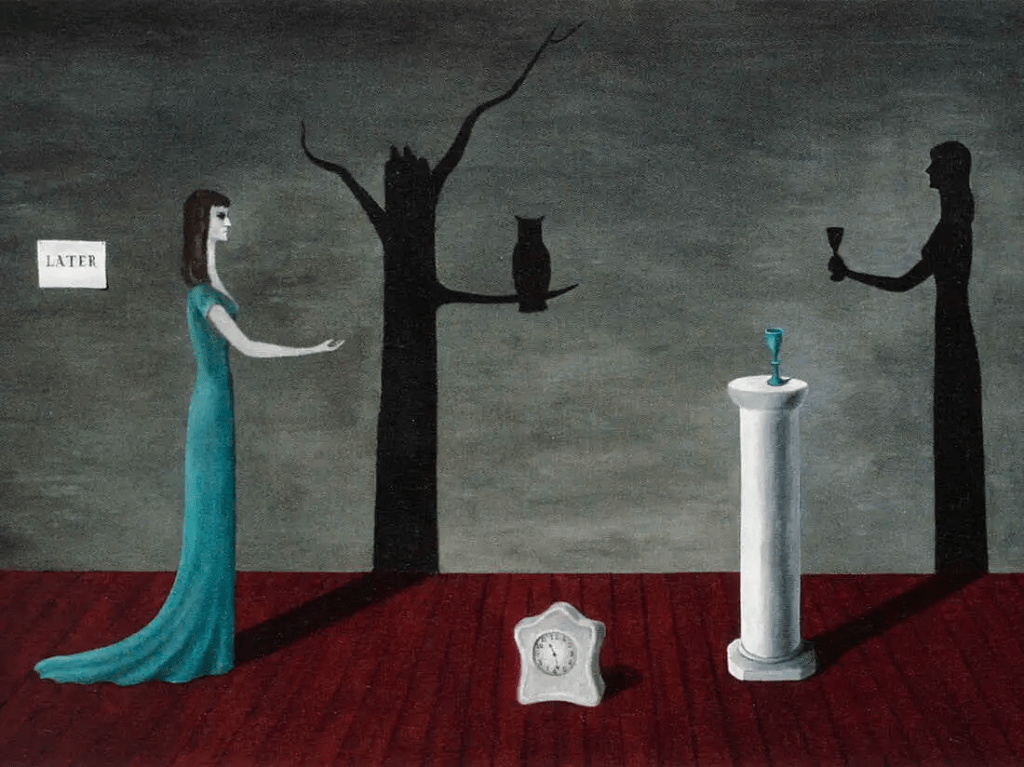
Strange Shadows (Shadows and Substance), by Gertrude Abercrombie, 1950

For Christ did not enter a sanctuary made by human hands, a mere copy of the true one, but he entered into heaven itself, now to appear in the presence of God on our behalf. 

Nor was it to offer himself again and again, as the high priest enters the holy place year after year with blood that is not his own, for then he would have had to suffer again and again since the foundation of the world.

But as it is, he has appeared once for all at the end of the ages to remove sin by the sacrifice of himself. And just as it is appointed for mortals to die once and after that the judgment, so Christ, having been offered once to bear the sins of many, will appear a second time, not to deal with sin but to save those who are eagerly waiting for him. (New Revised Standard Version)

I admit that the Book of Hebrews in the New Testament is one of my favorite books of the Bible. I also recognize that Hebrews is one of the most difficult books to deal with. And specifically, chapter 9 can be quite mind-boggling.

The author of Hebrews, whoever he was actually was, did the intellectually and theologically staggering job of establishing continuity between the two testaments of the Bible.

He compared and contrasted the old (or first) covenant with the new (or second) covenant, examining the Levitical priesthood and its sacrificial system, with Christ as the high priest whose singular sacrifice ended all sacrifices.

The old sacrificial system began on Mount Sinai. Moses sprinkled the sacrificial blood of bulls and goats on both the people and the tabernacle. He was consecrating them, and the sacrificial implements, so that everyone could participate in the worship of Yahweh.

In the new covenantal system, blood is also used to purify. Yet, the heavenly tabernacle could not be cleansed with the blood of animals. It required a better and superior sacrifice. (Hebrews 9:23)
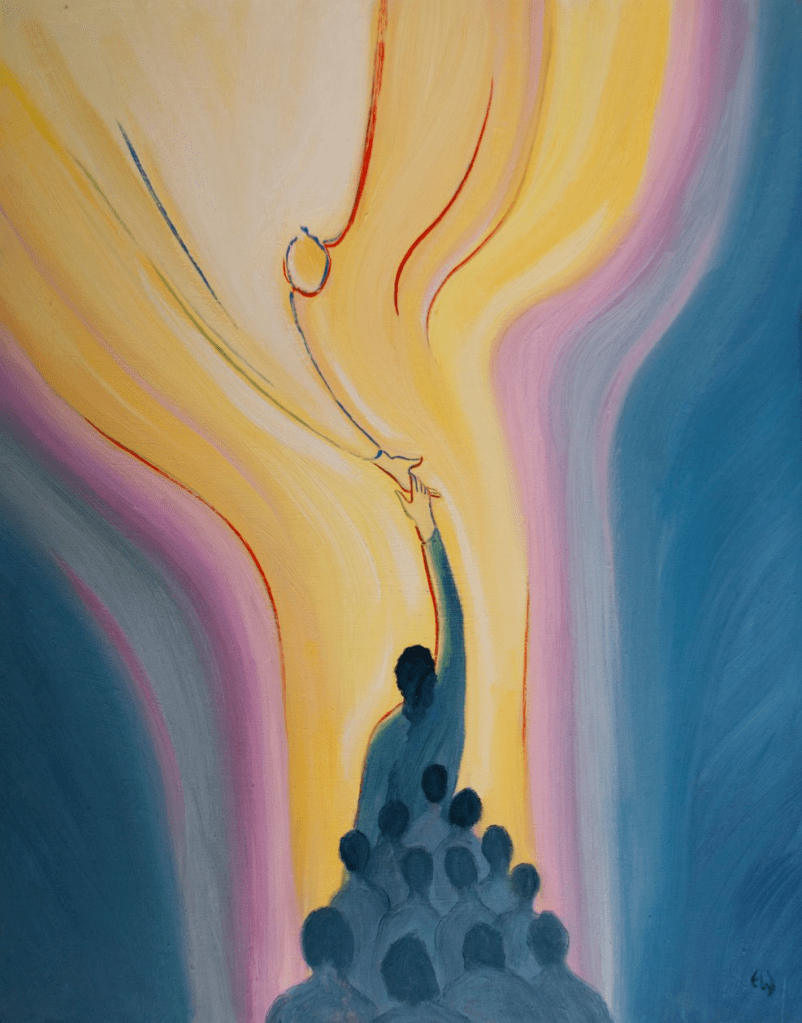
The Sacrifice of Christ, by Elizabeth Wang, 2002

That sacrifice is Jesus. He was both the high priest officiating the ritual, and the actual sacrificial offering. It is the life of Jesus, given in self-sacrificial death, which enables worshipers to come to God without any obstruction whatsoever.

Jesus does not have to keep offering himself. It was a one and done affair. One sacrifice on behalf of everyone. Once for all.

This is, of course, a distinctively Christian view and approach to the problem of guilt, shame, disobedience, and death. It has been a very compelling view for millions of people over the past two millennia.

In whatever way one seeks to understand and make sense of the author’s line of reasoning concerning a Christian approach to sacrifice and dealing with sin, what is apparent to me is that the author talked of a reality that we do not presently see.

The author of Hebrews was lifting up something important that he wanted us to notice. He was pointing out the reality of spiritual forces that have the power to both destroy and give life.

The earthly objects that we can see, touch, feel, hear, and smell are mere representations or shadows of heavenly things.

Many people, if not most people, today would say that invisible things such as our ideas and philosophies of religion are mere mental ways of understanding the objective reality in front of us that we can use our five senses to detect.

But the author of Hebrews insists – and I believe rightly so – that it’s the other way around. Everything we are presently experiencing with our objective senses is a projection of the ultimate invisible reality.

In other words, this entire world will pass away, because it is but a shadow in the history of eternity. The invisible God is the real deal. The heavenly sanctuary is reality. Love is the permanent operating system of eternity, and not your 401(k) or the next political election.

Jesus the Christ has offered himself once for all time, and for all sins. And he did it because the triune God – Father, Son, and Spirit – is a community of unitive love. That is, God is Love. So therefore, God can only do that which is love.

The end of time is not yet here. This present world with all of its inconsistent ways of doing both good and bad is still with us. But Jesus will come again.

The sin issue has been dealt with, once and for all. Christ did that. Jesus will return in order to bring salvation to those who are waiting for him.

If we must wait, let us do it patiently, with all of the faith and endurance it requires. Yet, this is not a passive waiting. We are to be busy proclaiming the good news of God’s invisible realm with both words and sacraments – with the signs and shadows and representations we have that point to the reality of God.

Everything visible and tangible on this earth is mirroring a greater, better, and superior reality which we cannot see with our eyes or touch with our hands.

Christianity is unabashed that all things point to Christ, who is the first and the last, the alpha and omega, the be all and end all of everything.

Come, Lord Jesus, Son of God, Son of Humanity. We long for you to return in glory and set us and this entire sinful world aright with your divine justice.

Be our guest, Lord Jesus, our Savior and Friend. We receive in faith your salvation. We trust that both the physical food and spiritual food you give will sustain us for our work and worship in this world.

May it be so, to the glory of God, and through the enablement of the Holy Spirit. You are one God – Father, Son, and Spirit – in one holy community of Love, now and forevermore. Amen.

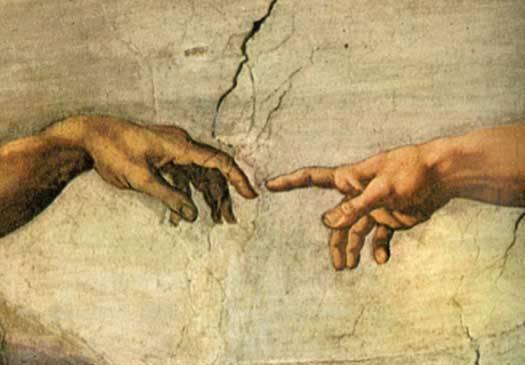
Visible Signs of Invisible Realities (Hebrews 9:15-24)

For this reason Christ is the mediator of a new covenant, that those who are called may receive the promised eternal inheritance—now that he has died as a ransom to set them free from the sins committed under the first covenant.

In the case of a will, it is necessary to prove the death of the one who made it, because a will is in force only when somebody has died; it never takes effect while the one who made it is living. This is why even the first covenant was not put into effect without blood. When Moses had proclaimed every command of the law to all the people, he took the blood of calves, together with water, scarlet wool and branches of hyssop, and sprinkled the scroll and all the people. He said, “This is the blood of the covenant, which God has commanded you to keep.” In the same way, he sprinkled with the blood both the tabernacle and everything used in its ceremonies. In fact, the law requires that nearly everything be cleansed with blood, and without the shedding of blood there is no forgiveness.

It was necessary, then, for the copies of the heavenly things to be purified with these sacrifices, but the heavenly things themselves with better sacrifices than these. For Christ did not enter a sanctuary made with human hands that was only a copy of the true one; he entered heaven itself, now to appear for us in God’s presence. (Hebrews 9:15-24)

The Hebrew Christians were tired. They had faced adverse circumstances, unjust imprisonments, persecution, prejudice, confiscation of their property, and public ridicule.

Most of all, they encountered rejection from their Jewish families of origin. There was precious little support for them, outside of their group.

The suffering went on long enough that the Christians began to experience a weakening of faith. In their distress, they started considering whether to return to Judaism, and renege on their commitment to Christ.

The author of Hebrews saw the struggle and spoke up, encouraging and exhorting the believers to keep going, to exercise faith and perseverance in the face of their ongoing troubles.

The author’s overall message to the discouraged believers was that Jesus Christ is superior over everything and everyone. Christ is better than the angels, Moses, and Aaron. Jesus is the ultimate high priest who offered himself as a sacrifice, once for all.

By means of the cross, Jesus became the mediator of a new and better covenant. There is, therefore, no more need of another high priest. Christ now occupies that office permanently.

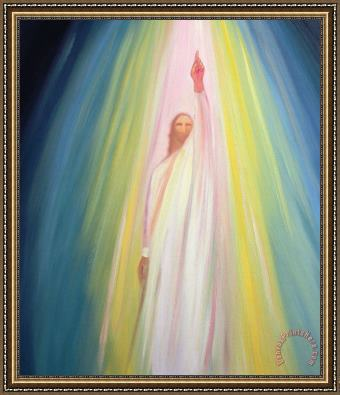
Jesus Christ Points us to God, by Elizabeth Wang

Christ’s death was efficacious for all. The sacrificial system with all of the officiating Levitical priests was the old order of things, meant to point us to Christ.

Offering sacrifices day after day, and engaging in prescribed liturgical rituals in order to access God, are no longer necessary. Perpetual anxiety exists wherever people keep wondering if they have done enough to satisfy their guilt and/or responsibility.

The answer of Christianity is yes, the work is finished; Jesus completed it, once and for all.

There is no longer anything that can distress us. Sin, death, and hell have been conquered through the death of Christ. His singular sacrifice has achieved victory over the sinful powers, and reconciliation and peace with God.

Blessed is the one
    whose sin the Lord does not count against them
    and in whose spirit is no deceit. (Psalm 32:2, NIV)

The covenant code’s sacrificial system was never designed to be a permanent way of doing things. All of the implements used in that system were symbols pointing to the real deal. They were a temporary means of leading people to Christ, who is the once for all sacrifice to end all sacrifices, the one who truly takes away our guilt and shame forever.

The picture is of Christ, as our high priest, who sprinkled us with his own blood and made us clean – not only today or for some temporary period of time – but for all time. We are not only made clean; we are made clean forever by the blood of Christ.

Cleanse me with hyssop, and I will be clean;
    wash me, and I will be whiter than snow. (Psalm 51:7, NIV)

The historical person of Jesus – his life, ministry, crucifixion, death, resurrection, ascension and glorification – was a visible image showing us the great importance of invisible realities.

The Ark of the Covenant was a visible sign of God’s invisible presence, and the need for a restoration of the divine/human connection.

The temple, the worship implements, and the whole sacrificial system was a visible sign of God’s invisible holiness, and the need for purity of heart amongst the people.

Jesus was a real person with a real body and real human needs, a visible reality which showed us the invisible God, and what God truly deems as right and good.

It is Jesus Christ, the Son of God and Son of Humanity, in whom we have redemption the forgiveness of sins. He is the image of the invisible God. (Colossians 1:14-15)

Christ is our Mediator, bridging the gap between heaven and earth.

Christ is our Savior, delivering us from our guilt and shame, our worry and anxiety, and our old enemy, death itself.

Christ is our Advocate, stepping in and acting on our behalf, and sending the Holy Spirit to be his continuing presence on this earth.

Christ is our champion, the pioneer of our salvation, securing redemption for us through his singular death.

Christ is our Intercessor, who even now lives to intercede for us, as we strive and struggle to live in humility, justice, and righteousness, as peacemakers in this world.

What this all means, from the vantage of Christianity, is that we need Jesus.

Without Christ, there is no hope. With Christ, all things are possible.

Jesus is the answer to every question, because Jesus is the center of all things. He is the fertile soil from which all of life sprouts; the first-fruit which provides life; and the continuing sustenance which saves us from a disconnected, fragmented, discouraging existence.

Along with the ancient Hebrew Christians, let us be encouraged with Christ, who is truly our everything.

Accept, O Lord, our thanks and praise for all that you have done for us. We thank you for the disappointments and failures that lead us to acknowledge our dependence on you alone.

Above all, we thank you for your Son Jesus Christ; for the truth of his Word, and the example of his life; for his steadfast obedience, by which he overcame temptation; for his dying, through which he overcame death; and for his rising to life again, in which we are raised to the life of your kingdom.

Grant us the gift of your Spirit; that we may know you and make you known; and through your Spirit, at all times and in all places, may give thanks to you in all things. Amen.

Coming to Grips with Grinding Adversity (Psalm 137)

“By the Waters of Babylon, They Sat Down and Wept” by Kate Gardiner Hastings

Alongside Babylon’s streams,
    there we sat down,
    crying because we remembered Zion.
We hung our lyres up
    in the trees there
    because that’s where our captors asked us to sing;
    our tormentors requested songs of joy:
    “Sing us a song about Zion!” they said.
But how could we possibly sing
    the Lord’s song on foreign soil?

Jerusalem! If I forget you,
    let my strong hand wither!
Let my tongue stick to the roof of my mouth
    if I don’t remember you,
    if I don’t make Jerusalem my greatest joy.

Lord, remember what the Edomites did
        on Jerusalem’s dark day:
    “Rip it down, rip it down!
    All the way to its foundations!” they yelled.
Daughter Babylon, you destroyer,
    a blessing on the one who pays you back
    the very deed you did to us!
    A blessing on the one who seizes your children
    and smashes them against the rock! (Common English Bible)

This side of heaven is full of both love and heartbreak, celebration and lament, encouragement and insult. It is a spiritually schizophrenic existence of heaven’s kiss and hell’s bite. 

We live in a fundamentally broken world. Yet, it is a world that is presently being reclaimed by God’s kingdom. Therefore, our emotions run the gamut from joyful happiness to sheer sorrow. Either way, especially through the difficult stretches of our lives, Christians are to tether themselves to their true home of heaven.

The psalmist was speaking of Jerusalem, the city that represented the very presence of God. Yet, the Babylonians came and destroyed the temple, their homes, and carried thousands of her citizens into exile.

Although experiencing the Babylonian Exile, the people of Jerusalem were not to forget their real home. 

For the believer in Jesus, this present abode is like camping in a tent – it is a temporary home, and not our permanent residence.

It is easy to forget our true home, which is why we need the constant perspective of eternity. We ought not get too familiar with our current living conditions. 

Simple acts like looking up at the stars at night or gazing into the vast expanse of the day’s sky can be tangible reminders that we are meant for larger things, for the embrace of heaven.

None of this, however, means that we are to ignore what is happening in the here and now. Trauma is real and needs to be dealt with. Having an expansive perspective doesn’t mean we stuff the details and emotions of traumatic events.

The psalmist names the difficult experience, the agonizing emotions, and the bitter thoughts. None of it is hidden or buried under a layer of positivity.

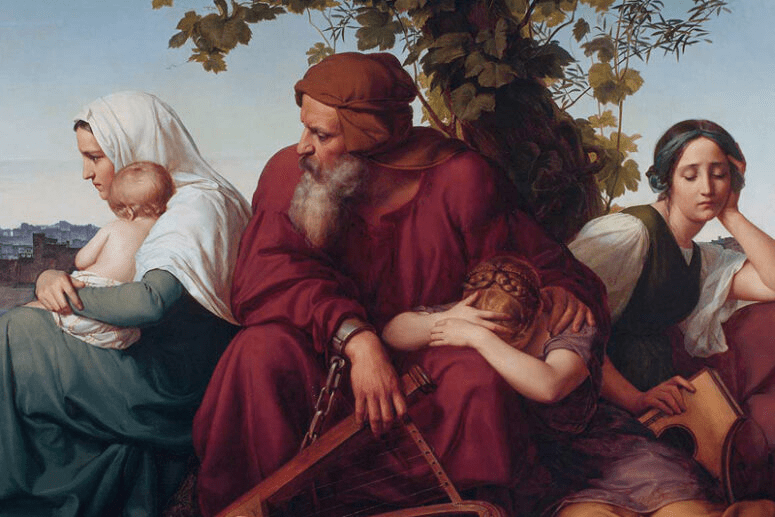
“Lamenting Jews in Exile” by Eduard Bendemann, 1832

We need the combination of faith that my experienced is acknowledged, of hope that a better future is coming, and of love that good still presently exists in the world. Faith, hope, and love are all vital in coming to grips with terrible adversity.

Hiding large swaths of our lives and stories from others is not the path to spiritual wellness, emotional healing, and personal peace. Spiritual and emotional health comes from owning our internal struggles. The virtues of weakness, humility, vulnerability, and faith opens us to the way of grace.

We too often struggle because we don’t struggle. 

I’m the expert on stuffing feelings and turning them into thoughts. I learned it well early in my life. Yet, feelings never evaporate just because we ignore them. Just the opposite, like a forgotten half-carton of cottage cheese in the back of the fridge, our feelings only gather moldy bacteria and crust over with nastiness. 

We need to understand that feelings really do have an expiration date to them. If not openly acknowledged and dealt with, they’ll fester into bitterness. It’s much better to deal with our present struggles instead of living with the wishful thinking that they’ll just go away.

There are 52 references to “one another” in the New Testament, including: 

  • Love one another (John 13:34-35)
  • Be kind to one another (Ephesians 4:32)
  • Show hospitality to one another (1 Peter 4:9)
  • Forgive one another (Colossians 3:13)
  • Encourage one another (Hebrews 3:13)
  • Bear the burdens of one another (Galatians 6:2)
  • Spur one another on toward spiritual well-being and healthy community relationships (Hebrews 10:24)

Nowhere in Holy Scripture will you find references to hide from one another, pester one another, or put up a false front toward one another.

God desires for us to take a risk on betting the farm on Jesus. Embracing Christ involves owning our struggles, both to God and to one another. 

You may argue that it isn’t helpful to wear your feelings on your sleeve. But I’m not talking about emotional diarrhea; I’m referring to something far worse: emotional prostitution, where we sell ourselves to others in a cheap façade of who we really are and how we are really doing. 

We want to be liked, loved, and longed for. And we very much desire to avoid heartrending pain. So, many mistakenly believe that keeping up false appearances will get them what they long for.

What matters most is faith expressing itself through love (Galatians 5:6). It takes personal risk to have faith. And it takes two to have love.

Own your struggle. Face it squarely in all of its foulness, degradation, and ugliness. Face it with both God and others. 

If you’re mad as hell at God, then say it; the Lord is big enough to take it. If you need prayer or help, ask for it. Don’t just expect someone to read your mind or your emotions. If someone asks you to pray, stop what you’re doing, get on your knees with that person, and pray like there’s no tomorrow.

Life is too short to sleepwalk through it with a constellation of unacknowledged emotions. It takes no relational effort to ask a pat question like, “How are you?” It takes even less relational energy to give a pat answer such as, “Fine,” or “Busy.” Instead, let’s get down to why you feel a constant need to say how busy you are, even when you’re not really all that busy.

Holy Scripture doesn’t call us to hide, but to love one another enough to both give and receive God’s grace. 

Daily reading and praying of the psalms is a good place to begin in learning to be authentic with God and the people in our lives. It’s the only way of dealing with the overwhelming circumstances and emotions we face.

Loving God, please grant me peace of mind and calm my troubled heart. My soul is like a turbulent sea. I can’t seem to find my balance, so I stumble and worry constantly. Give me spiritual strength, mental clarity, and emotional calm to find my purpose and walk the path you’ve laid out for me. Just as the sun rises each day against the dark of night, may the light of your divine countenance shine on the shadowy places of my life, through Jesus Christ my Lord, in the illumination of the Holy Spirit. Amen.

Revelation 4:1-11 – In Another Dimension

Hallgrímskirkja in Reykjavík, Iceland

After this I looked, and there before me was a door standing open in heaven. And the voice I had first heard speaking to me like a trumpet said, “Come up here, and I will show you what must take place after this.” At once I was in the Spirit, and there before me was a throne in heaven with someone sitting on it. And the one who sat there had the appearance of jasper and ruby. A rainbow that shone like an emerald encircled the throne. Surrounding the throne were twenty-four other thrones and seated on them were twenty-four elders. They were dressed in white and had crowns of gold on their heads.From the throne came flashes of lightning, rumblings and peals of thunder. In front of the throne, seven lamps were blazing. These are the seven spirits of God. Also, in front of the throne there was what looked like a sea of glass, clear as crystal.

In the center, around the throne, were four living creatures, and they were covered with eyes, in front and in back. The first living creature was like a lion, the second was like an ox, the third had a face like a man, the fourth was like a flying eagle. Each of the four living creatures had six wings and was covered with eyes all around, even under its wings. Day and night they never stop saying:

“‘Holy, holy, holy

is the Lord God Almighty,’

who was, and is, and is to come.”

Whenever the living creatures give glory, honor and thanks to him who sits on the throne and who lives for ever and ever, the twenty-four elders fall down before him who sits on the throne and worship him who lives for ever and ever. They lay their crowns before the throne and say:

“You are worthy, our Lord and God,
    to receive glory and honor and power,
for you created all things,
    and by your will they were created
    and have their being.” (New International Version)

Whenever we open the door to God’s gracious invitation to commune with us, we gain an incredible glimpse of heavenly realities.

The Apostle John’s vision is so otherworldly that all he can do is try and describe what we saw with the limitations of language, metaphor, and simile.

Let’s acknowledge up front that, when it comes to the biblical book of Revelation, there are plenty of folk who want to understand it all. I believe this to be a fool’s errand, not because we ought not to try and make sense of things, but because far too many people try and conquer the text of Holy Scripture rather than letting Scripture capture them.

In our anxiety about the future, we would like some certitude, some semblance of knowing and understanding what will occur so that it will ease our icky feelings of not being in control. Newsflash: You and I aren’t in control of anything but ourselves. Ultimate control belongs only to God, not us. Our role is self-control.

So, before we start making complicated prophecy charts and trying to predict future events with precise certainty, let’s take a step back and see that worship is always the appropriate response to any vision of God – not conquering the Bible and colonizing other people’s minds with our supposed apocalyptic insights.

Okay, now that that’s out of the way, and the soapbox is back in the closet, let’s simply appreciate this incredible scene before us of God’s heavenly throne room in today’s New Testament lesson.

Since God is an awesome God, I imagine that John was downright slack-jawed with awe over the bedazzling vision before him. It is a vision befitting a God of great majesty and power. The scene of worship which unfolded before John’s eyes is continual – praise and adoration of God has been going on, is going on, and will keep going on forever and ever.

To a church beat down by the world, John’s vision is meant to encourage and inspire the suffering believers toward persevering in faith. Hardship is but for a season; worship, however, is for all time.

The four living creatures worshiping God reflect the nature and character of God: the lion (majesty); the ox (strength and power); the man (intelligence); and the eagle (transcendent over creation). All of them, covered with eyes, front and back, testify to the sovereignty and omniscience of God, who sees and knows all things – nothing is hidden from God’s sight.

The twenty-four elders, likely signifying the twelve patriarchs of the Old Testament and the twelve apostles of the New Testament, together represent the one new people of God without walls or barriers to unity, fellowship, harmony, and peace. They all rightly honor God by giving back their own authority, given to them from the Lord to accomplish divine purposes on the earth.

We, as the people of God today, are meant to be encouraged and uplifted by the reality that God is forever the same – powerful, loving, good, honorable, and holy – and will be so permanently for all time and beyond time.

The Lord does not exist merely in three dimensional space, as we humans do. God is truly multi-dimensional and reigns supreme over each and every one of those dimensions – however many there truly are.

I suspect the Apostle John was privileged to step into another dimension so that he could return to our three-dimensional world with the good news that God is still and forever on the throne. God’s good purposes shall be accomplished, no matter how tough things get here.

Now is temporary; then is eternal. Let us, then, embrace that which is permanent and unchanging, even Christ our Lord, who shall return to judge the living and the dead, and consummate a benevolent kingdom which will last forever.

May you be so privileged to have the dimensions unveiled, for even a few minutes, and know the eternal love and grace of God for humanity. Amen.