Jesus: Introvert or Extrovert? (Luke 5:12-16)

A 4th century mural of Jesus from the Catacomb of Commodilla, Rome, Italy

While Jesus was in one of the towns, a man came along who was covered with leprosy. When he saw Jesus, he fell with his face to the ground and begged him, “Lord, if you are willing, you can make me clean.”

Jesus reached out his hand and touched the man. “I am willing,” he said. “Be clean!” And immediately the leprosy left him.

Then Jesus ordered him, “Don’t tell anyone, but go, show yourself to the priest and offer the sacrifices that Moses commanded for your cleansing, as a testimony to them.”

Yet the news about him spread all the more, so that crowds of people came to hear him and to be healed of their sicknesses. But Jesus often withdrew to lonely places and prayed. (New International Version)

Occasionally, I ask fellow clergy colleagues this question: “Was Jesus an introvert, or an extrovert?”

Let me be clear that extroversion and introversion are neither sinful nor blessed – they both are personality traits that cannot be changed any more than tiger stripes. That’s important to state upfront because some clergy make it about personal choices instead of inherent brain wiring.

So, setting aside the anti-reality kooky answers to my question, I’ve found that extroverted pastors, almost without fail, tell me Jesus was an extrovert. And they make a solid case for it. 

Conversely, with solid consistency, introverted pastors tell me Jesus was an introvert. And they give compelling reasons for it, as well. 

I believe the answer to my own question is that both are correct. Jesus, as the perfect human, displays the best of both extroversion and introversion. And Christ’s personality comes through wonderfully in today’s Gospel lesson.

This short story of healing begins with Jesus fully engaged in walking the city, a man of the people, interacting with the crowd, attentive to even the most marginal of them. Christ’s extroverted nature is on full display. Jesus, as the superb Son of God, is willing and ready; he fully heals the man from his leprosy. 
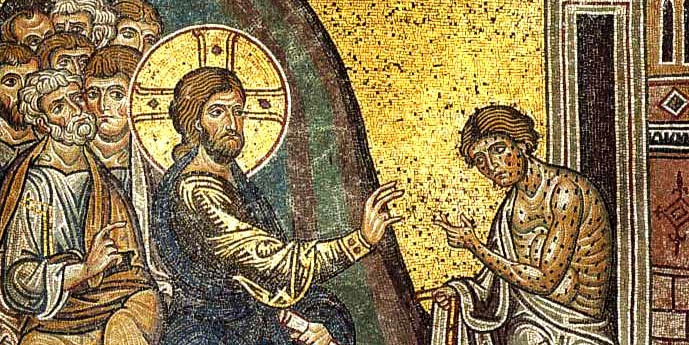
Jesus healing the leper, 12th century mosaic, Monreale Cathedral, Sicily, Italy

As the news of this people-centered Healer spread, more and more people flock to Jesus. An extroverted person would bask in the situation of having more people to connect with. 

However, the story ends with the note that, instead of engaging the mass of people and gaining energy from the crowd, Jesus would withdraw to quiet and deserted places in order to pray. I can think of no better description of an introvert that could be said.

Jesus lived on this earth in a way that modeled and demonstrated how humanity was truly meant to live. 

Christ had consistent rhythms of both human and divine engagement. He spent time with people – lots of them. The Lord talked and taught, healed and moved, from one person to next with all the seeming random activity of the extrovert. 

Yet, the Lord Jesus also consistently withdrew from all the people to be in solitude. He spent healthy amounts of extended time alone with his heavenly Father, deeply connected with him. 

We, too, need good healthy rhythms of being with others in effective and prolonged interaction, as well as extended time alone with God in silence and solitude.

Extroverts must understand that nowhere in Holy Scripture will you find that we have been called by God to be talkers. But instead, you will find a lot of biblical references on being called to servanthood. The Lord does not accept us because of our many words; God approves of us because of divine grace and the state of our hearts. 

My children, we should love people not only with words and talk, but by our actions and true caring. (1 John 3:18, NCV)

Too much talk leads to sin. Be sensible and keep your mouth shut. (Proverbs 10:19, NLT)

And introverts need to appreciate that the spoken word, not just the written word, is important and powerful. The world was created through divine speech. Jesus healed with words that people heard. And conversations with others are the effective means of restoring this fallen planet to Paradise.

By speaking the truth with love, let’s grow in every way into Christ. (Ephesians 4:15, CEB)

Encourage each other every day while you have the opportunity. If you do this, none of you will be deceived by sin and become stubborn. (Hebrews 3:13, GW)

Perhaps we might encounter more of the miraculous in our lives if we emulated the healthy rhythms of Jesus. The Spirit works in us and through us so that the words and ways of Jesus on this earth may impact a mass of humanity that desperately needs Christ’s healing from a heart that is deeply connected to God.

Loving Lord Jesus, I am in awe of your capacity to engage all kinds of people, as well as your close relationship to the heavenly Father. Let me be like you in the ability to move freely and effectively between human interaction and divine prayer so that the church is edified, and the world is blessed. Amen.

Leviticus 23:1-8 – There’s More to Life Than Work

The Lord said to Moses: Speak to the Israelites and say to them: These are my appointed times, the Lord’s appointed times, which you will declare to be holy occasions: Work can be done for six days, but the seventh day is a Sabbath of special rest, a holy occasion. You must not do any work on it; wherever you live, it is a Sabbath to the Lord. These are the Lord’s appointed times, holy occasions, which you will celebrate at their appointed times:

The Lord’s Passover is on the fourteenth day of the first month at twilight. The Lord’s Festival of Unleavened Bread is on the fifteenth day of the same month. You must eat unleavened bread for seven days. On the first day you will hold a holy occasion and must not do any job-related work. You will offer food gifts to the Lord for seven days. The seventh day will be a holy occasion; you must not do any job-related work. (Common English Bible)

When I was kid, watching the cartoon The Jetsons was a Saturday morning ritual. The futuristic family featured George the husband and father, an employee of Spacely Sprockets. 

In one episode, George comes home and is met by his dog, Astro, and wife, Jane, looking tired and haggard from a day’s work. George’s comment when he entered on the treadmill through the door was, “Jane, these 3-hour work-days are killing me!”

Indeed, the technological progress of post-World War II America had led to the common belief among many that with so many advancements, workdays would become smaller, with leisure time growing. In the 1960’s, it seemed a foregone conclusion that technology would provide the masses with unprecedented amounts of discretionary time for whatever they would want to do.

Sixty years removed from The Jetsons, and we now know what Americans and people across the world would do with time-saving devices: We simply work a lot more. 

Just the opposite has occurred from having loads of leisure time. People discovered that greater efficiency with technology has brought an equal competition for business and making more money. Time saved has translated into accomplishing more work, and not in taking vacations or indulging in new hobbies and ventures.

The fourth command of God’s Ten Commandments is needed today more than ever. It is high time that we come back to this basic instruction of the Lord and engraft its wise counsel into our lives. 

The point of God’s command for a Sabbath-rest is neither to squash commerce, nor to be a curmudgeon about fencing one day a week of doing nothing. Instead, the Sabbath command is designed to be a life-giving day where we discover that: There is more to life than work.

The word “Sabbath” literally means “to rest.” God built into creation a rhythm of rest and work. God rested, not because of being tired but so that there was enjoyment of the earth and everything in it. 

Everything in life is done in rhythm. We walk in rhythm, talk in rhythm, and our hearts beat in a rhythm. The earth cycles in rhythmic seasons of the year, and the animal kingdom mates and lives in annual rhythms. All creation is rhythmic.

Whenever we keep going and do not live according to the rhythm laid out for all of God’s creatures, we break. Therefore: Rest from work is needed.

Even machinery needs a break. I find it more than ironic that we treat our cars and vehicles with the regular maintenance and care that we don’t even extend to ourselves. We care for our cars because we don’t want to experience a breakdown on the highway. Yet, much more important is the care of our souls and our bodies. 

Without regular intervals of work and rest, in a consistent rhythmic pattern, we breakdown, burnout, and, like little children who have missed a nap, we have epic meltdowns of anger, frustration, and passive-aggressive behavior because we simply ignored God’s fourth command.

“Each person deserves a day away in which no problems are confronted, no solutions searched for. Each of us needs to withdraw from the cares which will not withdraw from us.”

Maya Angelou

Legalistic observances of the Sabbath miss the point through a continual, “Don’t do this, don’t do that, can’t do anything fun on Sunday,” as if God were some divine curmudgeon who frowns with a deeply furrowed brow at anything happy on the Sabbath. (Mark 2:23-3:6) 

To rest means to have a change of pace from the regular weekday activity of work. To rest and enjoy the difference of a Sabbath’s day is avoided by so many people because it brings this question to the forefront of our minds: Who am I if I’m not working?

Our identities can be so tied to our jobs that we compulsively check our multiple e-mail accounts on a day off; tie ourselves to our smart phones and iPhones on vacation; and allow work to bleed into our time away from the job. 

God has wisely placed loving boundaries around us. But like Adam and Eve, who were not content with enjoying the entire garden, we obsessively pluck the forbidden fruit from the one tree that is off limits.

Work brings money, influence, power, relationships, industry, and a host of good things. The problem is not work; the problem is that we humans can create an idol of it.

Whenever work and all that comes with it, consumes our attention, we are on a one-way road to nowhere. I have heard many deathbed confessions. I’ve yet to hear anyone wish they had worked more.

No, the confessions typically involve something out of rhythm and out of whack – that they let their jobs and their ambitions surrounding work call the shots in life, without stopping to enjoy the vast creation, the gifts of God, and the emotional wealth that can come from relationships.

“If we only stop when we are finished with all our work, we will never stop, because our work is never completely done… Sabbath… liberates us from the need to be finished.”

Wayne Muller

Because we aren’t sure who we are if we’re not working, we just keep working. If we feel bad, we work harder.  If things are tough at home, we just put more hours in at work. If we need more money, we pick up a part-time job. 

When work becomes the catch-all answer to our many problems, it has become our god and we will worship at the altar of money and activity… until we can learn to stop and rest. 

One day out of seven. Just one-seventh of your life is needed to allow a divine rhythm into your existence. 

The temptation, however, is to take a day off from work so that you can do other work at home. So, the challenge, for many people, is to allow the one day of the weekend to be the time you get stuff done, and another day to truly rest.

This is not easy. For me, it is terribly hard. I can easily slide into working seven days a week for weeks, even months, at a time. Few people bat an eye at my constant working, except my wife and a few friends. In fact, many people seem impressed when I work all the time. But what gets lost in all this is God’s grace to us through rest.

God wants enjoyment, not avoidance – for us to be still and know God. The Lord longs for us to connect with the Divine. This means we must plan and prepare for it. Maybe we need to put God on our calendars, to make an appointment with God like we would anyone else. That will often involve being out in God’s big creation.

Whenever we get down to practicing the Sabbath, we find that the world didn’t stop. Then, when we return to work, we discover that the earth is still spinning on its axis. 

Life doesn’t cease when we submit to a Sabbath rest; it’s just that we cease from participating in it for a short time. Our delusions of grandeur dissipate and disappear when we finally come around to consistently obeying a good old Sabbath rest.

Work is noble. But there is nothing noble about working without rest. 

We are still human beings when we aren’t making money, and still valuable when we don’t have jobs. Folks in healthcare facilities aren’t any less important because they no longer hold a job. Work doesn’t define us – God’s image within us does. 

It’s unlikely that we’ll ever see a George Jetson 3-hour workday, and that’s probably a good thing. Work’s inherent goodness can only be truly appreciated when we plan and prepare to live and enjoy a Sabbath’s day rest. 

Because I belong to you, God, and not to myself,
I will rest from worrying about the future
and rest in your never-ending divine presence;
I will rest from frustration at things not working out as I want them to;
I will rest from fear
and rest in my experience of courage when days are hard.
I will rest from complaining
and rest in the beauty and pleasure all around me.
For the Lord’s yoke is easy and his burden is light,
and I will find rest for my soul. Amen.

Ecclesiastes 3:1-13 – It’s Time

For everything there is a season,
    a time for every activity under heaven.
A time to be born and a time to die.
    A time to plant and a time to harvest.
A time to kill and a time to heal.
    A time to tear down and a time to build up.
A time to cry and a time to laugh.
    A time to grieve and a time to dance.
A time to scatter stones and a time to gather stones.
    A time to embrace and a time to turn away.
A time to search and a time to quit searching.
    A time to keep and a time to throw away.
A time to tear and a time to mend.
    A time to be quiet and a time to speak.
A time to love and a time to hate.
    A time for war and a time for peace.

What do people really get for all their hard work? I have seen the burden God has placed on us all. Yet God has made everything beautiful for its own time. He has planted eternity in the human heart, but even so, people cannot see the whole scope of God’s work from beginning to end. So, I concluded there is nothing better than to be happy and enjoy ourselves as long as we can. And people should eat and drink and enjoy the fruits of their labor, for these are gifts from God. (New Living Translation)

Maybe we enjoy celebrating the first day of a new year because it gives us a sense of having a clean slate. Perhaps we internally and/or unconsciously realize we wasted great chunks of time in the past year. So, we look forward to amending our ways and making new resolutions.

Time Is Finite

We cannot get it back once we lose it – hence, the lamenting of so much squandered time. We want to use our time in ways that reflect our most cherished values and commitments. For that, we need wisdom to know what to do, what not to do, and when to do it.

There needs to be a sense of purpose – of values which drive our goals and our actions – if we are to use our time in redemptive ways. Time is a gift, bestowed to us by a Creator who desires we steward that precious gift with sage understanding and wise discernment.

Time is a temporary commodity to be used for good purposes before the end of all time comes.

One of the realities of time is that our lives are full of seasonal rhythms and change over time. These are built into the life God has given us. The book of Ecclesiastes, throughout its contents, explains that nothing we pursue has any permanence to it. We throw ourselves into some work or activity, but what does that activity really do for us in the end?

Time Marches On

Time marches inexorably forward, no matter what we do or don’t do. Therefore, we must respect, and learn to work with, it’s slow and constant movement.

When I was twenty years old, I thought nothing of playing a round of golf in the morning, three sets of tennis in the afternoon, then staying up late at night with friends. If I did that same thing today, I would be in the hospital well before the sun sets.

We all, at some point, try to defy time and act like we can do the things we once did in the past. Sometimes it takes a lot for us to accept our limitations, whether it is our play or our work. Ecclesiastes teaches us that outside forces always seem to dictate what we can do and not do.

Time Is In Control

The cycles and rhythms of life can appear meaningless. We may feel as if we are prisoners of time. Yet, for the believer, time can be redeemed with godly purpose and meaning, no matter what the season of life is.

Because there is time, and all things will someday come to an end – all activity, or the lack of it, will be judged according to how we denied or accepted our limitations due to time. 

Ecclesiastes also offers to us what seems a subversive perspective that is counter-cultural to our society. Many Americans believe that by working hard and doing the right thing, we can shape our own destiny and prosperity.

However, the Teacher of Ecclesiastes insists we submit and move with the events, rhythms, and seasons God has established. Apart from God, time is futile and meaningless. In our denial of the power and effects of time, it is no wonder many Americans are so unhappy with their lives.

In the experiences we have from birth to death, the conclusion of Ecclesiastes is that everything is out of our control. Too many of us try to exert control over events, people, and circumstances when, in truth, any control we have is an illusion. I call this the “c-clamp syndrome,” trying to clamp down on others to get them to submit to our agenda.

Self-Control

Instead, Holy Scripture directs us to practice self-control – to focus on myself and my own actions:

Moderation is better than muscle, self-control better than political power. (Proverbs 16:32, MSG)

Prepare your minds for action and exercise self-control. Put all your hope in the gracious salvation that will come to you when Jesus Christ is revealed to the world. (1 Peter 1:13, NLT)

The end of everything has come. Therefore, be self-controlled and clearheaded so you can pray. (1 Peter 4:7, CEB)

Do your best to improve your faith. You can do this by adding goodness, understanding, self-control, patience, devotion to God, concern for others, and love. If you keep growing in this way, it will show that what you know about our Lord Jesus Christ has made your lives useful and meaningful. (2 Peter 1:5-7, CEV)

We cannot force time to stand still. So, instead, we must focus on how we spend our time now.

It is time for us to lay aside lesser pursuits and diligently pursue what is right, just, and good. We each must give ourselves to the unforced rhythms of grace and let God redeem the time.

What time is it?  It’s time to live in harmony with the clock, with God, and with others.

God of all time help us to know ourselves. Teach us to recognize our weaknesses and work to walk in holiness. Let us follow you in all things, submitting to the times you have for us. Thank you for your unending grace and mercy toward us when we need it most. Help us to trust you with our lives through Jesus Christ our Lord in the power of the Holy Spirit. Amen.

1 Timothy 5:9-16 – A Ministry of Giving and Receiving

No widow may be put on the list of widows unless she is over sixty, has been faithful to her husband, and is well known for her good deeds, such as bringing up children, showing hospitality, washing the feet of the Lord’s people, helping those in trouble and devoting herself to all kinds of good deeds.

As for younger widows, do not put them on such a list. For when their sensual desires overcome their dedication to Christ, they want to marry. Thus, they bring judgment on themselves because they have broken their first pledge. Besides, they get into the habit of being idle and going about from house to house. And not only do they become idlers, but also busybodies who talk nonsense, saying things they ought not to. So, I counsel younger widows to marry, to have children, to manage their homes and to give the enemy no opportunity for slander. Some have in fact already turned away to follow Satan.

If any woman who is a believer has widows in her care, she should continue to help them and not let the church be burdened with them, so that the church can help those widows who are really in need. (New International Version)

The subject of widows is throughout all of Holy Scripture. Since well over half of all women in the ancient world above age 60 were widows, there were continual and ongoing needs to be addressed.

Women were mostly dependent upon men in the biblical world. So, whenever a husband died, this put the widow immediately at risk. The children and other extended family needed to step up and care for her. And, if this didn’t happen for whatever reasons, then the church would fill the void of caring for them.

Because of their vulnerable situation, God especially cares about widows. This is made evident by the many instructions and exhortations of the Lord to Israel:

The Lord your God is the God of all gods and Lord of all lords, the great, mighty, and awesome God who doesn’t play favorites and doesn’t take bribes. He enacts justice for orphans and widows, and he loves immigrants, giving them food and clothing. (Deuteronomy 10:17-18, CEB)

A father to the fatherless, a defender of widows,
    is God in his holy dwelling.
God sets the lonely in families. (Psalm 68:5-6b, NIV)

Jesus maintained the stance of care and concern for widows in the Gospels:

 Soon afterward, Jesus went to a city called Nain. His disciples and a large crowd went with him. As he came near the entrance to the city, he met a funeral procession. The dead man was a widow’s only child. A large crowd from the city was with her.

When the Lord saw her, he felt sorry for her. He said to her, “Don’t cry.”

 He went up to the open coffin, took hold of it, and the men who were carrying it stopped. He said, “Young man, I’m telling you to come back to life!” The dead man sat up and began to talk, and Jesus gave him back to his mother. (Luke 7:11-15, GW)

So, it is no wonder that the Apostle Paul gave his young protégé Timothy some detailed instructions on how to handle ministry to widows in his church at Ephesus. The gist of that instruction is to encourage younger widows to remarry so that they would be properly cared for and enrolling older widows on a church list for support.

These widows within the church were expected to have a ministry of prayer and good works. This is truly wise counsel from Paul. Good relations and lifestyles require a healthy rhythm of giving and receiving. Widows are honored by having their needs met, as well as providing opportunities for them to give in ways they are able.

Religion that God accepts as pure and without fault is this: caring for orphans or widows who need help, and keeping yourself free from the world’s evil influence.

James 1:27, NCV

Whenever widows are only on the receiving end, they tend to become busybodies and gossips. And whenever they only give, then widows can be overlooked, and their daily needs neglected. All this is to say that there really needs to be thoughtful and intentional ministry to the widows among us.

Although in today’s modern society the status and station of many widows is different from the ancient world, there are still widows who need a life-giving ministry of both giving and receiving.

For this important dynamic to be successful, it’s necessary that adult children care for their elderly parents. I can testify firsthand as a hospital chaplain that there are many sons and daughters who fall woefully short of providing basic help to their aging mothers through a failure of consistent relational interactions, following through on needed paperwork, and answering calls in a timely manner.

Also, far too many aging widows are lonely with little to no resources and support in the form of both relationships and basic necessities. A truly Christian community is aware of the widows in their parish and seeks to honor them through establishing a ministry of giving and receiving.

Learn to do good.
 Seek justice.
Help the oppressed.
    Defend the cause of orphans.
    Fight for the rights of widows.

Isaiah 1:17, NLT

Families and churches have a responsibility to the elderly in giving sufficient financial help, practical assistance with driving to appointments, and consistent companionship. They also have a responsibility to arrange opportunities for widows to give their time in prayer and helping out others through good works and good wisdom.

If we ourselves who are not widows have healthy rhythms of giving and receiving in our own lives, then we are in a position to help the elderly establish healthy rhythms, as well. Perhaps it is telling that any lack of attention to widows reflects our own personal neglect of spiritual and emotional health.

May God be in my head and in my understanding. May God be in my eyes and in my looking. May God be in my mouth and in my speaking. May God be in my heart and in my thinking. May God be at my end and at my departing. May God be with us, in all things and in every way. Amen.