Acts 9:32-35 – Healed

St. Peter heals Aeneas, 12th century mosaic in Palermo, Italy

As Peter traveled about the country, he went to visit the Lord’s people who lived in Lydda. There he found a man named Aeneas, who was paralyzed and had been bedridden for eight years. “Aeneas,” Peter said to him, “Jesus Christ heals you. Get up and roll up your mat.” Immediately Aeneas got up. All those who lived in Lydda and Sharon, saw him and turned to the Lord. (New International Version)

The early church was growing. Both in numbers and in faith, the new believers following the words and ways of Jesus could be found everywhere in Judea. The Apostle Peter, therefore, decided to get out of Jerusalem and visit some of these folks in the town of Lydda, on the Mediterranean coast.

Back when Peter was following Jesus around in his earthly ministry, the Lord told the disciples that they will do the works he did, and, what’s more, they will do even greater things than Jesus himself. (John 14:12-14)

Peter emulated the example of his Lord. He simply stated that Christ is the one who heals you, Aeneas, so get up, take your mat, and go on home. (Mark 2:10-12; John 5:1-8)

The act of healing the paralyzed man, Aeneas, was a sign that the merciful saving ministry of Jesus was in effect, even when Jesus isn’t bodily present. Christ made it clear that the Holy Spirit would be the continuing presence of God on this earth. (John 16:1-15)

We, too, have this same Spirit.

The work of ministry is always done to the glory of God. People hear the good news, see the miracle, and believe in Jesus.

There are some who examine today’s New Testament lesson and expect that they (and all other believers) ought to be able to do exactly what Peter did: heal another miraculously.

Then, there are others who look at the same account and relegate it to some bygone era in which only the original apostles, like Peter, could do that sort of thing – if it even happened like that, at all.

To expect a dramatic physical healing, every time, all the time, is not consistent with healing narratives in Holy Scripture. And to never expect a miraculous healing is equally inconsistent with the biblical data.

It seems to me we need to reject both extremes. That’s because healing comes in all sorts of different forms.

An event which causes the need for healing and health, or a condition which prevents good health, isn’t limited to the body. A person’s mind, emotions, and spirit can also be damaged and need healing, as well. In fact, whenever there is trauma to the physical body, it profoundly effects the person’s thinking, feeling, and praying.

We need to beware of desiring the fast solution of dramatic and miraculous healing because of not wanting to deal with our emotions.

Perhaps you, like me, have had the experience of going to work or church when experiencing a difficult time in life. There is an emotional heaviness because of a strained, broken, or lost relationship. Or maybe there is emotional pain from an unexpected or unwanted situation.

Yet, when someone asks how you are doing, the response “Oh, fine!” tumbles automatically out of your mouth. But you are anything but fine. Inside, down in your heart, or painfully present in your head, the hurt dominates your thoughts and feelings.

Healing is for people. Fixing is for things and machines. It would be weird if I said I was going to heal a tractor. It is equally strange to try and fix people. To heal is to straighten what is broken. We cannot fix our emotions because, when hurt or damaged, they need healing – a process of restoration – and it usually doesn’t happen overnight.

Our emotional healing is like walking a slow journey. Along that path, our emotions are crying out for us to pay attention to three things:

  1. Grief. Grieving is the normal emotional reaction to any significant change or loss. To grieve our painful situations, whatever they may be, is necessary to healing our emotions. Putting a lid on our grief and sucking it up in a delusional show of strength at best prolongs our healing, and, at worst, brings further damage.
  2. Grace. Grace is an act of bestowing honor or forgiveness to a person. It is not dependent upon whether one deserves it, or not. Grace is the opposite of being judgmental. It chooses not to hold something over or against another, even oneself.
  3. Gratitude. Gratitude is a deliberate act of thankfulness for a specific act. It is both an attitude and an emotion. Gratitude comes from a heart of appreciation. Habits of gratitude creates new ways of being with others. And creating new experiences is one of the best ways of helping to heal the bad experience we just went through.

Embracing those three elements of grief, grace, and gratitude sets us on a healing path. Also, there are practices which we can utilize with each of those three which promote their healing work in our lives. For me, some of those practices include humor and laughter; meditation and other spiritual practices; walking the dog; watching cartoons; and journaling.

Healing is an art. It takes time, lots of practice, and plenty of love. Healing comes from God, which is a good thing, because the Lord knows exactly the kind of healing we need.

God of all comfort and healing, our help in time of need: We humbly ask you to relieve the suffering of your sick servants everywhere. Look upon them with the eyes of your mercy; comfort them with a sense of your goodness; preserve them from the temptations of the enemy; and give them patience in their afflictions. In your good time, restore them to health, and enable them to glorify your most holy name and dwell with you forever in the land of the living, through Jesus Christ our Lord. Amen.

Acts 5:12-16 – Healing For All

The apostles performed many signs and wonders among the people. And all the believers used to meet together in Solomon’s Colonnade. No one else dared join them, even though they were highly regarded by the people. Nevertheless, more and more men and women believed in the Lord and were added to their number. 

As a result, people brought the sick into the streets and laid them on beds and mats so that at least Peter’s shadow might fall on some of them as he passed by. Crowds gathered also from the towns around Jerusalem, bringing their sick and those tormented by impure spirits, and all of them were healed. (New International Version)

Healing is a universal longing.

To long for healing, of course, presupposes that something or someone is broken.

Those with bodily ills and infirmities; the ones carrying diseased and disordered minds; those with deep emotional wounds; and tortured souls with broken hearts and damaged spirits are all intimately familiar with pain – not to mention their friends and loved ones who observe their suffering day after day.

How will the healing ever come? When will it ever be realized? Dare I hope for a miracle?

There is a reason the ancient apostles were able to be agents of healing. There was something happening privately which worked itself out in miraculous public healing. Within the believing community, earnest prayers were being offered:

Stretch out your hand to heal and perform signs and wonders through the name of your holy servant Jesus. (Acts 4:30, NIV)

Just as all were healed when brought to Jesus, so the same happened with his followers.

The natural world, along with the most modern medical practices and interventions, has its limitations. Yet, the supernatural realm is unlimited in its power and scope to bring thorough and complete healing.

Prayer discerns and understands that humanity is limited in its abilities to transform and heal. There is no magical incantation to access such power. There isn’t any specific formula to achieve results. There is only the simple prayers and faithful ministry of believing persons who know that healing can come in many forms and in various ways.

In many cases, I have witnessed my hospital patients improve without any specific medical interventions – decades of intestinal issues gone; heart and brain function restored (which, biologically, doesn’t return when lost); and even the paralyzed walking again.

A miracle isn’t finding an open spot in a busy parking lot. Miracles don’t occur by sending in $19.95 to a “faith healer” who will pray and rid you of your gout.

Bona fide miracles have no natural, medical, or biological explanation. They aren’t tied to money. They only have divine explanations.

Prayers offered daily, and for years, are still effective prayers. That’s because the miraculous occurs irrespective of time.

There shall be healing. It just might not be today. We may have to wait.

Whenever God heals, there is complete healing. The physical trauma of an accident or disease isn’t confined to the body. It also traumatizes the person mentally, emotionally, and even spiritually. This is why faithful believers who come out of a major surgery may feel estranged from God. It’s not that God is absent, or that the individual did something wrong. The spirit just needs to heal along with the body.

The Lord wants to heal the whole person. Whenever a person has been emotionally abused, that abuse is experienced throughout the entirety of personhood. It is common for such persons to have a bevy of physical health issues in their lives. As the individual is healed from their damaged emotions, the body follows.

In this era of religious, church, and clergy abuse, the broken spirits left in its wake need healing. Victims may find themselves with chronic depression, anxiety, or other mental and emotional disorders. The spiritual healing which the Lord carefully provides will also effect the mind and the feelings.

The deepest need of healing is holistic – to impact the breadth and depth of a person’s life. The myriad diseases, disorders, and depressions of humanity are devastating enough, in and of themselves. Yet, they also create social separation, economic challenges, emotional distress, spiritual wondering, relational disconnection, terrible grief, and grinding loneliness.

God seeks to restore a life, and not just a malady.

Restoration to a family, a community, a workplace, a position of respect and responsibility, and to God is the Lord’s goal for all humanity.

The Lord your God will restore your fortunes and have compassion on you and gather you again from all the nations where he scattered you. Even if you have been banished to the most distant land under the heavens, from there the Lord your God will gather you and bring you back. (Deuteronomy 30:3-4, NIV)

Your righteousness, God, reaches to the heavens,
    you who have done great things.
    Who is like you, God?
Though you have made me see troubles,
    many and bitter,
    you will restore my life again;
from the depths of the earth
    you will again bring me up.
You will increase my honor
    and comfort me once more. (Psalm 71:19-21, NIV)

After you have suffered for a little while, the God of all grace, who has called you to his eternal glory in Christ, will himself restore, support, strengthen, and establish you. To him be the power forever and ever. Amen. (1 Peter 5:10-11, NRSV)

Our simple prayers focused on the restorative healing of a person, are what God has chosen to use to mend the broken. Prayer is not a last resort; it is always the believer’s first order of business.

O God, you made us in your own image and redeemed us through Jesus your Son: Look with compassion on the whole human family; take away the arrogance and hatred which infect our hearts; break down the walls that separate us; unite us in bonds of love; and work through our struggle and confusion to accomplish your purposes on earth; that, in your good time, all nations and races may serve you in harmony around your heavenly throne; through Jesus Christ our Lord. Amen.

Luke 9:10-17 – Jesus Feeds Five-Thousand

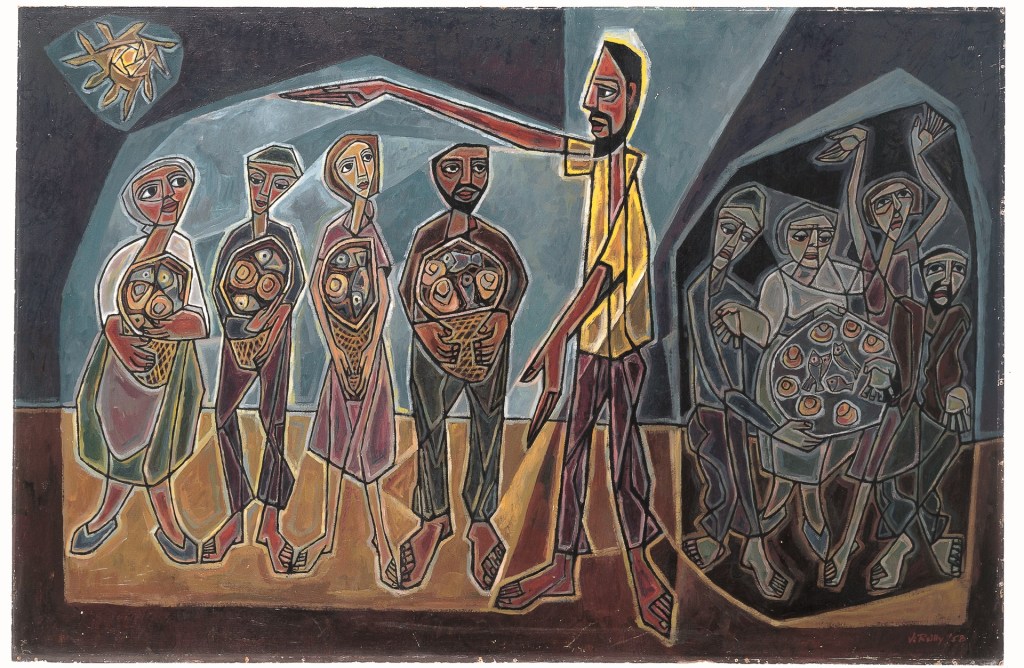
The Feeding of the Five Thousand by John Reilly, 1958

When the apostles returned, they reported to Jesus what they had done. Then he took them with him, and they withdrew by themselves to a town called Bethsaida, but the crowds learned about it and followed him. He welcomed them and spoke to them about the kingdom of God and healed those who needed healing.

Late in the afternoon the Twelve came to him and said, “Send the crowd away so they can go to the surrounding villages and countryside and find food and lodging, because we are in a remote place here.”

He replied, “You give them something to eat.”

They answered, “We have only five loaves of bread and two fish—unless we go and buy food for all this crowd.” (About five thousand men were there.)

But he said to his disciples, “Have them sit down in groups of about fifty each.” The disciples did so, and everyone sat down. Taking the five loaves and the two fish and looking up to heaven, he gave thanks and broke them. Then he gave them to the disciples to distribute to the people. They all ate and were satisfied, and the disciples picked up twelve basketfuls of broken pieces that were left over. (New International Version)

Jesus feeding five thousand people is not just an incredible story that happened a long time ago. Today, Jesus is still in the miracle business because he is still in the kingdom business. Christ still takes our meager resources and turns them into something that has a large impact on a lot of people. 

For that to happen, all we need do, is follow the Lord’s simple instructions: “You give them something to eat,” and, “Bring them [five loaves and two fish] here to me.” Jesus, using a simple act of obedience by his disciples, did one of the most famous miracles in history.

Jesus can multiply whatever little we possess to accomplish his kingdom work through us. 

It is true that Jesus most certainly can do miracles without us. And yet, Christ chooses to use us simple folk to participate in his work. God uses our simple prayers for the miracle of a transformed life. The Lord uses our imperfect speech to bring new life to others. Jesus takes our miniscule bank account to bring a river of financial resources to many through a small act of giving. 

Faith is our true work – to believe God can do the extraordinary through our ordinary loaf of bread and piece of fish.

The Compassion of Jesus Motivates Him To Do Miracles

Jesus withdrew to a solitary place. The crowd, however, did not leave him alone. But rather than being annoyed by the situation because this interruption was not on his divine day planner, Jesus looked at the large group of people and had compassion on them. 

Christ’s heart went out to thousands of people, so he set about the work of healing the sick. Please know that God does not begrudgingly deal with you, as if you were an interruption to his day; the Lord has compassion for you.

The Desire of Jesus is For Us to Participate in the Miracles He Does

After a full day of healing, Christ’s disciples came to him as if he was unaware of the people’s need for food.  They had a very rational and realistic answer to the problem of hunger in front of them; dismiss the crowd so they can go out to eat. 

Jesus calmly responded, “They don’t need to go away; you give them something to eat.” 

I detect perhaps a hint of sarcasm and a slight eye roll in the reply of the disciples, “We have only five loaves of bread and two fish.” But their math was way off because they did not count Jesus. 

The Five Thousand by Eularia Clarke, 1962

Jesus simply said, “Bring them here to me.” My friends, if we have ears to hear, Jesus is still saying this today to us – bring them here to me. Through simple prayer and active obedience, we must give Jesus what we have, no matter how little or insignificant.

Most of what happens in Western Christianity, much like the ancient disciples, is a reasonable doing of rational ministry. Many ministries have little to nothing to do with the impossibility of faith and seeing God work in ways that are incomprehensible to our modern sensibilities.

The earthly miracles of Christ were not an isolated instance. God has always been taking the impossible and making it possible.

Now there was a woman who had been married to a member of a group of prophets. She appealed to Elisha, saying, “My husband, your servant, is dead. You know how he feared the Lord. But now someone he owed money to has come to take my two children away as slaves.”

Elisha said to her, “What can I do for you? Tell me what you still have left in the house.”

She said, “Your servant has nothing at all in the house except a small jar of oil.”

He said, “Go out and borrow containers from all your neighbors. Get as many empty containers as possible. Then go in and close the door behind you and your sons. Pour oil into all those containers. Set each one aside when it’s full.”

She left Elisha and closed the door behind her and her sons. They brought her containers as she kept on pouring. When she had filled the containers, she said to her son, “Bring me another container.”

He said to her, “There aren’t any more.” Then the oil stopped flowing, and she reported this to the man of God.

He said, “Go! Sell the oil and pay your debts. You and your sons can live on what remains.” (2 Kings 4:1-7, CEB)

What if we were to live as if God was interested in doing the miraculous? Would it change the way we pray, and the way we act? 

What if we understood just enough of Jesus, of what he can and wants to do, that we are bold to say:

  • “This might sound crazy, but what if we found out the names of everyone in our community who needs food and go love on them and feed them?” (instead of only the rational means of a food pantry)
  • “This might sound crazy, but what if we used our property to create a community garden and help people grow their own food?” (instead of only the rational means of government aid) 
  • “This might sound crazy, but what if we prayed for one-hundred people, by name, to be healed?” (instead of only the rational means of relying on the pastor to pray)

Most of our plans are humanly possible and doable. Maybe we ought, instead, to seek the impossible.

We may often do nothing out of a sense that God either cannot or does not want to use me or what I have. However, it just won’t do to stand afar off and expect God to work without us giving what we have, whether that something is time, money, conversation, food, hospitality, or whatever. 

Our excuses won’t do for Jesus – my home is too small, I don’t have enough money, I am not smart enough, my schedule won’t allow it, I don’t have enough resources…. In God’s economy you don’t need much, at all. Just a mustard seed worth of faith will do. Jesus wants us to be a part of the miracles he is doing.

Conclusion

I can visualize the disciples befuddled by Christ’s words. I can imagine hearing their excuses. “You want me to do what?  Feed thousands?  Lead someone to Jesus?  Pray in front of others?….” 

The miracle for many a believer is to be open, real, and transparent enough to believe that Christ can do the impossible through confessing sin, participating in ministry, having a spiritual conversation with an unbeliever, or just naming out loud what one actually thinks and feels.  

The question is never, “Can God use me?” The real question is, “What miracle does God want to do through me, and through us as a community of faith?”

It is no accident that when Jesus distributed the bread, it sounds a lot like communion. The Lord’s Supper may seem to be irrelevant – only something we do to remember Jesus, or a mere ritual. But God’s design is much bigger. The Lord wants to do a miracle. 

God wants our observance of Christian communion to bring a healing which the world cannot give. It appears irrational that Jesus can use a small Table to feed and reach thousands. Yet, we don’t serve a God who is limited to work through rational means. 

O God, our heavenly Father, you have blessed us and given us dominion over all the earth. Increase our faith and our reverence for the mystery of life. Give us new insight into your purposes for the human race, and new wisdom and determination in making provision for its future, no matter whether it makes sense, or not, in accordance with your goodwill, through Jesus Christ our Lord. Amen.

1 John 2:1-6 – Live as Jesus Did

Photo by RODNAE Productions on Pexels.com

My dear children, I write this to you so that you will not sin. But if anybody does sin, we have an advocate with the Father—Jesus Christ, the Righteous One. He is the atoning sacrifice for our sins, and not only for ours but also for the sins of the whole world.

We know that we have come to know him if we keep his commands. Whoever says, “I know him,” but does not do what he commands is a liar, and the truth is not in that person. But if anyone obeys his word, love for God is truly made complete in them. This is how we know we are in him: Whoever claims to live in him must live as Jesus did. (New International Version)

Jesus is our advocate, the one who speaks on our behalf, our mediator, who stands in the gap between heaven and earth, standing-up for us when we have no leg to stand on. 

Christ has atoned for all our sin, guilt, and shame through his “propitiation” which means that his death satisfied all demands of justice and put to rest the sin issue once for all through his blood. Christ’s gracious intervention has saved us from ourselves. 

Jesus Christ has made it possible for us to experience forgiveness, restoration, and new life. Whenever we are so broken and so full of tears that we cannot even speak words at all, Jesus steps in and speaks on our behalf with words that mean something because they have been backed up with the action of the cross.

“But” as the late Ron Popeil used to say on the old commercials, “that’s not all!” Not only do we have deliverance from sin, death, and hell, Christ’s followers have both the means and the opportunity to give back and be a blessing to one another and the world. The Spirit enables us to obey God’s commands and is the continuing presence of Jesus to us and on this earth.

Christians are called to be little advocates, practicing the ministry of coming alongside and interceding for one another before God. We can agents of spiritual healing in a world of brokenness. Our gospel proclamation, a message of grace and forgiveness, gets to the very root of human problems and travails.

  • Anyone who harms and hurts others as a matter of habit in the name of Christ, and does not heal, is no follower of Jesus but is a victimizer.
  • Any person who talks a good talk, and walks a bad walk, is not living as Jesus did, and is a spiritual pettifogger.
  • Anybody who claims the name of Christ and avoids reading and studying and praying over the New Testament Gospels, is a slovenly lout, no matter whether they have prayed a “sinners prayer.”

Whoever claims to live for Christ must live as Jesus did. So, how did Jesus live?

“If any of you wants to be my follower, you must give up your own way, take up your cross, and follow me.”

Jesus (Matthew 16:24, NLT)

“You know that the rulers of the non-Jewish people love to show their power over the people. And their important leaders love to use all their authority. But it should not be that way among you. Whoever wants to become great among you must serve the rest of you like a servant. Whoever wants to become first among you must serve the rest of you like a slave. In the same way, the Son of Man did not come to be served. He came to serve others and to give his life as a ransom for many people.” (Matthew 20:25-28, NCV)

He came to tell about the light and to lead all people to have faith.

John 1:7, CEV

“You call me Teacher and Lord—and you are right, for that is what I am. So if I, your Lord and Teacher, have washed your feet, you also ought to wash one another’s feet. For I have set you an example, that you also should do as I have done to you.” (John 13:13-15, NRSV)

Your life must be controlled by love, just as Christ loved us and gave his life for us as a sweet-smelling offering and sacrifice that pleases God.

Ephesians 5:2, GNT

Adopt the attitude that was in Christ Jesus:

Though he was in the form of God,
        he did not consider being equal with God something to exploit.
But he emptied himself
        by taking the form of a slave
        and by becoming like human beings.
When he found himself in the form of a human,
        he humbled himself by becoming obedient to the point of death,
        even death on a cross. (Philippians 2:5-8, CEB)

Don’t be angry with each other but forgive each other. If you feel someone has wronged you, forgive them. Forgive others because the Lord forgave you.

Colossians 3:13, ERV

But if you suffer for doing good and you endure it, this is commendable before God. To this you were called, because Christ suffered for you, leaving you an example, that you should follow in his steps.

“He committed no sin,
    and no deceit was found in his mouth.”

When they hurled their insults at him, he did not retaliate; when he suffered, he made no threats. Instead, he entrusted himself to him who judges justly. (1 Peter 2:20-23, NIV)

This is how we know love: Jesus laid down his life for us, and we ought to lay down our lives for our brothers and sisters.

1 John 3:16, CEB

Christians inhabit unlovely places for the purpose of putting sacrificial love there. This is what it means to live as Jesus did.

O Lord, you have taught us that without love whatever we do is worth nothing. Send your Holy Spirit and pour into my heart your greatest gift, which is the love of God in Christ, the true source of healing and the real bond of peace. Amen.