Psalm 79 – Unbearable Pain

The nations have come into your inheritance, God!
    They’ve defiled your holy temple.
    They’ve made Jerusalem a bunch of ruins.
They’ve left your servants’ bodies
    as food for the birds;
    they’ve left the flesh of your faithful
    to the wild animals of the earth.
They’ve poured out the blood of the faithful
    like water all around Jerusalem,
    and there’s no one left to bury them.
We’ve become a joke to our neighbors,
    nothing but objects of ridicule
    and disapproval to those around us.

How long will you rage, Lord? Forever?
    How long will your anger burn like fire?
Pour out your wrath on the nations
        who don’t know you,
    on the kingdoms
        that haven’t called on your name.
They’ve devoured Jacob
    and demolished his pasture.
Don’t remember the iniquities of past generations;
    let your compassion hurry to meet us
    because we’ve been brought so low.
God of our salvation, help us
    for the glory of your name!
Deliver us and cover our sins
    for the sake of your name!
Why should the nations say,
    “Where’s their God now?”
Let vengeance for the spilled blood of your servants
    be known among the nations before our very eyes!
    Let the prisoners’ groaning reach you.
With your powerful arm
    spare those who are destined to die.
Pay back our neighbors seven times over,
    right where it hurts,
    for the insults they used on you, Lord.
We are, after all, your people
    and the sheep of your very own pasture.
We will give you thanks forever;
    we will proclaim your praises
    from one generation to the next. (CEB)

The setting behind today’s Psalm is the destruction of the temple and a conquering army who proudly gloats over their victory. This is a prayer, an angry cry for God to step in and act on behalf of the humiliated people. The psalm is more than a simple plea for help; it is a deeply passionate appeal. As a child of the 1960’s, my phrase for the psalmist’s entreaty is, “God, stick it to the man!”

There is no polite knock at the side door of God’s house in the face of such evil. This is a pounding on the front door with the demand for God to do something about this terrible trouble. For the psalmist, the incongruence between who God is and what has happened to God’s people is inconceivable and unacceptable. To profane God’s temple is to profane God; and to kill and maim God’s people is to flip the middle finger at God. The psalmist is beside himself and overwhelmed with emotion.

There is something very instructive here that we ought not miss. When we have been brutalized, victimized, and/or demoralized, we just want someone, especially the Lord we serve, to take notice and feel what we are feeling. Never underestimate the power of empathy and solidarity. To feel alone and bereft of help is an awful feeling.

Perhaps the psalmist’s prayer offends some sensibilities. I wonder, for those who find the language difficult, have ever had a daughter raped or a house destroyed by fire or seen a person killed without mercy in front of their own eyes. Methinks they have not. The feelings of helpless despair and sheer anger defy human words. These are not casual affronts but malicious destructions of property and people.

We need someone to affirm the raw ruthlessness of it all, to have some understanding of the impossible place we are in with such wanton cruelty. When our very support is ripped from our lives, the madness within is too much to bear. Who will rescue us from this body of death?

God is big enough to handle our rage and our hurt. The Lord is available and hears our desperate voice of prayer. Yet, God is not always going to directly and immediately answer on the terms we stipulate. God acts out of God’s own providence and justice, and not from our expectations. And that is a good thing, not a bad thing.

God sees, knows, and feels with us. The realization of this enables us to recenter and reorient ourselves around faith, hope, and love. New life is never a gift in a vacuum; it comes out of agonizing struggle in reckoning with the existing evil.

So, when someone goes through a hellish experience, we are to exercise our capacity to listen and witness the horrible spiritual pain of the person. Healing hurts: it is not a pleasant affair. We are to hang in there and walk alongside another in their hour of need, even when their vitriol seems over the top to us. For only in telling our story to another will any of us find relief and renewed hope.

The psalms permit us to use language appropriate to what has happened to us. They also allow us to move beyond the venom to the God who restores broken lives.

Lord Jesus Christ, by your patience in suffering you hallowed earthly pain and gave us the example of obedience to your Father’ will: Be near me in my time of weakness and pain; sustain me by your grace, that my strength and courage may not fail; heal me according to you will; and help me always to believe that what happens to me here is of little account if you hold me in eternal life, my Lord and my God. As the Lord Jesus cried out on the cross, I cry out to you in pain, O God my Creator. Do not forsake me. Grant me relief from this suffering and preserve me in peace, through Jesus Christ my Savior, in the power of the Holy Spirit. Amen.

Luke 17:11-19 – Give Thanks

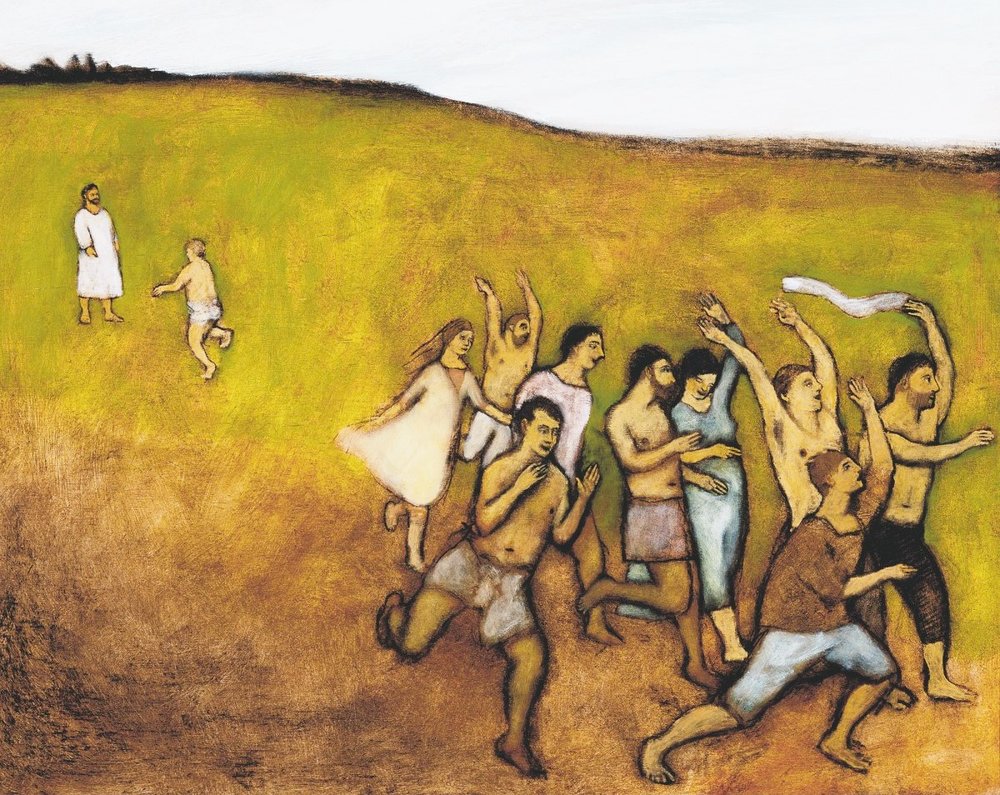
Ten Lepers Healed by American artist Brian Kershisnik

Now on his way to Jerusalem, Jesus traveled along the border between Samaria and Galilee. As he was going into a village, ten men who had leprosy met him. They stood at a distance and called out in a loud voice, “Jesus, Master, have pity on us!”

When he saw them, he said, “Go, show yourselves to the priests.” And as they went, they were cleansed.

One of them, when he saw he was healed, came back, praising God in a loud voice. He threw himself at Jesus’ feet and thanked him—and he was a Samaritan.

Jesus asked, “Were not all ten cleansed? Where are the other nine? Has no one returned to give praise to God except this foreigner?” Then he said to him, “Rise and go; your faith has made you well.” (NIV)

Today’s Gospel story is both joyous and sad. The healing of ten lepers is astonishing and elicits thanks – yet from only one. Perhaps this is because they stood at a distance. After all, it is connection which causes gratitude to arise within us. So, maybe we ought to consider what the nature of our connections are, especially on this Thanksgiving Day. 

Food, football, and family have become the annual trifecta of the American Thanksgiving Day. I confess that I liberally indulge in all three. I am not here to bash on the fact that Thanksgiving has become almost a day of secular worship around an unholy trinity. That is because I believe underneath all the gravy, naps at halftime, and the occasional obnoxious relative that we know why we are celebrating the day: To give thanks for our abundant blessings. It seems even those who do not readily acknowledge the Divine intuitively know there is a power and source of blessing well beyond themselves which makes all good things occur.

Celebrations are a spiritual activity. God invented parties. When Israel was preparing for a new national life in the Promised Land, God told them to celebrate the Feast of Harvest with the first fruits of the crops (Exodus 23:16).  The Levitical law prescribed how to go about giving thanksgiving offerings. Gratitude was commanded, expected, and was an important dimension of Old Testament worship:

Let us come into his presence with thanksgiving; let us make a joyful noise to him with songs of praise! (Psalm 95:2, NRSV)

Be thankful and praise the Lord as you enter his temple. The Lord is good! His love and faithfulness will last forever. (Psalm 100:4-5, CEV)

Give thanks to the Lord, for he is good! His faithful love endures forever. (Psalm 118:1, NLT)

It ought to have been reflexive for all ten lepers healed by Jesus to offer thanksgiving. A Samaritan, considered by many of the time as the lowliest of the low, a “half-breed,” was the lone person who came and fell at Christ’s feet with intense gratitude.  While the other nine went about their lives free from disease and glad for it, only one guy took the time to thank Jesus. 

Indeed, sometimes we must be reminded to give thanks and show gratitude for the ways God has provided for us. It is often the homeless, the sick, the lowly, and the outsiders who lead the way and demonstrate for us what genuine thanksgiving looks like.

The people of God are to always remember what they possess in Christ:

So, live in Christ Jesus the Lord in the same way as you received him. Be rooted and built up in him, be established in faith, and overflow with thanksgiving just as you were taught. (Colossians 2:6-7, CEB)

Never stop praying. Be ready for anything by praying and being thankful. (Colossians 4:2, ERV)

Everything God made is good, and nothing should be refused if it is accepted with thanks. (1 Timothy 4:4, NCV)

God and giving thanks are to go together like mashed potatoes and gravy. Since God created everything, and since Jesus has brought healing to us through the cross, every juicy morsel of goodness we have is to be received with the full cognizance that God is behind it all.

Our lives need to be punctuated with times of celebration, praise, giving thanks, and even (virtual) blowout parties. Otherwise, we become dull, boring, lifeless, and bereft of Christ’s lifeblood coursing through our spiritual veins. Conversely, a joyous and raucous group of healed believers chatting incessantly with thanksgiving of God’s goodness are winsome and peculiar (in a good way and not in the strange way of your weird uncle who wants the turkey neck to gnaw on).

It seems to me that Christians really ought to be at the forefront of having maximum fun because they have been forgiven; know the presence of God; are provided for; are confident in the fact they are protected; and, experience the power of the Spirit and the shepherding ministry of Jesus.

Yes, eat to your heart’s content and have a belly full of cornbread stuffing. But remember to give thanks – out loud and with others – for the God who stands behind every good gift of creation.  Let thanksgiving (not complaint) shape you and I. Be the person who comes back to Jesus and offers praise, worship, and gratitude – and see how such gratefulness can change the world.

Almighty God, Father of all mercies, we your unworthy servants give you humble thanks for all your goodness and loving-kindness to us and to all whom you have made. We bless you for our creation, preservation, and all the blessings of this life; but above all for your immeasurable love in the redemption of the world by our Lord Jesus Christ; for the means of grace, and for the hope of glory. And, we pray, give us such an awareness of your mercies, that with truly thankful hearts we may show forth your praise, not only with our lips, but in our lives, by giving up ourselves to your service, and by walking before you in holiness and righteousness all our days; Through Jesus Christ our Lord, to whom, with you and the Holy Spirit, be honor and glory throughout all ages. Amen.

Matthew 8:14-17 – A Changed Life

Jesus Heals Peters Mother In Law
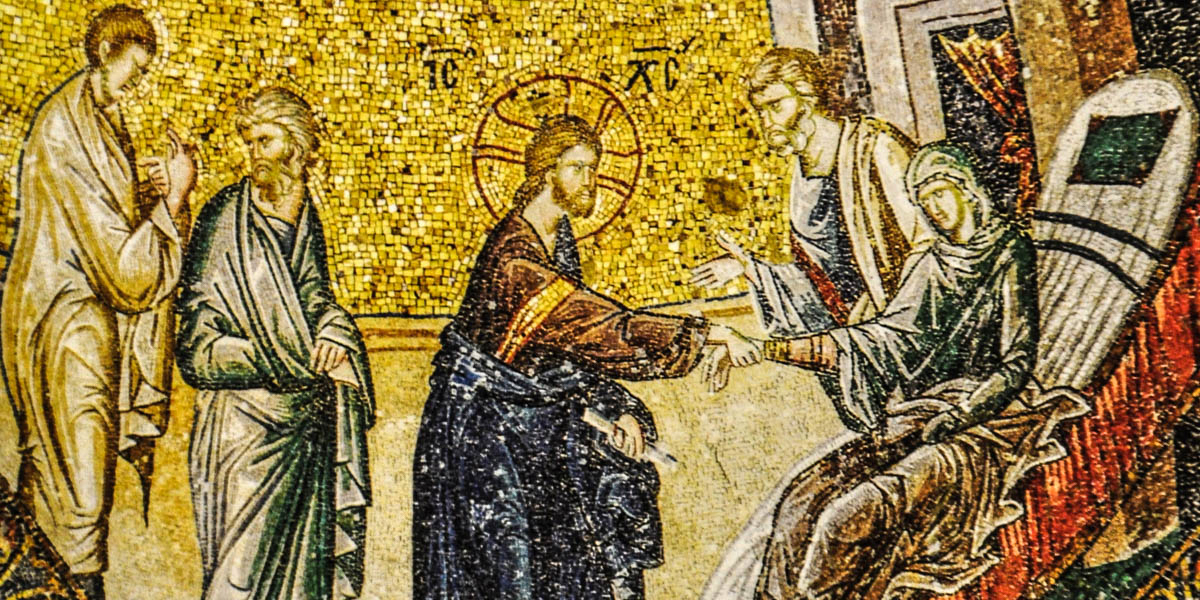
A mosaic of Jesus healing Peter’s mother-in-law, from a Byzantine Church, c.1100 C.E.

When Jesus came into Peter’s house, he saw Peter’s mother-in-law lying in bed with a fever. He touched her hand and the fever left her, and she got up and began to wait on him.

When evening came, many who were demon-possessed were brought to him, and he drove out the spirits with a word and healed all the sick. This was to fulfill what was spoken through the prophet Isaiah:

“He took up our infirmities
    and bore our diseases.” (NIV)

One of the great realities we run headlong into with the New Testament Gospels is that Jesus has the authority to heal and transform the world… and me. Forty-one years ago, today, I experienced the reviving and revolutionizing work of Jesus Christ. I realize not everyone has a specific time they can point to when God does something miraculous, and I also do not expect that everyone’s experience of the divine must conform or be like my own. No, my encounter with God was just that, mine alone. Yet, I hope you find some encouragement and solace in my brief story.

I was probably the least likely person to become a follower of Jesus, let alone to have shown any promise toward the pastoral and religious life. I had serious reservations about the veracity of faith, the relevance of church, and the importance of religion. Although, outwardly, my family made attending our local church mandatory, inwardly, I felt the entire Christianity thing to be boring, irrelevant, and contrived. I was much more likely to behave passive-aggressively than piously.

But I began to rethink and revisit my doubts and epistemic assumptions about all things God and Christianity. The love of Christians around me stirred the internal upheaval. I had come to view the world as a cruel place and saw other people through jaded lenses. Relationships were for me a necessary evil. So, when love and grace entered my orbit, it threw me into sort of an existential angst. Having come to settled-thinking in my understanding of a dark world and having learned to navigate it with the tools of sarcasm and skepticism, genuineness and authenticity were a complete monkey wrench in my cosmology.

To put the whole matter succinctly, Jesus touched me. My small sin-sick heart was healed and enlarged. I walked away completely changed. I cannot accurately say what happened any more than I could tell you how a transplant doctor puts a new heart into the chest of a person. I can only speak to the results: newfound joy instead of nihilism; new desires to bless others and the world instead of looking for ways to disengage from people; new speech and wanting to edify and encourage people instead of sly words of putting others down; and, perhaps most surprising of all (to me) a thoroughly new desire to glorify God and enjoy him forever.

Pastor Tim

The love of God in Christ made all the difference for me – and still does, all these years later. I stand in a long Christian tradition of outsiders and misfits entering the kingdom of God through spiritual metamorphosis – going all the way back to today’s story of Jesus healing and transforming.

In the first century, Jewish women were not allowed as far inside the temple as Jewish men.  Lepers could not go in, at all.  Centurions and Gentiles could only get into the outer court, emphasizing that they were outsiders.  In the synagogue service, women sat in the back, under the balcony. There were pious men who would pray, not in a spirit of humility, but thanking God they were not women.  In this healing account of a woman, no one asks Jesus for healing; he just walks into a house and heals Peter’s mother-in-law just because he wants to!

Christ’s authority, concern, and healing power even extended to the demonic realm. It perhaps goes without saying that most people would not want to hang-out with demonized people who carry a load of problems and sickness with them; they are yet another example of the classic outsiders.  If we take seriously that Jesus is our model for ministry, then we need to take passages like this seriously and connect with outsiders and bring them to Jesus.

The Old Testament quote comes from Isaiah 53:4. Sickness relates to sin – not always personal sin, but from living in a fallen and fundamentally broken world.  In other words, when the biblical text says that Jesus took up our infirmities and carried our diseases, it is saying that Christ takes our sin upon himself. His healing acts are tied to the cross.  There is new life and spiritual health in the cross of Jesus Christ.  We come to the foot of the cross as spiritual beggars, looking for grace and mercy in our time of need because Jesus has the authority to extend healing and deliverance from every sin and every sickness and every problem known to people.

Through Jesus Christ there is and can be healing for damaged emotions, broken hearts, pain-ridden bodies, and sin-sick souls. There shall be joy through mourning. There is life through death. A new day will dawn, carrying fresh grace and unique mercies for the journey ahead. Behind it all is the God who is still in the business of renewing minds and hearts, and reforming attitudes and actions through extravagant and inexhaustible love.

God of all creation forgive my foolish thoughts and errant ways; clothe me in my right mind; and, calm my troubled heart. My soul is off, and I cannot seem to find my balance, so I stumble and worry constantly. Give me the strength and clarity of mind to find my purpose and walk the path you have laid out for me. I trust your love, God, and know that you will heal this stress, and mend my spirit. Just as the sun rises each day against the dark of night, bring me clarity with the light of God, through Jesus Christ, Savior and Lord, in the power of your Holy Spirit. Amen.

Matthew 8:1-13 – Two Amazing Healings

Jesus heals the leper
Jesus touches the leper, a mosaic from an early Byzantine Church

When Jesus came down from the mountainside, large crowds followed him. A man with leprosy came and knelt before him and said, “Lord, if you are willing, you can make me clean.”

Jesus reached out his hand and touched the man. “I am willing,” he said. “Be clean!” Immediately he was cleansed of his leprosy. Then Jesus said to him, “See that you don’t tell anyone. But go, show yourself to the priest and offer the gift Moses commanded, as a testimony to them.”

When Jesus had entered Capernaum, a centurion came to him, asking for help. “Lord,” he said, “my servant lies at home paralyzed, suffering terribly.”

Jesus said to him, “Shall I come and heal him?”

The centurion replied, “Lord, I do not deserve to have you come under my roof. But just say the word, and my servant will be healed. For I am also a man under authority, with soldiers under me. I tell this one, ‘Go,’ and he goes; and that one, ‘Come,’ and he comes. I say to my servant, ‘Do this,’ and he does it.”

When Jesus heard this, he was amazed and said to those following him, “Truly I tell you: I have not found anyone in Israel with such great faith. I say to you that many will come from the east and the west and will take their places at the feast with Abraham, Isaac, and Jacob in the kingdom of heaven. But the subjects of the kingdom will be thrown outside, into the darkness, where there will be weeping and gnashing of teeth.”

Then Jesus said to the centurion, “Go! Let it be done just as you believed it would.” And his servant was healed at that moment. (NIV)

Maybe you, like me, have had your computer pick up a nasty virus that hijacks every file and function you possess. For me, the most frustrating thing about those events is that there is nothing I can do by myself to fix it or make it better. I must humble myself and ask some computer geek to get into my system and take care of the problem. It feels weird looking at my screen and having somebody I do not know working inside my personal computer. But if I fail to get help, my computer would be worthless – unless I let someone with authority fix the blasted thing.

Jesus Christ is Lord of all. Since he has authority over everything, we must live our lives in submission to his will and way. Only through humble resignation to Christ will we experience the healing and deliverance we seek.

Jesus preached his famous Sermon on the Mount (Matthew 5-7) and taught the people as one who had authority. In that Sermon, Jesus laid out the values of God’s kingdom: humility, sorrow over sin, meekness, purity, mercy, and peacemaking. Now, in today’s Gospel lesson, we see the power and values of God’s kingdom evidenced and expressed in two stories of healing and deliverance.

The world needs saving, and that is exactly what Jesus is up to. Jesus Christ’s authority is total, and comes from his moral authority, as the very embodiment of the Beatitudes he taught. Grace always gets the last word, as Jesus healed without showing favoritism nor discrimination.

In the first story, Jesus used his authority to heal and transform a leper. Leprosy was a feared disease in the ancient world. There was no known cure, and lepers were forced to live apart from everyone else. The Old Testament book of Leviticus says that a leper must wear torn clothes, let his hair be unkempt, cover the lower part of his face and cry out “unclean! unclean!” (Leviticus 13:45-46).  Lepers were the ultimate outsiders.

A leper came to Jesus with a humble profession of faith: “Lord, if you want to, you can make me clean.” It was a clear case of genuine need, and poverty of spirit. Jesus responded by doing the unthinkable: He touched him.  In a great and wonderful reversal, Jesus did not become unclean by touching the leper but instead the leper was made clean.

If we want the world to be saved and to follow the way of Jesus, then we will emulate our Lord by touching the world. It will not do for us to stand afar off from the outsiders of our community and avoid marginalized people. It will not do for us just to provide a service without having to touch someone. Authentic Christian ministry communicates love through contact and identification with others.

Eleven centuries after Jesus walked the earth, another man, Francis, met a leper on the road as he journeyed toward Assisi. “Though the leper caused him no small disgust and horror, he nonetheless, got off the horse and prepared to kiss the leper.  But when the leper put out his hand as though to receive something, he received money along with a kiss” (Life of St. Francis by Thomas of Celano). Francis did what seemed humanly impossible because he was filled with the love and compassion of Christ. The love of Jesus allows us to touch others with compassionate care, especially to those who have been rejected and mistreated.

Centurion Begs Jesus stained glass
The Centurion Begs Jesus to Heal his Servant, and The Lamp of Faith, from St. Matthew Catholic Church in Detroit, Michigan.

The second story was equally eye-popping and unbelievable to the people in Christ’s day. Jesus used his authority to heal and transform a Gentile. Again, we see the Beatitudes expressed toward a Roman Centurion who felt unworthy to even have the Lord Jesus come into his house. Furthermore, the Centurion’s profession of faith amazed even Jesus: “Just say the word,” he said in recognition of Christ’s authority, which is big enough to heal without even being present.  Centurions were the backbone of the Roman military machine and hated by the Jews. Yet, Jesus the Jew not only responded to the Centurion’s request, he affirmed this Gentile’s faith as greater than any Jew.

Grace answers to need, and not to smug self-confidence. The Roman Centurion did not ask for healing for himself but for his servant, and Jesus listened and answered. The Centurion neither demanded nor claimed healing but came in a spirit of humility and asked with confidence that Jesus could heal his servant if he wanted to. The Centurion simply threw himself on God’s mercy. So, Jesus upheld the Centurion as a model of faith for us all.

Not only did Jesus affirm the Centurion’s faith, he gave a solemn warning to the self-righteous: Their lack of humility and genuine faith would land them outside the kingdom. In another great reversal, the insiders will become the outsiders, and the outsiders become the insiders. The independently proud did not experience healing and transformation because they did not even know they were sin sick. They saw no need for an intervention by Jesus because they already had their righteous deeds to boast about. They were more concerned about looking good and saving face and did not perceive their own unworthiness.

The self-righteous approach to handling problems and difficult situations is to come up with good ideas and clever strategies, relying on sheer personal effort and willpower. Prayer may or may not happen after the plans are laid, and there is no sense of beginning with beseeching God.  Our delusional thoughts of personal autonomy only separate us from the grace of God we so desperately need.

There is a spiritual dimension to every situation and trouble we face – including sickness.  If we only examine the medical end of physical problems, we may be dealing with symptoms instead of the root issue that plagues us. The Apostle James said:

Are you hurting? Pray. Do you feel great? Sing. Are you sick? Call the church leaders together to pray and anoint you with oil in the name of the Master. Believing-prayer will heal you, and Jesus will put you on your feet. And if you have sinned, you will be forgiven—healed inside and out. Make this your common practice: Confess your sins to each other and pray for each other so that you can live together whole and healed. (James 5:13-16, MSG)

Jesus healed and transformed outsiders. The followers of Christ must constantly ask: Who are the outsiders among us? Do we care about strangers?  Are we willing to touch aliens and immigrants?  Will we intercede in prayer for those who are foreign to us?  Will we search for and pursue those on the periphery of society?  Do we believe the risen and ascended Jesus can and will heal, deliver, and transform people?

Jesus cannot be domesticated into some figurehead that suits our desires and conforms to our ideas about how things ought to be. Jesus is portrayed in these stories as eager to heal, wanting to show grace to the least and the lowly among society. May we participate in word and deed the Lord’s Prayer:

Our Father in heaven,
may your name be kept holy.
May your Kingdom come soon.
May your will be done on earth,
as it is in heaven.
Give us today the food we need,
and forgive us our sins,
as we have forgiven those who sin against us.
And don’t let us yield to temptation,
but rescue us from the evil one. Amen. (Matthew 6:9-13, NLT)