“Your Faith Has Made You Well” (Luke 17:11-19)

Jesus heals ten lepers, with one returning to give him thanks

On the way to Jerusalem Jesus was going through the region between Samaria and Galilee. As he entered a village, ten men with a skin disease approached him. Keeping their distance, they called out, saying, “Jesus, Master, have mercy on us!” When he saw them, he said to them, “Go and show yourselves to the priests.” And as they went, they were made clean. Then one of them, when he saw that he was healed, turned back, praising God with a loud voice. He prostrated himself at Jesus’s feet and thanked him. And he was a Samaritan. Then Jesus asked, “Were not ten made clean? So where are the other nine? Did none of them return to give glory to God except this foreigner?” Then he said to him, “Get up and go on your way; your faith has made you well.” (New Revised Standard Version)

Ten persons seeking healing called out to Jesus. And they got it. Yet, those persons were much more than passive receivers of healing. And Jesus was more than simply a giver.

Even though the lepers had heard about Jesus, they did not personally know him. It seems that – from their perspective – they had a chance encounter with Jesus. When they least expected a healing, a healing happened.

They called out to Christ, recognizing who it was that had entered their village. There was enough faith present for the diseased persons to make themselves known to Jesus – to expectantly put themselves out there and cry out for a healing to happen.

If you think about it, the power of any healing is really in the connection of being seen and heard in crying out to Jesus.

Although the healing of a person can come through a wondrous miracle, healing most often happens by the beautiful act of mutuality and participation. That is, the healer and the one in need of healing encounter each other with the willingness to both give and receive.

It’s in real human connection that healing happens. And it’s more than a physical cure; it’s also a healing reconnection of persons who were once isolated from the community. In other words, the healed person no longer needs to be on the outside of society, but can once again be a full participant in neighborhood and community.

Faith is central to what happens in the healing process. We all have some agency in realizing our own healing. We need not be passive spectators just wishing for things to be different.

Our anxiety and/or discouragement of present circumstances can move to a different place. We can discover relief through participating in social activities, taking walks in nature, and other modes requiring us to actively make a meaningful connection.

It requires faith.

Where faith is present, relational interaction and participation happens. In this context, a healing can occur. Rarely, if ever, does healing happen in complete isolation from others.

The fact that Jesus declared to the cleansed leper, “your faith has made you well,” indicates the mutuality of the healing encounter.

Let’s keep in mind that it takes at least two in order to have a healing: the healer and the healed one. Both participate together in the healing.

What’s more, when Christ heals, he heals without prejudice or favoritism.

In my front yard is a large ash tree with broad and expansive boughs. It is the ultimate shade tree. The tree’s name is Bob (I have a tendency to name trees, especially the ones I enjoy daily). Bob and I share the similarity of being created by the same Creator; and we both glorify God by simply being who we are created to be.

For Bob, he provides shade to people and animals without prejudice or favoritism. Anyone who comes under his great limbs can enjoy his shade. All that is needed for the protective and enjoyable experience of Bob’s boughs is a person under him.

Although it is appropriate to highlight the need for gratitude and praise in today’s story, the narrative itself builds to the climax of faith, of a participatory experience between Jesus and the leper(s).

And it did not matter if the persons healed were lepers, Samaritans, or even miscreants. What mattered was the faith-dialectic of the healer Jesus and the ones to be healed. All may enjoy the grace of divine shade if they move to becoming participants together with Christ by merely coming under his mercy.

I find that many people get hung-up about faith. We often make faith either too simple or too difficult. We create an overly simplistic faith when it becomes a completely passive affair of just waiting on God, or expecting someone else to heal me. We make faith a great difficulty whenever it becomes all about our level or amount of faith through the strenuous effort of intense prayer and contacting umpteen prayer chains.

But more or less prayer, more or less work, more or less of anything misses the point – because even a puny amount of faith will do, if it moves toward Jesus and seeks the participatory experience of a divine/human relation.

There is a cost to healing. It requires participation, relationship, and most of all, the humility to be seen and heard, instead of trying to control some sort of process to get the healing I want.

We call this genuine participation faith.

When the Son of Man comes, will he find faith on the earth? (Luke 18:8)

The only thing that counts is faith expressing itself through love. (Galatians 5:6)

Your faith has made you well. (Luke 17:19)

In your love, O God of all, your people find healing. Grant that the pains of our journey may not obscure the presence of Christ among us, but that we may always give thanks for your healing power as we travel on the way to your kingdom; through Jesus Christ, your Son, our Lord, who with you and the Holy Spirit are one God, now and forever. Amen.

His Resurrection Is Ours

The Resurrection, by Andrea Mantegna, c.1458 C.E.

The story of Christianity, the very heart and essence of the religion, is a tale of transformation from all the obstacles, impediments, and barriers which confine or cripple. The person and work of Jesus accomplished this. In his earthly ministry, Christ continually called people to transformative change into the reality of God’s gracious and benevolent realm.

“I have come to give the good life, a life that overflows with beauty and harmony.”

Jesus (John 10:10, First Nations Version)

Christ’s resurrection made possible our own transformative new life. This is both exciting and scary. Resurrection is frightening because it’s a call to live a life without any of the walls which have defined us and/or imprisoned us.

The massive stone covering the tomb of Jesus Christ was rolled away. He walked out of the grave by the power of resurrection. The cave of death was changed into the place of liberation.

That place is a powerful image of moving aside any and all obstacles to our own faith and freedom. The prison doors have been opened. Our self-contrived inner prisons, as well as the unjust shackles placed upon us, have dropped away.

As a result, those who have been exiled, excommunicated, and treated as expendable are visited by the luminous healing presence of God’s great liberating force: resurrection.

All of these words may either seem strange and/or compelling. If this is the case, it is a sad situation. Because it’s quite necessary that we become familiar with such language. Unfortunately, the gap between the world we are presently living in, and the world our hearts yearn to know, is quickly coming to an unsustainable place of high stress.

There is now a profound disconnect between the love deep inside us, and the way in which we are living our day-to-day lives on this earth. The issue has become so great as to warrant the need for resurrection.

And I am not simply addressing Christians. In his earthly ministry, Jesus was not only talking to his own Jewish people; he came for the whole world. Jesus is for everyone – whether we acknowledge him according to Christian dogma and doctrine, or not.

The evil gaslighting sort of person wants you to believe that you are alone, bereft of any help – that somehow you need to assert yourself aggressively into the dog-eat-dog world. Wickedness always looks to chaos and war as the path to gaining the life one wants.

But Jesus is the bridge to another kind of thinking, another sort of life. He is the guide to the greatest power which exists in the world: Love. And Love is why resurrection is a reality.

Although we suffer from systemic evil and all kinds of structural “ism’s” in this world, our shackles and chains have been largely forged by ourselves, through spiritual ignorance and misunderstandings of who we are and why we are here.

Resurrection opens us to new life. It provides identity, purpose, and passion to live the good life. Even though we live in this world below, our answers to living in the here-and-now are found in the world above.

All of us have experienced walking a dark path in life. But now it is high time to walk away from uncontrolled emotions and evil ways. There are plenty of lying spirits who intend on deceiving you and I for their own selfish purposes. Instead, we can refuse and resist such evil.

We can live in ways that represent the good, the right, and the just. We can experience living a resurrected life. Let us choose the pure path of the new person in Christ, the person you and I were created to be.

The telltale signs of the person living into resurrection are a deep feeling for the pain of others, kindness, humility of heart, a gentle spirit, and long-suffering patience with others. Such persons wear forgiveness like a well-worn pair of jeans.

This is the path of resurrection, the way of unity, peace, and harmony. And these qualities will always guide us and inform us in helpful and sacred ways.

Our current global decline comes from an accumulation of greed and sheer lovelessness. But the possibility of rebirth, of resurrection, rises from our deep universal yearning for the good and the true. It comes from our radical willingness to change and live a different counter-cultural life.

Resurrection does not occur because of lofty thoughts; it comes from a humble, and contrite heart which yearns for a better and more sacred existence.

Only until we find our present life on this world as intolerable with its injustice and persistent carelessness, will we see that we must put love where love is not.

The great lesson of resurrection is that Love makes all things right.

May resurrection move from being merely a theological concept, to a powerful reality that permeates and fills your life with meaning, power, and love. Amen.

Renewal (Mark 6:30-34, 53-56)

Great Crowds Followed Jesus as He Preached the Good News, by Elizabeth Wang (1942-2016)

The apostles gathered around Jesus and told him all that they had done and taught. He said to them, “Come away to a deserted place all by yourselves and rest a while.” For many were coming and going, and they had no leisure even to eat. And they went away in the boat to a deserted place by themselves. 

Now many saw them going and recognized them, and they hurried there on foot from all the towns and arrived ahead of them. As he went ashore, he saw a great crowd, and he had compassion for them, because they were like sheep without a shepherd, and he began to teach them many things….

When they had crossed over, they came to land at Gennesaret and moored the boat. When they got out of the boat, people at once recognized him and rushed about that whole region and began to bring the sick on mats to wherever they heard he was. 

And wherever he went, into villages or cities or farms, they laid the sick in the marketplaces and begged him that they might touch even the fringe of his cloak, and all who touched it were healed. (New Revised Standard Version)

Recuperation

Christ’s disciples had just returned from their first ministry trip without Jesus. He had sent them in pairs to take authority over unclean spirits, with specific instructions on how to handle themselves. (Mark 6:6-13)

Now they had come together after a successful experience. Jesus immediately recognized that the disciples needed rest in a private retreat so that they could recover and debrief on their mission.

Jesus knew a thing or two about what we now call “self-care.” Christ understood the necessity for awareness of one’s physical, mental, emotional, and spiritual state – and to take appropriate steps in caring for oneself in order to maintain a vigorous life and ministry. He often punctuated his life with solitary times away with his heavenly Father. (e.g. Mark 1:35)

So, the disciples followed Jesus to a deserted place where they could be alone. Besides, it had become ever more risky to be out in the open. The religious authorities were looking for ways to snuff out this popular upstart of a movement with Jesus as rabbi.

Redirection

Things don’t always go as planned, even for the Son of God. Interruptions are part of working with people. Yet, Jesus never saw those disruptions as a bad thing. It seems that perhaps he even understood them as part of the plan from his heavenly Father. However Christ thought of them, he was unfazed by them.

With an expanding ministry came a larger and more expansive crowd following Jesus. Like a group of ancient paparazzi, there were people dedicated to tracking down Jesus and watching for him; they were absolutely intent on seeing him.

Whereas a lot of people might be annoyed with this behavior (especially us introverts!) Jesus truly saw them, viewing the crowds as “sheep without a shepherd.” In other words, Christ understood the people’s vulnerability, and he had compassion on them.

Refocus

Christ felt genuine care and concern for the people from the pit of his gut. Jesus knew their very real spiritual predicament, an age-old one that God was familiar with:

I, the Lord God, say you shepherds of Israel are doomed! You take care of yourselves while ignoring my sheep. You drink their milk and use their wool to make your clothes. Then you butcher the best ones for food. But you don’t take care of the flock! You have never protected the weak ones or healed the sick ones or bandaged those that get hurt. You let them wander off and never look for those that get lost. You are cruel and mean to my sheep. They strayed in every direction, and because there was no shepherd to watch them, they were attacked and eaten by wild animals. (Ezekiel 34:2-5, CEV)

Jesus, in the spirit Moses, took up the concern for people:

Moses spoke to the Lord: “Let the Lord, the God of all living things, appoint someone over the community who will go out before them and return before them, someone who will lead them out and bring them back, so that the Lord’s community won’t be like sheep without their shepherd.” (Numbers 27:15-17, CEB)

Because the Lord Jesus is the Good Shepherd and takes up the responsibility of caring for the flock, there were sheep (the crowds of people) continually either present around him or pursuing him (hence, the need for continual times of rest and recuperation).

All of this resulted in the impossibility of Jesus strolling into a town, village, or city under the radar.

Restoration

Not only did everyone want to see Jesus, but the people also desired to touch him, or at least the tassels of his garment – anything toget close and experience healing.

What’s so amazing about this account is that every single person who Jesus saw or touched experienced healing – without exception. It wasn’t that a few people, or even some of them, walked away changed. All of them did.

Indeed, Jesus is the divine shepherd, who will gather his sheep from the places where they have been scattered.

Christ went into towns and villages to the public places where the people were. That meant Jesus spent a good deal of time in the marketplaces. Since these were gathering areas where people bought and sold and interacted with each other, there you would also find the weakest, sickest, and most vulnerable people.

The needy were looking for help. And Jesus did for them, well beyond what any of them expected.

The Lord Jesus was also doing more than we might expect, as well. By conducting ministry in the economic center of a town, he was introducing a different (and subversive) economy from the kingdom of God.

Those with goods, resources, and money do not occupy the commercial spaces in God’s kingdom realm. Instead, the ones with the least, inhabit the spaces and places of honor. Indeed, many who are first will be last, and the last will be first. (Mark 10:31)

Christ’s earthly ministry restored people’s bodies, minds, emotions, and spirits – thus bringing a thriving economy into God’s kingdom. All of his work resulted in renewal of people’s lives, and a renewed way of living in this world.

“Healer of Our Every Ill” by Marty Haugen, 1987

Refrain:
Healer of our every ill,
light of each tomorrow,
give us peace beyond our fear,
and hope beyond our sorrow.

You who know our fears and sadness,
grace us with your peace and gladness;
Spirit of all comfort, fill our hearts. [Refrain]

In the pain and joy beholding
how your grace is still unfolding,
give us all your vision, God of love. [Refrain]

Give us strength to love each other,
every sister, every brother;
Spirit of all kindness, be our guide. [Refrain]

You who know each thought and feeling,
teach us all your way of healing;
Spirit of compassion, fill each heart. [Refrain]

Amen.

The Logic of Faith and Prayer (Mark 9:14-29)

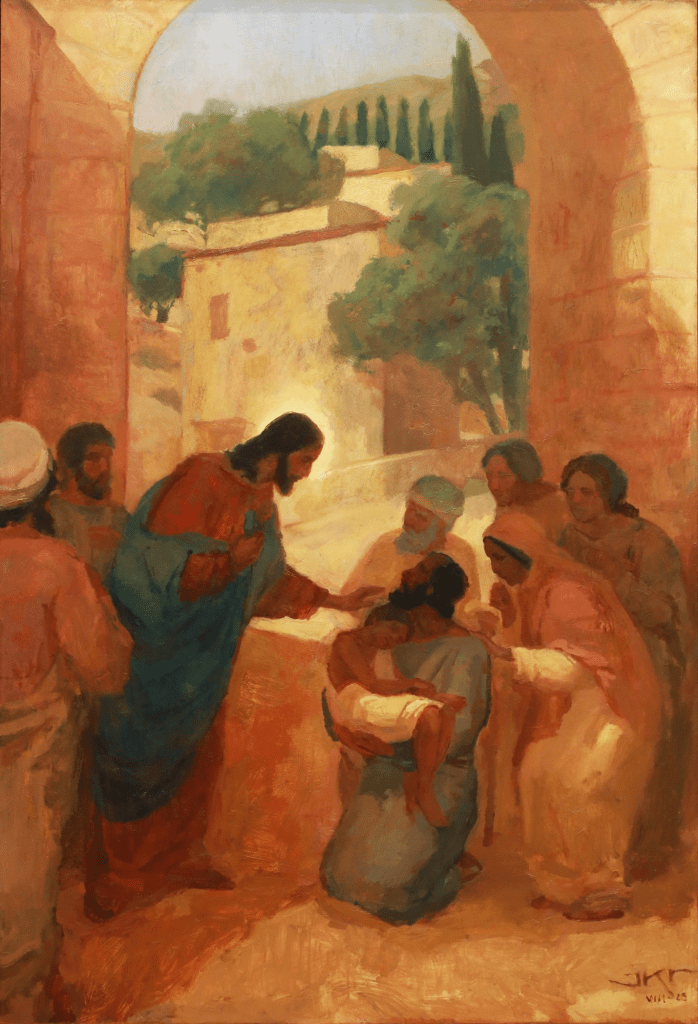
Help Thou My Unbelief, by J. Kirk Richards

When they came to the other disciples, they saw a large crowd around them and the teachers of the law arguing with them. As soon as all the people saw Jesus, they were overwhelmed with wonder and ran to greet him.

“What are you arguing with them about?” he asked.

A man in the crowd answered, “Teacher, I brought you my son, who is possessed by a spirit that has robbed him of speech. Whenever it seizes him, it throws him to the ground. He foams at the mouth, gnashes his teeth and becomes rigid. I asked your disciples to drive out the spirit, but they could not.”

“You unbelieving generation,” Jesus replied, “how long shall I stay with you? How long shall I put up with you? Bring the boy to me.”

So they brought him. When the spirit saw Jesus, it immediately threw the boy into a convulsion. He fell to the ground and rolled around, foaming at the mouth.

Jesus asked the boy’s father, “How long has he been like this?”

“From childhood,” he answered. “It has often thrown him into fire or water to kill him. But if you can do anything, take pity on us and help us.”

“‘If you can’?” said Jesus. “Everything is possible for one who believes.”

Immediately the boy’s father exclaimed, “I do believe; help me overcome my unbelief!”

When Jesus saw that a crowd was running to the scene, he rebuked the impure spirit. “You deaf and mute spirit,” he said, “I command you, come out of him and never enter him again.”

The spirit shrieked, convulsed him violently and came out. The boy looked so much like a corpse that many said, “He’s dead.” But Jesus took him by the hand and lifted him to his feet, and he stood up.

After Jesus had gone indoors, his disciples asked him privately, “Why couldn’t we drive it out?”

He replied, “This kind can come out only by prayer.” (New International Version)

Please, stick with me here, on what I see as the logic which undergirds this story:

God has authority over everything. God is powerful. Therefore, God can do the miraculous.

Humans have limited authority over some things. Humanity is sometimes strong, yet often weak. Therefore, humans must look outside themselves for a miracle.

God created people. Humans reflect the divine image and likeness of God. Therefore, God and humanity are inextricably linked.

God has miraculous power. Humans can have confidence (faith and hope) in God’s power. Therefore, miracles can happen when God’s power meets human confidence in that power.

God is personal. Humans are personal. Therefore, humans can know God.

God listens to human prayers. Humans have the ability to pray to God. Therefore, God’s power and human faith in that power are very much connected to each other.

Since God is authoritative, powerful, and personal, then God’s choice and ability to effect miracles is not an impersonal force which can be used and manipulated by humans, but rather is a gift to be prayed for and received with gratitude to God.

This then, is why Jesus seems exasperated with the experience of a botched exorcism, because:

  1. The father and the crowd have a profound lack of faith in God’s authority and power to personally effect the miraculous.
  2. The disciples have a disappointing lack of prayer in their own ministry.

The father of the son with the bad spirit was understandably desperate. And, on top it, disappointed with the disciples’ inability to do anything about the situation. The issue, however, is never about God’s ability – which is where the father went in talking to Jesus.

“If you are able” expresses little confidence in Christ.

Jesus emphatically replied that everything can be done for the one who believes. To which the father, still desperate, but then adding a healthy dose of honesty, confessed: “I believe; help my unbelief!”

That was all Jesus needed. The father’s humble and honest confession opened the soul’s door to receive the gift of faith. And the boy was rid of the bad spirit.

Furthermore, the father was also rid of his own bad spirit. The man was not demonized, like his son, nevertheless he possessed a spirit of ill confidence. The encounter with Jesus changed him, as well. It wasn’t just one person who walked away healed; both a father and a son were healed.

As often happened, the disciples left the scene with Jesus scratching their heads. They couldn’t figure out their own inability and failure to help the desperate father and his demonized son.

The bad spirit was indeed a stubborn one, and quite hard to deal with. Jesus told his disciples that one like this can only come out for those who nurture the spiritual habit of prayer.

Essentially, Jesus was saying that the vital connection between God and humans is dependent upon God. People don’t give orders to God, or act as the keepers and manipulators of divine power, like the ancient magicians did with their gods.

Rather, humans pray and ask for what they need, based upon the quality of their connection with God. This isn’t about the level of faith; it’s about whether there is any connection.

I can have lots of faith that my desk lamp will illuminate if I tell it to, but it won’t light unless I plug it in and turn it on. And if I do that, and the lamp will not turn on, then I know there is a problem with the connection – and not with my level of faith in making the lamp light up.

Everything in life must be maintained well, and taken care of. If it isn’t, it will eventually stop working, and may even fall into complete disrepair.

Faith and prayer are not simply tools which we wield with our own authority and autonomy. They must be developed and used with care for where they’ve come from.

Our prayers are opportunities for us to establish and maintain our vital connection with God via faith. Then, whenever we are in dire straits, the confidence is there, because of our connection with the Lord; nothing is hindering the power from flowing and lighting up the situation.

At its heart, Christianity is a relationship with God through Jesus Christ in the power of the Holy Spirit. And that relational connection has been brought about God, not me; and the means to maintain the relationship is from God, not me. Yet, we get to enjoy this beautiful access.

So, take advantage of it.

O Lord, our blessed Companion in life and death, your love is steadfast and never ends. Our wondering and weeping may linger in the night, but you give joy in the morning. Touch us with your healing grace so that, restored to wholeness, we may live our calling as your faithful resurrected people. Amen.