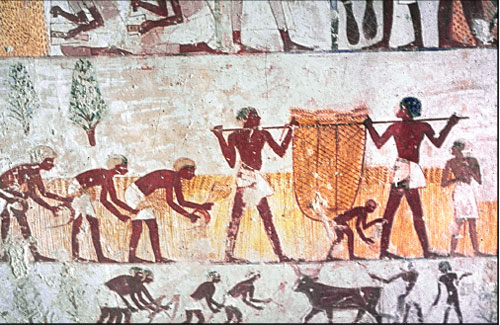
Egyptian workers harvesting grain. From the tomb of Mena in Thebes, c.1420 B.C.E.
Give thanks to the Lord and proclaim his greatness.
Let the whole world know what he has done.
Sing to him; yes, sing his praises.
Tell everyone about his wonderful deeds.
Exult in his holy name;
rejoice, you who worship the Lord.
Search for the Lord and for his strength;
continually seek him.
Remember the wonders he has performed,
his miracles, and the rulings he has given,
you children of his servant Abraham,
you descendants of Jacob, his chosen ones….
He called for a famine on the land of Canaan,
cutting off its food supply.
Then he sent someone to Egypt ahead of them—
Joseph, who was sold as a slave.
They bruised his feet with fetters
and placed his neck in an iron collar.
Until the time came to fulfill his dreams,
the Lord tested Joseph’s character.
Then Pharaoh sent for him and set him free;
the ruler of the nation opened his prison door.
Joseph was put in charge of all the king’s household;
he became ruler over all the king’s possessions.
He could instruct the king’s aides as he pleased
and teach the king’s advisers….
All this happened so they would follow his decrees
and obey his instructions.
Praise the Lord! (NLT)
Our spiritual and emotional vision can sometimes be myopic. It is precisely in those times when we have tunnel vision and neither look back to a past in which God acted with justice nor see ahead to a future with hope that we must remember God is supreme over everything, including time.
God’s providence and blessing is the animating force behind all events. The biblical character of Joseph is Exhibit A of God’s sovereign backstage orchestration of personal and world forces. Joseph’s story of brotherly betrayal, bondage, imprisonment, and rise to power include some lessons for us (Genesis 37-41):
Joseph is portrayed as a model of wisdom for us to follow.
Respect and obey the Lord! This is the beginning of knowledge. Only a fool rejects wisdom and good advice (Proverbs 1:7, CEV).
Do not letmercy and truth leave you. Fasten them around your neck. Write them on the tablet of your heart. Then you will find favor and much success in the sight of God and humanity (Proverbs 3:3-4, GW).
Joseph did not know the end of the story while he was in the middle of it, languishing in prison. Little did he know that God was testing his character, training him to listen well, and preparing him for his eventual leadership in Egypt – all to save many lives from hunger and starvation.
Now faith is the assurance of things hoped for, the conviction of things not seen. (Hebrews 11:1, NRSV)
Joseph successfully negotiated and navigated a world which was vastly different from his own religion and ethics. He was determined not to give in to the seductions of women and power around him; and, he did not become bitter against his brothers, nor against the Egyptians.
Don’t love the world’s ways. Don’t love the world’s goods. Love of the world squeezes out love for the Father. Practically everything that goes on in the world—wanting your own way, wanting everything for yourself, wanting to appear important—has nothing to do with the Father. It just isolates you from him. The world and all its wanting, wanting, wanting is on the way out—but whoever does what God wants is set for eternity. (1 John 2:15-17, MSG)
Four-hundred years later, Moses also had to navigate the situation of being an Israelite in the world of Egypt, and walked in the footsteps of his forebear, Joseph:
By faith Moses, when he had grown up, refused to be known as the son of Pharaoh’s daughter. He chose to be mistreated along with the people of God rather than to enjoy the pleasures of sin for a short time. He regarded disgrace for the sake of Christ as of greater value than the treasures of Egypt because he was looking ahead to his reward. (Hebrews 11:24-26, NIV)
We understand, knowing the end of the story, that Joseph was in Egypt (in the world) to be a blessing and that God had him there for a purpose. This is no less true for the people of God. We do not exist merely for ourselves but to be a blessing to the world. God, as he did for Joseph, shows us mercy while we are smack in the middle of hardship and not by taking us out of our worldly predicament. Life must sometimes be lived at great risk amid the world and not apart from it.
Seen from a strictly worldly perspective, Joseph’s time in slavery and prison was an unnecessary injustice. However, from God’s vantage point, Joseph was learning to be mindful of God despite his circumstances. For the Lord is much more concerned about the process we undergo in spiritual formation, rather than simply producing a product at the end of the line. Most of life is lived in the mundane, and Joseph was faithful in all the workaday decisions and demands of life. This made him able to handle all the vicissitudes of others in their fickle and feckless ways and see God’s providential working.
Lord God, you hold both heaven and earth in a single peace. Let the design of your great love shine on the waste of our anger and sorrow, and give peace to your Church, peace among nations, peace in our homes, and peace in our hearts through Jesus Christ our Lord who with you and the Holy Spirit benevolently reign as one God, now and forever. Amen.
Lord, hear my prayer for justice.
I am calling loudly to you.
I am being honest in what I say,
so please listen to my prayer.
You will make the right decision,
because you can see the truth.
You were with me all night
and looked deep into my heart.
You questioned me and found that
I did not say or do anything wrong.
Unlike most people, I have obeyed your commands,
so I have never been like those who are cruel and evil.
I have followed your way.
My feet never left your path.
Every time I call to you, God, you answer me.
So listen to me now, and hear what I say.
Show your amazing kindness
and rescue those who depend on you.
Use your great power
and protect them from their enemies.
I have done only what is right, so I will see your face….
And seeing you, I will be fully satisfied. (ERV)
This is one of David’s personal psalms of lament. It is a prayer forged during a time of severe adversity with enemies who sought to snuff-out his life. The psalm is a plea uttered with the hope that God would indeed vindicate him and subdue those who wanted to harm him. It is a lament that wickedness exists and often gets its way; and, it is grief over the constant threats that swirled around David.
It was David’s prayer that with all the heartless and arrogant violence continually in his life that God would keep him as the apple of his eye and hide him in the shadow of his wings. Indeed, perhaps no better prayer could be said in those times when there are people who make untrue accusations and only wish harm to be done to you, that God would be gracious, merciful, and kind through rescuing us from both bodily harm and spiritual abuse. It is in the times when angry simpletons spew their worst that we need to confidently know that God watches over his people with affection and cares for them as a mother hen protects her chicks.
You and I are precious to God. We can and ought to run to him when there is trouble and feel no shame in loudly crying for fairness and justice. The Lord is a benevolent God showing firm commitment to those who seek truth, loving actions, and merciful words. When going through a difficult time in which another or others accuse you of wrongdoing and you know you are innocent, the proper prescription is to pray this very psalm repeatedly at night before bed. For we all know that sleep can be elusive and hard to come by in such circumstances. Perhaps, along with David, you will be able to say: I have done what is right. I will see your face. I will be fully satisfied.
Arise, Lord God Almighty! Deliver my soul from the wicked and subdue them! I seek refuge in you, O Savior; show me your steadfast love as I cry out to you for justice. Incline your ear to hear me, and answer when I call through the name of Jesus Christ in the power of the Holy Spirit. Amen.
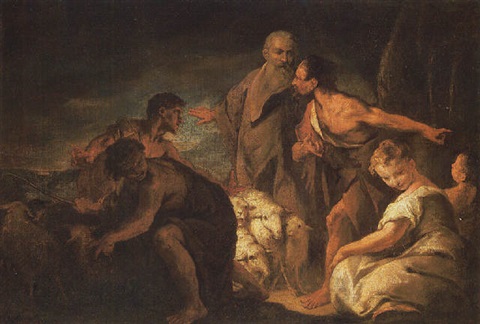
Jacob and Laban by Italian painter Nicola Grassi (1682-1748)
On the third day Laban was told that Jacob had fled. Taking his relatives with him, he pursued Jacob for seven days and caught up with him in the hill country of Gilead. Then God came to Laban the Aramean in a dream at night and said to him, “Be careful not to say anything to Jacob, either good or bad.”
Jacob had pitched his tent in the hill country of Gilead when Laban overtook him, and Laban and his relatives camped there too. Then Laban said to Jacob, “What have you done? You’ve deceived me, and you’ve carried off my daughters like captives in war. Why did you run off secretly and deceive me? Why didn’t you tell me, so I could send you away with joy and singing to the music of timbrel and harp? You didn’t even let me kiss my grandchildren and daughters goodbye. You have done a foolish thing.I have the power to harm you; but last night the God of your father said to me, ‘Be careful not to say anything to Jacob, either good or bad.’ Now you have gone off because you longed to return to your father’s household. But why did you steal my gods?”
Jacob answered Laban, “I was afraid, because I thought you would take your daughters away from me by force. But if you find anyone who has your gods, that person shall not live. In the presence of our relatives, see for yourself whether there is anything of yours here with me; and if so, take it.” Now Jacob did not know that Rachel had stolen the gods.
So, Laban went into Jacob’s tent and into Leah’s tent and into the tent of the two female servants, but he found nothing. After he came out of Leah’s tent, he entered Rachel’s tent. Now Rachel had taken the household gods and put them inside her camel’s saddle and was sitting on them. Laban searched through everything in the tent but found nothing.
Rachel said to her father, “Don’t be angry, my lord, that I cannot stand up in your presence; I’m having my period.” So, he searched but could not find the household gods.
Jacob was angry and took Laban to task. “What is my crime?” he asked Laban. “How have I wronged you that you hunt me down? Now that you have searched through all my goods, what have you found that belongs to your household? Put it here in front of your relatives and mine and let them judge between the two of us.
“I have been with you for twenty years now. Your sheep and goats have not miscarried, nor have I eaten rams from your flocks. I did not bring you animals torn by wild beasts; I bore the loss myself. And you demanded payment from me for whatever was stolen by day or night. This was my situation: The heat consumed me in the daytime and the cold at night, and sleep fled from my eyes. It was like this for the twenty years I was in your household. I worked for you fourteen years for your two daughters and six years for your flocks, and you changed my wages ten times. If the God of my father, the God of Abraham, and the Fear of Isaac, had not been with me, you would surely have sent me away empty-handed. But God has seen my hardship and the toil of my hands, and last night he rebuked you.” (NIV)
Jacob’s in-law issues did not magically disappear when he sneaked out of town with his entire family. I am glad God is faithful and acts on our behalf even when we are fearful with little faith. Far too often we do the right thing in the wrong way. It is far too easy to run away from people we don’t like. Yet, it is rarely so simple. Sometimes we plain need divine intervention to deal with people in our lives.
To Jacob’s credit, he obeyed God and headed back to the land of Canaan. However, he did it in a deceitful way which avoided confrontation. Out of fear of facing his father-in-law Laban and the worry of what might happen, Jacob got out of Dodge. It seems Jacob’s wife Rachel also acted out of fear by taking her father’s idols. Fear can cause us to have some skewed ideas and do some stupid things which get us in trouble.
“According to most studies, people’s number one fear is public speaking. Number two is death. Death is number two. Does that sound right? This means to the average person, if you go to a funeral, you’re better off in the casket than doing the eulogy.” –Jerry Seinfeld
Laban found out what was going on with Jacob and was anything but a happy camper. He went after the upstart Jacob with gusto and finally caught up to him. Despite having the power and ability to deal severely with Jacob, Laban backs off because Jacob finally found his voice and took his father-in-law to task. Embedded in Jacob’s rehearsal of their relationship is the God who intervened and took care of Jacob when Laban didn’t.
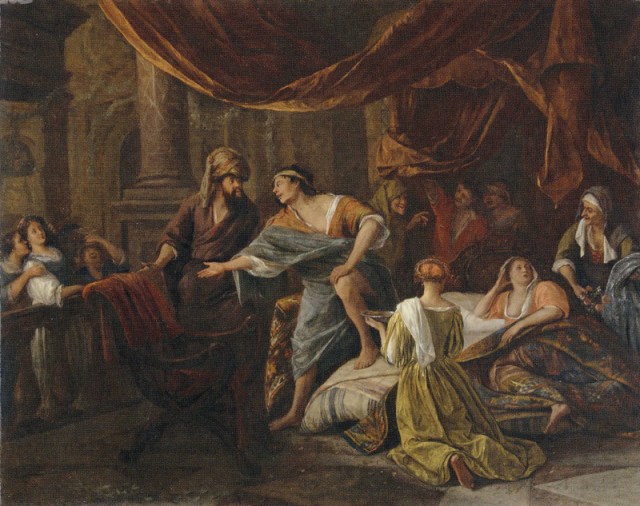
Jacob Confronts Laban by Dutch painter Jan Steen, 1669
The lengthy dialogue between Jacob and Laban was a power struggle: Laban wanted to keep the status quo authority as family head over Jacob’s family; but Jacob asserted himself as having his own distinct household. In the end, they ended-up on equal footing because of God’s intervention. Whereas Laban had his own intentions for Jacob and his family, God had other plans. It was God who enriched Jacob with a wealth of flocks and herds, even as he was being oppressed and intimidated by Laban.
The same God, who was with Jacob, is with you and me:
God is with us through difficulty, oppression, and injustice.
Now, it is commendable if, because of one’s understanding of God, someone should endure pain through suffering unjustly. But what praise comes from enduring patiently when you have sinned and are beaten for it? But if you endure steadfastly when you’ve done good and suffer for it, this is commendable before God. (1 Peter 2:19-20, CEB)
God does not give up on his people. We Christians are often living contradictions, like Jacob, who acknowledge God and give him glory but at the same time act out of fear and insecurity. Out of the compost of human sin, the sovereign God accomplishes his will.
Christ died for us when we were unable to help ourselves. We were living against God, but at just the right time Christ died for us… while we were still sinners, and by this God showed how much he loves us. (Romans 5:6, 8, ERV)
God cares both about what we do, and about why and how we do it. Ethics is the difference between morality and legality; and, between what I ought to do, and what is required of me. Jacob did what was demanded of him by God; yet, he did it out of fear along with unwise methods.
Anything that is not done in faith is sin. (Romans 14:23b, GW)
God’s intervention is needed. Without divine help, we are hopelessly lost. Furthermore, we continue to need God so we can deal with the unpredictable attempts of others to control us and push us into a mold outside of trusting in God.
Give all your worries to God because he cares about you. (1 Peter 5:7, NCV)
God instills confidence in us. After twenty hard years of service, Jacob returned to the land of Canaan prosperous and more confident in God than ever. Jacob’s trials with Laban gave him a growing sense of dependence on God. Jacob struggled, suffered, and endured – and came out the stronger for it.
You know that when your faith is tested, your endurance has a chance to grow. So, let it grow, for when your endurance is fully developed, you will be perfect and complete, needing nothing. (James 1:3-4, NRSV)
God loves us enough to not always give us an easy out because he is concerned for our walk of faith and our education in grace. So, may you discover the intervening God and exercise trust through those times when others give you a hard time.
God, grant me the serenity to accept the things I cannot change, the courage to change the things I can, and the wisdom to know the difference. Living one day at a time, enjoying one moment at a time; accepting hardship as a pathway to peace; taking, as Jesus did, this sinful world as it is, not as I would have it; trusting that You will make all things right if I surrender to Your will; so that I may be reasonably happy in this life and supremely happy with You forever in the next.Amen. –The Serenity Prayer by Reinhold Niebuhr, 1951






 Rev. Tim Ehrhardt