Exodus 5:10-23 – More Bricks, Less Straw “Why, God!?”

A brick making scene from an ancient the ancient Egyptian tomb of Rekhmire, c.1400 B.C.E.

So, the slave drivers and foremen went out and told the people: “This is what Pharaoh says: I will not provide any more straw for you. Go and get it yourselves. Find it wherever you can. But you must produce just as many bricks as before!” So, the people scattered throughout the land of Egypt in search of stubble to use as straw.

Meanwhile, the Egyptian slave drivers continued to push hard. “Meet your daily quota of bricks, just as you did when we provided you with straw!” they demanded. Then they whipped the Israelite foremen they had put in charge of the work crews. “Why haven’t you met your quotas either yesterday or today?” they demanded.

So the Israelite foremen went to Pharaoh and pleaded with him. “Please don’t treat your servants like this,” they begged. “We are given no straw, but the slave drivers still demand, ‘Make bricks!’ We are being beaten, but it isn’t our fault! Your own people are to blame!”

But Pharaoh shouted, “You’re just lazy! Lazy! That’s why you’re saying, ‘Let us go and offer sacrifices to the Lord.’ Now get back to work! No straw will be given to you, but you must still produce the full quota of bricks.”

The Israelite foremen could see that they were in serious trouble when they were told, “You must not reduce the number of bricks you make each day.” As they left Pharaoh’s court, they confronted Moses and Aaron, who were waiting outside for them. The foremen said to them, “May the Lord judge and punish you for making us stink before Pharaoh and his officials. You have put a sword into their hands, an excuse to kill us!”

Then Moses went back to the Lord and protested, “Why have you brought all this trouble on your own people, Lord? Why did you send me? Ever since I came to Pharaoh as your spokesman, he has been even more brutal to your people. And you have done nothing to rescue them!” (New Living Translation)

It was God – Yahweh, the great I AM – who called to Moses from the burning bush. It was God who told Moses to go to Egypt because of the groaning of the Israelites in their slavery. It was also God who promised Moses that Divine help would deliver the people from their awful bondage. 

But the promised vision of release and rescue from captivity ran into the harsh buzz-saw of reality. 

Moses did exactly what God told him to do. He was completely attentive and obedient to God’s revealed will. And the result? Pharaoh forced the Israelite slaves to make bricks without being supplied with the straw to do it. Now, the people’s situation is even worse than it was before Moses showed up on the scene. What’s up with that!?

Since we know the end to the story, we understand where all of this is going. However, when we put ourselves in the sandals of Moses, it’s anything but clear about what was happening.

“Confusion is a sign of intelligence; only fools are crystal clear.”

Haresh Sippy

None of us gets off this planet without facing some hard things. We may even face those difficulties when we’re just trying to do the right thing. We’re simply trying to help, do our best, obey God, and then we get in trouble. In those situations, we can empathize with Moses getting testy with God and expressing his complaint.

The God of the universe is big enough to handle our protests in the midst of trouble – even when those complaints are directly pointed toward him. God gets it.

There is an appropriate place for us to freely express our abject disbelief, our painful wonderings, and our outright anger toward God. We won’t get a lightning bolt from heaven if we ask and cry out, “Why, God? What the **** are you doing!?”

There have been many times in my life when I questioned whether I was really sent by God to be in a certain place or to do a certain thing. I seriously wondered whether I really heard God, or not. Maybe it was my own voice in my head. Perhaps it was an emotional decision. 

The incongruence between what we believe and how things are actually turning out can be maddening.

But there is something we must all realize: Just because things go from bad to worse does not necessarily mean God isn’t in the thing. 

We are not always, even usually, privy to the mind of God in the big picture of what the Lord is doing. 

In the middle of trouble, we might think God is not at work, not paying attention, or slow to act. Yet, God knows exactly what’s going on and what the plan is. Sometimes, we need to discern and know that things will get worse before they will get better – and that God has not abandoned us.

Wise God, I trust you that you know what you are doing, even though I don’t see what in the world is going on. Help me to see all things from your perspective so that I might have the wisdom to move forward in faith and patience. I’m out on a limb for you! Please don’t let it break! Amen.

Psalm 56 – In God We Trust

Have pity, God Most High!
    My enemies chase me all day.
Many of them are pursuing
    and attacking me,
    but even when I am afraid,
    I keep on trusting you.
I praise your promises!
I trust you and am not afraid.
    No one can harm me.

Enemies spend the whole day
    finding fault with me;
    all they think about
    is how to do me harm.
They attack from ambush,
    watching my every step
    and hoping to kill me.
They won’t get away
    with these crimes, God,
    because when you get angry,
    you destroy people.

You have kept record
    of my days of wandering.
You have stored my tears
in your bottle
    and counted each of them.

When I pray, Lord God,
    my enemies will retreat,
    because I know for certain
    that you are with me.
I praise your promises!
I trust you and am not afraid.
    No one can harm me.

I will keep my promises
to you, my God,
    and bring you gifts.
You protected me from death
    and kept me from stumbling,
so that I would please you
    and follow the light
    that leads to life. (Contemporary English Version)

We all have enemies and opposition of both body and soul. It’s just part of the human condition on this fallen planet to experience forces oppressing us.

David’s enemies were real flesh and blood people. The Philistines and the Israelites were always at odds with each other. Wars and battles continually broke out amongst them. Dealing with enemies was, and always has been, a constant reality of the Jewish people.

As for us Gentiles, we may or may not have a person seeking to take our life. Yet, no matter who we are, we all deal with our own visible and invisible enemies which wage war against our souls.

The psalmist expresses a way of coping with the intense stress of opposition: Trust in God.

Yes, the bedrock issue whenever we face our demons within and without is trust. In whom or what will we put our trust?

If we have a philosophy of watching out for number one, then we merely look to ourselves and our own independence. Yet, since humanity is hard-wired for community, radical autonomy hits its limit rather quickly. Thus, we are left vulnerable to our enemies with no means of security.

If we put our trust in education, then we will focus efforts on mental solutions, coming up with ideas to deal with our enemies. However, since our very personhood is much more than a brain, this too shall eventually meet its limits with our stressful situation.

If we possess a strong Protestant work ethic, we may put all our energy into working harder, better, and faster to overcome our enemies. But subscribing to a philosophy of outworking everyone fails when our bodies break trying to keep ahead of the stress.

We must account for the transcendent, for that which is over and above all. We must trust in the Lord.

Trust in the Lord with all your heart;
    don’t rely on your own intelligence.
Know him in all your paths,
    and he will keep your ways straight.

Proverbs 3:5-6, CEB

To trust means to live consistent with the reality that we are in the Lord’s hands. Our ultimate protection is divine, not human. Not realizing we are in the grip of the Almighty only causes fear, anxiety, and the frenetic search to get out from under our enemy’s oppression.

When all is said and done, our hard circumstances point us to the hard realization that we are not in control of the universe – and not even the people standing right in front of us. Attempting to control others is called manipulation. And, I might add, is something that never ends well. We are only in control of ourselves, and even then, if our primary enemy is within, we can rarely even manage our own lives.

Deciding about whom or what we will trust is the existential basis of living. Hardship, stress, and fear in the teeth of enemy opposition calls for trust. Without faith, we will be swallowed alive.

Faith and trust is not only personal; it’s communal. The entire community of believers are to affirm together that God is with us, and that in Jesus Christ, there is no fear; there is security.

If God is for us, no one can stand against us. And God is with us. He even let his own Son suffer for us. God gave his Son for all of us. So now with Jesus, God will surely give us all things. Who can accuse the people God has chosen? No one! God is the one who makes them right. Who can say that God’s people are guilty? No one! Christ Jesus died for us, but that is not all. He was also raised from death. And now he is at God’s right side, speaking to him for us. Can anything separate us from Christ’s love? Can trouble or problems or persecution separate us from his love? If we have no food or clothes or face danger or even death, will that separate us from his love? As the Scriptures say,

“For you we are in danger of death all the time.
    People think we are worth no more than sheep to be killed.”

But in all these troubles we have complete victory through God, who has shown his love for us. Yes, I am sure that nothing can separate us from God’s love—not death, life, angels, or ruling spirits. I am sure that nothing now, nothing in the future, no powers, nothing above us or nothing below us—nothing in the whole created world—will ever be able to separate us from the love God has shown us in Christ Jesus our Lord. (Romans 8:31-39, ERV)

There is a way through the thicket of hate from others. It is to trust in the Lord with all our heart, to have the unshakable faith that the Lord is with us, to know we are ultimately in God’s gracious hands.

O God, the Creator of all, whose Son commanded us to love our enemies: Lead them and us from prejudice to truth; deliver them and us from hatred, cruelty, and revenge; and in your good time enable us all to stand reconciled before you in Jesus Christ; in whose Name we pray. Amen.

Psalm 28 – Prayer, Praise, and Possibility

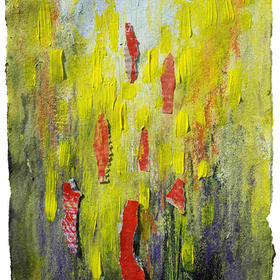
Psalm 28 by Dutch artist Wim van de Wege

I pray to you, O Lord, my rock.
    Do not turn a deaf ear to me.
For if you are silent,
    I might as well give up and die.
Listen to my prayer for mercy
    as I cry out to you for help,
    as I lift my hands toward your holy sanctuary.

Do not drag me away with the wicked—
    with those who do evil—
those who speak friendly words to their neighbors
    while planning evil in their hearts.
Give them the punishment they so richly deserve!
    Measure it out in proportion to their wickedness.
Pay them back for all their evil deeds!
    Give them a taste of what they have done to others.
They care nothing for what the Lord has done
    or for what his hands have made.
So he will tear them down,
    and they will never be rebuilt!

Praise the Lord!
    For he has heard my cry for mercy.
The Lord is my strength and shield.
    I trust him with all my heart.
He helps me, and my heart is filled with joy.
    I burst out in songs of thanksgiving.

The Lord gives his people strength.
    He is a safe fortress for his anointed king.
Save your people!
    Bless Israel, your special possession.
Lead them like a shepherd,
    and carry them in your arms forever. (New Living Translation)

The biblical character David, in frustration and agony, cried out for help, for God to hear his prayers. And, when his prayer was heard, David gave exuberant praise to the Lord for listening to him.

We are not told specifically of how that prayer was answered and what happened between the request and the response. It seems the juicy details are left out on purpose, so that maybe we would not get lost in the retribution but stick with the fact that there was a desperate need and the Lord stepped in and did something about it.

As I pondered this psalm and its lack of life-detail, I wondered about David’s situation:

Could it be that David gave God praise just for being heard by him? 

Was David cured in some way, or was he healed from the need to be healed? 

Was there even any actual deliverance that occurred? 

Did David come to praise God despite a lack of deliverance? 

Was David’s joy in his relationship with God conditional, or unconditional?

William Shakespeare’s Hamlet (c.1601 C.E.) put the question this way: “To be, or not to be, that is the question.” Hamlet’s soliloquy went on to say:

“Whether ’tis nobler in the mind to suffer
The slings and arrows of outrageous fortune,
Or to take arms against a sea of troubles,
And by opposing end them? To die: to sleep;
No more; and by a sleep to say we end
The heartache and the thousand natural shocks
That flesh is heir to, ’tis a consummation
Devoutly to be wish’d. To die, to sleep;
To sleep: perchance, to dream: ay, there’s the rub;
For in that sleep of death what dreams may come
When we have shuffled off this mortal coil,
Must give us pause: there’s the respect
That makes calamity of so long life;
For who would bear the whips and scorns of time,
The oppressor’s wrong, the proud man’s contumely,
The pangs of despised love, the law’s delay,
The insolence of office and the spurns
That patient merit of the unworthy takes,
When he himself might his quietus make
With a bare bodkin (knitting needle)?”

Hamlet, much like David of old, was miserable and burdened with a profound lack of power to change his circumstances. So, he reflects on life and death in a morbid and melancholy way. It’s not that Hamlet was contemplating suicide as much as he meditated on what life truly is and finding some meaning within it. Unlike David, Hamlet cannot find the courage to deal with his frustration and feels stymied with fear of the unknown.

If we are blatantly honest with ourselves, we must admit that far too often we have a particular outcome in mind that we want or expect God to do.  Our hopes become tethered to God doing something extremely specific so that, if it does not come to pass (or does not come quickly!) we become discouraged and disillusioned. Like Hamlet, we become lost in the shadows of our thinking and ponder some sort of escape.

So, here is another set of questions I am asking myself: 

If my adverse circumstances do not change, can I praise God anyway? 

Can I, like David, take joy in simply being heard? 

Can I find gratitude in all situations? 

Do I only express thanks and praise to God when things are going my way? 

Am I open to whatever God wants to do in my life, even if it is not what I would choose? 

Do I feel that I am above having to put up with the wickedness of this world? 

Am I expecting heaven on earth, or am I willing to suffer as Jesus did? 

I honestly believe the answers to those questions will determine the trajectory of our Christian experience. For the identity and meaning of all persons is found in the divine.

I praise you, O God, in the good and the bad, the easy and the difficult, the failures and the victories.  You are Lord over all things.  You are my strength and shield in every circumstance.  When I am weak, I am strong. I can do all things through Christ who strengthens me. Amen.

Job 39:1-30 – Questions without Answers

God responds to Job out of the whirlwind by William Blake (1757-1827)

When do mountain goats
    and deer give birth?
Have you been there
    when their young are born?
How long are they pregnant
    before they deliver?
Soon their young grow strong
and then leave
    to be on their own.

Who set wild donkeys free?
I alone help them survive
    in salty desert sand.
They stay far from crowded cities
    and refuse to be tamed.
Instead, they roam the hills,
    searching for pastureland.

Would a wild ox agree
to live in your barn
    and labor for you?
Could you force him to plow
or to drag a heavy log
    to smooth out the soil?
Can you depend on him
to use his great strength
    and do your heavy work?
Can you trust him
    to harvest your grain
or take it to your barn
    from the threshing place?

An ostrich proudly
    flaps her wings,
but not because
    she loves her young.
She abandons her eggs
and lets the dusty ground
    keep them warm.
And she doesn’t seem to worry
that the feet of an animal
    could crush them all.
She treats her eggs as though
    they were not her own,
unconcerned that her work
    might be for nothing.
I myself made her foolish
    and without common sense.
But once she starts running,
she laughs at a rider
    on the fastest horse.

Did you give horses their strength
and the flowing hair
    along their necks?
Did you make them able
    to jump like grasshoppers
or to frighten people
    with their snorting?

Before horses are ridden
    into battle,
they paw at the ground,
    proud of their strength.
Laughing at fear, they rush
    toward the fighting,
while the weapons of their riders
    rattle and flash in the sun.
Unable to stand still,
they gallop eagerly into battle
    when trumpets blast.
Stirred by the distant smells
and sounds of war,
they snort
    in reply to the trumpet.

Did you teach hawks to fly south
    for the winter?
Did you train eagles to build
    their nests on rocky cliffs,
where they can look down
    to spot their next meal?
Then their young gather to feast
    wherever the victim lies. (Contemporary English Version)

God has a way of asking questions for which he already has answers to.

The older I get, and the more understanding I gain, the more I realize how little knowledge I truly possess. When I was eighteen years old, I thought I had the world pretty much figured out. Since then, it has all been downhill. With each passing year, my ignorance seems to grow exponentially.

I suppose this all really makes some sense when talking about God’s upside-down kingdom. So much more of life is a mystery to us than we realize. Turns out that those with understanding need to become stupid before they can truly be wise. Seems like the biblical character of Job found this out the hard way.

If there is any person in Holy Scripture that would be wise and understanding, its him. God speaks highly of Job in the Bible. Regarding the upcoming destruction of Jerusalem, God said, “even if these three men—Noah, Daniel and Job—were in it, they could save only themselves by their righteousness, declares the Sovereign Lord” (Ezekiel 14:14). Job is held up the model of patience under suffering: “As you know, we count as blessed those who have persevered. You have heard of Job’s perseverance and have seen what the Lord finally brought about. The Lord is full of compassion and mercy” (James 5:11).

Yet, with all of Job’s integrity, patience, and righteousness his understanding can barely get a movement on the Richter Scale of God’s expansive knowledge. Being a conscientious follower of God, Job is careful to live uprightly. He acknowledges God in all things and worships him alone. Yet, suffering befell him – for no other reason than that God allowed it. Job knew fully well that there was no personal sin behind his awful ordeal of grief and grinding pain.

So, Job contended with God. For an agonizing thirty-five chapters (Job 3:1-37:24) Job questions God and respectfully takes him to task – as Job’s supposed friends questioned him and assume his guilt. Through it all God is there… silent, saying nothing….

Then, just when we think God is paying no attention, he suddenly speaks. And what is so remarkable about God’s speech is that for four chapters God gives no answers (Job 38:1-41:34). It is all questions. God said, “Brace yourself like a man; I will question you and you shall answer me” (Job 38:3).

It becomes abundantly clear after just a few questions that it would be impossible for any human being to even come close to having the understanding to answer anything God asks. And that was the whole point. God is God, and we are not. Our questions, however legitimate, real, and raw they are, come from a very puny perspective.

We just don’t know as much as we think we do.

To Job’s great credit, he keeps his mouth shut and listens. At the end of the questioning, Job responds in the only wise way one could after such an encounter: “Surely I spoke of things I did not understand, things too wonderful for me to know” (Job 42:3).

None of this means that, for us, we need to face our hardships and our sufferings with a stoic keep-a-stiff-upper-lip approach. Trapped grief will inevitably come out sideways and only cause more hurt.

I believe God allowed Job to express his terrible physical, emotional, and spiritual pain for chapter after chapter because he needed to. Only when God sensed it was the proper timing did he jump in and bring the perspective Job then needed. And even after being challenged by God about his vantage point, Job still did not receive answers as to why he had to endure the awfulness of loss beyond what most of us could comprehend.

It just might be that, even if God directly answered all our questions, we still would not understand what the heck is happening to us.

Most likely, God protects us from knowing things that might bring irreparable damage to our human psyches. Yet, this is all pure conjecture. Which leaves us with perhaps one of our greatest challenges as human beings: We must eventually come to the place of being comfortable with mystery – and even embracing it. We simply will not have all things revealed to us that we want to know. And that’s okay.

Anytime we try to pin God down to nice, neat, understandable categories, he typically colors outside our human contrived lines and demonstrates he cannot be contained in our ramshackle box.

God is unbound by any human knowledge, understanding, ideas, or plans. God will do what God will do. God will be who God will be. “I Am who I Am,” he once said. Now that’s a God I can put my trust in.

O Lamb of God that takes away the sins of the world, have mercy upon me.

O Lamb of God that takes away the sins of the world, have mercy upon me.

O Lamb of God that takes away the sins of the world, grant me your peace. Amen.