Acts 7:44-53 – Pickle Barrel Christians

“The Holy Tent where God spoke to our ancestors was with them in the desert. God told Moses how to make this Tent, and he made it like the plan God showed him. Later, Joshua led our ancestors to capture the lands of the other nations. Our people went in, and God forced the other people out. When our people went into this new land, they took with them this same Tent they had received from their ancestors. They kept it until the time of David, who pleased God and asked God to let him build a house for him, the God of Jacob. But Solomon was the one who built the Temple.

“But the Most High does not live in houses that people build with their hands. As the prophet says:

‘Heaven is my throne,
    and the earth is my footstool.
So do you think you can build a house for me? says the Lord.
    Do I need a place to rest?
Remember, my hand made all these things!’”

Stephen continued speaking: “You stubborn people! You have not given your hearts to God, nor will you listen to him! You are always against what the Holy Spirit is trying to tell you, just as your ancestors were. Your ancestors tried to hurt every prophet who ever lived. Those prophets said long ago that the One who is good would come, but your ancestors killed them. And now you have turned against and killed the One who is good. You received the law of Moses, which God gave you through his angels, but you haven’t obeyed it.” (New Century Version)

Every year it’s a guarantee that some folks will complain about the weather. In the summer it’s too hot; in the winter, too cold. Can’t wait for autumn to come, then when it’s here, the murmuring comes out about how the weekend weather won’t cooperate with personal plans.

No matter the season, no matter the weather, somebody will be grumbling about it.

A big reason why I personally hold to the Christian Calendar with its liturgical seasons is that it helps shape me spiritually so that I can avoid being a stubborn complaining fool.

It seems like some folks have been baptized in pickle juice and inhabit a church resembling a pickle barrel. They have something negative to say about everything. And even when they acknowledge they don’t really understand something, they’ll still give a stone-faced retort, “I’m against it.”

They’re, ironically, surprised when they find themselves in a pickle.

The liturgical calendar, when properly observed, keeps us grounded in faith, hope, and love. There are plenty of things in this old fallen world which can take our eyes off our calling as Christians. Pandemics, politics, poverty, and pain can mess with us.

If we aren’t on solid spiritual ground, all the misfortunes of this life can take a significant toll on us. And for all the tangible things we see which creates angst within us, we miss the invisible God because our spiritual eyes are blind from all that vinegar in the pickle barrel.

Like the ancient Israelites for whom Stephen railed against in our New Testament lesson for today, we might become stubborn, hard-headed, and inflexible. We get lost in doing things our own way, and wanting our way, to the neglect of what God wants. 

Whenever that happens, there is damage to God’s people, God’s name, and God’s law. Rather than tongues being used for praising the Lord and encouraging others, God’s prophets who are calling us to holiness are verbally decapitated.

Anytime someone believes they have piously figured out everything, they will soon find themselves fighting against God.

The Lord of All has not called us to figure out every mystery and nail down each uncertainty. Those who claim to have done it are living in a pickle barrel. Perhaps they will eventually discover how large and immense God really is – much bigger than our puny thoughts and misguided practices. 

How then shall we live?

Let go of our illusions of power and privilege.

Submit afresh to the Lord for whom we must bow in all things. 

Open our spiritual eyes so that we can see the God who made the universe.

Take up our holy calling as Christ’s ambassadors, instead of expecting Jesus to be the ambassador for us.

If we can do that, then we are well on our way to seeing the grand and immense God of all.

So be humble under God’s powerful hand. Then he will lift you up when the right time comes.

1 Peter 5:6, ERV

The following practices can help us become more spiritually flexible and open to the Spirit’s work:

  • Stretch your faith muscle. Physical muscles which get little to no use will atrophy – which is why people who are confined to bed or with limitations need physical therapists to help work the muscles. Spiritually, if we are rarely or never in positions which work our faith muscle, then that faith will diminish and eventually atrophy. Faith is not static, but dynamic. It needs to be worked.
  • Breathe deeply. Proper breathing is essential in using our bodies. The same is true spiritually. Fear, worry, and anxiety cause us to have shallow breathing and unable to think straight. When we are amped-up about something, focus on doing some breath prayers, i.e., breathing in saying, “More of you,” and breathing out saying, “Less of me.”
  • Avoid extreme positions. A hyper-extended muscle will tear and cause a lot of damage. An acceptance of limitations and an awareness of our body’s true capacity prevents us from trying to do something our body simply cannot do. Our faith will not support extreme positions which alienate people and put God to the test.
  • Move more. Getting in bodily shape does not have to be dramatic and involve triathlons. Most of us simply need to get out of our chairs and move a bit more and we would be a lot healthier. Faith is mostly lived in the mundane daily decisions of life. Consistently taking small steps of faith each day will go a long way toward our spiritual health and vitality – not to mention helping us see a big God at work.
  • Listen. It is always best to listen to your body— only push it as far as it can handle, even if it is little by little. Many people would be better served if they would just listen to their gut and the spirit God put within them – rather than pushing themselves and others beyond what they can handle. Behind the attempt at doing too much is typically an issue of wanting the kind of control God possesses.

To do the will of God, we must have a growing awareness of a big unlimited God who cannot be contained in a tent or a building; and a small, limited self who is dependent upon God.

This will take relaxing the puckered pickle face and opening to greater flexibility. If you are not in the habit of following the Christian Calendar through the year, now is a good time to start. After all, nobody wants to smell like they just crawled out of a pickle barrel.

Holy God, heaven is your throne and the earth your footstool. You cannot be kept within any one church or any single place.  You are much too big for that!  Forgive me for my small thoughts of you and my weak faith. I humble myself before you so that you can live in and through me for the sake of Jesus. Amen.

Luke 10:13-16 – Confronting Hard Hearts

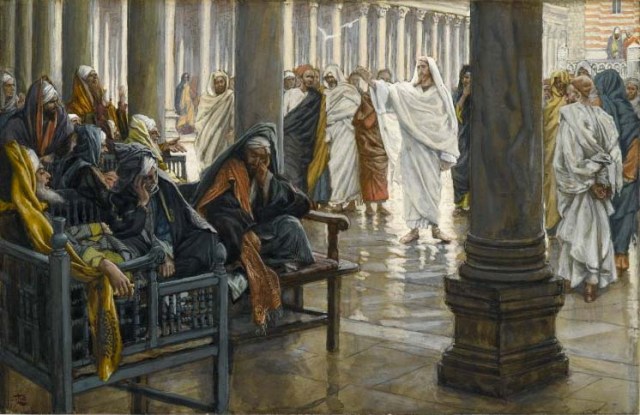
“Woe unto You” by French painter James Tissot (1836-1902)

“Woe to you, Chorazin! Woe to you, Bethsaida! For if the miracles that were performed in you had been performed in Tyre and Sidon, they would have repented long ago, sitting in sackcloth and ashes. But it will be more bearable for Tyre and Sidon at the judgment than for you. And you, Capernaum, will you be lifted to the heavens? No, you will go down to Hades.

“Whoever listens to you listens to me; whoever rejects you rejects me; but whoever rejects me rejects him who sent me.” (New International Version)

Hardness of heart is the greatest malady and the most serious condition which could ever afflict a spiritual person.

A soft heart needs only gentle words and humble responses in order to continue learning and growing in life. Not so with the hard heart. It needs a mighty chisel from God to scrape the encrusted barnacles off the heart so that it might receive goodness.

This is why today’s Gospel lesson recounts some rather harsh words from Jesus. Christ had some hard things to say in order to get at the hardness of heart he was experiencing from the people. His scathing words were specifically leveled at the towns in which he had performed miraculous healings. Their inability to accept what was happening in front of their very faces testified to how hard their hearts truly were.

The miracles of Jesus, in addition to being gracious restorations of individual lives, were also meant to demonstrate that the kingdom of God has broken into history in the person of Jesus Christ. The crowd refused to acknowledge this reality. So, Jesus began leveling a rebuke to the towns who observed his ministry firsthand, and yet did nothing in response to those good works.

A hard heart observing Christ’s ministry will likely be unresponsive to Jesus. A soft heart will likely reply with humility by forsaking everything to follow him. For Jesus, the height of hubris was to simply ignore his righteous works of merciful teaching and benevolent healing.

Christ’s denunciation of the particular towns came not because he was experiencing opposition or persecution; rather, he was denouncing them for their bonehead lack of response and refusal to change their lives to conform to what they were seeing and experiencing from God.

The crowd heard Christ’s teaching and saw his miracles, and it had no effect on them. So, Jesus gave them a big “C’mon, man!”

Judgment becomes the lot of someone who is unaffected and unresponsive to the vast sea of human need around them, viewing Jesus as just another voice, and living a life of mediocrity in the face of opportunity.

The Holy Spirit has been provided, who is the power source of the Christian life. We possess all the resources of grace necessary to step into this world and make a difference, yet so many do nothing but occupy a place in the pew [or couch] because they are too afraid to sacrifice their time in meaningful ministry.

There are neighbors, relatives, and co-workers who are lost and lonely, in need of the kind of grace Jesus gives, yet too many of us are oblivious to them and instead are constantly worried about things that, in the end, don’t really matter at all.

We have opportunities to grow in the grace and knowledge of Jesus Christ through a vast array of available ministries, yet many do not take the chance to change and be spiritually stretched. For these situations and more, the words of Jesus are there in front of our faces, and yet some, out of hardness of heart, will have the audacity to read them and remain unchanged, unchallenged, and unresponsive.

If our highest values in life are sameness, stability, and security, we may very well, at the least, miss Jesus altogether, and, at worst, find ourselves under his condemnation. These verses are for those whom Jesus has become all too familiar, as if he is just another piece of furniture in the living room – the coffee table with a dusty Bible resting on it.

There are times when nice gets us nowhere and we must have hard conversations because of hard hearts.

Yes, conversations, and not verbal rockets launched from one group to another. Jesus did not denounce from a distance; he did it up close and personal. Furthermore, he was specific and not generic about why he was speaking in the way he did.

So, may you be able to pray this prayer of repentance today with heartfelt conviction:

Almighty God, Father of our Lord Jesus Christ, Sovereign Lord of the universe, Creator of humanity, we, your unfaithful children, are sorry for our sins and the lives that we have lived apart from your grace. We sincerely believe and confess in our hearts that only through the precious blood of our Lord Jesus Christ on the cross, can we obtain your forgiveness.

We repent that: in thought, word, and deed, we have committed serious offences against you and our neighbors. Through spiritual laziness and prideful lust for power, we have provoked hatred, division, despair, and hurt within our communities.

Through our greed, deceit, and indifference, we have inflicted serious damage, unnecessary conflict, and aggravated destruction to those different than us.

Through our selfishness, insensitivity, and bias (both conscious and unconscious) we have encouraged and emboldened those who inflict hurt, pain, and sorrow on those who are already oppressed and poor.

In the name of religion, doctrine, and even of Christ himself, we have wounded fellow believers and those who genuinely pursue a faith different than ours.

In stubbornness, pride, and arrogance, we have caused division and strife within your church and among your people.

Mercifully send your Holy Spirit, the Spirit of order and comfort, to cleanse us from all unrighteousness; to restore in us true faith in Christ which brings truth, peace and harmony; and, to help us walk together
with our brothers and sisters in the peace of our Lord Jesus Christ, to the glory of your name. Amen.

Amos 6:1-8 – Against Complacency

Woe to you who think you live on easy street in Zion,
    who think Mount Samaria is the good life.
You assume you’re at the top of the heap,
    voted the number-one best place to live.
Well, wake up and look around. Get off your pedestal.
    Take a look at Calneh.
Go and visit Great Hamath.
    Look in on Gath of the Philistines.
Doesn’t that take you off your high horse?
    Compared to them, you’re not much, are you?

Woe to you who are rushing headlong to disaster!
    Catastrophe is just around the corner!
Woe to those who live in luxury
    and expect everyone else to serve them!
Woe to those who live only for today,
    indifferent to the fate of others!
Woe to the playboys, the playgirls,
    who think life is a party held just for them!
Woe to those addicted to feeling good—life without pain!
    those obsessed with looking good—life without wrinkles!
They could not care less
    about their country going to ruin.

But here’s what’s really coming:
    a forced march into exile.
They’ll leave the country whining,
    a rag-tag bunch of good-for-nothings.

God, the Master, has sworn, and solemnly stands by his Word.
    The God-of-the-Angel-Armies speaks:

“I hate the arrogance of Jacob.
    I have nothing but contempt for his forts.
I’m about to hand over the city
    and everyone in it.” (The Message)

A fool is one who either cannot or will not see that their personal actions have communal ramifications. Arrogant people are shortsighted, and when there is no immediate consequence to their selfish actions, they quickly assume everything is okay.

Perhaps we are fools – not so much because of any heinous sins – but because of our great indifference toward the mass of humanity across the world, as well as the neighbor across the street.

If there is any foolishness with the Christian, I submit to you that it could likely be because we believers have abjectly avoided the Old Testament minor prophets as some anachronistic judgment of the past which has little to do with living in today’s New Testament grace.

It is high time that Christians, especially Western Christians, take the entirety of their Bibles seriously through a hard examination of the prophet Amos.

“Morally, there is no limit to the concern one must feel for the suffering of human beings. Indifference to evil is worse than evil itself; in a free society, some are guilty, but all are responsible.”

Abraham Joshua Heschel

Those with power and privilege nearly always believe that what is good for themselves is good for everybody else. In their pride, they either cannot or will not look under the ghost of Christmas Present’s robe. The boy Ignorance, and the girl Want, are out-of-sight, out-of-mind, for the foolish person of indifference.

The issue is not one of actually possessing wealth and influence. After all, the Lord God is wealthy and influential beyond anything we can imagine. The real issue is how we have obtained such things and whether we seek to use them for the common good of all people, and not just for myself or people just like me.

It will not do to be a simpleton and toss out flippant phrases such as, “If they want money they can get a job,” “They’re just lazy and unmotivated,” “The government takes plenty from me for those people,” “They could be self-sufficient if they really wanted to,” “They should be happy that I give them a [minimum wage] job,” “The poor are uneducated…addicts…drug seekers…unreliable…” And on the blustering goes, ad infinitum, ad nauseum.

Those, and many more statements like them, are nothing more than mere projections of the privileged few upon the masses. Truth is that addiction, debt, ingratitude, and laziness are marks of the rich and powerful in the same way you can find them anywhere. What’s more, projecting and deflecting are endemic of the mind that either cannot or will not engage in critical thinking and avoid logical fallacies.

Such persons are unaware that their luxurious eating and drinking in the dining room of the Titanic will suddenly be their last meal. Their complacency is their ruin.

Many of us tend to see the sins of others rather than our own sins. So, reading Amos, we may reflexively think of “those people’s sins, back then,” or, the sins of “other people.” Yet, as Jesus suggests in the Sermon on the Mount, when we interpret the law, we should first examine the logs in our own eyes, rather than starting with the slivers in our neighbor’s eye. (Matthew 7:3-5)

The place to begin with giving Amos an honest hearing, is to look inwardly at our own shadow selves. The lack of self-awareness is the beginning of all callousness, complacency, and conceit.

“Unfortunately, there can be no doubt that man is, on the whole, less good than he imagines himself or wants to be. Everyone carries a shadow, and the less it is embodied in the individual’s conscious life, the blacker and denser it is. If an inferiority is conscious, one always has a chance to correct it.”

Carl Jung

There are two practices which can help illumine our inner person, thus opening the way to greater compassion for others:

  1. Listen to your self-talk. What’s going on in your mind? Is it a series of negative thoughts that make you feel like crud? Or do you also consider gratitude and positive thoughts? Take a couple of minutes each day to sit in silence and listen to the tone of your inner voice. It might even help to write down your thoughts so that you can get a better idea of what they are truly like. If we cannot listen to ourselves, we won’t be able to listen to the voice of others – which means we’ll never really understand other people.
  2. Pay attention to your feelings. Emotions are barometers of how we are truly doing, as well as flags which signal what we are supposed to be paying attention to.For example, a warm feeling in your face might mean you’re embarrassed; ‘butterflies’ in your stomach can mean you’re nervous; or clenching your teeth might mean you’re angry. Stuffing emotions or trying to avoid them will inevitably lead to hardness of heart.

I suggest focusing on these two practices while you are reading the prophet Amos. That’s because reading the prophets never leaves us the same. They evoke lots of self-talk and plenty of emotion. This is the path to better understanding the prophet’s message.

God of the prophets, and of all living things: We are all hungry in a world full of abundance. Give us the grace and awareness to see the abundance of our world and to acknowledge our sins of greed and fear. Give us openness of soul and courageous, willing hearts to be with our sisters and brothers who are in need. We ask for your intervention on behalf of every person hungry for earthly food and hungry for the taste of the Spirit of God.

We give thanks that we can be part of your compassion for all people. This world is blessed with enough food for every person to eat and be satisfied. And we can all feed on the bread of Christ, as God makes a home in our hearts. We are in awe and wonder your great love for us, that we are invited and urged to participate with you in the care of our brothers and sisters. In the name of the Father, Son, and Spirit, one God, now and forever. Amen.

Matthew 5:27-36 – Lusting, Liquidating, and Lying

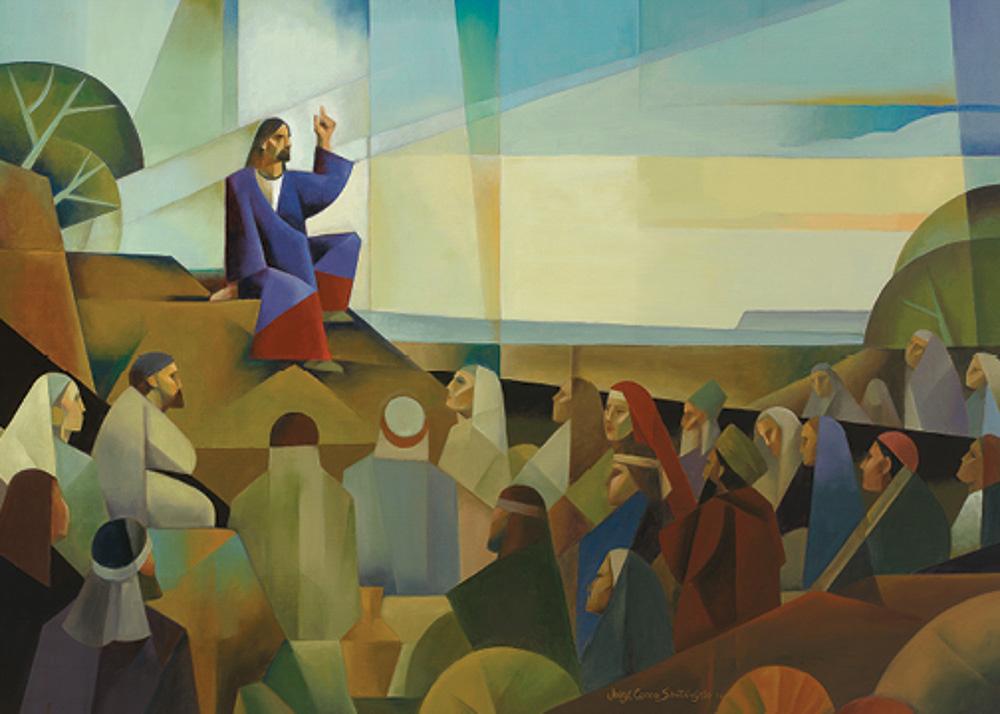
Sermon on the Mount by Argentine artist Jorge Cocco Santángelo

“You have heard that it was said, ‘You shall not commit adultery.’But I tell you that anyone who looks at a woman lustfully has already committed adultery with her in his heart. If your right eye causes you to stumble, gouge it out and throw it away. It is better for you to lose one part of your body than for your whole body to be thrown into hell. And if your right hand causes you to stumble, cut it off and throw it away. It is better for you to lose one part of your body than for your whole body to go into hell.

“It has been said, ‘Anyone who divorces his wife must give her a certificate of divorce. ’But I tell you that anyone who divorces his wife, except for sexual immorality, makes her the victim of adultery, and anyone who marries a divorced woman commits adultery.

“Again, you have heard that it was said to the people long ago, ‘Do not break your oath, but fulfill to the Lord the vows you have made.’ But I tell you, do not swear an oath at all: either by heaven, for it is God’s throne; or by the earth, for it is his footstool; or by Jerusalem, for it is the city of the Great King. And do not swear by your head, for you cannot make even one hair white or black. (New International Version)

Adultery. Divorce. Oaths. Jesus chose these topics from the Ten Commandments (7, 9, and 10) to uphold the ethical law of God.

In Christ’s Sermon on the Mount, Jesus gets to the heart of immorality and unethical behavior. The physical act of adultery arises from mental adultery. Divorce results from hardness of heart. Breaking oaths as a form of lying.

Adultery

Pornography is a 60 billion dollar a year industry, worldwide. It is the church’s problem, as well:

  • 53% of Christian men consume pornography.
  • 51% of pastors say porn is a temptation.
  • 69% of pastors started looking at porn out of curiosity.
  • 37% of pastors say it’s currently a struggle.
  • 35% of men have used pornography in the past month.
  • 4 in 10 of pastors looked at porn today.
  • There are 100,000 websites that offer illegal child pornography.
  • 90% of 8-16 year old’s have viewed porn online (most while doing homework).
  • 20% of men, and 13% of women, admit to viewing pornography at work.
  • 70 percent of all internet porn traffic occurs during the 9-to-5 workday.

Adultery initially occurs when someone feeds on mental sexual activity with another person. As with most of Christ’s solutions, he lays out a radical means of overcoming it.

Jesus is not condemning normal gender attraction, nor sex itself (which is a gift of God). Rather, Jesus condemns the leering upon another with sexual fantasy. All adulterous relationships and inappropriate sexual relations start with the “look.”

“Lust” is to intensely desire and burn for something, to seek mastery over another. The reason people stare, and lust, is not because of the other person’s manner or dress; it’s because they already have an adulterous heart. 

Whenever we are caught in physical or mental adultery, decisive and drastic action is needed. Jesus used hyperbole to drive his point home about the need of dealing with adultery. The approach is not applying a band aid; it is amputation.

The reason many men and women are snared by adultery, and seem unable to stop, is that they deal with it on their own. The radical action needed is accountability; confession must be offered.

Trying to manage lust on our own is like one individual attempting to contain a nuclear meltdown.

Jesus leaves no room to think it is okay to lust in the heart because I am not hurting anybody. Pornography enslaves its users and degrades women.

As powerful and addictive lust is, God’s grace is bigger and more powerful. There’s no need to be burdened with shame and guilt when the cross of Christ has already taken care of it.

There would not be a multi-billion dollar industry if there were not places in our hearts that are black. Now is the time for forgiveness, grace, and healing.

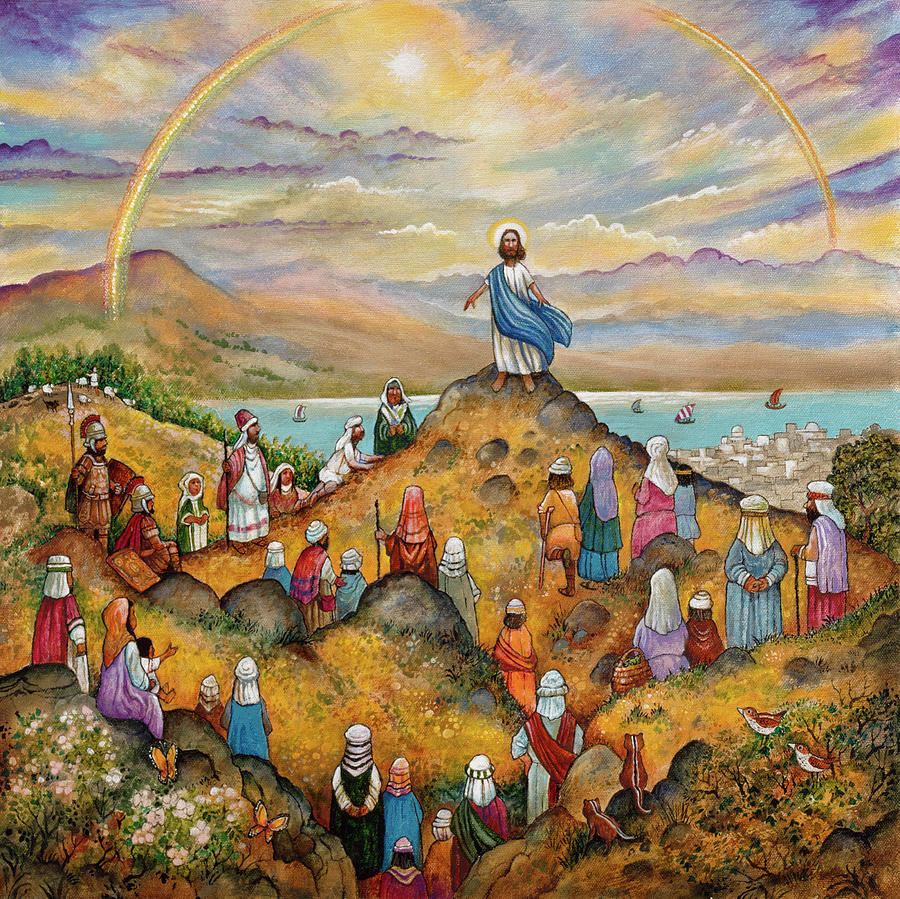
Sermon on the Mount by American artist Bill Bell

Divorce

Today in America more than one-third of all adults have experienced divorce.

Unfortunately, many divorced persons feel their faith community provided rejection rather than support and healing. There is a lot of room for improvement when to help families, and those having experienced divorce.

Please know Jesus condemns the cavalier divorce, and not all divorce. Anybody who doesn’t like their spouse doesn’t have ground for divorce. They entertain the thought of having a better spouse, even though there is no marital unfaithfulness. 

This is yet another form of mental adultery (and idolatry) which believes someone else can better meet my needs. 

Jesus clearly makes provision for divorce to occur in certain circumstances. Yet, he will not bend to liquidating a marriage over unhappiness with what God has joined together.

The intent of Old Testament legislation on divorce is to avoid a casual stance toward marriage (Deuteronomy 24:1-4). Over the centuries, people found creative ways of getting around the law. Although a divorce may be legal, it might not be ethical. Jesus wanted divorce practiced with concern for the woman, so that her rights and needs were considered.

Many took a loose view of divorce and focused solely on “indecency” as grounds for divorce. They did not interpret the term solely as sexual infidelity, as Jesus did, but had a broad understanding of indecency.

For example, if a husband did not like his wife, or, in the words of one rabbi, she continually burns the supper, he may “put her away” (divorce her). Jesus, however, insisted divorce must not happen because of a hard time getting along; or don’t love your spouse anymore; or that your spouse keeps irritating you. 

Being frustrated or unhappy are not biblical grounds for divorce. The answer to most marital problems does not lie in a new spouse, but in the hard work of identifying the idols of our hearts, overthrowing them, and re-connecting. Sin is crouching at the door, but you and I must master it.

Jesus said the ground for divorce is marital unfaithfulness, that is, any sexual activity outside the bounds of the marriage relationship. And, even in this case, divorce need not be an option, if the two people can reconcile.

Christ sought to defend women who are genuine victims. In biblical times, if a wife was given a certificate of divorce, she had four options: 1) Return to her family of origin; 2) Become a beggar; or 3) Become a prostitute to make ends meet; or, 4) Marry again, thus committing adultery if she was divorced because her husband didn’t like her. 

Jesus doesn’t take sides between spouses. Instead, he lifts the original intent of marriage: oneness. Divorce was never meant to be. Separating two people is damaging. However, it obviously occurs. (Matthew 19:1-12)

Divorce exists because of the heart’s hardness in one or both of the marriage partners. Divorce, really, is a legal testimony verifying that a separation has already occurred. It’s a recognition that disunity and non-oneness is already present. Legal divorce affirms that a terrible break already happened, damaging the people involved.

Just as God is one, two marital partners are to be one. Oneness is the primary goal of any marriage relationship. God did not institute marriage for people to live as roommates, but to be a new entity operating as one.

If God found it necessary to divorce his own covenant people, then it is inevitable divorce will occur among people (Jeremiah 3:1-8).  Therefore, let’s be discerning in how we handle each individual situation of marital difficulty.

Sermon on the Mount by Janice Elizabeth Steward

Oaths

“I swear on a stack of Bibles I won’t…” “I will, if I get around to it….” These are a few of the caveats we give when making a promise or oath. Oaths communicate our level or ability of getting it done, or not.

That’s fine. What isn’t fine is making excuses or false promises with no intention of doing what you say you will do. So, Jesus wants all the extraneous language out. Say “yes” or “no” and then follow through. And if you don’t, you’re a liar.

We often lie because we don’t want to do something to begin with. “Yes” and “no” are clear boundary words. Boundaries are needed so there is no oath-breaking.

Boundaries define where I end and someone else begins, leading me to a sense of ownership. Knowing what I am to take and not take responsibility for gives me freedom.

  • Boundaries keep the good in and the bad out. Setting boundaries involves taking responsibility for your choice of “yes” and “no” and living with the consequences.
  • Boundaries protect us from “gaslighting.” Gaslighting is a form of emotional abuse. The abuser manipulates another into doubting their thoughts, feelings, judgments, perceptions, and/or memories.
  • Boundaries hold people accountable for their words and actions. Without boundaries, we can easily feel used and mistreated.

Jesus wants us to clarify our values and live them out; make wise decisions; identify what we will accept and reject; and follow through on what we say we will do.

Conclusion

Adultery, divorce, and oaths are related. Boundaries – making and keeping promises – deals with outside forces trying to compromise our values. Accountability in naming our struggles mitigates covetousness.

Dissolved marriages and broken promises still happen. Yet, Jesus is there offering grace, not judgment. We may become emotionally damaged, however, there is healing available through the mercy of Christ. Amen.