Who Do You Look To When Things Are Tough? (1 Samuel 9:1-14)

There was a Benjamite, a man of standing, whose name was Kish son of Abiel, the son of Zeror, the son of Bekorath, the son of Aphiah of Benjamin. Kish had a son named Saul, as handsome a young man as could be found anywhere in Israel, and he was a head taller than anyone else.

Now the donkeys belonging to Saul’s father Kish were lost, and Kish said to his son Saul, “Take one of the servants with you and go and look for the donkeys.” So he passed through the hill country of Ephraim and through the area around Shalisha, but they did not find them. They went on into the district of Shaalim, but the donkeys were not there. Then he passed through the territory of Benjamin, but they did not find them.

When they reached the district of Zuph, Saul said to the servant who was with him, “Come, let’s go back, or my father will stop thinking about the donkeys and start worrying about us.”

But the servant replied, “Look, in this town there is a man of God; he is highly respected, and everything he says comes true. Let’s go there now. Perhaps he will tell us what way to take.”

Saul said to his servant, “If we go, what can we give the man? The food in our sacks is gone. We have no gift to take to the man of God. What do we have?”

The servant answered him again. “Look,” he said, “I have a quarter of a shekel of silver. I will give it to the man of God so that he will tell us what way to take.” (Formerly in Israel, if someone went to inquire of God, they would say, “Come, let us go to the seer,” because the prophet of today used to be called a seer.)

“Good,” Saul said to his servant. “Come, let’s go.” So they set out for the town where the man of God was.

As they were going up the hill to the town, they met some young women coming out to draw water, and they asked them, “Is the seer here?”

“He is,” they answered. “He’s ahead of you. Hurry now; he has just come to our town today, for the people have a sacrifice at the high place. As soon as you enter the town, you will find him before he goes up to the high place to eat. The people will not begin eating until he comes, because he must bless the sacrifice; afterward, those who are invited will eat. Go up now; you should find him about this time.”

They went up to the town, and as they were entering it, there was Samuel, coming toward them on his way up to the high place. (New International Version)

“He who seeking asses, found a kingdom.”

John Milton, Paradise Regained

We are introduced to Saul, who eventually became the infamous first king of Israel. And he is described in almost a kingly sort of tone; his stature and pedigree are impressive. Saul looks the part of someone who could be important, do things, and go places.
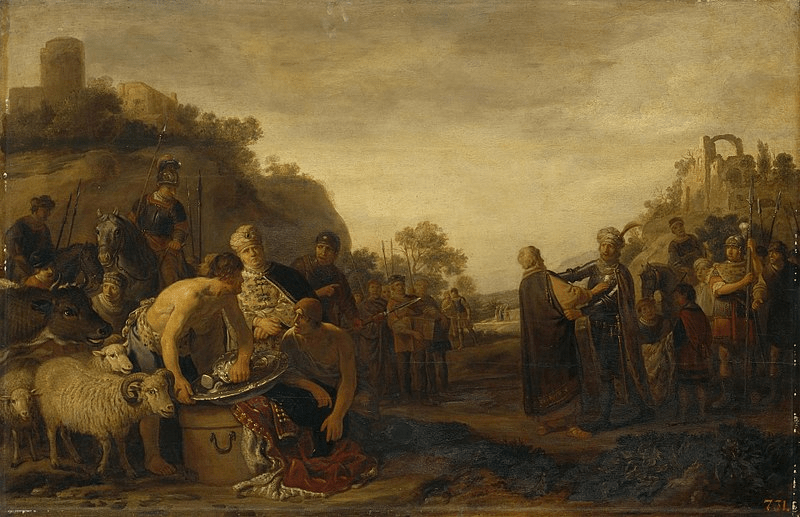
Samuel and Saul, by Dutch painter Claes Moeyaert (1592-1655)

In today’s story, we find Saul to be an obedient and responsible son, going out to find some lost donkeys. By all appearances, Saul was an upright, law-abiding, faithful Jew from the tribe of Benjamin. However, appearances can be rather deceitful. The outward presentation of someone is not always congruent with what is on the inside; and vice versa.

These were the days when Samuel the priest would make a circuit through the country. He made regular rounds as Israel’s judge. Saul and Samuel would encounter each other in a divine appointment. The contrast between the two of them would become ever more pronounced and obvious. But to the point at hand, Saul was simply out looking for some lost animals.

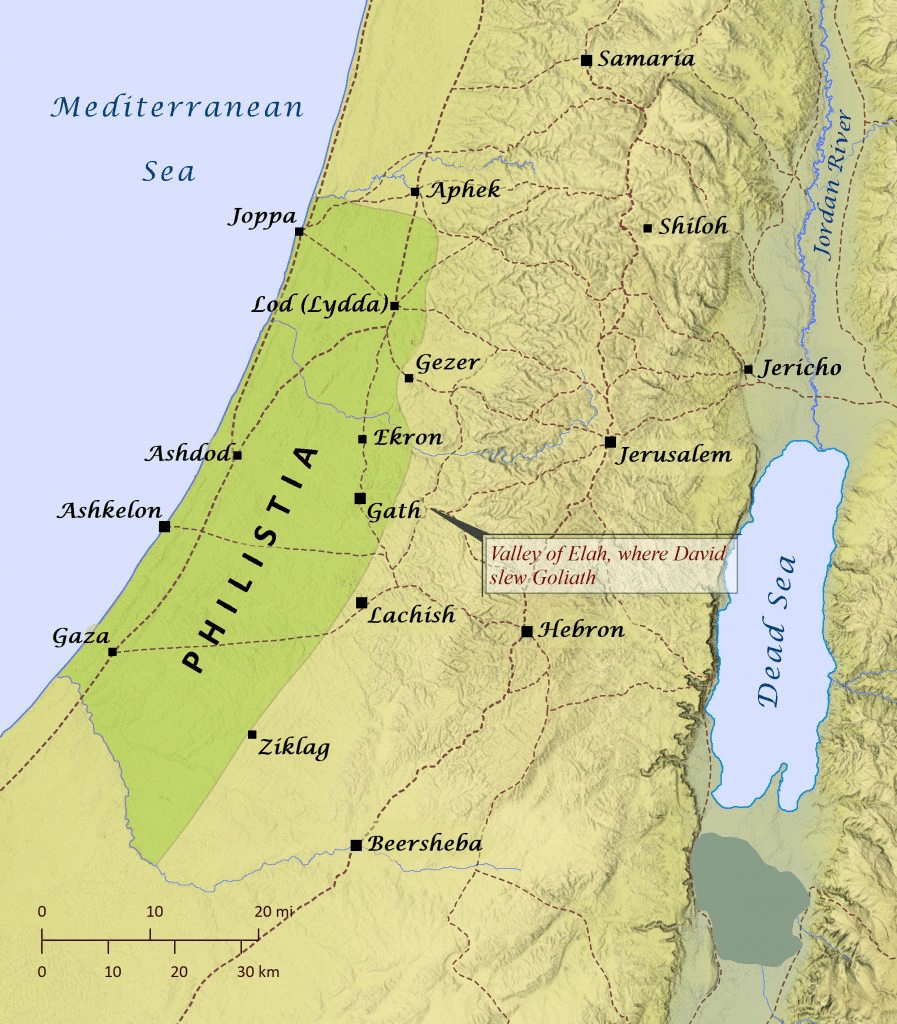
At that time, Israel was facing yet another Philistine military threat. The Philistines were not indigenous to Palestine. The Egyptians referred to them as “sea people;” they originally came from somewhere around the Aegean Sea area and settled in Canaan along the coastal plain between Gaza and Jaffa.

The Philistines expanded their territory, which continually put them at odds with Israel their neighbor. Militarily, the Israelites looked like bumpkins compared to the Philistines – who were skilled warriors with state of the art weapons.

Israel had no king. Instead, they were led by a series of judges who gave rulings throughout the land. Samuel was the last of them because the Israelite tribes determined and demanded that they must have a king in order to face the Philistine threat. (1 Samuel 8:1-21)

Samuel wisely perceived that asking for a king was not going to go well for the people. And he had warned them appropriately. Yet, Israel persisted in wanting to be like all the other nations in having a king to lead an army and fight Israel’s battles.

Although the people loved and appreciated the priest and prophet Samuel, his leadership was regarded as insufficient for the constant anxiety of dealing with the Philistines. It seems the people did not realize or consider what they were asking for, because they got it, and it wasn’t always victory and celebration.

If Israel wanted a king – and someone who looked the part – then that is exactly what they would receive. Saul was tall, strong, and seemed qualified to wage war on the pesky Philistines. Frankly, Saul was a putz who lacked the internal character needed to govern God’s people and ensure God’s will would be done in Israel.

But, again, I get ahead of myself. Reading the account of Saul for the first time, it’s easy for one to not see the signs of a coming personal implosion of the soul.
Sometimes whenever circumstances have been challenging for so long, and difficulty just keeps showing up, we begin to lose our good judgment and start wanting easy solutions for complex problems. And that is what I believe happened to Israel.

The Israelites got tired of the constant Philistine threat – to the point of believing that the grass is greener on the other side of the fence. They thought they needed a king and that everything would be better. And initially it was. But, over the long haul, it proved to be fatal.

For us today, it is good to remember that sound self-discipline through proven spiritual practices, and development of the soul by means of humility, patience, and wisdom, accomplish what is most needed in life.

Becoming weary and tired, we may slowly lose faith. Yet, the ability to persevere, stay the course, and listen well to wise people, can begin to erode and decay through the discouragement of constant adversity.

There is, however, a way to keep going when things are hard. Encourage one another daily. Avoid a critical spirit which drains the energy from others. Be careful who you listen to and take advice from. Become ever more familiar with Holy Scripture and that which is right, just, and good. Rely upon the Lord.

Living a faithful and devoted life to the divine covenant, instead succumbing to human culture, may not be easy; but it will serve us well in the long run.

Father of mercy, alone we have no power in ourselves to help ourselves. When we are discouraged by our weakness, strengthen us to follow Christ, our pattern and our hope; who lives and reigns with you and the Holy Spirit, one God, now and forever. Amen.

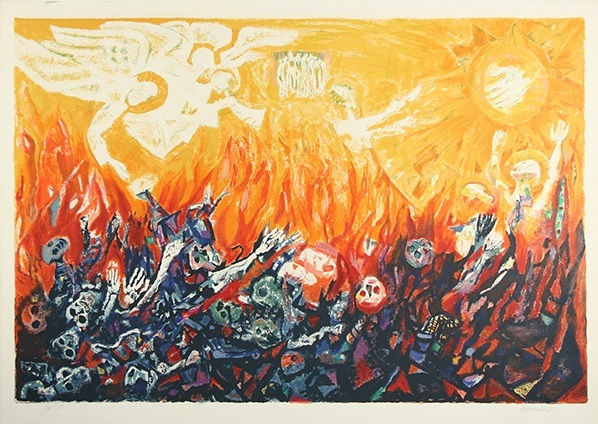
Speak To the Dry Bones (Ezekiel 37:1-14)

Valley of the Dried Bones, by Abraham Rattner (1895–1978)

The power of the Lord came over me. The Lord brought me out by his Spirit and put me down in the middle of a valley. The valley was filled with bones. He led me all around them. I saw that there were very many bones at the bottom of the valley, and they were very dry.

Then he asked me, “Son of man, can these bones live?”

I answered, “Only you know, Almighty Lord.”

Then he said to me, “Prophesy to these bones. Tell them, ‘Dry bones, listen to the Lord’s word. This is what the Almighty Lord says to these bones: I will cause breath to enter you, and you will live. I will put ligaments on you, place muscles on you, and cover you with skin. I will put breath in you, and you will live. Then you will know that I am the Lord.’ ”

So I prophesied as I was commanded. While I was prophesying, suddenly there was a rattling noise, and the bones came together, one bone ⌞attaching itself⌟ to another. As I looked, I saw that ligaments were on them, muscles were on them, and skin covered them. Yet, there was no breath in them.

Then the Lord said to me, “Prophesy to the breath! Prophesy, son of man. Tell the breath, ‘This is what the Almighty Lord says: Come from the four winds, Breath, and breathe on these people who were killed so that they will live.’ ”

So I prophesied as he commanded me, and the breath entered them. Then they came to life and stood on their feet. There were enough of them to form a very large army.

The Lord also said to me, “Son of man, all the people of Israel are like these bones. The people say, ‘Our bones are dry, and our hope has vanished. We are completely destroyed.’ So prophesy. Tell them, ‘This is what the Almighty Lord says: My people, I will open your graves and take you out of them. I will bring you to Israel. Then, my people, you will know that I am the Lord, because I will open your graves and bring you out of your graves. I will put my Spirit in you, and you will live. I will place you in your own land. Then you will know that I, the Lord, have spoken, and I have done it, declares the Lord.’ ” (God’s Word Translation)

Dry. It might be good for humor or a martini. Dry, however, doesn’t feel good when it’s a time of spiritual dryness.

Perhaps you are dry. It seems the entire world is dry. Wars, conflict, death, violence, uncertainty, unrest, and upset people everywhere is evidence that there is dryness across the earth. Many institutions, organizations, companies, and faith communities have become so withered and dry, that they have folded and died.

The hard circumstances of our world, stress in our families, and challenging personal lives may easily create anxiety, and, so, parch our souls and leave our spirits bone dry. There is, however, a God who can breathe new life into us and move us from old-worn ruts in our thinking, feeling, and behaving, to renewed ways of being in the world. 

The prophet Ezekiel’s vision is a promise and a hope of resurrection, revival, and new life. Regardless of who we are and the situations in front of us, we are all displaced people – cast out of Eden and in need of restoration. 

We, along with the ancient Israelites, are in exile and long to return to our true home with God. Along with St. Augustine we declare that our “hearts are forever restless until they find their rest in God.”

Maybe you are presently experiencing the dry bones of hopelessness and despondency. Perhaps you are in a dark night of the soul where all of life seems like one huge rut. It could be you are wondering if God is really listening, or is even there at all, because of the dry bones surrounding you.

In my work as a hospital chaplain I often encounter patients who are, ironically, bone dry from too much drinking. Their alcoholism is like a massive desert littered with thousands of dry bones. Attempting to reanimate themselves while dulling the pain of incredibly hard dry circumstances, they drink liter after liter of “spirits” to replace the dead spirit inside them. Some become so dry and dead inside their immaterial selves, that they seek to end their material lives through suicide.

But it need not be this way. We might believe we will be able to live life and pursue God better without danger or hardship – that somehow difficulty is not to be part of life. The dry bones exist, however, as an opportunity for God to give life. That’s why Alexander Solzhenitsyn’s reaction to his exile in a Soviet labor camp in Siberia was to bless it, because it was there he said:

“I discovered that the meaning of earthly existence lies not, as we have grown used to thinking, in prospering, but in the development of the soul.”

Alexander Solzhenitsyn

God not only gives life; God restores life. And this is an important truth to know and remember in the inevitable dry times of our lives. God is not only a helper; the Lord reanimates us from spiritual rigor mortis to lively resurrection through breathing on us. And this is done for a reason. Jesus came to his disciples after his resurrection and said:

God resuscitates us for a purpose, so that we might be a blessing to the world. Faith is not only a possession to keep, but a gift to give. We glorify God in loving one another and loving the world as Jesus did.  God could have resurrected the bones without Ezekiel. Instead, the Lord used Ezekiel and had him participate in the revival by speaking to the bones. 

Such a challenge to speak to the dry bones can seem overwhelming to us. What do you do when your life is upended, even shattered – when such a profound change comes to you that it is impossible for your life to be as it was? 

The questions and commands of God seemed totally absurd to Ezekiel, speaking to dead dry bones. Yet methinks we ought to operate more in the realm of the absurd than in the realm of the safe routine.

Perhaps we ought to expect our faith to be exercised and look for God to breathe new life into the dead and decaying. To believe that something, someone, or even myself can change is to have internalized this amazing story of dry bones living again. 

Our self-imposed graves cannot hold us because God is among us.

We need a genuine heaven-sent, Spirit-breathed, glorious reanimation in which God sends reviving grace and raises the dead. 

Lord of Resurrection, please be attentive to our prayers; and make what is impossible possible:

For those without hope – feeling dried up and cut off from you – open their graves and bring them back to the land of the living.

For those spiritually oppressed – held captive by sin – release them from their chains and let them go! For those who weep – lost and lifeless in a tomb of fear and shame – give them the peace of your presence, and show them what your love can do.

For those complacent – withering on the vine, and living a dull dry existence without any spiritual vigor – awaken them, O Lord! Breathe into them new life!

Pour out your Spirit, gracious God, and awaken all kinds of people to a revival of obedience, love, and courage.

May your people be so full of your Spirit that life comes rolling off our tongues and the strength of life empowers our hands for service. Amen.

How To Handle the One Who Grieves (Job 37:1-13)

The Wrath of Elihu, by William Blake, 1805

“At this my heart pounds
    and leaps from its place.
Listen! Listen to the roar of his voice,
    to the rumbling that comes from his mouth.
He unleashes his lightning beneath the whole heaven
    and sends it to the ends of the earth.
After that comes the sound of his roar;
    he thunders with his majestic voice.
When his voice resounds,
    he holds nothing back.
God’s voice thunders in marvelous ways;
    he does great things beyond our understanding.
He says to the snow, ‘Fall on the earth,’
    and to the rain shower, ‘Be a mighty downpour.’
So that everyone he has made may know his work,
    he stops all people from their labor.
The animals take cover;
    they remain in their dens.
The tempest comes out from its chamber,
    the cold from the driving winds.
The breath of God produces ice,
    and the broad waters become frozen.
He loads the clouds with moisture;
    he scatters his lightning through them.
At his direction they swirl around
    over the face of the whole earth
    to do whatever he commands them.
He brings the clouds to punish people,
    or to water his earth and show his love.” (New International Version)

Job’s Despair, by William Blake, 1821

On the one hand, the biblical book of Job needs little introduction. Many people know it has to do with a man’s innocent suffering and tenacious faith. Most folks are familiar with how it feels to suffer for no apparent reason. And everyone understands the struggle when life is broken by pain and loss.

Yet, on the other hand, the book of Job defies simple anecdotes about suffering. And the relationship between Job and God has a lot of complexity to it. Add in Job’s friends with their wordy offerings into his situation, and there becomes a fuller picture of the true wrestling of faith and patience that occurs.

Elihu was a young person who was with the three friends of Job. After listening to everyone speak, he himself went on a long speech, stretching six chapters from Job 32-37. He was angry with Job, and with Job’s three friends.

The young Elihu had picked up that Job thought of himself more righteous than God. And he was also upset that the “friends” offered nothing helpful, and could provide no convincing answers to Job – thus making it appear that God was guilty of Job’s intense suffering and grief.

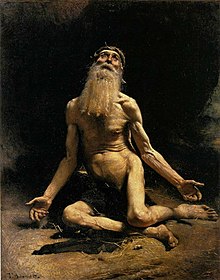
Job, by French painter Léon Bonnat, 1880

In today’s Old Testament lesson, we are getting an end part of Elihu’s speech in which he sought to defend God’s justice through observing the majesty and order of creation.

The testimony of God’s sovereign governance of the world is found in the rain, the thunder, and the lightning; through the winter storms and the frost. The Lord uses the created order to both judge and sustain people. And through the ecological systems we can see that God is at work, regulating it all, and using it for divine purposes, Elihu points out.

What strikes me about Elihu’s words is that he is not wrong, he’s just not very helpful. As a believer, I look at his speech as more of a Captain Obvious moment; yes, he is stating theological reality, but no, he’s not really breaking any new ground or giving any great insight here.

Both Job and Job’s friends had already expressed a theological perspective in kind. Which makes me curious as to why Elihu felt so compelled to even talk at all. I think he would have been better remembered, and maybe even hailed as spiritual beyond his years, if he would have just kept silent.

I realize not everyone is going to go with me on that observation, and that’s fine. Yet it seems to me that a good many people lob too many words toward the suffering among us, when what is actually needed is a compassionate presence that has learned to be comfortable with the uncomfortable.

There are times when words are not needed, when the situation is so incredibly unique and/or difficult that to offer a speech is like yelling in the woods with no one around; it might make the one yelling feel better but that’s about it.

If anyone needed to feel better it wasn’t Elihu. What’s more, a perceived need of defending God’s reputation or honor perhaps betrays a shortsighted theology to begin with. The Lord is quite big enough to handle any rebuffs or misunderstandings from mouthy humans. God isn’t in Junior High School, requiring a mouthpiece to help him out in a scuffle.

I would personally rather give comfort to a hurting person, instead of theological exhortations and speeches about how we ought to talk to, and about, God. That’s because I observe Jesus bringing genuine comfort and help. And I would much rather take my cues for dealing with grieving people from Christ than from Elihu, or anybody else for that matter.

“God blesses those people who grieve. They will find comfort!” (Matthew 5:4, CEV) Jesus said this in his Sermon on the Mount, as a beatitude of all who desire God’s kingdom. Christ understood well the psalmist’s understanding of God’s role and stance concerning people’s grief: “The Lord is close to the brokenhearted; he saves those whose spirits are crushed.” (Psalm 34:18, CEB)

The Apostle Paul, taking a lesson from both his Jewish learning and his encounter with Christ said, “mourn with those who mourn.” (Romans 12:15, NIV) Comfort because of grief and suffering will be built into the end of time. Methinks, then, that this is important…

“Look! God’s dwelling place is now among the people, and he will dwell with them. They will be his people, and God himself will be with them and be their God. ‘He will wipe every tear from their eyes. There will be no more death’ or mourning or crying or pain, for the old order of things has passed away.” (Revelation 21:3-4, NIV)

In whatever way you choose to look at the book of Job, please don’t miss what is to be our response to another’s pain. There is a time for theological education, and there is a time to put a robust theology into practice through a very real comforting presence of another who is in terrible suffering.

God, the strength of the weak and the comfort of those who suffer: Hear my prayers and grant those who suffer in body, mind, or spirit the power of your grace, that affliction may be turned into health, and sorrow into joy. Amen.

How Long, O Lord? (Psalm 80)

Hear us, Shepherd of Israel,
    you who lead Joseph like a flock.
You who sit enthroned between the cherubim,
    shine forth before Ephraim, Benjamin and Manasseh.
Awaken your might;
    come and save us.

Restore us, O God;
    make your face shine on us,
    that we may be saved.

How long, Lord God Almighty,
    will your anger smolder
    against the prayers of your people?
You have fed them with the bread of tears;
    you have made them drink tears by the bowlful.
You have made us an object of derision to our neighbors,
    and our enemies mock us.

Restore us, God Almighty;
    make your face shine on us,
    that we may be saved.

You transplanted a vine from Egypt;
    you drove out the nations and planted it.
You cleared the ground for it,
    and it took root and filled the land.
The mountains were covered with its shade,
    the mighty cedars with its branches.
Its branches reached as far as the Sea,
    its shoots as far as the River.

Why have you broken down its walls
    so that all who pass by pick its grapes?
Boars from the forest ravage it,
    and insects from the fields feed on it.
Return to us, God Almighty!
    Look down from heaven and see!
Watch over this vine,
    the root your right hand has planted,
    the son you have raised up for yourself.

Your vine is cut down, it is burned with fire;
    at your rebuke your people perish.
Let your hand rest on the man at your right hand,
    the son of man you have raised up for yourself.
Then we will not turn away from you;
    revive us, and we will call on your name.

Restore us, Lord God Almighty;
    make your face shine on us,
    that we may be saved. (New International Version)

What do you do when your life is not going as expected? How do you deal with the confusion of unwanted circumstances you didn’t ask for?

Nobody willingly signs up for chronic pain, constant hardship, debilitating situations, and unanswered prayer. And yet, all of us know what it feels like to have our hearts broken over a child, parent, or relative; or to be grief-stricken with either a physical malady, mental disease, emotional disorder, spiritual abuse, or some combination of them.

The psalmist most certainly knows your difficulty and your pain. That’s because he intimately knew God – and still had questions! In fact, all of us who worship and adore the Lord have faced the conundrum that God seems, at times, to be missing in action.

We may wonder, like the psalmist, where the God of the past is. Where is the One who manhandled enemies, provided for the godly, and brought abundant life? The Lord might sometimes seem to be foreign to our human condition, and far from our human experience of things.

There are plenty of stories in the Bible about God doing the miraculous, bringing deliverance, and extending help in dire situations. Yet, for many, in this present time, there is silence. Prayer after prayer brings nothing but bupkis from God. A sullen angst can easily settle into our spiritual bones.

It could also be that people we love and care for are experiencing too many hardships, boatloads of anxiety, and are wracked with worry. And we wonder why God has not risen up to answer our prayers on their behalf.

How long, Lord? Will you forget me forever?
    How long will you hide your face from me?
How long must I wrestle with my thoughts
    and day after day have sorrow in my heart?
    How long will my enemy triumph over me? (Psalm 13:1-2, NIV)

The very fact that with only a cursory look at the news there are children dying in war, senseless murders in the streets, and wanton destruction throughout the world, we may cry out, “Where is God in all this? Wake up! How long, O Lord, must we endure this!?”

Even the small tragedies of life might push us beyond what we can bear, because grief is stacked upon grief in a big lamentable sandwich of spiritual hurt. And if God seems nowhere to be found, our afflictions are multiplied.

The psalmist drew upon agricultural metaphors that his culture was quite familiar with. A society of farmers knows how much hard work is involved in their vocation – and the hours of anxiety and concern for the field to produce some crops and bear some fruit.

Farmers very much realize the power that nature can do through either drought or flood, hail or wind. The picture of the attentive farmer, gardener, and vinedresser is an apt picture of how God looks upon us.

I grew up on an Iowa farm. I have an intimate understanding of the requirements for tending to the land so that it will produce a crop, and yield a good harvest. Like many jobs, farming isn’t something that requires the same amount of attention every single day.

There are times and seasons for a high degree of activity, like planting in the Spring and harvesting in the Fall. At other times, there isn’t much to do but wait.

By no means does the farmer expect the plants to grow overnight. The faithful farmer learns to be patient, knowing that it will be weeks before anything breaks the ground; and that it will take all summer for the crops to grow and mature before they are ready for harvest.

In those times of inactivity, the corn stalks don’t start talking to one another about where the farmer went to, and whether he is off fishing or not. Even though the farmer is absent, the actions of the farmer are still very much evident.

Our own wonderings and questions about God’s presence and absence are all understandable and valid. Yet, we must keep in mind that there is continual evidence all around us that the Lord has been at work, and is still laboring as the Divine Gardener in ways we cannot see.

God is continually watching over us, ensuring that we have the proper conditions of sun, water, and good soil in order to grow, thrive, and produce a harvest of righteousness. We will still face the adverse circumstances of inclement weather, unfavorable weeds, and pests eating on and around us. Yet, we already and always have everything we need to live a successful spiritual life – without choking or starving to death.

We are not going to have all of our questions answered this side of heaven. We are, however, assured that God is good and can restore us when we are broken or failing to thrive. However, it just might take some time to do it, that’s all.

O God of heavenly powers, by the might of your command, drive away from our bodies all sickness and infirmity, and everything that brings us ill health of either body, mind, or spirit. Be present in your goodness with all your servants who are in need, that their weakness may be banished and strength restored; and that, with health renewed, they may bless your holy Name. Amen.