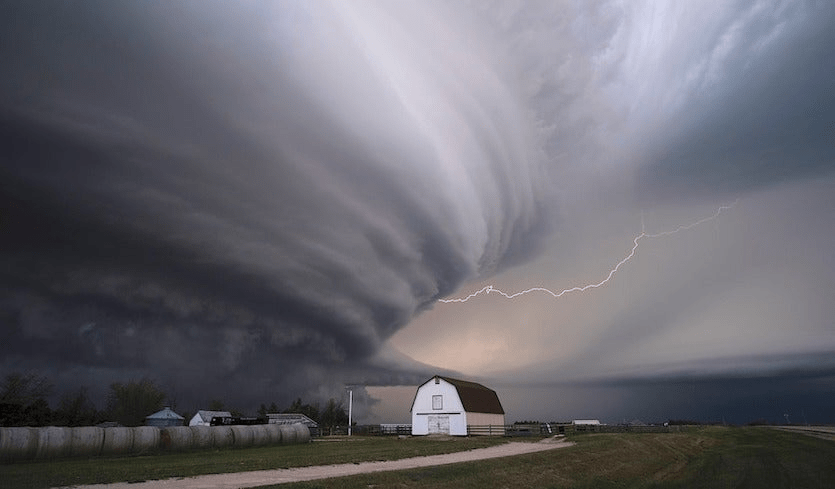
How To Handle the One Who Grieves (Job 37:1-13)

The Wrath of Elihu, by William Blake, 1805

“At this my heart pounds
    and leaps from its place.
Listen! Listen to the roar of his voice,
    to the rumbling that comes from his mouth.
He unleashes his lightning beneath the whole heaven
    and sends it to the ends of the earth.
After that comes the sound of his roar;
    he thunders with his majestic voice.
When his voice resounds,
    he holds nothing back.
God’s voice thunders in marvelous ways;
    he does great things beyond our understanding.
He says to the snow, ‘Fall on the earth,’
    and to the rain shower, ‘Be a mighty downpour.’
So that everyone he has made may know his work,
    he stops all people from their labor.
The animals take cover;
    they remain in their dens.
The tempest comes out from its chamber,
    the cold from the driving winds.
The breath of God produces ice,
    and the broad waters become frozen.
He loads the clouds with moisture;
    he scatters his lightning through them.
At his direction they swirl around
    over the face of the whole earth
    to do whatever he commands them.
He brings the clouds to punish people,
    or to water his earth and show his love.” (New International Version)

Job’s Despair, by William Blake, 1821

On the one hand, the biblical book of Job needs little introduction. Many people know it has to do with a man’s innocent suffering and tenacious faith. Most folks are familiar with how it feels to suffer for no apparent reason. And everyone understands the struggle when life is broken by pain and loss.

Yet, on the other hand, the book of Job defies simple anecdotes about suffering. And the relationship between Job and God has a lot of complexity to it. Add in Job’s friends with their wordy offerings into his situation, and there becomes a fuller picture of the true wrestling of faith and patience that occurs.

Elihu was a young person who was with the three friends of Job. After listening to everyone speak, he himself went on a long speech, stretching six chapters from Job 32-37. He was angry with Job, and with Job’s three friends.

The young Elihu had picked up that Job thought of himself more righteous than God. And he was also upset that the “friends” offered nothing helpful, and could provide no convincing answers to Job – thus making it appear that God was guilty of Job’s intense suffering and grief.

Job, by French painter Léon Bonnat, 1880

In today’s Old Testament lesson, we are getting an end part of Elihu’s speech in which he sought to defend God’s justice through observing the majesty and order of creation.

The testimony of God’s sovereign governance of the world is found in the rain, the thunder, and the lightning; through the winter storms and the frost. The Lord uses the created order to both judge and sustain people. And through the ecological systems we can see that God is at work, regulating it all, and using it for divine purposes, Elihu points out.

What strikes me about Elihu’s words is that he is not wrong, he’s just not very helpful. As a believer, I look at his speech as more of a Captain Obvious moment; yes, he is stating theological reality, but no, he’s not really breaking any new ground or giving any great insight here.

Both Job and Job’s friends had already expressed a theological perspective in kind. Which makes me curious as to why Elihu felt so compelled to even talk at all. I think he would have been better remembered, and maybe even hailed as spiritual beyond his years, if he would have just kept silent.

I realize not everyone is going to go with me on that observation, and that’s fine. Yet it seems to me that a good many people lob too many words toward the suffering among us, when what is actually needed is a compassionate presence that has learned to be comfortable with the uncomfortable.

There are times when words are not needed, when the situation is so incredibly unique and/or difficult that to offer a speech is like yelling in the woods with no one around; it might make the one yelling feel better but that’s about it.

If anyone needed to feel better it wasn’t Elihu. What’s more, a perceived need of defending God’s reputation or honor perhaps betrays a shortsighted theology to begin with. The Lord is quite big enough to handle any rebuffs or misunderstandings from mouthy humans. God isn’t in Junior High School, requiring a mouthpiece to help him out in a scuffle.

I would personally rather give comfort to a hurting person, instead of theological exhortations and speeches about how we ought to talk to, and about, God. That’s because I observe Jesus bringing genuine comfort and help. And I would much rather take my cues for dealing with grieving people from Christ than from Elihu, or anybody else for that matter.

“God blesses those people who grieve. They will find comfort!” (Matthew 5:4, CEV) Jesus said this in his Sermon on the Mount, as a beatitude of all who desire God’s kingdom. Christ understood well the psalmist’s understanding of God’s role and stance concerning people’s grief: “The Lord is close to the brokenhearted; he saves those whose spirits are crushed.” (Psalm 34:18, CEB)

The Apostle Paul, taking a lesson from both his Jewish learning and his encounter with Christ said, “mourn with those who mourn.” (Romans 12:15, NIV) Comfort because of grief and suffering will be built into the end of time. Methinks, then, that this is important…

“Look! God’s dwelling place is now among the people, and he will dwell with them. They will be his people, and God himself will be with them and be their God. ‘He will wipe every tear from their eyes. There will be no more death’ or mourning or crying or pain, for the old order of things has passed away.” (Revelation 21:3-4, NIV)

In whatever way you choose to look at the book of Job, please don’t miss what is to be our response to another’s pain. There is a time for theological education, and there is a time to put a robust theology into practice through a very real comforting presence of another who is in terrible suffering.

God, the strength of the weak and the comfort of those who suffer: Hear my prayers and grant those who suffer in body, mind, or spirit the power of your grace, that affliction may be turned into health, and sorrow into joy. Amen.

How Long, O Lord? (Psalm 80)

Hear us, Shepherd of Israel,
    you who lead Joseph like a flock.
You who sit enthroned between the cherubim,
    shine forth before Ephraim, Benjamin and Manasseh.
Awaken your might;
    come and save us.

Restore us, O God;
    make your face shine on us,
    that we may be saved.

How long, Lord God Almighty,
    will your anger smolder
    against the prayers of your people?
You have fed them with the bread of tears;
    you have made them drink tears by the bowlful.
You have made us an object of derision to our neighbors,
    and our enemies mock us.

Restore us, God Almighty;
    make your face shine on us,
    that we may be saved.

You transplanted a vine from Egypt;
    you drove out the nations and planted it.
You cleared the ground for it,
    and it took root and filled the land.
The mountains were covered with its shade,
    the mighty cedars with its branches.
Its branches reached as far as the Sea,
    its shoots as far as the River.

Why have you broken down its walls
    so that all who pass by pick its grapes?
Boars from the forest ravage it,
    and insects from the fields feed on it.
Return to us, God Almighty!
    Look down from heaven and see!
Watch over this vine,
    the root your right hand has planted,
    the son you have raised up for yourself.

Your vine is cut down, it is burned with fire;
    at your rebuke your people perish.
Let your hand rest on the man at your right hand,
    the son of man you have raised up for yourself.
Then we will not turn away from you;
    revive us, and we will call on your name.

Restore us, Lord God Almighty;
    make your face shine on us,
    that we may be saved. (New International Version)

What do you do when your life is not going as expected? How do you deal with the confusion of unwanted circumstances you didn’t ask for?

Nobody willingly signs up for chronic pain, constant hardship, debilitating situations, and unanswered prayer. And yet, all of us know what it feels like to have our hearts broken over a child, parent, or relative; or to be grief-stricken with either a physical malady, mental disease, emotional disorder, spiritual abuse, or some combination of them.

The psalmist most certainly knows your difficulty and your pain. That’s because he intimately knew God – and still had questions! In fact, all of us who worship and adore the Lord have faced the conundrum that God seems, at times, to be missing in action.

We may wonder, like the psalmist, where the God of the past is. Where is the One who manhandled enemies, provided for the godly, and brought abundant life? The Lord might sometimes seem to be foreign to our human condition, and far from our human experience of things.

There are plenty of stories in the Bible about God doing the miraculous, bringing deliverance, and extending help in dire situations. Yet, for many, in this present time, there is silence. Prayer after prayer brings nothing but bupkis from God. A sullen angst can easily settle into our spiritual bones.

It could also be that people we love and care for are experiencing too many hardships, boatloads of anxiety, and are wracked with worry. And we wonder why God has not risen up to answer our prayers on their behalf.

How long, Lord? Will you forget me forever?
    How long will you hide your face from me?
How long must I wrestle with my thoughts
    and day after day have sorrow in my heart?
    How long will my enemy triumph over me? (Psalm 13:1-2, NIV)

The very fact that with only a cursory look at the news there are children dying in war, senseless murders in the streets, and wanton destruction throughout the world, we may cry out, “Where is God in all this? Wake up! How long, O Lord, must we endure this!?”

Even the small tragedies of life might push us beyond what we can bear, because grief is stacked upon grief in a big lamentable sandwich of spiritual hurt. And if God seems nowhere to be found, our afflictions are multiplied.

The psalmist drew upon agricultural metaphors that his culture was quite familiar with. A society of farmers knows how much hard work is involved in their vocation – and the hours of anxiety and concern for the field to produce some crops and bear some fruit.

Farmers very much realize the power that nature can do through either drought or flood, hail or wind. The picture of the attentive farmer, gardener, and vinedresser is an apt picture of how God looks upon us.

I grew up on an Iowa farm. I have an intimate understanding of the requirements for tending to the land so that it will produce a crop, and yield a good harvest. Like many jobs, farming isn’t something that requires the same amount of attention every single day.

There are times and seasons for a high degree of activity, like planting in the Spring and harvesting in the Fall. At other times, there isn’t much to do but wait.

By no means does the farmer expect the plants to grow overnight. The faithful farmer learns to be patient, knowing that it will be weeks before anything breaks the ground; and that it will take all summer for the crops to grow and mature before they are ready for harvest.

In those times of inactivity, the corn stalks don’t start talking to one another about where the farmer went to, and whether he is off fishing or not. Even though the farmer is absent, the actions of the farmer are still very much evident.

Our own wonderings and questions about God’s presence and absence are all understandable and valid. Yet, we must keep in mind that there is continual evidence all around us that the Lord has been at work, and is still laboring as the Divine Gardener in ways we cannot see.

God is continually watching over us, ensuring that we have the proper conditions of sun, water, and good soil in order to grow, thrive, and produce a harvest of righteousness. We will still face the adverse circumstances of inclement weather, unfavorable weeds, and pests eating on and around us. Yet, we already and always have everything we need to live a successful spiritual life – without choking or starving to death.

We are not going to have all of our questions answered this side of heaven. We are, however, assured that God is good and can restore us when we are broken or failing to thrive. However, it just might take some time to do it, that’s all.

O God of heavenly powers, by the might of your command, drive away from our bodies all sickness and infirmity, and everything that brings us ill health of either body, mind, or spirit. Be present in your goodness with all your servants who are in need, that their weakness may be banished and strength restored; and that, with health renewed, they may bless your holy Name. Amen.

Restoration (Jeremiah 30:1-11a)

This is the word that came to Jeremiah from the Lord: “This is what the Lord, the God of Israel, says: ‘Write in a book all the words I have spoken to you. The days are coming,’ declares the Lord, ‘when I will bring my people Israel and Judah back from captivity and restore them to the land I gave their ancestors to possess,’ says the Lord.”

These are the words the Lord spoke concerning Israel and Judah: 

“This is what the Lord says:

“‘Cries of fear are heard—
    terror, not peace.
Ask and see:
    Can a man bear children?
Then why do I see every strong man
    with his hands on his stomach like a woman in labor,
    every face turned deathly pale?
How awful that day will be!
    No other will be like it.
It will be a time of trouble for Jacob,
    but he will be saved out of it.

“‘In that day,’ declares the Lord Almighty,
    ‘I will break the yoke off their necks
and will tear off their bonds;
    no longer will foreigners enslave them.
Instead, they will serve the Lord their God
    and David their king,
    whom I will raise up for them.

“‘So do not be afraid, Jacob my servant;
    do not be dismayed, Israel,’
declares the Lord.
‘I will surely save you out of a distant place,
    your descendants from the land of their exile.
Jacob will again have peace and security,
    and no one will make him afraid.
I am with you and will save you,’
    declares the Lord.” (New International Version)

The cry of Jeremiah the prophet, by Slovakian artist, 1937

To be restored is a beautiful thing, namely because it presupposes that someone or a group of people were dilapidated and in need of healing. Restoration implies that something was lost, but now is found.

If you have lost things like finances, a home, a car, precious memorial items, a job; or relationships such as a marriage, a friendship, estrangement from family members; or your health to disease or disaster; or even lost your mind or your soul – you can completely understand the longing for restoration and wholeness.

The Jews lost their homeland, their property, their temple, and their dignity to the invading Babylonians. Babylon took everything from Judea. The people became exiled in a strange land. Only some poor folk were left behind in a land that was ravaged.

This was the place that was once referred to as a land of milk and honey, a good home of abundance and blessing. But in the prophet Jeremiah’s day, it was becoming a thing of the past. Would the people ever recover what they had lost? Is restoration even a possibility? Could they learn to hope again?

Into a time of distress and despair, God spoke, and said that yes, it is possible; yes, restoration can and will happen. The people will not be in captivity forever.

Things can get so bad that you become physically sick, emotionally spent, mentally fearful, and spiritually disheartened – as if your life has been ripped from you without mercy and with malice. Yet, what is true of us today is not necessarily going to be true of us tomorrow.

Oppression is a terrible thing. To be constantly harassed by others or by chronic pain or by adverse situations is draining; it sucks the life out of us. Into these sorts of circumstances, God says to us, “I am with you, and I will save you.”

Perhaps tomorrow comes and nothing changes. The pain is still there. The mean-spirited people haven’t gone anywhere. The lost things are not found. And yet, there is something primal and universal which has always been here and shall never go away, no matter the circumstances: God is with us, and God loves us.

If we have the spiritual eyes to see, we will notice that God is alongside us, weeping with us. God knows a thing or two about the sort of suffering and pain that is unimaginable.

“Why does not God do something sooner, if God is so loving and powerful?” you may ask. If you are a parent, you have likely had a child ask you why you are doing something to them that feels awful. You know that emotion of feeling hurt alongside them. You also know that there is sometimes no way you can adequately explain to them what’s going on.

You commit yourself to being there, being present, and assuring the child that you aren’t going anywhere. So, when it comes to us, why is it so hard to understand that God is not a divine Santa or a cosmic Genie granting our every wish? If we want kids to understand, then perhaps we ought to first understand our own relationship as God’s children.

There will be times of trial and tribulation, even divine judgment. Yet there shall also be deliverance from evil, and salvation from sin, death, and hell. The yoke of oppression won’t last because there is the promise of restoration.

No matter how nasty, misguided, or sinful the political leadership and governmental system, none of those rulers or politicians have the last word – God does, not them. Grace has the final say, utilizing a restorative mercy which cannot be undone.

The days are coming when there will be a new future, based in the resolve of God to accomplish it. Fortunes shall be restored. Rehabilitation and renewal are ahead for the faithful. Healing will happen, whether it be in this life, or the next.

Things may seem impossibly hopeless now, but God can and will overrule the present evil machinations of oppressive rulers. Terror may be on every side, yet the Lord will break the bonds of oppression; God will burst the unjust practices. Indeed, God will save.

Therefore, we need not fear, for God is with us; and divine intervention is nearly here.

O God of heavenly powers, by your holy might, be present to us in your goodness and grace; banish all injustice and unrighteousness and restore your people in the strength of faith. Amen.

Learning to Trust (Psalm 4)

Answer me when I cry out, my righteous God!
    Set me free from my troubles!
        Have mercy on me!
        Listen to my prayer!

How long, you people,
    will my reputation be insulted?
How long will you continue
    to love what is worthless
    and go after lies?
Know this: the Lord takes
    personal care of the faithful.
The Lord will hear me
    when I cry out to him.
So be afraid, and don’t sin!
    Think hard about it in your bed
    and weep over it!
Bring righteous offerings,
    and trust the Lord!

Many people say,
    “We can’t find goodness anywhere.
    The light of your face has left us, Lord!”
But you have filled my heart with more joy
    than when their wheat and wine are everywhere!
I will lie down and fall asleep in peace
    because you alone, Lord, let me live in safety. (Common English Bible)

The psalmist, David, was a man after God’s own heart. But that did not mean that he was inoculated from trouble and hardship.

David had a lot of adversity and much difficulty throughout his life. So, it only made sense to him to cry out to the Lord for deliverance and help. God had helped David in the past, and David was confident that the Lord would help him yet again.

We all find ourselves in a tight spot, between a rock and hard place, at times. It’s what we do when we are in that position that is critical. David had a history of looking to God, seeking God’s grace, and soliciting answers to prayer.

David, the psalmist, was a real victim of slander and lies. More than once in his life, he had people out to get him, to actually take his life. Whatever your understanding of stress is, it doesn’t get much more stressful than someone hunting you down like an animal to literally kill you. I’m sure that many times David wondered how long this surreal madness was going to go on.

Whenever we are especially stressed, it can be hard to even breathe. If we aren’t mindful of ourselves, we will take lots of short staccato breaths that only feed anxious signals to the brain. It leaves us in a perpetual state of hypervigilance, almost unable to pray and have thoughts of God.

But we absolutely need to take deep breaths and trust in God’s sustaining presence. We’ll never get to sleep, nor stay at rest, without a sense of the divine presence.

Insomnia happens for a lot of reasons. Many people have diagnosed sleep disorders that are very real medical conditions. Others can’t get a good night’s rest because of poor sleep hygiene by not planning for adequate sleep, drinking too much caffeine during the day, inattention to a healthy diet, or a host of other habits. Some have issues of chronic pain which can make it difficult to sleep well.

And then there are yet others who suffer from racing thoughts, anxiety, and depression. The stress of their waking life is so significant that several hours of deep sleep seems only like some pipe dream. It’s impossible to sleep when the weight of the day is pressing on you. Finding a sense of calm before bed isn’t easy—especially when you can’t unplug from the demands of your day.

I am wondering if many of us will even allow ourselves to unplug and establish some quiet wind-down time. Reading a real book – not one on a backlit tablet device – or talking with a friend or family member are simple ways of easing our anxiety and letting rest come.

The psalmist, David, had a regular practice of meditating on Scripture, recalling the events of God, and expressing gratitude and praise for answered prayer. Each of us has a built-in spiritual rhythm just like we have a circadian rhythm. Always trying to buck those God-given rhythms will inevitably result in being “off,” at the least, and experiencing debilitating depression, at the worst.

Yet, when we learn to move with the unforced rhythms of grace, there is a groove we slip into which serves us well. In other words, what I am trying to say, is that by allowing ourselves to be human, we can discover health.

David neither had delusions, nor illusions, about his enemies, friends, others, and himself. He didn’t try to be somebody he was not. Instead, David had firm and confident convictions about God and the place of prayer.

By taking in a steady diet of David’s psalms, we can learn to hold together both faith and doubt, confidence and confusion, perseverance and perplexity, in ways which strengthens our faith.

Everyone of us who desire God must learn to trust; and it’s in the school of hard knocks where our faith is developed in order to sustain us for a lifetime of service and resilience.

There will always be those who believe ill of us through slander, lies, or outright oppression. In such times, let’s cry out to God for both peace and guidance; and ask the Lord for help in learning to breathe, lie down, and get some rest.

As our trust develops, we may even find the grace and courage to confront our oppressors, so that they can seek their own peace with God.

May Christ be with you, and within you;
May Christ go before you, and linger behind you;
May Christ be on your right, and on your left;
May Christ hover above you, and bring support beneath you;
May the Lord Jesus Christ completely and thoroughly surround you, now and forever. Amen.