Dealing with Another’s Evil Intentions (1 Samuel 19:18-24)

David and Saul, by He Qi

When David had fled and made his escape, he went to Samuel at Ramah and told him all that Saul had done to him. Then he and Samuel went to Naioth and stayed there. 

Word came to Saul: “David is in Naioth at Ramah;” so he sent men to capture him. But when they saw a group of prophets prophesying, with Samuel standing there as their leader, the Spirit of God came on Saul’s men, and they also prophesied. 

Saul was told about it, and he sent more men, and they prophesied too. Saul sent men a third time, and they also prophesied. Finally, he himself left for Ramah and went to the great cistern at Seku. And he asked, “Where are Samuel and David?”

“Over in Naioth at Ramah,” they said.

So Saul went to Naioth at Ramah. But the Spirit of God came even on him, and he walked along prophesying until he came to Naioth. He stripped off his garments, and he too prophesied in Samuel’s presence. He lay naked all that day and all that night. This is why people say, “Is Saul also among the prophets?” (New International Version)

King Saul was in the middle of a personal downward spiral of evil. And David was his target. Even though David served Israel and the king with distinction and bravery, his success aroused the jealousy of Saul.

It came to the point that David needed to flee for his life because Saul saw him as a threat and was out to kill him. Instead of trying to go it alone, feeling angry and defeated, David went to the one person he knew was wise, discerning, and could help: Samuel, the priest and prophet of Israel.

David was not looking to kill Saul, as Saul was trying to kill him. He just needed someone to talk to, some empathy and solid help in this very unwanted and awful situation.

As we move through the biblical narratives which tell of Saul and David, we will observe that God is with David and helps him through his travails; but God is not with Saul, who is continually haunted with a bad spirit whenever he descends into the dark path of jealousy, anger, even murder.

It is only human to wonder why people of faith, with good and genuine hearts, must contend with such self-absorbed narcissistic people like Saul. We can only answer it in part: the presence of evil in the world; the place of trials and tribulations in the believer’s life, etc. For the most part, it is a mystery for which we shall not have answers, this side of heaven.

But what we do know is that God is concerned for the godly, for those who seek to do right, have pure hearts, and think of the common good of all the people. And the Lord can deal with evil, while protecting the good, in quite unexpected ways.

We expect prophets to prophesy. We don’t expect anyone else to necessarily do so. Yet, in this story, we see God sending the spirit of prophetic speech not just upon the prophets and the good folk, but upon those who have ill intentions toward the godly ones.

Yes, the Lord sent a spirit upon people who were trying to kill David, and then even upon Saul himself; not to illumine, but to prevent. The power of prophecy in this instance was not a sign of being chosen by God, but a clear sign from God of rejection.

In stripping off his clothes and laying naked in prophetic utterance, Saul was being humbled, abased, and mortified. Decades later, King David would do so willingly as a repentant person. But here, King Saul does so unwillingly, as an unrepentant person who needs to let himself be among the penitent persons. But, alas, Saul did not do so, and was continually moved by other forces other than the Lord.

For the believer who is in the throes of a gaslighting boss, or a narcissistic leader, or a self-centered relative, today’s story is an encouragement: God’s will on this earth shall prevail; and the Lord will take care of those who desire to live a just, right, and good life.

Conflict and trouble must not necessarily result in one’s devastation and discouragement.

Whenever we find ourselves in the crosshairs of an evil person, we do not need to add to the madness with harsh and divisive words.

Instead, we can be sober-minded and good-hearted by handling the adverse situation with gentle words and a wise spirit. We can face the trouble, without wishing it away, by going to a wise person for counsel and help, if need be.

The mark of a truly good person is not whether they have conflict in their life, or not, but by how they handle the trouble when it comes. And as for the troublemakers and chaotic people themselves, the Lord knows how to deal with them.

You may be in an unwanted situation, dealing with a difficult person. Please don’t let that person steal your personal integrity and happiness from you. The one thing you can always control – that nobody can ever take away from you – is your own attitude and ability to respond.

“Everything can be taken from a man but one thing: the last of the human freedoms—to choose one’s attitude in any given set of circumstances, to choose one’s own way.”

Viktor Frankl, Man’s Search for Meaning

You and I really can deal with this. If the hurt was unintentional, then forgive and let it go. If the hurt was intentional, we need not be judge, jury, and/or executioner. That’s God’s job, not ours. Rather, we can choose to forgive and not hold onto bitterness; talk with a wise person to receive wise counsel, and not spread anger and slander; and determine to be joyful and godly, not sullen and irritable.

O Lord God almighty, listen to the prayer of the righteous! Direct the way of your servants in safety under your gracious divine protection, so that through all of the changes of our earthly pilgrimage, we may be guarded by your mighty help and power. Amen.

Seeking God in Hard Times (Psalm 9:9-20)

By Bible Art

The Lord is a safe place for the oppressed—
    a safe place in difficult times.
Those who know your name trust you
    because you have not abandoned
    any who seek you, Lord.

Sing praises to the Lord, who lives in Zion!
    Proclaim his mighty acts among all people!
Because the one who avenges bloodshed
    remembers those who suffer;
    the Lord hasn’t forgotten their cries for help.

Have mercy on me, Lord!
    Just look how I suffer
    because of those who hate me.
But you are the one who brings me back
    from the very gates of death
        so I can declare all your praises,
        so I can rejoice in your salvation
        in the gates of Daughter Zion.

The nations have fallen
    into the hole they themselves made!
    Their feet are caught
        in the very net they themselves hid!
The Lord is famous for the justice he has done;
    it’s his own doing that the wicked are trapped.

Let the wicked go straight to the grave,
    the same for every nation that forgets God.

Because the poor won’t be forgotten forever,
    the hope of those who suffer won’t be lost for all time.

Get up, Lord! Don’t let people prevail!
    Let the nations be judged before you.
Strike them with fear, Lord.
    Let the nations know they are only human. (Common English Bible)

I firmly believe that there is hopeful comfort in the Lord – that when people go through awful things, God is there to be a safe place for them.

I also believe that, in the end, good triumphs and evil perishes. That’s because I am convinced that the Lord is an equitable judge; God hears the cries of defenseless righteous victims and acts on behalf of the oppressed without prejudice or favoritism.

Yet, that does not mean God’s people will always be inoculated from trouble, hardship, and adversity. What it does mean is that the Lord is with us, and that God loves us.

Everyone goes through difficult times. Some folks endure horrible trauma. And those experiences can dog us and torment us, even long after the event. Even in good times, we might sometimes become anxious or frantic without any real threat in front of us.

We may want to praise God with genuineness and sincerity. However, we might not yet feel vindicated or released. And there still may be some unjust suffering going on. We long to declare the goodness of God, but we also want to do so with a testimony of deliverance and healing.

That is precisely how the psalmist felt. He knows the wicked won’t endure, but he also wants to give praise to the Lord for seeing them sink in the sinister pit they’ve dug for others.

God is a righteous judge. And there are times when the Lord brings judgment upon evil by letting the wicked self-destruct with their own words and behavior. In other words, God at times engages in direct judgment, and other times lets the moral gravity of the earth crush them in their duplicitous crimes.

Whenever circumstances are hard, it’s easy to feel forgotten, as if no one sees or hears our suffering; they don’t realize the depth of our hurt by a wicked person. It’s appropriate, as the psalmist did, to cry out and plead with God to rise up on behalf of the weak and powerless; and to call for an end of the mindless and godless insanity of arrogant people.

It is equally hard to observe others we care about experience oppression. We cry out to the Lord on their behalf, that they will no longer have to endure such injustice. We want our loved ones to thrive and enjoy life and thrive – not to be crushed under an unjust burden from selfish people who only care about themselves.

We boldly ask God to knock them off the evil hill they’ve built for themselves – to blot them out because of their continual oppression of the righteous. The wicked think no one can touch them atop their proud strong perch. They believe they’re above accountability and can get away with anything. That makes us angry!

Whenever we are wronged or treated unfairly – or observe another person or group of people experiencing injustice – it stirs up our anger.

Anger, in and of itself, is neither good nor bad. It just is. It’s what we do with our anger that gets dicey. A lot of human anger gets expressed in unhealthy ways by either passively stuffing it and ignoring it; aggressively lashing out with verbal and/or physical violence; or passive-aggressively doing indirect jabs at the object of our anger.

The psalmist, however, is assertive with his anger. He offered straightforward observations with definite feelings to God. He also affirmed that the Lord is the One who administers justice with fairness and equity.

There are times when only God can bring an evil system, institution, organization, government, nation, group of people, or individual to heel.

When the poor are overlooked or oppressed by the rich, it’s unjust. It creates anger, both human and divine. In their misery and hardship, the needy can flee to God, who is faithful to care for them and treat them with respect and dignity, as people carrying the divine image.

The nations of the earth are not all attentive to the needy. They don’t all serve their citizens and try to do right by them. Unfortunately, many people throughout the world groan under national leadership which is enamored with power and privilege – and forget those who are powerless, unable to lift themselves by their bootstraps.

In the teeth of such a reality, the psalmist petitioned God. He asked, even insisted, that God step in and act as judge and jury. It was an assertive use of anger that went to the source of true help, to the Lord, who possesses both the will and the ability to overturn injustice and establish a right use of power.

Do you know what I want? I want justice—oceans of it. I want fairness—rivers of it. That’s what I want. That’s all I want.

Amos 5:24, MSG

The Lord, thankfully, is a strong fortress for the oppressed and a protective force in times of trouble.

God remembers the prayers of the down-and-out.

Sooner, or later, those who are wicked in their dealings through exploitation of the powerless, will know firsthand that they are puny humans, and that God is immensely big.

God almighty, you have given all peoples one common origin. It is your will they be gathered together as one family in yourself. Fill the hearts of humanity with the fire of your love and with the desire to ensure justice for all.

By sharing the good you give us, may we ensure equity for all our brothers and sisters throughout the world. May there be an end to division, strife and war. May there be a dawning of a truly human society built on love and peace, through Jesus Christ, our Lord. Amen.

Who Do You Look To When Things Are Tough? (1 Samuel 9:1-14)

There was a Benjamite, a man of standing, whose name was Kish son of Abiel, the son of Zeror, the son of Bekorath, the son of Aphiah of Benjamin. Kish had a son named Saul, as handsome a young man as could be found anywhere in Israel, and he was a head taller than anyone else.

Now the donkeys belonging to Saul’s father Kish were lost, and Kish said to his son Saul, “Take one of the servants with you and go and look for the donkeys.” So he passed through the hill country of Ephraim and through the area around Shalisha, but they did not find them. They went on into the district of Shaalim, but the donkeys were not there. Then he passed through the territory of Benjamin, but they did not find them.

When they reached the district of Zuph, Saul said to the servant who was with him, “Come, let’s go back, or my father will stop thinking about the donkeys and start worrying about us.”

But the servant replied, “Look, in this town there is a man of God; he is highly respected, and everything he says comes true. Let’s go there now. Perhaps he will tell us what way to take.”

Saul said to his servant, “If we go, what can we give the man? The food in our sacks is gone. We have no gift to take to the man of God. What do we have?”

The servant answered him again. “Look,” he said, “I have a quarter of a shekel of silver. I will give it to the man of God so that he will tell us what way to take.” (Formerly in Israel, if someone went to inquire of God, they would say, “Come, let us go to the seer,” because the prophet of today used to be called a seer.)

“Good,” Saul said to his servant. “Come, let’s go.” So they set out for the town where the man of God was.

As they were going up the hill to the town, they met some young women coming out to draw water, and they asked them, “Is the seer here?”

“He is,” they answered. “He’s ahead of you. Hurry now; he has just come to our town today, for the people have a sacrifice at the high place. As soon as you enter the town, you will find him before he goes up to the high place to eat. The people will not begin eating until he comes, because he must bless the sacrifice; afterward, those who are invited will eat. Go up now; you should find him about this time.”

They went up to the town, and as they were entering it, there was Samuel, coming toward them on his way up to the high place. (New International Version)

“He who seeking asses, found a kingdom.”

John Milton, Paradise Regained

We are introduced to Saul, who eventually became the infamous first king of Israel. And he is described in almost a kingly sort of tone; his stature and pedigree are impressive. Saul looks the part of someone who could be important, do things, and go places.

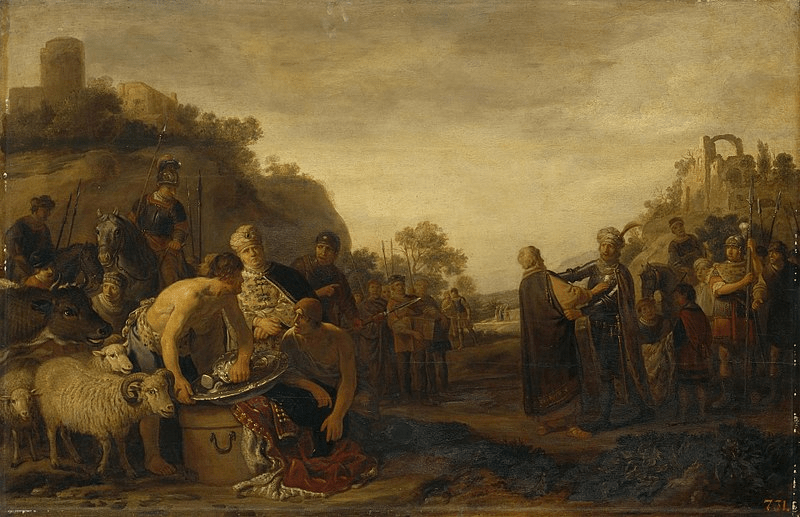
Samuel and Saul, by Dutch painter Claes Moeyaert (1592-1655)

In today’s story, we find Saul to be an obedient and responsible son, going out to find some lost donkeys. By all appearances, Saul was an upright, law-abiding, faithful Jew from the tribe of Benjamin. However, appearances can be rather deceitful. The outward presentation of someone is not always congruent with what is on the inside; and vice versa.

These were the days when Samuel the priest would make a circuit through the country. He made regular rounds as Israel’s judge. Saul and Samuel would encounter each other in a divine appointment. The contrast between the two of them would become ever more pronounced and obvious. But to the point at hand, Saul was simply out looking for some lost animals.

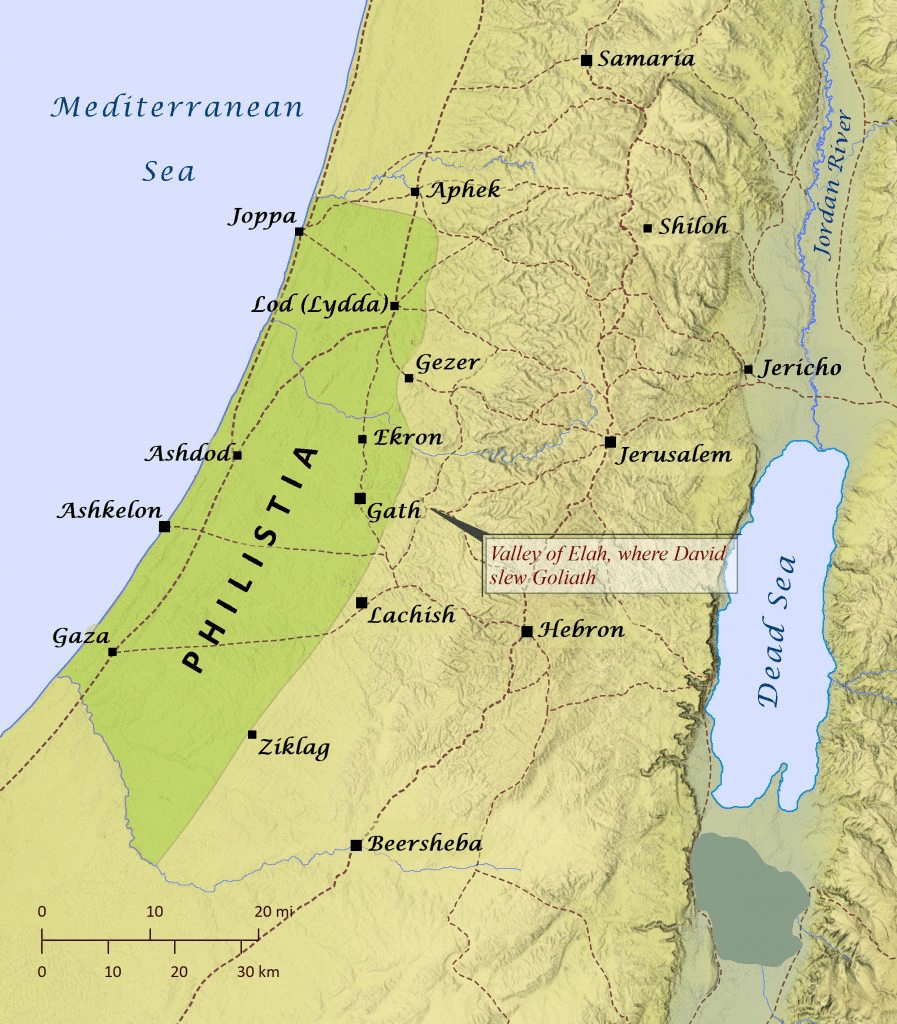
At that time, Israel was facing yet another Philistine military threat. The Philistines were not indigenous to Palestine. The Egyptians referred to them as “sea people;” they originally came from somewhere around the Aegean Sea area and settled in Canaan along the coastal plain between Gaza and Jaffa.

The Philistines expanded their territory, which continually put them at odds with Israel their neighbor. Militarily, the Israelites looked like bumpkins compared to the Philistines – who were skilled warriors with state of the art weapons.

Israel had no king. Instead, they were led by a series of judges who gave rulings throughout the land. Samuel was the last of them because the Israelite tribes determined and demanded that they must have a king in order to face the Philistine threat. (1 Samuel 8:1-21)

Samuel wisely perceived that asking for a king was not going to go well for the people. And he had warned them appropriately. Yet, Israel persisted in wanting to be like all the other nations in having a king to lead an army and fight Israel’s battles.

Although the people loved and appreciated the priest and prophet Samuel, his leadership was regarded as insufficient for the constant anxiety of dealing with the Philistines. It seems the people did not realize or consider what they were asking for, because they got it, and it wasn’t always victory and celebration.

If Israel wanted a king – and someone who looked the part – then that is exactly what they would receive. Saul was tall, strong, and seemed qualified to wage war on the pesky Philistines. Frankly, Saul was a putz who lacked the internal character needed to govern God’s people and ensure God’s will would be done in Israel.

But, again, I get ahead of myself. Reading the account of Saul for the first time, it’s easy for one to not see the signs of a coming personal implosion of the soul.

Sometimes whenever circumstances have been challenging for so long, and difficulty just keeps showing up, we begin to lose our good judgment and start wanting easy solutions for complex problems. And that is what I believe happened to Israel.

The Israelites got tired of the constant Philistine threat – to the point of believing that the grass is greener on the other side of the fence. They thought they needed a king and that everything would be better. And initially it was. But, over the long haul, it proved to be fatal.

For us today, it is good to remember that sound self-discipline through proven spiritual practices, and development of the soul by means of humility, patience, and wisdom, accomplish what is most needed in life.

Becoming weary and tired, we may slowly lose faith. Yet, the ability to persevere, stay the course, and listen well to wise people, can begin to erode and decay through the discouragement of constant adversity.

There is, however, a way to keep going when things are hard. Encourage one another daily. Avoid a critical spirit which drains the energy from others. Be careful who you listen to and take advice from. Become ever more familiar with Holy Scripture and that which is right, just, and good. Rely upon the Lord.

Living a faithful and devoted life to the divine covenant, instead succumbing to human culture, may not be easy; but it will serve us well in the long run.

Father of mercy, alone we have no power in ourselves to help ourselves. When we are discouraged by our weakness, strengthen us to follow Christ, our pattern and our hope; who lives and reigns with you and the Holy Spirit, one God, now and forever. Amen.

Speak To the Dry Bones (Ezekiel 37:1-14)

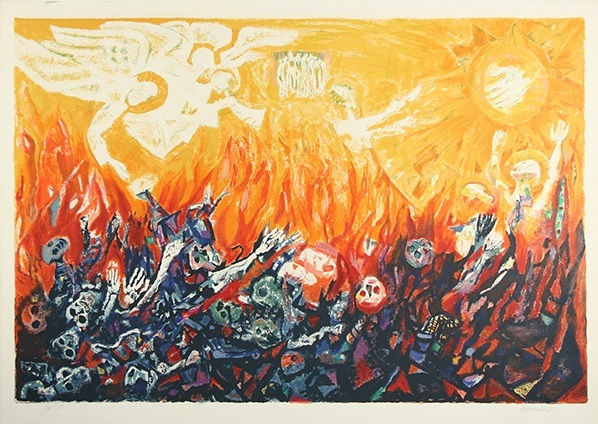
Valley of the Dried Bones, by Abraham Rattner (1895–1978)

The power of the Lord came over me. The Lord brought me out by his Spirit and put me down in the middle of a valley. The valley was filled with bones. He led me all around them. I saw that there were very many bones at the bottom of the valley, and they were very dry.

Then he asked me, “Son of man, can these bones live?”

I answered, “Only you know, Almighty Lord.”

Then he said to me, “Prophesy to these bones. Tell them, ‘Dry bones, listen to the Lord’s word. This is what the Almighty Lord says to these bones: I will cause breath to enter you, and you will live. I will put ligaments on you, place muscles on you, and cover you with skin. I will put breath in you, and you will live. Then you will know that I am the Lord.’ ”

So I prophesied as I was commanded. While I was prophesying, suddenly there was a rattling noise, and the bones came together, one bone attaching itself to another. As I looked, I saw that ligaments were on them, muscles were on them, and skin covered them. Yet, there was no breath in them.

Then the Lord said to me, “Prophesy to the breath! Prophesy, son of man. Tell the breath, ‘This is what the Almighty Lord says: Come from the four winds, Breath, and breathe on these people who were killed so that they will live.’ ”

So I prophesied as he commanded me, and the breath entered them. Then they came to life and stood on their feet. There were enough of them to form a very large army.

The Lord also said to me, “Son of man, all the people of Israel are like these bones. The people say, ‘Our bones are dry, and our hope has vanished. We are completely destroyed.’ So prophesy. Tell them, ‘This is what the Almighty Lord says: My people, I will open your graves and take you out of them. I will bring you to Israel. Then, my people, you will know that I am the Lord, because I will open your graves and bring you out of your graves. I will put my Spirit in you, and you will live. I will place you in your own land. Then you will know that I, the Lord, have spoken, and I have done it, declares the Lord.’ ” (God’s Word Translation)

Dry. It might be good for humor or a martini. Dry, however, doesn’t feel good when it’s a time of spiritual dryness.

Perhaps you are dry. It seems the entire world is dry. Wars, conflict, death, violence, uncertainty, unrest, and upset people everywhere is evidence that there is dryness across the earth. Many institutions, organizations, companies, and faith communities have become so withered and dry, that they have folded and died.

The hard circumstances of our world, stress in our families, and challenging personal lives may easily create anxiety, and, so, parch our souls and leave our spirits bone dry. There is, however, a God who can breathe new life into us and move us from old-worn ruts in our thinking, feeling, and behaving, to renewed ways of being in the world. 

The prophet Ezekiel’s vision is a promise and a hope of resurrection, revival, and new life. Regardless of who we are and the situations in front of us, we are all displaced people – cast out of Eden and in need of restoration. 

We, along with the ancient Israelites, are in exile and long to return to our true home with God. Along with St. Augustine we declare that our “hearts are forever restless until they find their rest in God.”

Maybe you are presently experiencing the dry bones of hopelessness and despondency. Perhaps you are in a dark night of the soul where all of life seems like one huge rut. It could be you are wondering if God is really listening, or is even there at all, because of the dry bones surrounding you.

In my work as a hospital chaplain I often encounter patients who are, ironically, bone dry from too much drinking. Their alcoholism is like a massive desert littered with thousands of dry bones. Attempting to reanimate themselves while dulling the pain of incredibly hard dry circumstances, they drink liter after liter of “spirits” to replace the dead spirit inside them. Some become so dry and dead inside their immaterial selves, that they seek to end their material lives through suicide.

But it need not be this way. We might believe we will be able to live life and pursue God better without danger or hardship – that somehow difficulty is not to be part of life. The dry bones exist, however, as an opportunity for God to give life. That’s why Alexander Solzhenitsyn’s reaction to his exile in a Soviet labor camp in Siberia was to bless it, because it was there he said:

“I discovered that the meaning of earthly existence lies not, as we have grown used to thinking, in prospering, but in the development of the soul.”

Alexander Solzhenitsyn

God not only gives life; God restores life. And this is an important truth to know and remember in the inevitable dry times of our lives. God is not only a helper; the Lord reanimates us from spiritual rigor mortis to lively resurrection through breathing on us. And this is done for a reason. Jesus came to his disciples after his resurrection and said:

God resuscitates us for a purpose, so that we might be a blessing to the world. Faith is not only a possession to keep, but a gift to give. We glorify God in loving one another and loving the world as Jesus did.  God could have resurrected the bones without Ezekiel. Instead, the Lord used Ezekiel and had him participate in the revival by speaking to the bones. 

Such a challenge to speak to the dry bones can seem overwhelming to us. What do you do when your life is upended, even shattered – when such a profound change comes to you that it is impossible for your life to be as it was? 

The questions and commands of God seemed totally absurd to Ezekiel, speaking to dead dry bones. Yet methinks we ought to operate more in the realm of the absurd than in the realm of the safe routine.

Perhaps we ought to expect our faith to be exercised and look for God to breathe new life into the dead and decaying. To believe that something, someone, or even myself can change is to have internalized this amazing story of dry bones living again. 

Our self-imposed graves cannot hold us because God is among us.

We need a genuine heaven-sent, Spirit-breathed, glorious reanimation in which God sends reviving grace and raises the dead. 

Lord of Resurrection, please be attentive to our prayers; and make what is impossible possible:

For those without hope – feeling dried up and cut off from you – open their graves and bring them back to the land of the living.

For those spiritually oppressed – held captive by sin – release them from their chains and let them go! For those who weep – lost and lifeless in a tomb of fear and shame – give them the peace of your presence, and show them what your love can do.

For those complacent – withering on the vine, and living a dull dry existence without any spiritual vigor – awaken them, O Lord! Breathe into them new life!

Pour out your Spirit, gracious God, and awaken all kinds of people to a revival of obedience, love, and courage.

May your people be so full of your Spirit that life comes rolling off our tongues and the strength of life empowers our hands for service. Amen.