Be Merciful to Me (Psalm 57)

“For thy mercy is great unto the heavens, and thy truth unto the clouds.” (Psalm 57:10, KJV) by Bible Art

Be merciful to me, O God; be merciful to me,
    for in you my soul takes refuge;
in the shadow of your wings I will take refuge,
    until the destroying storms pass by.
I cry to God Most High,
    to God who fulfills his purpose for me.
He will send from heaven and save me;
    he will put to shame those who trample on me.
God will send forth his steadfast love and his faithfulness.

I lie down among lions
    that greedily devour human prey;
their teeth are spears and arrows,
    their tongues sharp swords.

Be exalted, O God, above the heavens.
    Let your glory be over all the earth.

They set a net for my steps;
    my soul was bowed down.
They dug a pit in my path,
    but they have fallen into it themselves.
My heart is steadfast, O God;
    my heart is steadfast.
I will sing and make melody.
    Awake, my soul!
Awake, O harp and lyre!
    I will awake the dawn.
I will give thanks to you, O Lord, among the peoples;
    I will sing praises to you among the nations.
For your steadfast love is as high as the heavens;
    your faithfulness extends to the clouds.

Be exalted, O God, above the heavens.
    Let your glory be over all the earth. (New Revised Standard Version)

The Human Condition

Maybe it’s just me, yet it seems, over the past several years, that our world has become increasingly depressed, jaded, and unkind. Things like appreciation and encouragement of others are found less and less as time goes on. It’s as if we are all in some sort of collective funk, in which everyone has an underlying sullenness and frustration about them.

Humanity has suffered a great deal of change and loss, without a healthy means of grieving and lamenting for what has happened to them. In other words, we simply don’t know what to do with our hurt, so we end up projecting our hurt onto others. *Sigh*

There is something that we all share together about the human experience: Sooner or later, someone or a group of people will let us down. They will hurt us in some way. And that hurt will change us – either for good or for ill.

What’s worse, many have experienced, or will experience, some sort of abuse and victimization from another person or group – leaving them scarred by trauma. And, what’s more, there are those who have had their very lives at risk, because someone intentionally sought to kill them. 

King David’s Condition

That is the company David found himself in when King Saul, and the later when his son Absalom, sought to do away with his life.

To David’s credit, he never retaliated and did not try and turn the tables by putting a hit out on either Saul or Absalom. Instead, David cried out to God. And we get to listen in on the prayer. Today’s psalm is David’s prayerful reliance upon the God in whom he put all his trust and praise. 

The entire basis of prayer is to let God be God. So, how do we exactly do that?

Our Condition

Whenever the storms of life assail us, calloused persons trample on us with impunity, devious individuals set traps for us, and greedy organizations prey upon us, we must refuse to respond in kind.

Instead, let us deliberately praise the Lord, rely on divine protection, and pray to God, so that we might steadfastly hold on to our confidence. Because if God is for us, nothing nor no one, can be against us.

That advice may seem like a sort of pie-in-the-sky rot of ginning up positive thoughts when there is nothing positive to be seen in the experience. Yet, please keep in mind that we must never, and I repeat, never invalidate another’s experience, nor our own, when those experiences are hellish.

There is always hope. There are two unshakable truths which are constant, and are never diminished by any adverse circumstance:

  1. God is present with us
  2. God loves us

If we know nothing else, and everything seems to be descending into the abyss of tragedy, the twin towers of divine presence and divine mercy stand guard as the strongest sentinels over our dilapidated situation, and struggling faith.

Letting God be God means not to try and control things we have no control over. Rather, it means to affirm that the Lord is willing and capable of handling our worst stuff.

It could be that we are stuck in the belly of a whale because, without our knowing it, there are sharks surrounding us, who cannot get to us because of divine attention and protection.

Our perspective of life-circumstances is, at best, severely limited. It is much better to place faith in the God who sees it all, with an expansive eye which misses nothing.

One of the best things, to me, about the psalms is that they are a wonderful collection of prayers we can adopt for our own. Not only can we use them for ourselves, but we are also obliged to do so. 

If anyone has been in an adverse situation, so deep that it feels like having ambled into a pride of lions, it’s quite likely that the experience leaves one with no adequate words to say. There we are – paralyzed with fear, and unable to move. 

So, let the psalm say for you what you cannot even begin to utter yourself. The Word of God is not meant to sit on a coffee table,  or to rest on a shelf; it is meant to be opened and used for prayer. Allow it to do its intended purpose.

Who knows? Perhaps your faith in the mercy of God, and your praises lifted to God, will give rise to a newfound confidence and peace, so that you can rest secure, even when all around you is going to hell.

Be merciful to me, O God, for in you my soul takes refuge. Even though I feel the slash of people with tongues as swords, my heart is steadfast, and I will exalt your name above the heavens. Let your glory be over all the earth! Amen.

Some Perspective: Pray Like You Mean It (Psalm 61)

Hear my cry, O God;
    listen to my prayer.
From the end of the earth I call to you,
    when my heart is faint.

Lead me to the rock
    that is higher than I,
for you are my refuge,
    a strong tower against the enemy.

Let me abide in your tent forever,
    find refuge under the shelter of your wings.
For you, O God, have heard my vows;
    you have given me the heritage of those who fear your name.

Prolong the life of the king;
    may his years endure to all generations!
May he be enthroned forever before God;
    appoint steadfast love and faithfulness to watch over him!

So I will always sing praises to your name,
    as I pay my vows day after day. (New Revised Standard Version)

Some Historical Perspective

Historically, the book of Psalms has been the Church’s prayer book. Yet, over the centuries, the biblical psalms have tended to lose this understanding of being a written expression of one’s inner response to God.

Protestant Evangelicalism, in particular, has tended to disdain anything written, rote, and repetitive. Instead, the Evangelical understanding of true spirituality tends toward a strong bent of extemporaneous prayers.

Some Personal Perspective

I still remember years ago, when I was a young Pastor, a parishioner happened to see that I had a written prayer in my notes for the worship service. This person ended up “reporting” me to the church elders, questioning my relationship to God – simply because I read a prayer, instead of improvising it for the congregation.

The church elders had a discussion with me and “dressed me down” for the practice of using written prayers. What’s more, they didn’t like the content of the prayer – charging that I must be emotionally and spiritually unstable for having crafted such a prayer (assuming that I wrote the prayer myself).

After they were all done (and having not asked me why I “read” my prayer) I responded to them calmly, stating, “Yes, I read a prayer on Sunday. And the prayer I read was Psalm 61. By the way, that’s in the Bible. And I apologize that I didn’t have it memorized.”

Some Logical Perspective

Aside from my sarcastic and passive-aggressive statements at the end, it is a sad affair whenever we are unable to take advantage of Holy Scripture for it’s intended use in the life of the believer.

To be sure, the condemnation of written prayers originally came about because of clergy and lay persons alike reading prayers without any sincerity or heart behind it – sometimes not even understanding what they were reading.

Yet, it’s illogical and unreasonable to simply throw out the baby with the bath water. The problem was never with the prayers themselves, or the act of reading them; the issue always has been with the person praying.

Some Existential Perspective

All of this is to say that I am inviting you to read today’s psalm, out loud and several times; and to adopt it as your own and express it as your own offering to God in prayer.

Because it is truly possible (and I would argue necessary and important) to read biblical prayers with personal flavor, resonating with their content and intent.

Furthermore, I also invite you to restate the psalm in your own words, to write out your understanding of the text (with actual pen and paper) so that the concepts and ideas of the psalm are expressed from the heart. This is just one way of embracing both the written and personal aspects of praying to God.

Some Biblical Perspective

Psalm 61 is a personal lament of King David, concerned with having the reassurance of God’s protective presence. David found security in the Lord as his refuge and strength. Whatever particular circumstances prompted the prayer, it seems David was facing an adversity out and away from the worship center of Jerusalem.

David longed to be in that center, to be in the place where God dwells. He pictured himself under the shelter of angelic wings, as if he were there inside the Ark of God itself, as close to the Lord as he could possibly get.

Because it is in the presence of God that there is perfect steadfast love and faithfulness. There’s no better place in all the world than to be in that spot, enjoying the peace and protection of the sovereign almighty God of the universe.

Ultimately, deliverance from threatening situations, fearful circumstances, and dire straits, comes from the Deliverer, the Savior, the God who sees all, knows all, and has the power to do something about it!

Some Prayerful Perspective

So, having said all that, here is my own expression/translation/transliteration of Psalm 61 – and may the Lord’s blessing and peace rest upon you this day, and every day, as you pray for yourself and for those who are good and godly leaders:

God, listen to my loud echoing shout,
    and bend your ear to respond to my heartfelt prayer.
When I am experiencing a disappointed heart and at my last breath,
    from a place that seems the very end of the earth,
I cry out and call to You from the highest lonely mountain,
    so that You may hear me above all else that’s going on in the world.

You’ve always given me plenty of space and grace to be myself,
    and provided for me a place to get away from it all on this messed-up planet,
You have always taken me seriously, God,
    welcoming me under the shadow of your wings, letting me reside permanently in Your tent.

I know that You will let the days of the benevolent ruler add up,
    and that there will be years and years of good and just leadership.
Make this good leader’s chair last forever, in the full light of God.
    Post the sentries of Steadfast Love and Faithful Truth as ever-watching lookouts.
Then, it will be me who makes a grand musical fuss to You forever and ever,
    and I shall make good on that promise every single day.

Amen.

This Is No Time for Bitterness (2 Samuel 3:31-38)

David at the tomb of Abner, by Unknown Artist, 1850

Then David said to Joab and all the people with him, “Tear your clothes and put on sackcloth and walk in mourning in front of Abner.” King David himself walked behind the bier. They buried Abner in Hebron, and the king wept aloud at Abner’s tomb. All the people wept also.

The king sang this lament for Abner:

“Should Abner have died as the lawless die?
    Your hands were not bound,
    your feet were not fettered.
You fell as one falls before the wicked.”

And all the people wept over him again.

Then they all came and urged David to eat something while it was still day; but David took an oath, saying, “May God deal with me, be it ever so severely, if I taste bread or anything else before the sun sets!”

All the people took note and were pleased; indeed, everything the king did pleased them. So on that day all the people there and all Israel knew that the king had no part in the murder of Abner son of Ner.

Then the king said to his men, “Do you not realize that a commander and a great man has fallen in Israel this day? (New International Version)

To put it succinctly, Abner was a rascal. He was smart and savvy, as well as self-centered and treacherous. Abner was the general of Israel’s armies. In his shrewdness, Abner knew that King David of Judah would eventually win out.

So, he set things up to sell-out his position with Ish-Bosheth, the king of Israel, and bring all of Israel and Judah together as one people. Then, he would be the general in a united kingdom under David.

However, Abner had burned some bridges in his day, and created some enemies. Joab was one of them, David’s general. What’s more, Joab was loyal to King David and did not have intentions like those of Abner. All of this (and more) stirred within Joab, as Abner and David talked through a transition plan.

Joab was a bitter man. He and his brother Abishai did not like their king consorting with Abner. Abner had killed their brother Asahel in the battle at Gibeon. Bitterness turned Joab into a myopic person who could only see his own perspective. So he and his brother murdered Abner without David’s knowledge. Abner was a stinker in a lot of ways. But he didn’t go around murdering people, and he himself didn’t deserve to be murdered.

When David found out, he chose not to channel his anger into another murder. Instead, he wisely focused on grieving the loss of Abner and demonstrating to all Israel and Judah what sort of king he really was.

“Many people suffer because of the false supposition on which they have based their lives. That supposition is that there should be no fear or loneliness, no confusion or doubt. But these sufferings can only be dealt with creatively when they are understood as wounds integral to our human condition.” Henri Nouwen

Far too many people allow their spiritual and emotional wounds to fester – eventually poisoning their own character. With the illness of bitterness, someone is always bound to get hurt.

We all have to contend with adverse situations and hard circumstances. Our doubts, wonderings, hurts, and suffering may be legitimate, yet if addressed in an illegitimate way, those things become emotional wounds that seek to wound others.

Make every effort to live in peace with everyone and to be holy; without holiness no one will see the Lord. See to it that no one falls short of the grace of God and that no bitter root grows up to cause trouble and defile many. (Hebrews 12:14-15, NIV)

David had no picnic for a life. Saul had tried to repeatedly kill him, hunting David down like an animal. After Saul was killed in battle, there were all sorts of shenanigans going on with people like Abner and Joab. This was no idyllic setting for David to set up a kingdom.

And yet, David made it work by not succumbing to the bitterness which was so easy for others. King David did something different. He seemed to understand that his own woundedness, sufferings, and doubt was the place for personal and spiritual growth – a way of connecting with God.

The hurts which David acquired in his life never became a source of shame to him. Instead, those things became a source of healing – which made him a wounded healer who was able to rule Israel and Judah with mercy, wisdom, and justice.

For us, the same thing can happen. All of the stuff we’ve been through, from people who intended harm for us, doesn’t have to end with being poisoned by bitterness. Our actual woundedness can become the place where we bless the world.

Indeed, ‘tis our weaknesses which give us our true strength.

Bitterness, on the other hand, may fuel some anger and give us a false sense of strength; but it’s only really a matter of time until we implode. And before that happens, the bitter person will likely take down others with the inevitable spit of poison which is vomited up from the pit of their serpentine belly.

We are, like David, to take a different path in dealing with the troubles brought upon us by others:

And do not grieve the Holy Spirit of God, with whom you were sealed for the day of redemption. Get rid of all bitterness, rage and anger, brawling and slander, along with every form of malice. Be kind and compassionate to one another, forgiving each other, just as in Christ God forgave you. (Ephesians 4:30-32, NIV)

The road to a better life is full of twists and turns, and fraught with severe potholes and downed trees. But the road to a bitter life is quite easy, straight and paved perfectly smooth with asphalt. The problem is that it is a one way highway to the cemetery.

The clock is ticking, and it’s no time for bitterness. Which road will you take?

Blessed God and Father of our Lord Jesus Christ, please don’t let our appropriate anger morph into destructive revenge. Don’t let our raw hurts become a festering and putrid abscess of the soul, which is bent on getting even—repaying harm for harm, evil for evil, and death for death.

Holy Spirit, our Companion and Counselor, don’t let our hearts become gardens for the roots of resentment, growing into bushes of bitterness. Give us, instead, the desire to forgive others. May redemption and restoration have their way in us, through Christ our Lord. Amen. 

The Wounded Healer (Psalm 18:1-6, 43-50)

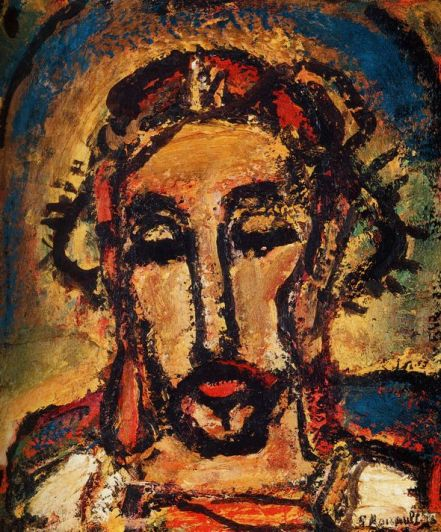
By French painter Georges Rouault (1871-1958)

I love you, Lord;
    you are my strength.
The Lord is my rock, my fortress, and my savior;
    my God is my rock, in whom I find protection.
He is my shield, the power that saves me,
    and my place of safety.
I called on the Lord, who is worthy of praise,
    and he saved me from my enemies.

The ropes of death entangled me;
    floods of destruction swept over me.
The grave wrapped its ropes around me;
    death laid a trap in my path.
But in my distress I cried out to the Lord;
    yes, I prayed to my God for help.
He heard me from his sanctuary;
    my cry to him reached his ears…

You gave me victory over my accusers.
    You appointed me ruler over nations;
    people I don’t even know now serve me.
As soon as they hear of me, they submit;
    foreign nations cringe before me.
They all lose their courage
    and come trembling from their strongholds.

The Lord lives! Praise to my Rock!
    May the God of my salvation be exalted!
He is the God who pays back those who harm me;
    he subdues the nations under me
    and rescues me from my enemies.
You hold me safe beyond the reach of my enemies;
    you save me from violent opponents.
For this, O Lord, I will praise you among the nations;
    I will sing praises to your name.
You give great victories to your king;
    you show unfailing love to your anointed,
    to David and all his descendants forever. (New Living Translation)

King David, the psalmist, had no problem with publicly expressing his great feeling of love for God. His desire was to be thoroughly devoted to the Lord; and he confidently discerned God as the source of his strength.

What’s more, David freely recognized God as the One who brought him deliverance. David cried out in distress. In his despair and desperation, he looked to the Lord, and God responded.

This is in contrast to those who complain about God and consider the Lord as distant and uncaring – if existing at all. David’s experience was that of being heard by God. And he wanted everyone to know, so that the faithful may be encouraged.

David didn’t want people becoming discouraged because of the bitterness of others who accuse God of being unconcerned.

The psalmist was not just talking about some mundane request, like asking for parking spot close to the building. David was in a life-and-death situation, stressful beyond imagination. Things were not looking good for him.

It seemed that the insolent, who think God isn’t watching, believed they could act unjustly and do whatever they wanted. Sadly, their lust for power and control blinds them to the larger reality of an invisible God who sees, and who responds at just the right time.

David wanted people to remember and not to forget about the saving actions of God. Because by keeping in mind who God truly is, then we can have confident trust, and will live in a way that is right, just, and good.

“Our service will not be perceived as authentic unless it comes from a heart wounded by the suffering about which we speak.”

Henri Nouwen

A good, right, and just life is always the appropriate response to divine mercy and deliverance. We are saved from evil, so that we might live in the spiritual freedom of purity and peace. And David gave God some due praise, adoration, and thanksgiving for rescuing him from his enemies.

Since David went through all of the adversity, hardship, stress, and suffering of dealing with unjust people, he was in a position to be a wounded healer for us.

A wounded healer is not someone who endorses a victim mentality. Rather, this is a person who has been profoundly hurt – physically, mentally, emotionally, or spiritually – and comes through the experience with an ability to be present with others and help facilitate healing in those who suffer.

Surely he took up our pain
    and bore our suffering,
yet we considered him punished by God,
    stricken by him, and afflicted.
But he was pierced for our transgressions,
    he was crushed for our iniquities;
the punishment that brought us peace was on him,
    and by his wounds we are healed. (Isaiah 53:4-5, NIV)

We all suffer and face various hard circumstances. And we are all changed by the hurtful encounters. But we don’t all respond the same way to that adversity. The difficult experiences of pain lead us to become either bitter or better.

If we have a wounded healer in our life, there is a good chance that we will be able to move through the hardship and come to a place of gratitude for what the Lord has done for us and how God brought us deliverance.

“As followers of Jesus we can also allow our wounds to bring healing to others.”

Henri Nouwen

Deliverance may not end up looking like anything we anticipate. If we are stuck on particular outcomes and have a singular expectation, then we may very well miss the Rescuer when the ship of salvation shows up.

Yet, if we can remain open to and aware of God – as well as of what’s going on inside us – then we shall likely experience healing for our deep wounds of pain. And we will embrace the scars it leaves as a reminder of the Lord’s deliverance.

It could be that things don’t change, at least like we want. In such times, perhaps the greatest healing that can take place is to be healed from the need for healing.

The Lord shows unfailing commitment and steadfast love to the faithful, to those who seek God. We shall find the divine in all circumstances, that is, if we seek God with all our heart.

“You will seek me and find me when you seek me with all your heart.” (Jeremiah 29:13, NIV)

Pain cannot be taken away unless we enter into it. So, it only makes sense to me, that we have a guide like the psalmist to lead us, and a Savior like Jesus to rescue us.

“Wholeness is not achieved by cutting off a portion of one’s being, but by integration of the contraries.”

Carl Jung

May you be patient in suffering, as Christ was in his earthly pain.

May the Lord be near you in your time of weakness and wondering.

May God sustain you by divine grace, and grant you courage not to have a failure of faith.

May you know healing of both body and soul.

And may you always believe that what happens to you in this present life is of little account if you hold Christ in eternal life. Amen.