Jeremiah 29:1-14 – Bloom Where You Are Planted

This is the text of the letter that the prophet Jeremiah sent from Jerusalem to the surviving elders among the exiles and to the priests, the prophets and all the other people Nebuchadnezzar had carried into exile from Jerusalem to Babylon. (This was after King Jehoiachin and the queen mother, the court officials and the leaders of Judah and Jerusalem, the skilled workers and the artisans had gone into exile from Jerusalem.) He entrusted the letter to Elasah son of Shaphan and to Gemariah son of Hilkiah, whom Zedekiah king of Judah sent to King Nebuchadnezzar in Babylon. It said:

This is what the Lord Almighty, the God of Israel, says to all those I carried into exile from Jerusalem to Babylon: “Build houses and settle down; plant gardens and eat what they produce. Marry and have sons and daughters; find wives for your sons and give your daughters in marriage, so that they too may have sons and daughters. Increase in number there; do not decrease. Also, seek the peace and prosperity of the city to which I have carried you into exile. Pray to the Lord for it, because if it prospers, you too will prosper.” Yes, this is what the Lord Almighty, the God of Israel, says: “Do not let the prophets and diviners among you deceive you. Do not listen to the dreams you encourage them to have. They are prophesying lies to you in my name. I have not sent them,” declares the Lord.

This is what the Lord says: “When seventy years are completed for Babylon, I will come to you and fulfill my good promise to bring you back to this place. For I know the plans I have for you,” declares the Lord, “plans to prosper you and not to harm you, plans to give you hope and a future. Then you will call on me and come and pray to me, and I will listen to you. You will seek me and find me when you seek me with all your heart. I will be found by you,” declares the Lord, “and will bring you back from captivity. I will gather you from all the nations and places where I have banished you,” declares the Lord, “and will bring you back to the place from which I carried you into exile.” (NIV)

Whenever I am in a conversation with a Christian, I often ask them what their favorite Bible verse or passage of Scripture is. Hands down, the most often cited verse is Jeremiah 29:11 –

“For I know the plans I have for you,” declares the Lord, “plans to prosper you and not to harm you, plans to give you hope and a future.” (NIV)

It certainly is a wonderful verse. Yet, there is a distinct situation and context surrounding that verse about the future, which is very much rooted in the present. The nation of Judah had been invaded and taken into captivity to Babylon. Understandably, the people were longing to go back home. They did not want to be in Babylon. So, Jeremiah (who remained in Judah) sent them a letter, warning them not to listen to false prophets who would give them an easy answer about getting out of Babylon quickly. Instead, he instructed them to make a good life for themselves in their captive land.  He essentially told them to “bloom where you are planted.”

If you don’t like something, change it.

If you can’t change it, change your attitude about it.

maya angelou

The people, although in a place and in a situation which they neither wanted nor expected, needed to be present to their surroundings and settle down. They were to pray for peace, both for themselves and for their captors, because their own success in life was inextricably tied to their geographical place in Babylonia. The sooner the people listened to Jeremiah on this, the better off they would be.           

Plans to give us a hope and future only have meaning for us today when we:

  • Understand that we are to work hard, right where we are, in a place we do not want to be.
  • Pray for that place, its people, and their welfare.
  • Thrive in our present hard circumstance. 
  • Only then, can we look to the bright future of hope.

Our present sufferings are incomparable to the coming glory yet to be revealed. That future hope only occurs if we persevere and find ways of flourishing in the place and situation where we are today. 

So, how will you thrive in the place God has you right now? We always have the choice to practice resilience and make the absolute best of unwanted circumstances – or sit and stew over our misfortune to the point of becoming bitter and hard. It is important to choose wisely.

Lord God, almighty and everlasting Father, you have brought me in safety to this new day.  Preserve with your mighty power so that I might not just wish for a different today and are not able to see what you have for me in this place.  May I not be overcome by adversity, but in all things direct me to the fulfilling of your purposes, through Jesus Christ, my Lord in the strength of the Holy Spirit.  Amen.

Jeremiah 20:14-18 – Overwhelmed with Grief

By Unknown artist

Cursed be the day I was born!
    May the day my mother bore me not be blessed!
Cursed be the man who brought my father the news,
    who made him very glad, saying,
    “A child is born to you—a son!”
May that man be like the towns
    the Lord overthrew without pity.
May he hear wailing in the morning,
    a battle cry at noon.
For he did not kill me in the womb,
    with my mother as my grave,
    her womb enlarged forever.
Why did I ever come out of the womb
    to see trouble and sorrow
    and to end my days in shame? (NIV)

Perhaps you feel as though you must put on a good face, a decent front for others to see. You don’t like other people seeing you upset or cry because it can be embarrassing. Maybe you believe others don’t need to be burdened with your sadness. The last thing you want is to be a killjoy.

Sometimes you might even put up a front with God.  Maybe you think God wants everyone to be perpetually happy and always sing with the birds in blissful joy and gladness, or whistle while you work. However, that would not be an accurate view of God.

One of the most faithful people in Holy Scripture, Jeremiah, freely and unabashedly lamented before God – to the point of wishing he were dead. Jeremiah, the incredible prophet of God, closer to the Lord than anyone of his generation, was so despondent and ashamed that he wished he were never even born. The suffering and the shame were just too overwhelming.

To say that Jeremiah had a difficult ministry is a gross understatement. He literally had the ministry from hell, prophesying to people who neither liked him, nor his message to them. In the middle of it all, Jeremiah threw up his hands and let out his complaint to God. Jeremiah was in such ministerial misery that he wished he had been a stillborn baby.

Lest you think Jeremiah was sinfully depressed or just cuckoo, he is far from alone in the Bible. King David had no scruples about letting God know how he felt about his dire circumstances. Job, likely the most famous sufferer of all, spent time doing nothing but lamenting his terrible losses for months. What all three of them have in common is that they openly grieved with great tears, yet neither cursed God nor forsook the Lord.

Lamentation is the sacred space between intense grieving to God without blaming the Lord for our significant changes and losses in life. I would even argue that lamenting and grieving before God is a necessary spiritual practice which needs full recognition in the Body of Christ. Please sit with that last statement for a bit and consider how it might become a reality in your own life and context.

Grief can and does attach itself to any change or loss. It is the normal emotional, spiritual, physical, and relational reaction to that injury of the heart. There is only one way through grief. We must tell our story to another. It is both biblical and quite necessary.

Share each other’s burdens, and in this way obey the law of Christ.”

galatians 6:2, NLT

We need our spirituality to support us in such times – not drive us away through a misguided theology of believing you must keep a stiff upper lip. It is critical to have safe and supportive people in our lives when going through overwhelming circumstances.

“Spirituality is recognizing and celebrating that we are all inextricably connected to each other by a power greater than all of us, and that our connection to that power and to one another is grounded in love and compassion.”

Brené Brown

Our tears are holy. They are not the mark of weakness, but of power. The prophet Jeremiah was doing a very godly thing in expressing his grief. And Jeremiah’s lament is what helped steel him for the several attempts on his life that he faced.

Let the tears do their intended work in your life.

God of all, you feel deeply about a great many things.  As your people, we also feel a great depth of emotion when our lives go horribly awry from our dreams and expectations.  Hear our lament as we pour out our grief before you, through Jesus, our Savior, with the presence of the Holy Spirit.  Amen.

Psalm 86 – Theology Proper

Psalm 86 by Ann Williams

Incline your ear, O Lord, and answer me,
    for I am poor and needy.
Preserve my life, for I am devoted to you;
    save your servant who trusts in you.
You are my God; be gracious to me, O Lord,
    for to you do I cry all day long.
Gladden the soul of your servant,
    for to you, O Lord, I lift up my soul.
For you, O Lord, are good and forgiving,
    abounding in steadfast love to all who call on you.
Give ear, O Lord, to my prayer;
    listen to my cry of supplication.
In the day of my trouble I call on you,
    for you will answer me.

There is none like you among the gods, O Lord,
    nor are there any works like yours.
All the nations you have made shall come
    and bow down before you, O Lord,
    and shall glorify your name.
For you are great and do wondrous things;
    you alone are God.
Teach me your way, O Lord,
    that I may walk in your truth;
    give me an undivided heart to revere your name.
I give thanks to you, O Lord my God, with my whole heart,
    and I will glorify your name forever.
For great is your steadfast love toward me;
    you have delivered my soul from the depths of Sheol.

O God, the insolent rise up against me;
    a band of ruffians seeks my life,
    and they do not set you before them.
But you, O Lord, are a God merciful and gracious,
    slow to anger and abounding in steadfast love and faithfulness.
Turn to me and be gracious to me;
    give your strength to your servant;
    save the child of your serving girl.
Show me a sign of your favor,
    so that those who hate me may see it and be put to shame,
    because you, Lord, have helped me and comforted me. (NRSV)

Today’s psalm is a prayer of David, asking God for help against enemies. David was a guy who knew what it was like to have evil men hate him and pursue taking his life through no fault of his own. I am not sure about your experiences with such people. Although I have never faced adversity to such a degree as David, I do know something about people who, to put it bluntly, just flat-out hate my guts. It feels awful, and it can be terribly draining emotionally and spiritually. Having disrespectful and rude people talk behind your back (and sometimes even to your face) is in direct contrast to who God is.

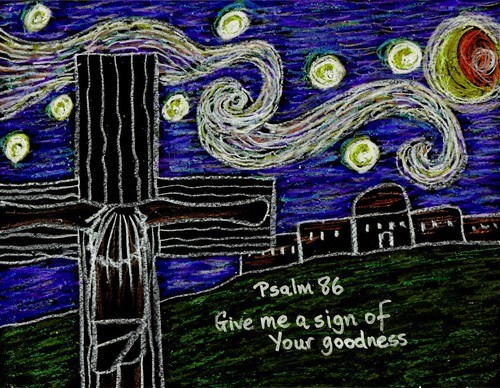
God is described by David as merciful and gracious, slow to anger, abounding in steadfast love, and faithful. Whereas insolent people objectify others and seek their own selfish agendas, God always acts in accord with a basic character of love and grace. Based upon the nature of God, we can choose to cry out, just like David did, to show us a sign of God’s favor. We can pray for God to provide us with some tangible communication of divine love in ways we can understand so that we can be helped and receive the kind of comfort we need through our adversity.

Psalm 86, chalk art by Scottish pastor and artist John Stuart, 2009

Be assured that with such a God, our pleas, cries, and tears will be noticed, affirmed, and answered. We can trust the sovereign Lord of all creation to address the insolence and injustice that exists around us and toward us.

All of this gets down to our view of God, our theological understanding of the basic Divine nature and purpose.  For some people, God is up there, somewhere, like some white-bearded old guy who is aloof to what is going on down here – there is neither anything personal nor personable about him, at all. For others, God is a force which binds all things together. In this theology, God exists, but you are never quite sure how to connect – it is like a crapshoot trying to get in touch with him.  For yet others, God is perpetually perturbed about something; he has a bee in his bonnet, and it is apparently our job to figure out what he is so sullen and upset about all the time so that we can appease him in some way.

However, the psalmist, David, sees God in wholly other ways than this. For David, God is personal, knowable, and reachable. David thought about God in ways which transcend either gendered or personality-type categories. Note the descriptions David provided: a willingness to forgive; an abiding, consistent, and steadfast presence of divine love; always having the time and desire to listen; possessing the power and ability to provide help and protection; being kind and merciful; not being easily angered; and extending needed comfort and consolation.

Now this is a God you can sink your teeth into – attentive, engaged, and anything but upset all the time. This is the reason why David has confidence to ask for deliverance, direction, and delight. Such a God is like a caring grandmother who seeks to always love and serve, and not a crotchety old curmudgeon who always seems bothered by everyone and everything.

If your theology, your view of God, cannot support and bear the weight of life’s hardest circumstances, then you need a different view of God! I invite you to see the God of David. Theology proper discerns the being, attributes, and works of God as fundamentally faithful and loving. This God has both the ability and the will to meet and satisfy your life’s greatest needs.

Great God of David, you are above all things and beside all things and with all things. You are uniquely positioned and powerful to walk with me through all the situations of my life. Thank you for sending the Son of David to make real your promises to me.  Amen.

Psalm 69:1-5, 30-36 – The Praise of Suffering

Psalm 69 by Japanese painter Makoto Fujimura

Save me, God,
    because the waters have reached my neck!
I have sunk into deep mud.
    My feet cannot touch the bottom!
I have entered deep water;
    the flood has swept me up.
I am tired of crying.
    My throat is hoarse.
    My eyes are exhausted with waiting for my God.

More numerous than the hairs on my head
    are those who hate me for no reason.
My treacherous enemies,
    those who would destroy me, are countless.
    Must I now give back
    what I did not steal in the first place?
God, you know my foolishness;
    my wrongdoings are not hidden from you….

I will praise God’s name with song;
    I will magnify him with thanks
    because that is more pleasing to the Lord than an ox,
    more pleasing than a young bull with full horns and hooves.
Let the afflicted see it and be glad!
    You who seek God—
    let your hearts beat strong again
    because the Lord listens to the needy
        and does not despise his captives.

Let heaven and earth praise God,
    the oceans too, and all that moves within them!
God will most certainly save Zion
    and will rebuild Judah’s cities
    so that God’s servants can live there and possess it.
The offspring of God’s servants will inherit Zion,
    and those who love God’s name will dwell there. (CEB)

As the Church’s and the Christian’s prayer book, the psalms offer a way to come to God when our feelings and emotions have us not knowing how to pray, at all.  If you are depressed because of people who would like to see you fail or are out to get you, then this is the psalm for you to pray!

When you are voiceless, the psalter can voice it for you. When you are unable to put your thoughts into words, the Scripture can word it for you. Two of the great attributes of God are divine power and love, which means that the Lord is more than able to do something about your situation, and it will always be done in a loving way.  Know today that God hears you and is working on a response to your lament – even if it is not in your own words but the words of Holy Scripture.

Psalm 69 by Austrian artist Ernst Fuchs, 1960

God will come through in God’s own good time. However, you can still praise the Lord right now, smack in the middle of your dilemma. David, the author of today’s psalm, chose to praise God, even though he did not get an immediate answer to his prayers. Perhaps God is more concerned to change us before changing our circumstances.

We need a solid theology of suffering. And that biblical psalms give it to us. I know of no one who wakes in the morning, sits on the edge of their bed, and says, “Gee, I want to suffer today and feel lots of emotional and spiritual pain.” No, we want happiness and joy, not agony and hardship. Yet suffering has much to teach us and the Lord is rarely quick to snatch us from its lessons. The hardship of personal suffering teaches us faith and dependence upon God, as well as leading us to ask for help from others so that we are lovingly supported.

“The way you look at things is the most powerful force in shaping your life.”

john o’donohue

Tribulations in life are common to all people without exception. The issue is whether we will submit to its hard-knock education, or not – whether we will become better people, or bitter. The Irish teacher and poet, John O’Donohue, penned a poem entitled, “For Suffering,” concerning the blessing of hard things:

May you be blessed in the holy names of those

Who, without knowing it,

Help to carry and lighten your pain.

May you know serenity

When you are called

To enter the house of suffering.

May a window of light always surprise you.

May you be granted the wisdom

To avoid false resistance;

When suffering knocks on the door of your life,

May you glimpse its eventual gifts.

May you be able to receive the fruits of suffering.

May memory bless and protect you

With the hard-earned light of past travail;

To remind you that you have survived before

And though the darkness is now deep,

You will soon see approaching light.

May the grace of time heal your wounds.

May you know that though the storm may rage,

Not a hair of your head will be harmed.

To Bless the Space Between Us: A Book of Blesings (Doubleday, 2008)

We have all likely at times felt the anguish of the psalmist – being so overwhelmed that it feels like we are drowning. The feeling is compounded exponentially when behind the sense of trying to keep our heads above water there are people who do not like us – maybe even hate us, to the point of undermining our work every chance they get.  It is in such circumstances we might experience sleepless nights hoping that somehow and someway God will show up.

The typical modus operandi for some within adverse situations is the age-old route of complaining and wishing things were different. Yet neither griping about our problems nor dishing out slander and gossip toward others is a healthy way of dealing with adversity. Just the opposite response is the proper path to the bone-crushing feeling of opposition: to praise God’s name with a song and magnify the Lord with thanksgiving. 

The reason the believer can engage in adoring God during trouble is not some Jedi-type mind trick to make us think more positively. Instead, the basis for praise is in knowing God. It is God who ultimately will deal with the wicked; it is the Lord who will bend to listen to our lament when times are hard. 

Thanking God for answers to prayer in advance of them being answered is a biblical thing to do. Having a faith robust enough to see ahead toward hope can bring love to a loveless situation, and usher in praise before the divine deed of deliverance is even accomplished.

Saving God, thank you for your deliverance!  I give you praise for loving me through sending your Son, the Lord Jesus, to this earthly realm so that I might experience salvation from sin, death, and hell. By Christ’s authority, in the power of the Holy Spirit given to me, I resist the enemy’s attempts to seize control of my life.  I belong to you, holy God. Amen.