Revelation 19:1-8 – The Time Is Coming

Photo by Andrea Piacquadio on Pexels.com

After this I heard what sounded like the roar of a large crowd of people in heaven, saying, “Praise God! Salvation, glory, and power belong to our God! True and just are his judgments! He has condemned the prostitute who was corrupting the earth with her immorality. God has punished her because she killed his servants.” Again, they shouted, “Praise God! The smoke from the flames that consume the great city goes up forever and ever!” The twenty-four elders and the four living creatures fell down and worshiped God, who was seated on the throne. They said, “Amen! Praise God!”

Then there came from the throne the sound of a voice, saying, “Praise our God, all his servants and all people, both great and small, who have reverence for him!” Then I heard what sounded like a crowd, like the sound of a roaring waterfall, like loud peals of thunder. I heard them say, “Praise God! For the Lord, our Almighty God, is King! Let us rejoice and be glad; let us praise his greatness! For the time has come for the wedding of the Lamb, and his bride has prepared herself for it. She has been given clean shining linen to wear.” (The linen is the good deeds of God’s people.) (Good News Translation)

The past few years, it seems as if the world is upside-down. For many people, living on this earth has become something of a surreal experience of folks dying apart from loved ones, racism rearing its ugly head through microaggressions, as well as overt words and actions, and neighbors killed due to gun violence. The suffering is palpable.

However, things will not always be this way. There is coming a time when disease, death, and poverty will end. In the age to come there will be no more numbing grief, seemingly endless tears, constant oppression, grinding hardship, and silent suffering.

The day will arrive when, together with all saints past and present, and along with the angelic host, we will collectively shout, “Hallelujah!” The end of this present age will eventually come.

Time is nothing more than the relationship between events. When all events are ended, there will be no more time – only unending eternity in the presence of God. For the Christian, this is our hope and ultimate salvation. Our deliverance from sin, death, and hell will be complete.

So, we wait and watch, preparing ourselves for the consummation of God’s kingdom. Meanwhile, we are truly in an awkward time between the two advents of Christ. It is the already/not yet time. We are already saved, yet not fully; we are holy, yet not completely; we have our adoption papers as children of God, yet still wait for our celebration feast with Christ.

There are few times more impatient, agonizing, joyful, and hopeful than a marriage engagement. It’s as if two people are inextricably connected but not yet completely together.

I still remember the weird feeling of the six months between my engagement to my heart’s love and standing at the altar marrying my bride. Those months included every emotion imaginable, from exuberant happiness to agonizing waiting, along with hopeful anticipation and sheer nervousness.

It was a time, for me, of unique joy and unwanted suffering. Since I was separated by two-thousand miles from my beloved for most of our engagement, it was an unparalleled longing for the marriage to occur.

That is likely how believers have felt throughout the ages as they look forward to the second coming of Christ. In a period of hardship and even persecution, Christians long for their Savior – to be with Jesus forever and be shed of the world’s crud, the sinful nature, and the machinations of the devil.

In this present age, we have received the Holy Spirit as a sort of engagement ring, a constant sign and presence to help us until the marriage happens with Christ as groom and the Church as bride. Since we have not yet experienced this, it is difficult for us to anticipate just how incredible and inconceivable the coming age will be.

Yet, the Christian intuitively knows, by means of the Spirit, that the upcoming marriage supper will be a heavenly paradise – and so we long for it, especially in these days of uncertainty and difficulty.

Presently, the great harlot attempts to seduce the believers, if that were possible, away from Christ. However, along with all God’s holy angels, we will join in the heavenly chorus which continually sings, “Praise God!” to Father, Son, and Spirit.

The book of Revelation describes the end of history for the purpose of encouraging the saints of God in the present moment of hardship. God will, once and for all, destroy evil, and faithful believers will be united with Christ forever in glory.

So, as we plod through the Christian season of Lent, we do so with the anticipation and hope of Easter and new life. Because Jesus is risen from death, we gaze into the future longing for our own resurrection. Presently, we hold both suffering and glory together, the past and the future.

For it is the past redemptive deeds of Christ which guide us in the present and gives shape to our future. Christ shall return – and it will be soon.

Even so, come, Lord Jesus. Amen.

Job 1:1-22 – A Better Way Through Impossible Suffering

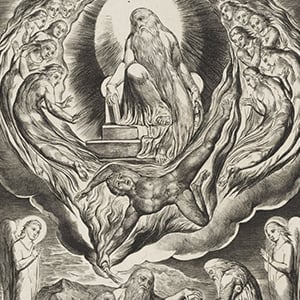
Satan Going Forth from the Presence of the Lord by William Blake, 1825

In the land of Uz there lived a man whose name was Job. This man was blameless and upright; he feared God and shunned evil. He had seven sons and three daughters, and he owned seven thousand sheep, three thousand camels, five hundred yoke of oxen and five hundred donkeys, and had a large number of servants. He was the greatest man among all the people of the East.

His sons used to hold feasts in their homes on their birthdays, and they would invite their three sisters to eat and drink with them. When a period of feasting had run its course, Job would arrange for them to be purified. Early in the morning he would sacrifice a burnt offering for each of them, thinking, “Perhaps my children have sinned and cursed God in their hearts.” This was Job’s regular custom.

One day the angels came to present themselves before the Lord, and Satan also came with them. The Lord said to Satan, “Where have you come from?”

Satan answered the Lord, “From roaming throughout the earth, going back and forth on it.”

Then the Lord said to Satan, “Have you considered my servant Job? There is no one on earth like him; he is blameless and upright, a man who fears God and shuns evil.”

“Does Job fear God for nothing?” Satan replied.“Have you not put a hedge around him and his household and everything he has? You have blessed the work of his hands, so that his flocks and herds are spread throughout the land. But now stretch out your hand and strike everything he has, and he will surely curse you to your face.”

The Lord said to Satan, “Very well, then, everything he has is in your power, but on the man himself do not lay a finger.”

Then Satan went out from the presence of the Lord.

One day when Job’s sons and daughters were feasting and drinking wine at the oldest brother’s house, a messenger came to Job and said, “The oxen were plowing and the donkeys were grazing nearby, and the Sabeans attacked and made off with them. They put the servants to the sword, and I am the only one who has escaped to tell you!”

While he was still speaking, another messenger came and said, “The fire of God fell from the heavens and burned up the sheep and the servants, and I am the only one who has escaped to tell you!”

While he was still speaking, another messenger came and said, “The Chaldeans formed three raiding parties and swept down on your camels and made off with them. They put the servants to the sword, and I am the only one who has escaped to tell you!”

While he was still speaking, yet another messenger came and said, “Your sons and daughters were feasting and drinking wine at the oldest brother’s house, when suddenly a mighty wind swept in from the desert and struck the four corners of the house. It collapsed on them, and they are dead, and I am the only one who has escaped to tell you!”

At this, Job got up and tore his robe and shaved his head. Then he fell to the ground in worship and said:

“Naked I came from my mother’s womb,
    and naked I will depart.
The Lord gave and the Lord has taken away;
    may the name of the Lord be praised.”

In all this, Job did not sin by charging God with wrongdoing. (New International Version)

Much of life is a mystery. We simply do not know why some things happen. And it’s likely we won’t have answers to many of our vexing questions, this side of heaven. From our limited human perspective, **** happens, and that’s about all we can say about it. 

There are times in Holy Scripture, however, when the veil between heaven and earth is peeled back long enough for us to catch a glimpse of mystery. Today’s Old Testament lesson is such a story. 

Job was a wealthy man and had everything this earthly life could offer. What’s more, he was a pious godly person of faith. It was commonly understood that those two things always went together. So, when we see behind the curtain and are privy to a conversation between God and Satan, the devil himself points this out – that Job only praises God because of how good he has it.  Even with this understanding of what was behind Job’s misery, we still see the mysterious God allowing Satan to operate with only God-knows reasons why.

Whenever calamity strikes, or bad news causes us to slump in our chairs, or adversity hits unexpectedly, or trouble smacks us upside our life like a sledgehammer, it’s only human to begin wondering what we did wrong or what we did to bring on such a terrible set of circumstances. 

But the truth is this: We just don’t always know. 

Yes, I fully understand that statement is hard to swallow; it even sucks. For example, no amount of understanding why my grandson has a rare form of epilepsy will make the pain go away. All my wonderings about his future isn’t going to help my daughter. It’s an impossible emotional place to be. It’s sad and it’s frustrating.

Yet, there is a better way.

Although there is so much we don’t know, we do know Job’s inconceivable response to the mystery of God. He made an incredible confession of faith, despite the most awful of circumstances. Job made the affirmation:

“When I was born into this world,
    I was naked and had nothing.
When I die and leave this world,
    I will be naked and have nothing.
The Lord gives,
    and the Lord takes away.
Praise the name of the Lord!”

Job 1:21, ERV

Rather than spending all of our emotional energy trying to figure out an answer to our “why” questions, perhaps the more sage response is to confess our faith in a radical trust of God. 

Using these actual words from Job can be a necessary start to navigating the troubled waters of evil which swirl around us, even if we have to say them over and over again to believe them.

I know I do.

Almighty God, every good thing I have in my life comes from you. It is your prerogative whether I continue to have those things, or not. Whatever happens, whether it causes heartbreak or happiness, is completely known to you. I trust that you know what you are doing, and I completely throw myself upon your mercy through Jesus Christ, my Savior. Amen.

Exodus 6:1-13 – Our Own Worst Enemy

Moses and the Burning Bush by Marc Chagall

Then the Lord told Moses, “Now you will see what I will do to Pharaoh. When he feels the force of my strong hand, he will let the people go. In fact, he will force them to leave his land!”

And God said to Moses, “I am Yahweh— ‘the Lord.’I appeared to Abraham, to Isaac, and to Jacob as El-Shaddai—‘God Almighty’—but I did not reveal my name, Yahweh, to them. And I reaffirmed my covenant with them. Under its terms, I promised to give them the land of Canaan, where they were living as foreigners. You can be sure that I have heard the groans of the people of Israel, who are now slaves to the Egyptians. And I am well aware of my covenant with them.

“Therefore, say to the people of Israel: ‘I am the Lord. I will free you from your oppression and will rescue you from your slavery in Egypt. I will redeem you with a powerful arm and great acts of judgment.I will claim you as my own people, and I will be your God. Then you will know that I am the Lord your God who has freed you from your oppression in Egypt. I will bring you into the land I swore to give to Abraham, Isaac, and Jacob. I will give it to you as your very own possession. I am the Lord!’”

So, Moses told the people of Israel what the Lord had said, but they refused to listen anymore. They had become too discouraged by the brutality of their slavery.

Then the Lord said to Moses, “Go back to Pharaoh, the king of Egypt, and tell him to let the people of Israel leave his country.”

“But Lord!” Moses objected. “My own people won’t listen to me anymore. How can I expect Pharaoh to listen? I’m such a clumsy speaker!”

But the Lord spoke to Moses and Aaron and gave them orders for the Israelites and for Pharaoh, the king of Egypt. The Lord commanded Moses and Aaron to lead the people of Israel out of Egypt. (New Living Translation)

We can become our own worst enemy.

In Lodi, California, in March of 2006, a city dump truck backed into a car belonging to a man named Curtis Gokey. The car was damaged badly. So, Gokey sued the city of Lodi for $3,600. There is, however, a catch to the story: Curtis Gokey was driving the city dump truck that crunched his personal car. And he admitted it was his fault. The city dropped the lawsuit, stating that Gokey could not sue himself. 

Like Curtis Gokey, we are often our own worst enemies. We might get down on ourselves or on God. There are times when it’s easy for us to either justify ourselves or blame ourselves, while wondering why God and/or others keep doing things we don’t like. 

When life is not going so well, it’s possible to slide into a private belief system that thinks God is not good for his promises (James 1:16-17). At worst, one can start to think that God is the problem and the source of the trouble. 

To be self-deceived is to go astray and slowly drift from the truth…. It can happen to anybody. The first step is having expectations that go unmet. An expected answer to prayer goes unanswered. Somebody lashes out and there seems to be no protection from it. Some anticipated blessing does not come to pass….

Moses was downright confused. He was confident and convinced God had called him to free the Israelites from their cruel bondage in Egypt. But nothing was going right. And the people were upset with Moses for making things worse, not better.

Trusting God and not becoming discouraged when we don’t understand everything that’s happening can be a big challenge. We might wonder if we really have what it takes to do anything well. We may wonder if God is even listening, or if God is paying any attention, at all, to our terrible plight….

  • “Why, God, did you let my son or daughter die? How in the hell am I supposed to keep going!?” 
  • “Why, God, did you give me a gaslighting boss to deal with? I get tongue-tied around her. How is she ever going to listen to me?”
  • “Why won’t people get vaccinated for COVID-19? How am I supposed to talk to the anti-vaxers?”
  • “Why, God, is everything changing? How am I going to speak up?”

Questioning can help us make sense of our situations. However, questioning may also cause us to doubt that God is there and will act on our behalf. In such times, it might be tempting to blame God for a broken relationship, a terrible event, a dysfunctional family, or an adverse situation. 

Yet, God has chosen to give us birth through the word of truth (not a word of deception and lies) so that we might have new life with fresh eyes of faith to see our situations as God sees them (James 1:18).  That is what wisdom is – the ability to see all of life from God’s perspective. 

If any of us lacks wisdom, we should ask God, who gives generously without finding fault, and it will be given to us (James 1:5).  This is a promise from a good God who knows how to give good gifts.

None of us are above falling into misinterpretations that lead to the self-deceptions of questioning God’s goodness and our own God-given personhood. We need to be vigilant in watching for the false stories we might tell ourselves such as: 

  • “This wouldn’t have happened, if I just would’ve been better.”
  • “There’s nothing I can do about it.”
  • “I’m just a big screw-up. I can’t do anything right.”
  • “God messed-up when he made me.” 
  • “I don’t know what to say. I’m not good with words.”

We are all to take charge of our lives through having a robust theology of God that discerns the Lord is always good, all the time, without exception; and that we are called by a good God to do good work.

The good news is that a good God has taken care of the sin issue once for all through the cross of Christ. The Lord has brought us the good gifts of forgiveness and grace. God has given us the Holy Spirit to help us and guide us into all truth so that we will have wisdom and humility to live the Christian life as it is meant to be lived. 

For the Christian, the key to it all is faith – genuine authentic faith that places head, heart, and hands completely in Jesus Christ so that we have right belief, right motives, and right actions all rightly working together in a full-orbed Christianity that glorifies the triune God, encourages Christ’s church, and blesses God’s big world. 

Don’t be your own worst enemy by sabotaging your thoughts with the double-mindedness of wondering about the true nature of God. 

Explore the depths of God in Christ and discover the goodness that can result even in life’s most difficult experiences.

Lord God almighty, Creator of heaven and earth:

When evil darkens our world, give us light.

When despair numbs our souls, give us hope.

When we stumble and fall, lift us up.

When doubts assail us, give us faith.

When nothing seems sure, give us trust.

When ideals fade, give us vision.

When we lose our way, be our guide!

That we may find serenity in Your presence, and purpose in doing Your will.

Through Jesus Christ, our Savior, Lord, Brother, and Friend. Amen.

Exodus 5:10-23 – More Bricks, Less Straw “Why, God!?”

A brick making scene from an ancient the ancient Egyptian tomb of Rekhmire, c.1400 B.C.E.

So, the slave drivers and foremen went out and told the people: “This is what Pharaoh says: I will not provide any more straw for you. Go and get it yourselves. Find it wherever you can. But you must produce just as many bricks as before!” So, the people scattered throughout the land of Egypt in search of stubble to use as straw.

Meanwhile, the Egyptian slave drivers continued to push hard. “Meet your daily quota of bricks, just as you did when we provided you with straw!” they demanded. Then they whipped the Israelite foremen they had put in charge of the work crews. “Why haven’t you met your quotas either yesterday or today?” they demanded.

So the Israelite foremen went to Pharaoh and pleaded with him. “Please don’t treat your servants like this,” they begged. “We are given no straw, but the slave drivers still demand, ‘Make bricks!’ We are being beaten, but it isn’t our fault! Your own people are to blame!”

But Pharaoh shouted, “You’re just lazy! Lazy! That’s why you’re saying, ‘Let us go and offer sacrifices to the Lord.’ Now get back to work! No straw will be given to you, but you must still produce the full quota of bricks.”

The Israelite foremen could see that they were in serious trouble when they were told, “You must not reduce the number of bricks you make each day.” As they left Pharaoh’s court, they confronted Moses and Aaron, who were waiting outside for them. The foremen said to them, “May the Lord judge and punish you for making us stink before Pharaoh and his officials. You have put a sword into their hands, an excuse to kill us!”

Then Moses went back to the Lord and protested, “Why have you brought all this trouble on your own people, Lord? Why did you send me? Ever since I came to Pharaoh as your spokesman, he has been even more brutal to your people. And you have done nothing to rescue them!” (New Living Translation)

It was God – Yahweh, the great I AM – who called to Moses from the burning bush. It was God who told Moses to go to Egypt because of the groaning of the Israelites in their slavery. It was also God who promised Moses that Divine help would deliver the people from their awful bondage. 

But the promised vision of release and rescue from captivity ran into the harsh buzz-saw of reality. 

Moses did exactly what God told him to do. He was completely attentive and obedient to God’s revealed will. And the result? Pharaoh forced the Israelite slaves to make bricks without being supplied with the straw to do it. Now, the people’s situation is even worse than it was before Moses showed up on the scene. What’s up with that!?

Since we know the end to the story, we understand where all of this is going. However, when we put ourselves in the sandals of Moses, it’s anything but clear about what was happening.

“Confusion is a sign of intelligence; only fools are crystal clear.”

Haresh Sippy

None of us gets off this planet without facing some hard things. We may even face those difficulties when we’re just trying to do the right thing. We’re simply trying to help, do our best, obey God, and then we get in trouble. In those situations, we can empathize with Moses getting testy with God and expressing his complaint.

The God of the universe is big enough to handle our protests in the midst of trouble – even when those complaints are directly pointed toward him. God gets it.

There is an appropriate place for us to freely express our abject disbelief, our painful wonderings, and our outright anger toward God. We won’t get a lightning bolt from heaven if we ask and cry out, “Why, God? What the **** are you doing!?”

There have been many times in my life when I questioned whether I was really sent by God to be in a certain place or to do a certain thing. I seriously wondered whether I really heard God, or not. Maybe it was my own voice in my head. Perhaps it was an emotional decision. 

The incongruence between what we believe and how things are actually turning out can be maddening.

But there is something we must all realize: Just because things go from bad to worse does not necessarily mean God isn’t in the thing. 

We are not always, even usually, privy to the mind of God in the big picture of what the Lord is doing. 

In the middle of trouble, we might think God is not at work, not paying attention, or slow to act. Yet, God knows exactly what’s going on and what the plan is. Sometimes, we need to discern and know that things will get worse before they will get better – and that God has not abandoned us.

Wise God, I trust you that you know what you are doing, even though I don’t see what in the world is going on. Help me to see all things from your perspective so that I might have the wisdom to move forward in faith and patience. I’m out on a limb for you! Please don’t let it break! Amen.