Walk on Water? Why? (Matthew 14:22-33)

Jesus Walks on Water, by Konstantin Alexejewitsch Korowin, 1890 

Immediately Jesus made the disciples get into the boat and go on ahead of him to the other side, while he dismissed the crowd. After he had dismissed them, he went up on a mountainside by himself to pray. Later that night, he was there alone,and the boat was already a considerable distance from land, buffeted by the waves because the wind was against it.

Shortly before dawn Jesus went out to them, walking on the lake. When the disciples saw him walking on the lake, they were terrified. “It’s a ghost,” they said, and cried out in fear.

But Jesus immediately said to them: “Take courage! It is I. Don’t be afraid.”

“Lord, if it’s you,” Peter replied, “tell me to come to you on the water.”

“Come,” he said.

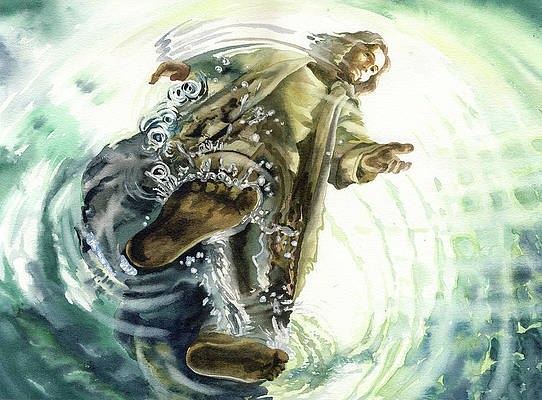
Then Peter got down out of the boat, walked on the water and came toward Jesus. But when he saw the wind, he was afraid and, beginning to sink, cried out, “Lord, save me!”

Immediately Jesus reached out his hand and caught him. “You of little faith,” he said, “why did you doubt?”

And when they climbed into the boat, the wind died down. Then those who were in the boat worshiped him, saying, “Truly you are the Son of God.” (New International Version)

In the New Testament Gospels, we see Jesus for who he is – Son of God and true Sovereign of the universe – seeking to reconcile people to God through his life, miracles, and teaching. In the Gospels we also see Christ’s disciples for who they are – a rag-tag bunch who express both belief and doubt, and experience both faith and failure.

The reality of the Christian life is that it is a sort of three-steps-forward and two-steps-backward kind of experience. The expectation that we will “succeed” and have everything go hunky-dory each time we step out in faith, is far from how things actually work in both the world and in God’s kingdom. Doubt and failure are important experiences for the believer in Jesus.

Without failure, there is no Christian life. Why? Because it means we are still in the boat.

It’s evidence that we never left the safety of established routines and responded to God’s command to step out of our comfort zone, and boldly go where we’ve never gone before.

Our failures may, like Peter, be colossal bellyflops. Yet, Jesus is there – extending grace to Peter and helping him, even in his failure of faith. Failure does not define us; it isn’t our identity. Jesus is Lord over everything, including storms, hardship, and trouble. 

Yes, there are a lot of scary things in life. Learning to ride a bike was scary. Driving for the first time on an icy road was scary. Getting married and having kids was scary. Admitting a fault, mistake, or weakness is scary. Being vulnerable with another person is scary.

It can even be scary to be at church. Why? Because we might fail, and it may crush us.

The fear of failure, however, need not control our lives. Why? Because grace overcomes everything.

We all find ourselves, at times, caught midway between faith and doubt. But to know this situation is to experience grace. If the worst scenario you worry about in your head would actually come to pass, it will still never change the reality that God loves you! And it will not stop Jesus from extending his hand to you in a life-saving grip of grace. 

Fear melts away when we keep our eyes on Jesus. So, we must focus on Christ, instead of fixating on the waves around us. The truth sets us free. Therefore, let’s notice five truths about Jesus that help us overcome the fear of failure and embrace a life of faith.

1. Jesus is a person of prayer

Jesus was deeply dependent on his heavenly Father. His life exhibited the necessities of simple prayer and obedience. If Jesus found the need for solitude and prayer for his life and ministry, how much more to we need it!? 

The Lord had his disciples get into the boat and go out on the lake. Jesus knew they were about to face a storm. The boat ended up getting thrown around by the waves. Even though the disciples were doing God’s will by going out on the lake, they were not spared from adversity.  

Jesus wanted his disciples to experience the storm. Why? Because it is through the storm that we learn faith.  

Faith is developed through experience and adversity. Faith that never endures distress, never grows and matures. Faith must be exercised – and if it isn’t, it atrophies and becomes useless. 

Show me a person with great faith, and I’ll show you a person that has gone through a boatload of adversity and hurt, having allowed Jesus to grace them with healing.

2. Jesus is present with us, and this presence brings an end to fear

Being in the middle of a lake during a storm did not prevent Jesus from being present with the disciples – he just walked on the water to be with them. Even though the disciples had just participated in the miracle of Jesus feeding the five thousand, another miracle was not on their radar – which is why they did not recognize Jesus and were afraid when they saw him.

While afraid, we don’t see Jesus, even when he’s right in front of our faces. Why? Because we don’t expect him to be there and mistake him for a ghost.  

When the disciples cried out in fear, Jesus responded. I used to have a factory job, training workers. When the training was completed, I had the trainees evaluate our time together. The top response I received is that my presence helped them to learn their job – the freedom to fail time and time again without judgment. Having me there to rescue them, when things got too much, built confidence that they could do it on their own.

3. Jesus desires those who follow him to imitate him

Jesus walked on water. Jesus invited Peter to walk on water. Peter was not chided by Jesus for getting out of the boat, but for doubting that he could continue in the miracle that was happening. 

Jesus isn’t merely interested in disciples being able to regurgitate his teaching. Why? Because he wants us to exercise our learning through actual deeds of faith.  

Once the command of Jesus was given to Peter, “Come”, then walking on water became only a matter of trust.

“Christianity has not been tried and found wanting. It has been found difficult and left untried.”

G.K. Chesterton

We understandably get nervous when a crazy Jesus and an unpredictable Holy Spirit call us to change by getting out of the friendly confines of the boat. Why? After all, we might fail. 

However, it is at those times that we bank on God’s Word and promises. The Apostle James said that if we find ourselves lacking wisdom to deal with the unpredictable and unknowable, we are to ask God who gives generously to all without finding fault and will be given to us. (James 1:5)
Christ Walking on the Sea, by Natali Fedorova

Peter responded to his predicament by crying out to Jesus, “Lord, save me!” Jesus immediately reached out and saved Peter from his own doubt and lack of faith. Jesus called Peter a “little-faith.”

Many people have lived too long with the notion that God is some stern angry deity who is constantly displeased with sinful people, and that only through perfection will God ever be happy with us. The truth is that Jesus wants us to imitate him; and, when we fail, he is there to pick us up. 

4. Jesus has the authority to settle the storm when he is ready to do it

Jesus is King. Christ is Sovereign of the world. He will bring the crisis to an end according to his own good pleasure and good timing. Rather than spending all our emotional capital by worrying or conniving to get out of a situation, we can trust God and keep our eyes on Jesus.  Our job is to believe; God’s job is everything else.

5. Jesus’ power led the disciples to acknowledge who he is

Worship happens when we see Jesus as he really is, the Son of God. Flat, dull, boring worship comes from flat, dull, boring Christians who are unable to see the power of Jesus in their lives. We discover the power of God when we are in a situation which requires God’s strength to deliver us. Grasping Jesus as the Son of God is more than a verbal confession of faith; it is being able to trust him, like getting out of a boat in the middle of a lake.

We are to live by faith in the Son of God who loved us and gave himself for us (Galatians 2:20). It doesn’t require much faith to pray that Aunt Mable’s bunions will feel better. It only requires a little faith to give a dollar when you have ten dollars. It takes no faith to discuss the weather and steer clear of hard conversations.

But it does require faith:

  • to pray for a miraculous healing every day without giving up for a little boy who is racked by epilepsy, and trust God to spare his life
  • to write a check for $100 to someone in need when you have exactly $100 in your checking account, and trust God to provide for you own necessities. 
  • to go off the grid of the routine schedule to have a difficult discussion about social justice, and trust God to act on Christ’s teachings. 
  • to live as though the mission of God in this world is the most important thing we could ever do, and trust God to step out and do it.

It would be great if we could pray and act without ever doubting or failing, yet the only way to do that is to never step out of the boat. Instead, live life. Trust God. And see what happens.

Holy God, help us, your people, to embrace the life that is truly life by stepping out of the boat.  May Jesus define our lives instead of letting failure define us. May we accept the grace that is ours in Jesus Christ our Lord, in whose name we are bold to pray. Amen.

I Am with You (Isaiah 43:1-7)

The Train Crossed the Red Sea, by Marc Chagall, 1966

But now thus says the Lord,
    he who created you, O Jacob,
    he who formed you, O Israel:
Do not fear, for I have redeemed you;
    I have called you by name; you are mine.
When you pass through the waters, I will be with you,
    and through the rivers, they shall not overwhelm you;
when you walk through fire you shall not be burned,
    and the flame shall not consume you.
For I am the Lord your God,
    the Holy One of Israel, your Savior.
I give Egypt as your ransom,
    Cush and Seba in exchange for you.
Because you are precious in my sight
    and honored and I love you,
I give people in return for you,
    nations in exchange for your life.
Do not fear, for I am with you;
    I will bring your offspring from the east,
    and from the west I will gather you;
I will say to the north, “Give them up,”
    and to the south, “Do not withhold;
bring my sons from far away
    and my daughters from the end of the earth—
everyone who is called by my name,
    whom I created for my glory,
    whom I formed and made.” (New Revised Standard Version)

God is for us, not against us. The Lord is with us. In fact, a healthy way of viewing the entirety of Holy Scripture is to see it communicating a singular message that divine presence is always there, always a given. Which, then, allows us to respond with faith and trust, instead of fear and anxiety.

God is with us because God loves us. Contrary to how many folks were raised in the church, the Lord is not a continually angry Being. God isn’t like the perpetually upset parent who always finds fault with the child. Rather, the God of Scripture is Love itself, alive and flamed with a desire to gather humanity within a protective brood, much like a concerned mother hen.

“Be still, and know that I am God!
    I am exalted among the nations;
    I am exalted in the earth.”
The Lord of hosts is with us;
    the God of Jacob is our refuge.

Psalm 46:10-11, NRSV

“Look, the virgin shall become pregnant and give birth to a son, and they shall name him Emmanuel,” which means, “God is with us.” (Matthew 1:23, NRSV)

Jesus said, “And remember, I am with you always, to the end of the age.” (Matthew 28:20, NRSV)

Beloved, let us love one another, because love is from God; everyone who loves is born of God and knows God. Whoever does not love does not know God, for God is love. (1 John 4:7-8, NRSV)

There are times when our souls can become parched and dry, times when it seems no one quite understands, and as if circumstances might overwhelm the spirit. The best remedy to such times is to fill oneself full of God, of the divine love and presence that is with us. 

Today’s Old Testament lesson is the perfect prescription for those passing through difficulty and/or wondering what lies ahead, fearful of the future. The following is my own translation/interpretation of this encouraging passage of Holy Scripture; may it fortify your soul today and lead you through the sticking points of life:

Now listen up to what the Lord says, the One who created you and formed you:

Don’t be afraid, because I’m the God who has bought you from the auction block with the ultimate price;

            I have called you by name, and you are now mine.

When you are in water over your head, I want you to know that I will be with you;

            and when it seems like you are drowning, please understand that I’ve got you;

when you walk through fiery trials, I want you to know that you will not be burned,

            and the circumstance will not consume you and burn you out.

This will all be true because I am the Lord your God,

            the Holy One, your Savior.

I put everyone around you in their place,

            and there is no one who is in a position to buy you back from me.

Because you are infinitely precious in my eyes,

            and honored, and I love you,

there is nothing I would not give for you,

            nothing I would not do to keep you with me.

Don’t be afraid because I am with you always;

            I will gather all my children from the east and from the west,

            so that you will never be alone on this earth.

In fact, I will command all the ends of this planet of yours

            to not withhold, to bring together every son and daughter from the farthest reaches,

everyone who is called by my name,

            whom I created for my glory,

            whom I formed and made.

You are all in this life together,

            and I, the Lord, am watching over each and every one of you. 

 Bank on it.

Amen.

Praise and Prayer (Psalm 86:11-17)

Teach me your way, Lord,
        so that I can walk in your truth.
    Make my heart focused
        only on honoring your name.
I give thanks to you, my Lord, my God,
    with all my heart,
    and I will glorify your name forever,
    because your faithful love toward me is awesome
    and because you’ve rescued my life
        from the lowest part of hell.

The arrogant rise up against me, God.
    A gang of violent people want me dead.
    They don’t give a thought for you.
But you, my Lord,
    are a God of compassion and mercy;
    you are very patient and full of faithful love.
Come back to me! Have mercy on me!
    Give your servant your strength;
    save this child of your servant!
Show me a sign of your goodness
    so that those who hate me will see it and be put to shame—
        show a sign that you, Lord,
        have helped me and comforted me. (Common English Bible)

Psalms are prayers. And today’s prayer is from David, a guy who knew what it was like to have evil men hate him and pursue taking his life, through no fault of his own. 

I don’t know about you, but, although I have never faced adversity to such a degree as David, I do know something about people who, to put it bluntly, just flat-out hate my guts. It is not a good feeling, and it can be terribly draining emotionally and even spiritually. 

Having disrespectful and rude people who talk behind your back (and sometimes even to your face) is in direct contrast to who God is.

Who is God? What is God’s character?

God is described by David as merciful and gracious, slow to anger and abounding in steadfast love and faithfulness. Whereas insolent people objectify others and do not seek their best interests, God always acts in accord with a basic divine character of love and grace. 

Based upon the nature of God, we can choose to cry out, just like David did, to show us a sign of God’s favor. We can pray for God to provide us with some tangible communication of divine love, given on our level, so that we can grasp and understand it.

For we all, at various points in our life, need help and comfort through hardship and adversity.

Be assured that God hears the cries of the godly. The Lord notices ungodliness and injustice, and will do something about it. 

At the same time we are receiving divine guidance and help, we can trust God to address the insolence that exists around us and toward us.

Why can we trust God? What is the basis of such faith?

Seven times in the psalm, David refers to Yahweh as my Lord. And three times David refers to himself as your servant. This is a relationship – Lord to servant, Creator to creature – and it means the servant can cry out to his Lord and can confidently expect a positive response to his cry.

It is the nature and character of God to be attentive and answer God’s people.

The Lord is merciful and gracious,
    slow to anger and abounding in steadfast love.

Psalm 103:8, NRSV

Because of the divine/human relationship, David can call boldly to God, confident of God’s will and of God’s power to help. The gang of violent people who had it out for David also have no regard for God. So, David is emboldened to pray for divine favor, while at the same time, praying against those that despise him.

Yahweh, the God of David, can deliver us from the lowest parts of hell itself, because God is the expert on deliverance from the worst places that humanity finds themselves in. And so, the Lord is the One who is worthy of praise. Eventually, this reality will ultimately be recognized by all nations.

“Great and amazing are your deeds,
    Lord God the Almighty!
Just and true are your ways,
    King of the nations!
Lord, who will not fear
    and glorify your name?
For you alone are holy.
    All nations will come
    and worship before you,
for your judgments have been revealed.” (Revelation 15:3-4, NRSV)

Praise and petition go together like a hand in a glove. David freely praises God with thanksgiving for the divine character and saving actions – while at the same time, he offers fervent prayer, based upon the understanding that God is good.

David’s impassioned petition is this: Teach me your way, Lord, so that I will walk in truth; and give me an undivided heart to keep on honoring and praising your name. David longed for a completely focused heart on God and God’s will for his life.

“Hear, O Israel: The Lord is our God, the Lord alone. You shall love the Lord your God with all your heart, and with all your soul, and with all your might.” (Deuteronomy 6:4-5, NRSV)

In those times when we feel as if we are between a rock and a hard place, wanting to remain positive, yet also acknowledging life’s crud, we can come to Psalm 86 and adopt it as our own prayer for the day…

Train me, God, to walk straight;
    then I’ll follow your true path.
Put me together, one heart and mind;
    then, undivided, I’ll worship in joyful fear.
From the bottom of my heart I thank you, dear Lord;
    I’ve never kept secret what you’re up to.
You’ve always been great toward me—what love!
    You snatched me from the brink of disaster!
God, these bullies have reared their heads!
    A gang of thugs is after me—
    and they don’t care a thing about you.
But you, O God, are both tender and kind,
    not easily angered, immense in love,
    and you never, never quit.
So look me in the eye and show kindness,
    give your servant the strength to go on,
    save your dear, dear child!
Make a show of how much you love me
    so the bullies who hate me will stand there slack-jawed,
As you, God, gently and powerfully
    put me back on my feet. (The Message)

What Is Your View of God? (Psalm 86:1-10)

God’s Love… by Hope G. Smith

Incline your ear, O Lord, and answer me,
    for I am poor and needy.
Preserve my life, for I am devoted to you;
    save your servant who trusts in you.
You are my God; be gracious to me, O Lord,
    for to you do I cry all day long.
Gladden the soul of your servant,
    for to you, O Lord, I lift up my soul.
For you, O Lord, are good and forgiving,
    abounding in steadfast love to all who call on you.
Give ear, O Lord, to my prayer;
    listen to my cry of supplication.
In the day of my trouble I call on you,
    for you will answer me.

There is none like you among the gods, O Lord,
    nor are there any works like yours.
All the nations you have made shall come
    and bow down before you, O Lord,
    and shall glorify your name.
For you are great and do wondrous things;
    you alone are God. (New Revised Standard Version)

What is your view of God? 

For some, God is up there, somewhere, like some white-bearded old guy who is aloof to what is going on down here – there is neither anything personal nor personable about him, at all. If he gets involved, at all, it’s just to get out his divine BB gun and shoot a few sinners in the backside.

For others, God is a force which binds all things together; God is there, but you’re never quite sure how to get in touch with him – it’s like a crap shoot trying to connect with God. So, you might do all sorts of things to get God’s attention, like be especially good – and if that doesn’t work, maybe you’ll go the other way and be especially bad, just to get any sort of attention.

For yet others, God is perpetually perturbed about something; he’s got a bee in his divine bonnet and it’s our job to figure out what he’s sullen and upset about all the time, that we might appease God in some way. So, you might double-down on being self-sacrificial, try not to swear in front of the Pastor, and help others so that God will, in turn, help you.

The psalmist David, however, sees God in a very different way than all the aforementioned. God is not aloof and distant, nor angry. Instead, David understands and views God as personal, knowable, and reachable.

What characterizes God?

Reading today’s psalm tells us a great deal of how David thought and felt about God. Notice what we learn about God from David’s description: good and forgiving; abounding in steadfast love; listens and answers; and, does great and wondrous things.

Now this is a God you can sink your teeth into. This God is attentive, engaged, and is anything but upset all the time – which is why David has no problem asking God to listen and answer his prayer.

David put his trust in God to save him and make his heart glad. With this kind of God, David can willingly affirm his devotion. With a God of steadfast love and support, the worshiping and praying person’s heart forever belongs to the Lord.

If your view of God cannot support and bear the weight of your life’s hardest circumstances, then you need a different view of God!

Rather than God being the problem, it could be that your understanding of God is off. And if your understanding of God is off, then it’s likely that your own understanding of yourself is skewed – which is why many persons who have darker views of God are down on themselves and possess little self-worth.

I invite you to see the God of David. This God has both the ability and the willingness to satisfy your life’s greatest needs.

What will you do with your view of God?

In humility and brokenness, we call out in our misery. God responds in steadfast love and abundant mercy. With God, we can move from trouble to confidence.

And sometimes, we discover that our troubles and our circumstances change very little. But we ourselves have changed a great deal. Our compulsions for solid answers to our questions give way to a settled confidence in divine mystery. And our obsessions with a pain-free and problem-free life are replaced with a curiosity for what the hard situations in our lives will teach us.

The poor and needy cry out to God, knowing that grace and mercy characterizes the Lord. Life on this earth may not treat us well, but God gives us much more than we deserve.

The faithful trust in the Lord, fully confident that their preservation and protection are in God’s hands – and not in political leaders or padded bank accounts.

The miserable pray, constantly persevering in prayer, because their hope is in the name of the Lord who made heaven and earth. They have learned to pray expectantly, understanding that sometimes the greatest miracle of all is being delivered from the need to have a miracle.

Those who lift their faces to heaven, looking for the bright sunshine of grace, will know joy, down deep in their soul – and not simply a fleeting happiness from temporary reprieve of trouble.

The ones calling on the name of the Lord, banking their lives on God’s love, discover forgiveness and a good peaceful life of peace – rather than the anxiety of constantly worrying about tomorrow.

The spiritually devoted are confident that God will answer in their day of trouble – and they are patient, knowing full well that God’s sense of timing is much better than their own. So, they learn to hold all things loosely, knowing that God gives and God takes away. Blessed be the name of the Lord.

All those taking the time and effort to find the God who is truly characterized by kindness and compassion know in their gut, without a shadow of a doubt, that there is no one like the Lord – a God who does wondrous things and is attentive to justice and righteousness.

What is your view of God? Listen closely to the psalmist, and he will tell you what the Lord has done for him because of God’s basic nature of love and goodness.

Great God of David, you are above all things and beside all things and with all things. You are uniquely positioned and powerful to walk with me through all the situations of my life. Thank you for sending the Son of David to make your promises real to me. Amen.