Hallelujah! (Psalm 150)

Psalm 150, by Christie Michael

Hallelujah!

Praise God in his holy place.
Praise him in his mighty heavens.
Praise him for his mighty acts.
Praise him for his immense greatness.
Praise him with sounds from horns.
Praise him with harps and lyres.
Praise him with tambourines and dancing.
Praise him with stringed instruments and flutes.
Praise him with loud cymbals.
Praise him with crashing cymbals.

Let everything that breathes praise the Lord!

Hallelujah! (God’s Word Translation)

The word “hallelujah” is an English transliteration of the Hebrew word, הַלְלוּ יָהּ, which when translated means, “praise Yahweh,” or “praise the Lord.” According to today’s psalm, there is a whole lot of hallelujah that is encouraged for us to do.

There is a time for quiet reflection and contemplation, and there is a time for jubilant shouts of praise. The biblical psalms mirror the full range of human emotion. Having moved through the ups and downs of doubt, curiosity, anger, lament, and trust, it is appropriate that the psalter ends with lots of joyful noise.

I grew up in a generation where children were expected to be quiet in church. Not surprisingly, as a child, I found the church worship service on Sunday to be the most boring hour of my week. After a Saturday of morning cartoons, sugary cereal, All-Star Wrestling, and playing outside in the dirt with my brother, Sunday morning was typically a big letdown.

All I have to say about that, and about cranky old women shushing kids in church, is that the adults somehow forgot to read Psalm 150. Maybe if us big people were better about encouraging our little people to dance in the aisles, blow a kazoo as loud as they can, and freely give a shout to the Lord, then perhaps there would be a lot fewer defections from church worship services.

But don’t think that I’m advocating for everyone to go all out noise, all the time. Just as it is neither necessary nor appropriate to always shout everything you say, and skip everywhere you go, so the worship of God needs to encompass the broad scope of the human condition. Silence, meditation, and stillness have their important place. In a desire to make church fun, some Christians have created imbalanced experiences of only victory in Jesus.

By Marc Chagall, 1977

One of the reasons I follow the Christian Year with its liturgical movements is that it holds and maintains the balance of worship and the theological tension of both crucifixion and resurrection. We need healthy rhythms of sorrow and joy, stillness and movement, quietness and shouting.

The Church is currently in the Christian season of Eastertide. It is a focused time of celebration – which is why we have biblical sections in this time of year like Psalm 150. This is the appropriate time to lift loud praise to God for the risen Christ and celebrate salvation and new life in Jesus.

I’m not really a numbers kind of guy, yet it’s easy to notice the word “praise” occurs 10 times in a psalm of just 6 verses. And 7 musical instruments are mentioned. Methinks we’re supposed to not miss something here.

Praise is to happen in heaven and earth, in all creation, out in the world as well as inside the walls of the church building. It is to be done with voice, dance, drums, horns, woodwinds, and stringed instruments. Because God has done wonderful and marvelous acts throughout the earth, people are to respond with profuse gratitude expressed with lots of emotion.

Just so you know, that means sourpuss Christians who wrongheadedly believe human feelings ought to be stuffed and suppressed, need some remedial theological education about who God is and exactly what he expects from people. Somebody, please dispense the laxative of Psalm 150 to loosen their spiritual constipation!

God gave us our breath, and we are to use it for praise. If we see the entire book of Psalms as a life, then it is fitting the final psalm ends with sanguine praise. Indeed, when a person is at end of life, do they have reason to praise? A life of walking with God through thick and thin will inevitably end with recounting the ways in which the Lord has shown up and delivered. They want musical praise filling their last days and minutes.

That is exactly what Duke Ellington did in the twilight of his life. On January 19, 1968, Ellington performed a concert of sacred music at St. John the Divine cathedral in New York City. Among the original songs he performed and later recorded was his musical interpretation of Psalm 150. He called it “Praise God and Dance.”

Duke Ellington said that this praise music, and the two other albums of sacred music he recorded, were “the most important thing I have ever done.” When Ellington performed “Praise God and Dance” at the ancient Church of Santa Maria del Mar in Barcelona, Spain, the congregation spontaneously burst into the aisles with dancing and singing.

The whole person is to be involved in praise – mind, body, emotions, and spirit – because Yahweh is the God of the whole earth, and not just of the spiritual dimension.

Make a joyful noise to the Lord, all the earth; break forth into joyous song and sing praises. Sing praises to the Lord with the lyre, with the lyre and the sound of melody. With trumpets and the sound of the horn make a joyful noise before the King, the Lord. (Psalm 98:4-6, NRSV)

I will bless you every day. I will praise your name forever and always. The Lord is great and so worthy of praise! God’s greatness can’t be grasped. (Psalm 145:2-3, CEB)

Praise the Lord! My whole being, praise the Lord. I will praise the Lord all my life; I will sing praises to my God as long as I live. (Psalm 146:1-2, NCV)

Shout praises to the Lord! Our God is kind, and it is right and good to sing praises to him. (Psalm 147:1, CEV)

Hallelujah! Amen.

The Who, What, When, Why, Where, and How of Praise (Psalm 148)

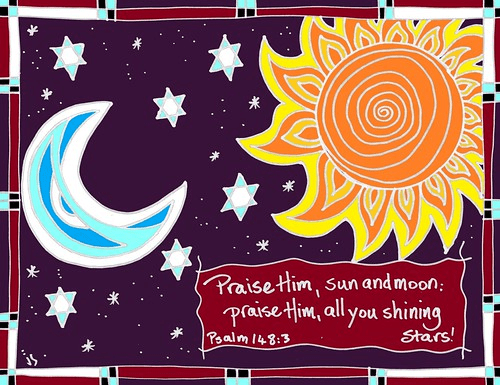
By Stushie Art

Praise the Lord!
Praise the Lord from the heavens;
    praise him in the heights!
Praise him, all his angels;
    praise him, all his host!

Praise him, sun and moon;
    praise him, all you shining stars!
Praise him, you highest heavens
    and you waters above the heavens!

Let them praise the name of the Lord,
    for he commanded, and they were created.
He established them forever and ever;
    he fixed their bounds, which cannot be passed.

Praise the Lord from the earth,
    you sea monsters and all deeps,
fire and hail, snow and frost,
    stormy wind fulfilling his command!

Mountains and all hills,
    fruit trees and all cedars!
Wild animals and all cattle,
    creeping things and flying birds!

Kings of the earth and all peoples,
    princes and all rulers of the earth!
Young men and women alike,
    old and young together!

Let them praise the name of the Lord,
    for his name alone is exalted;
    his glory is above earth and heaven.
He has raised up a horn for his people,
    praise for all his faithful,
    for the people of Israel who are close to him.
Praise the Lord! (New Revised Standard Version)

By Stushie Art

Everything in all creation points to a Creator who cares for us. The 12 days of Christmas (December 25–January 5) are a great celebration. King Jesus has come; he is the rightful Sovereign over all creation. Believers recognize Christ’s incarnation – affirming the identity of Jesus as both full human and fully divine. 

Worshipers praise the Lord. It’s in our spiritual DNA to give adoration, praise, and honor to God. Today’s Psalm is not only meant for good times; it’s also for the despondent, difficult, and downright hard times. There’s always an open season on praising the Lord, no matter what’s going on in and around us. 

Psalm 148 helps to re-orient us around praise to God, instead of remaining stuck in being disoriented.  Whether in good times or bad, we praise the Lord. 

Who should praise the Lord?

Everyone. Everything. 

God has created and continues to impact every nook and cranny of creation. Therefore, the entire universe – every creature and all humanity – acknowledge the Lord with praise. 

The outer reaches of the universe, on everything out there which we cannot even see, praise the Lord. 

The earth and everything in it praise the Lord. 

The forces of nature praise the Lord. 

The landscape, the flora and fauna, animals and humans, together with all creation, praise the Lord. 

Young people, old people, men and women – no matter who they are or where they come from – praise the Lord. 

The proper purpose of everything and everyone that exists is giving adoration and praise to God.

In the Ancient Near East, the sun, moon, and stars were considered gods by the various people groups. This Psalm was, therefore, more than a summons to praise – this was a call to recognize the One true God as the sovereign and the rightful ruler of all. Thus, the ancient peoples understood this psalm as a claim that their gods must bow to Israel’s God.

What is praise to the Lord?

Praise to the Lord is a recognition that God deserves praise from everyone and everything. Praise is physical posture and a heart stance of bowing, yielding, and submitting to God. “Praise the Lord” in the Hebrew language is “hallelujah.” And “hallelujah literally means “to raise the hands.”

We are told 10 times in the 14 verses of Psalm 148 to praise the Lord, that is, to raise our hands. It’s a symbol of submission and joy. To have open hands lifted toward heaven conveys our obedience and commitment to God. 

When do we praise the Lord?

Praising the Lord and lifting the hands, is not only to occur in church or worship setting; praise happens everywhere.

We lift our arms in reverent submission at our workplaces when we land a client or have a good day; and when cranky and critical people demean us. Praising the Lord isn’t limited to good circumstances.

We raise our hands and praise the Lord when our neighbors care about us and look out for us, as well as when they make noise and irritate us with their less than kept up yards and houses. Yielding to God’s purposes for our lives is not dependent upon whether we have good neighbors or not. 

We praise the Lord and raise our hands when our marriages are life-giving and thriving, as well as when our relationship with our spouse is dry, dull, and going nowhere. It’s always open season on praising the Lord and reflecting his image through love. 

By Stushie Art

We praise the Lord for our kids, not only when they do what’s right; but also when they’re complete stinkers and drive us nuts. We are to use our hands for praise and enact obedience, and not for violence through finger pointing or physical punishment.

In adversity, we praise the Lord because it gives us a chance to put our faith into action. In times when someone is being insensitive and callous, it provides the opportunity to praise the Lord and love them because God loves us.

At all times, in all places, in every circumstance, and with each situation we raise our hands in hallelujah to Jesus for saving us from our misguided ways and bringing us back into fellowship with God. 

Lift your hands, always! And when, like Moses, we can no longer lift them, let others help hold them up we so that we can keep praising God. (Exodus 17:11-12)

Why praise the Lord?

Because God created everything and everyone. 

The Lord designed every living thing and fashioned a man and a woman in the divine image as the pinnacle of creative work. 

Adam and Eve walked with God and had perfect praise of the Lord and fellowship with each other. Yet, tragedy happened. The people God formed were deceived into thinking that the Lord was holding out on them by not letting them eat from a certain tree in the garden. So, they disobeyed, ate the fruit, and so plunged the world into darkness.

However, God did not turn away from humanity. Holy Scripture is the revelation of a God who goes out of the way to do whatever it takes to reclaim people back to fellowship so that they can fulfill their original design to praise the Lord. 

The height of God’s love is sending the Son, the Lord Jesus. God became one of us so that he could save us from ourselves. 

Whenever we have exhausted all the avenues this world has to offer in bringing fulfillment, satisfaction, and peace to our lives – there stands Jesus, crucified, risen, ascended, and waiting with open arms for you and me to lift our hands and see that he has the only way for us to live. 

The reason you have felt for so long that you are a square peg in a round hole is that your life is meant to praise the Lord. You are not meant to fit into the world; you are meant for God.

Where do we praise the Lord?

From the heavens and the earth. From everywhere in all creation, and from everyone as creatures, there is to be praise to the Lord.

Humanity is one part of a big grand chorus of praise that arises from all creation. Some of the psalmist’s pairings of praise are quite informative. 

The sun that praises God during the daytime and the moon that offers its praise at night, reminds us that God’s praise is never silenced. 

The highest heavens and waters above the sky, along with the earth and what’s under its waters, helps us recall that God’s creation, from top to bottom, praises the Lord. 

The mountains and hills, with creatures and flying birds on them and circling them, communicates to us that both the noticeable and scarcely noticeable offer their praises to our God and King.

All creation burps out their praise – which means that some folk really are dumber than rocks because even the rocks know enough to praise the Lord. 

We praise the Lord – outdoors, indoors, at home, at work, in the neighborhood, with family, church, from every place there is to be a lifting of the hands to God.

How do we praise the Lord?

Of course, we raise our hands in adoration for the God who gives us life and watches over us in such a way that not a hair on our heads can fall apart from the divine will. 

We praise the Lord by being the people God created us to be – walking in fellowship with the Lord and enjoying the divine/human relationship forever.

No matter our current situation, every day and every situation is a summons to praise the Lord. God’s claim upon our lives leads us toward raising our hands to heaven. 

The person who praises God is marked by a deep humility of understanding that they are not God; expressive gratitude for God’s actions; patient confidence in God’s promises; and a sense of unity, participating in harmony with God, others, and all creation in praising the Lord!

Most High, all-powerful, all-good Lord,
All praise is Yours, all glory, honor and blessings.
To you alone, Most High, do they belong;
no mortal lips are worthy to pronounce Your Name.

We praise You for all Your creatures,
especially for Brother Sun,
who is the day through whom You give us light.
He is beautiful and radiant with great splendor,
of You Most High, he bears Your likeness.

We praise You for Sister Moon and the stars,
in the heavens You have made them bright, precious and fair.

We praise You for Brothers Wind and Air,
fair and stormy, all weather’s moods,
by which You cherish all that You have made.

We praise You, for Sister Water,
so useful, humble, precious and pure.

We praise You for Brother Fire,
through whom You light the night.
He is beautiful, playful, robust, and strong.

We praise You for Sister Earth,
who sustains us
with her fruits, colored flowers and herbs.

We praise You for those who pardon,
or who for love of You bear sickness and trial.

Blessed are those who endure in peace,
by You they will be crowned.

We praise You for Sister Death,
from whom no-one living can escape.
Woe to those who die in their sins!
Blessed are those that She finds doing Your Will.
No second death can do them harm.

We praise and bless You Lord,
give You thanks,
and humbly serve You. Amen.

 – A canticle of praise from St. Francis of Assisi

Revelation 19:1-9 – “Hallelujah!”

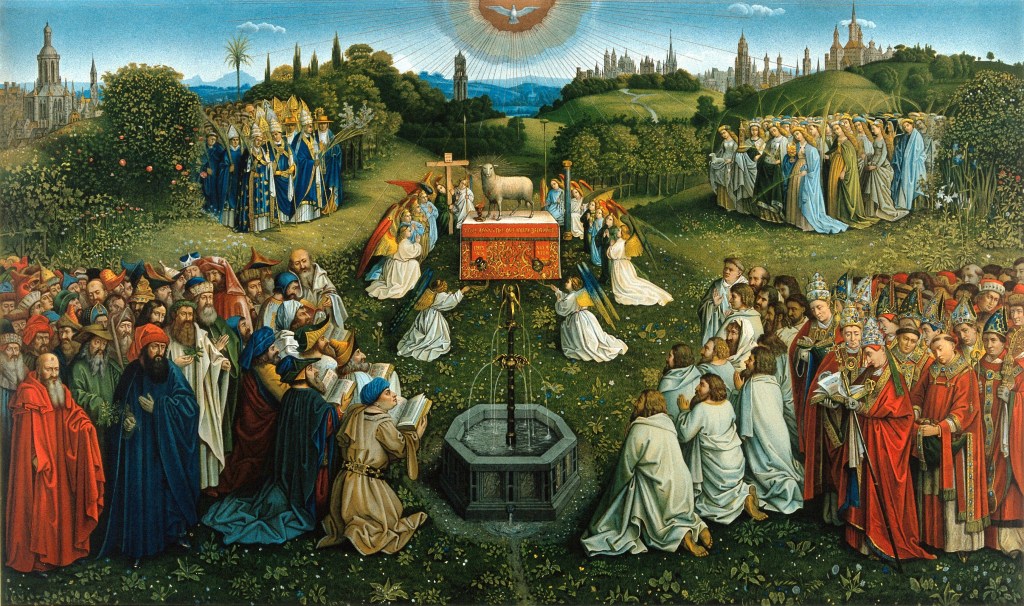
Adoration of the Lamb by Renaissance artist Jan van Eyck, 1432

After this I heard what sounded like the roar of a great multitude in heaven shouting:

“Hallelujah!
Salvation and glory and power belong to our God,
    for true and just are his judgments.
He has condemned the great prostitute
    who corrupted the earth by her adulteries.
He has avenged on her the blood of his servants.”

And again, they shouted:

“Hallelujah!
The smoke from her goes up for ever and ever.”

The twenty-four elders and the four living creatures fell and worshiped God, who was seated on the throne. And they cried:

“Amen, Hallelujah!”

Then a voice came from the throne, saying:

“Praise our God,
    all you his servants,
you who fear him,
    both great and small!”

Then I heard what sounded like a great multitude, like the roar of rushing waters and like loud peals of thunder, shouting:

“Hallelujah!
    For our Lord God Almighty reigns.
Let us rejoice and be glad
    and give him glory!
For the wedding of the Lamb has come,
    and his bride has made herself ready.
Fine linen, bright and clean,
    was given her to wear.”

(Fine linen stands for the righteous acts of God’s holy people.)

Then the angel said to me, “Write this: Blessed are those who are invited to the wedding supper of the Lamb!” And he added, “These are the true words of God.” (NIV)

Things will not always be this way. There is coming a time when pandemics and poverty will end. In the age to come there will be no more grief, tears, oppression, hardship, and suffering. The day will arrive when, together with all saints past and present, and along with the angelic host, we will collectively shout, “Hallelujah!”

Time is simply the relationship between events. When all events are ended, there will be no more time – only unending eternity in the presence of God. For the Christian, this is our hope and ultimate salvation. Our deliverance from sin, death, and hell will be complete.

So, we wait and watch, preparing ourselves for the consummation of God’s kingdom. Meanwhile, we are truly in an awkward time between the two advents of Christ. It is the already/not yet time. We are already saved, yet not fully; we are holy, yet not completely; we have our adoption papers as children of God, yet still wait for our celebration feast with Christ.

Second Coming by English painter Kevin Derek Moore

There are few times more awkward, agonizing, joyful, and hopeful than a marriage engagement. Its as if two people are inextricably connected but not yet completely together. I still remember the downright weird feeling of the six months between my engagement to my heart’s love and standing at the altar marrying my bride.

Those months included every emotion imaginable, from exuberant happiness to terrible impatience, along with hopeful anticipation and sheer nervousness. It was a time, for me, of unique joy and unwanted suffering. Since I was separated by two-thousand miles from my beloved for most of our engagement, it was an unparalleled longing for the marriage to occur.

That is likely how believers have felt throughout the ages as they anticipate the second coming of Christ. In a period of hardship and even persecution, Christians long for their Savior – to be with Jesus forever and be shed of the world, the flesh, and the devil.

In this present age, we have received the Holy Spirit as a sort of engagement ring, a continual sign and presence to help us until the marriage happens with Christ as groom and the Church as bride. Since we have not yet experienced this, it is difficult for us to anticipate just how incredible and inconceivable the coming age will be.

Yet, the Christian intuitively knows, by means of the Spirit, that the upcoming marriage supper will be a heavenly paradise – and so we long for it, especially in these days of uncertainty and difficulty.

Presently, the great harlot attempts to seduce the believers, if that were possible, away from Christ. However, along with all God’s holy angels, we will join in the heavenly chorus which continually sings, “Hallelujah!” to Father, Son, and Spirit.

The book of Revelation describes the end of history for the purpose of encouraging the saints of God in the present. God will once and for all destroy evil and faithful believers will be united with Christ forever in glory.

So, as we draw near to a close of this Christian Year with its anticipation of the new, beginning with Advent, we are mindful of both advents, both comings of Jesus. As we remember the first, we anticipate and gaze longingly for the second. Holding them both together, the past and the future, guides us in the present because Jesus Christ bookends our lives with the mercy of the cross and the grace of his coming again.

Even so, come, Lord Jesus. Amen.