Welcome, friends! On this Resurrection Day, we consider the impact of Christ rising from death. The Lord’s resurrection is not only a doctrine to believe; it is a powerful reality to live into. Click the videos below, and let us celebrate new life in Jesus Christ….
Colossians 3:1-4, Pastor Tim Ehrhardt
“Death has been swallowed up in victory.”
“Where, O death, is your victory? Where, O death, is your sting?”
The sting of death is sin, and the power of sin is the law. But thanks be to God! He gives us the victory through our Lord Jesus Christ. (1 Corinthians 15:54b-57, NIV)
Have mercy on me, O God, according to your steadfast love; according to your abundant mercy blot out my transgressions. Wash me thoroughly from my iniquity, and cleanse me from my sin.
For I know my transgressions, and my sin is ever before me. Against you, you alone, have I sinned, and done what is evil in your sight, so that you are justified in your sentence and blameless when you pass judgment. Indeed, I was born guilty, a sinner when my mother conceived me.
You desire truth in the inward being; therefore teach me wisdom in my secret heart. Purge me with hyssop, and I shall be clean; wash me, and I shall be whiter than snow. Let me hear joy and gladness; let the bones that you have crushed rejoice. Hide your face from my sins, and blot out all my iniquities.
Create in me a clean heart, O God, and put a new and right spirit within me. Do not cast me away from your presence, and do not take your holy spirit from me. Restore to me the joy of your salvation, and sustain in me a willing spirit. (NRSV)
David experienced a lot of hard things. Through it all, he held fast to walking with God. Eventually, David became king. He used his power and authority to do exactly what God likes – showing grace and kindness to those in need. Except in the case of Bathsheba, another man’s wife. He made one unwise decision, which led to a bad decision, and then to another and another – until the prophet Nathan came and called David on the carpet.
Whereas King David began his reign using his royal position to show kindness, he ended up acting like any other worldly king by giving orders and using his authority to get what he wanted. Just as David sent others to do his personal bidding, God finally sent Nathan for a divine intervention.
If we confess our sins, God will forgive us. We can trust God to do this. He always does what is right. He will make us clean from all the wrong things we have done.
1 John 1:9, ERV
Nathan wisely helped David see his sin for what it really was. Irresponsibility, adultery, and murder are serious matters. The mental and spiritual gymnastics people make to justify their poor decisions always ends up devaluing what is right and making sin less heinous than it really is.
Good news can only be properly understood considering the bad news.
Without seeing our true predicament of being held in the vice grip of sin and unable to move, we will go on wondering why nothing ever goes like we want. A person who is lost, and doesn’t know it, is in the worst of situations. Calamity is just around the corner.
Like a restaurant owner who fails to see the health violations all around him, the business is about to be shut down with him scratching his head or blaming others for his misfortune. Only when the owner comes to recognize and agree with established health standards will there be a turn around and a renewed existence for the establishment.
We must agree and comply with God about how bad things really are without sugar coating any of it.
Only then can best practices be put into place which help everyone to be safe, healthy, and happy. To King David’s credit, he saw his terrible decisions and actions for what they were and faced them squarely with a repentant heart and a renovated life.
Thus, we have today’s psalm, crafted by David as a response to his own egregious wandering from how God wanted him to reign as king. David’s sin was mercifully outdone by God’s grace. The main event to the psalm is not David’s wrongs but God’s forgiveness. Prayer is the mechanism which accesses divine pardon to even the most awful of transgressions.
The appropriate posture of the devout Christian is to pray.
Specifically, to confess our great and many sins, shortcomings, and moral failures. This might sound negative and a major downer. Yet, to not look evil square in the face and call it out for what it is, is at best denial, and at worst, allows a bitter seed of unforgiveness to gestate in the depths of your soul.
I believe one of the best ways to confront the darkness within is by using the ancient prayer book, the Old Testament Psalms. Sometimes when we pray apart from considering the psalms, our prayers go along the lines of something like, “Change my situation so I can praise you, God.” Rather, the psalms guide us toward a shift in direction by praying:
“Change me, God, because I am the problem.”
I encourage you to pray Psalm 51 out loud, slowly, with a generous amount of emotional flavor – even, and especially, if you don’t feel like it. Pray it over more than once, and perhaps several times punctuated throughout the day today. In doing so, you will be joining the faithful across the world who today offer God a prayer of subversion against the blackness on this earth.
What places in your life allow you the freedom to confess your sins? What places seem to keep you from confession? How might a regular practice of repentance help you beyond this season of Lent?
May almighty God, who has promised forgiveness of sins to all who turn in faith, pardon you and set you free from all your sins, strengthen you for right living, and keep you in eternal life, through Jesus Christ our Lord. Amen.
Ethiopian Orthodox Church icon of Christ’s crucifixion
It was necessary for the sketches of the heavenly things to be purified with these rites, but the heavenly things themselves need better sacrifices than these. For Christ did not enter a sanctuary made by human hands, a mere copy of the true one, but he entered heaven itself, now to appear in the presence of God on our behalf. Nor was it to offer himself again and again, as the high priest enters the Holy Place year after year with blood that is not his own; for then he would have had to suffer again and again since the foundation of the world.
But as it is, he has appeared once for all at the end of the age to remove sin by the sacrifice of himself. And just as it is appointed for mortals to die once, and after that the judgment, so Christ, having been offered once to bear the sins of many, will appear a second time, not to deal with sin, but to save those who are eagerly waiting for him. (NRSV)
Once for all. Those few words are some of the most gruesome and beautiful in the entirety of Holy Scripture. The sacrifices of bulls and goats in the Old Testament had its place. Yet, those were mere shadows pointing to the reality of the Messiah – the one whose sacrifice is so potent as to do away with sacrifice forever.
The cross of Christ was the once for all sacrifice that has settled the sin issue forever.
This is the heart of New Testament good news. Forgiveness of sins comes through the sheer grace of God in Christ. Through faith, we have the privilege of entering new life. Jesus has paved the way for eternal life, everlasting salvation, and complete remission of sins.
If it has not yet become self-apparent as to why Christ’s once for all sacrifice is such a game changer, then let’s perceive the cross from this angle: guilt is done away with, forever. Do you believe your life would change forever if you never had guilt hanging over your head? What if all your past indiscretions, unhealthy life decisions, failures to speak or act when needed, overt things done which you cannot take back, or even the little things said or done in anger or hate were all washed away, forever?
Just as Jesus was nailed to a cruel cross, so guilt and shame was nailed there – once for all. There are three options of dealing with a guilty conscience when it happens…
Rationalize
First, you can rationalize it away, as if you have no responsibility or no culpability. One simply ignores their conscience. This is a one-way path to hardness of heart. Whenever we sin in speech or in action, and do not acknowledge it as our fault, then there is a little piece of us which hardens. The next time it happens, it’s a bit easier to respond with callousness. If you’ve ever encountered someone who seems utterly unfeeling to your situation, then there has likely been a pattern in that person’s life of keeping distance from pain. It only leads to hardness of heart.
Punish
A second way of facing guilt is just the opposite of rationalization. It is to punish and beat yourself for your faults and sins. Heaping abuse on ourselves for our sins takes two different tracks with either: discouragement, defeat, and depression resulting in inaction; or, working like crazy to try and earn God’s favor with hyper-activity. Both ways are a kind of self-imposed penance to try and atone for one’s sins or failures.
Confess
Fortunately, there is a better way to face and deal with our guilt. When there is true guilt for things done or undone, said, or unsaid, we must confess it, repent of it, and believe God has taken care of it. Unlike dealing with guilt in unhealthy ways resulting in callousness, discouragement, and hyperactivity, the path of confession and repentance allows the person to have a clear conscience, resulting in freedom. Christ’s once for all sacrifice is completely able to clear the conscience of the worshiper so that they may live into the grace and freedom of an enjoyable daily life.
Nothing needs to hang over the believer’s head because Jesus Christ, the pioneer of our salvation, has accomplished deliverance from and forgiveness of sin, once and for all. Jesus didn’t just put a nice-looking veneer over sin; he took care of it, thoroughly and completely. Jesus didn’t whitewash things so that we looked okay; the salvation he offers is permanent.
The cross which held Christ’s naked and tortured body exposed the true violence and injustice of sin. The cross revealed what kind of world we have and what kind of God we have: a world of gross unfairness and sin, and, a God of extreme sacrificial love and grace.
What I believe this world, including you and me, need more than anything else is forgiveness – not a cheap sentimental forgiving, but a real forgiveness which lasts forever.
To justify or to judge is God’s business. Our business is to believe in the once-for-all sacrifice of Jesus that brings permanent and lasting forgiveness; and, to share that life-giving message with others so that they, too, might experience deliverance from sin and its horrible effects.
“For he delivered us from the domain of darkness and transferred us to the kingdom of his beloved Son, in whom we have redemption, the forgiveness of sins.” (Colossians 1:13-14, NIV)
May you know the freedom and joy today which comes from knowing Christ as Savior.
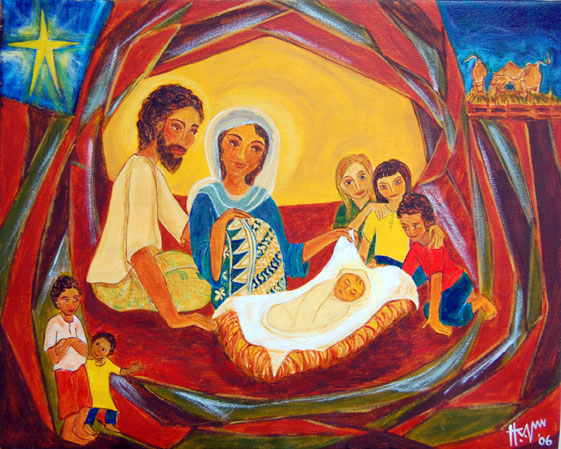
God Is With Us, by Malaysian artist Hanna Varghese, 2006
Now the main point of what we are saying is this: We do have such a high priest, who sat down at the right hand of the throne of the Majesty in heaven, and who serves in the sanctuary, the true tabernacle set up by the Lord, not by a mere human being.
Every high priest is appointed to offer both gifts and sacrifices, and so it was necessary for this one also to have something to offer. If he were on earth, he would not be a priest, for there are already priests who offer the gifts prescribed by the law. They serve at a sanctuary that is a copy and shadow of what is in heaven. Therefore, Moses was warned when he was about to build the tabernacle: “See to it that you make everything according to the pattern shown you on the mountain.” But in fact, the ministry Jesus has received is as superior to theirs as the covenant of which he is mediator is superior to the old one, since the new covenant is established on better promises.
For if there had been nothing wrong with that first covenant, no place would have been sought for another. But God found fault with the people and said:
“The days are coming, declares the Lord, when I will make a new covenant with the people of Israel and with the people of Judah. It will not be like the covenant I made with their ancestors when I took them by the hand to lead them out of Egypt, because they did not remain faithful to my covenant, and I turned away from them, declares the Lord. This is the covenant I will establish with the people of Israel after that time, declares the Lord. I will put my laws in their minds and write them on their hearts. I will be their God, and they will be my people. No longer will they teach their neighbor, or say to one another, ‘Know the Lord,’ because they will all know me, from the least of them to the greatest. For I will forgive their wickedness and will remember their sins no more.”
By calling this covenant “new,” he has made the first one obsolete; and what is obsolete and outdated will soon disappear. (NIV)
Our wait is nearly over. Christmas Day is almost here. The Messiah is coming. I genuinely believe that Jesus is the mid-point of history; everything for all time hinges upon Christ’s incarnation. The most cataclysmic event in the history of the world is a birth. The hopes of humanity are focused, of all things, in a stinky old feeding trough for animals – a manger.
Yes, Christians put a lot of focus on the cross and resurrection. Yet, the incarnation was the signature event of God’s breaking into this world. The inconceivable was conceived. God became human. Nothing would ever be the same again….
Nativity by African artist Joseph Mulamba-Mandangi, 2001
Jesus is our great high priest, the nexus between heaven and earth. All else are only mere shadows of the real Savior. Christ is the hinge upon which our own personal lives turn. The old system of law fades and gives way to the person for whom it all pointed. For the law, as important as it was, has never been able to save. In Christ there is a new covenant established by grace, taking care of the sin issue once for all.
Through the Christ child, all other means of deliverance have become obsolete. No matter how much he washed his hands, Pilate could not wash away his guilt. Despite all our efforts to hide or undo our shame, it will not go away. It is through Jesus that all guilt and shame have been banished. Human iniquity is taken away. All that we have done and left undone is forgiven – our sin is purged forever.
A new age has dawned. A new era has been inaugurated. The miracle of the Nativity explodes with continuing effect throughout history. Its continuing effects can still be felt, two-thousand years later. Nothing will ever undo the power of love and grace which was unleashed in the little town of Bethlehem.
Here is a clear and confident declaration to any and all in despondency or despair, no matter the reasons why: We may feel crushed, dejected, confused, or broken because of this past year’s events; but our salvation depends not on our mood or the constant changing of circumstances. Christ has offered himself once for all. The work is finished. Our faithful high priest is even now interceding for you and me in heaven.
Our faith is grounded not in our pedigree, our position, or our ability to produce but forever in what Christ has done in becoming human on our behalf. See the manger where he lies. Know that salvation is before us. Believe the promise of God.
May this eternal truth be always on our hearts: That the God who breathed this world into being Placed stars into the heavens And designed a butterfly’s wing Is the God who entrusted his life to the care of ordinary people became vulnerable that we might know how strong is the power of Love A mystery so deep it is impossible to grasp A mystery so beautiful it is impossible to ignore.






 Rev. Tim Ehrhardt