Have mercy on me, God, according to your faithful love! Wipe away my wrongdoings according to your great compassion! Wash me completely clean of my guilt; purify me from my sin! Because I know my wrongdoings, my sin is always right in front of me. I’ve sinned against you—you alone. I’ve committed evil in your sight. That’s why you are justified when you render your verdict, completely correct when you issue your judgment. Yes, I was born in guilt, in sin, from the moment my mother conceived me. And yes, you want truth in the most hidden places; you teach me wisdom in the most secret space.
Purify me with hyssop and I will be clean; wash me and I will be whiter than snow. Let me hear joy and celebration again; let the bones you crushed rejoice once more. Hide your face from my sins; wipe away all my guilty deeds! Create a clean heart for me, God; put a new, faithful spirit deep inside me! Please don’t throw me out of your presence; please don’t take your holy spirit away from me. Return the joy of your salvation to me and sustain me with a willing spirit. Then I will teach wrongdoers your ways, and sinners will come back to you.
Deliver me from violence, God, God of my salvation, so that my tongue can sing of your righteousness. Lord, open my lips, and my mouth shall proclaim your praise. You don’t want sacrifices. If I gave an entirely burned offering, you wouldn’t be pleased. A broken spirit is my sacrifice, God. You won’t despise a heart, God, that is broken and crushed. (Common English Bible)
Ash Wednesday is an ancient holy day on the Church Calendar. It marks the beginning of the season of Lent—a time of penitence, discipline, and renewal.
We are reminded of our mortality, we confess our sins, and we experience forgiveness through Christ’s death and resurrection. The “imposition of ashes” is a central part of Ash Wednesday observances, whereby the penitent worshiper receives ashes on the forehead in the sign of the cross.
In Holy Scripture, ashes serve both as a symbol of mortality and as a sign of mourning and repentance. But neither sin nor death is the final word. So, we also have confidence and gratitude that Christ has conquered death, and nothing can separate us from the love of God, which is in Jesus, our Lord.
Today, on this Ash Wednesday, the appropriate posture of the devout Christian is prayer. Specifically, prayers of confession of our great and many sins, shortcomings, and moral failures.
This might sound negative and a major downer. Yet, to not look evil square in the face and call it out for what it is, is at best denial, and at the worst allowing a bitter seed of unforgiveness to gestate in the depths of your soul.
It seems to me there is no better way to confront the darkness within than with using the ancient prayer book of the Old Testament Psalms. I encourage you to pray Psalm 51 out loud and slowly, with a generous amount of emotional flavor – even, and especially, if you don’t feel like it.
Pray the ancient psalm over more than once, and perhaps several times punctuated throughout the day today. In doing so, you will be joining the faithful across this entire big world who today offer to God a prayer of subversion against the blackness on this earth.
Holy God, as the season now turns to Lent, we pray that you will guide us in the days ahead. As we journey with Jesus, give us an abiding sense of your presence, an unguarded sense of ourselves, and an awareness of the needs of this world.
Loving God, as we are marked with the ashes of earth, we bring before you the frailty of our very human lives: our fragile health; the uncertainty of our plans; the changing nature of our relationships. Grant us patience in suffering and healing from our ills. Give us, in equal measure, humility and hope in our pursuits. Bind us in love that is constant, yet able to change according to the needs and circumstances before us.
Just God, you call us to action; to bring freedom to the oppressed; to care for those in need; to lift the burdens of others. We ask you to increase our courage and our will to work for the peace you envision and desire. We pray for an end to warfare and conflict, accepting our call to be peacemakers. We pray for an end to hunger and homelessness, knowing we are called to share with others and show hospitality. We pray for an end to false righteousness, evil speech, and shallow faith in our lives, in the church, in our public life, and among all the nations.
Eternal God, we pray your kingdom will come in fullness; that what is perishable will be raised imperishable; that death itself will be swallowed up in victory; through Jesus Christ, our Savior and Lord. Amen.
Moses continued: “So, while the mountain was blazing with fire I turned and came down, holding in my hands the two stone tablets inscribed with the terms of the covenant. There below me I could see that you had sinned against the Lord your God. You had melted gold and made a calf idol for yourselves. How quickly you had turned away from the path the Lord had commanded you to follow! So, I took the stone tablets and threw them to the ground, smashing them before your eyes.
“Then, as before, I threw myself down before the Lord for forty days and nights. I ate no bread and drank no water because of the great sin you had committed by doing what the Lord hated, provoking him to anger. I feared that the furious anger of the Lord, which turned him against you, would drive him to destroy you. But again, he listened to me. The Lord was so angry with Aaron that he wanted to destroy him, too. But I prayed for Aaron, and the Lord spared him. I took your sin—the calf you had made—and I melted it down in the fire and ground it into fine dust. Then I threw the dust into the stream that flows down the mountain.
“You also made the Lord angry at Taberah, Massah, and Kibroth-hattaavah. And at Kadesh-barnea the Lord sent you out with this command: ‘Go up and take over the land I have given you.’ But you rebelled against the command of the Lord your God and refused to put your trust in him or obey him. Yes, you have been rebelling against the Lord as long as I have known you. (New Living Translation)
I’m really glad there was no social media back in the day when the Israelites made the golden calf idol. Most people tend to post flattering pictures of happy families and wonderful experiences. Somehow, methinks the ancient Israelites would have tried to make the whole thing at Mount Sinai look like some party we would envy going to.
But there’s always a dark underbelly to all the glitter and photoshopped pics. And God sees and knows it all.
God is full of grace, steadfast love, and covenant commitment. Yet, this does not mean that God is okay with disobedience and people doing whatever the heck they want to do. The Lord has anything but a shoulder-shrugging “meh” attitude toward hedonism.
In fact, grace only exists because of sin. Where there is boundless grace and compassion there will be found bucket loads of self-absorbed behavior. And, oh my, was there a load of it among the ancient Israelites! They were characterized as stubborn, rebellious, and idolatrous. It’s the kind of stuff that evokes the ire of God.
Genuinely godly people share God’s heart and interests. That is, what upsets God, upsets them; and what makes God pleased, makes them pleased. Moses was in sync with God. So, he was visibly angered by the people’s idolatry. Moses confronted the people with going far astray from the Lord. And, what’s more, Moses showed that his heart reflects God’s heart by immediately engaging in an extended time of fasting and prayer on their behalf – forty days and forty nights.
Lackadaisical attitudes and approaches toward God are a dime-a-dozen with many so called believers. There is little to no sustained, prolonged, and focused times of prayer and fasting among both individuals and groups of people. Many folks are simply too busy indulging in revelry with their idols of money, sex, power, and perfectionist control.
Until we are cut to the heart with this present darkness of empty souls and vacuous spirits, which run to everything and everyone but God, there will be no entering the Promised Land of peace, love, and joy in the Holy Spirit.
The dark underbelly of sin needs to be turned over so that it can be exposed to the purifying light of God’s glory. The worms of guilt must be unearthed, spread before the heat of the Son, and destroyed. The heavy load of shame needs to be jettisoned and thrown into the fire of God’s wrath.
The glory of the Lord is almost upon us, and the season of Lent is nearly here. So, let us make a solid spiritual plan for the forty days leading up to Easter for prayer and fasting on behalf of our own wrongdoing and shortcomings, as well as for the sin of the world.
Holy God, idolatry brings about your wrath because you cannot stand the lack of love in the world. I bow before you and bend the knee to your sovereign reign in my life. Please lead me in your way of righteousness and have mercy on those trapped in darkness so that we might see you, through Jesus Christ, our Lord and Savior. Amen.
“‘If anyone sins because they do not speak up when they hear a public charge to testify regarding something they have seen or learned about, they will be held responsible.
“‘If anyone becomes aware that they are guilty—if they unwittingly touch anything ceremonially unclean (whether the carcass of an unclean animal, wild or domestic, or of any unclean creature that moves along the ground) and they are unaware that they have become unclean, but then they come to realize their guilt;or if they touch human uncleanness (anything that would make them unclean) even though they are unaware of it, but then they learn of it and realize their guilt; or if anyone thoughtlessly takes an oath to do anything, whether good or evil (in any matter one might carelessly swear about) even though they are unaware of it, but then they learn of it and realize their guilt—when anyone becomes aware that they are guilty in any of these matters, they must confess in what way they have sinned. As a penalty for the sin they have committed, they must bring to the Lord a female lamb or goat from the flock as a sin offering; and the priest shall make atonement for them for their sin.
“‘Anyone who cannot afford a lamb is to bring two doves or two young pigeons to the Lord as a penalty for their sin—one for a sin offering and the other for a burnt offering. They are to bring them to the priest, who shall first offer the one for the sin offering. He is to wring its head from its neck, not dividing it completely, and is to splash some of the blood of the sin offering against the side of the altar; the rest of the blood must be drained out at the base of the altar. It is a sin offering. The priest shall then offer the other as a burnt offering in the prescribed way and make atonement for them for the sin they have committed, and they will be forgiven.
“‘If, however, they cannot afford two doves or two young pigeons, they are to bring as an offering for their sin a tenth of an ephah of the finest flour for a sin offering. They must not put olive oil or incense on it, because it is a sin offering. They are to bring it to the priest, who shall take a handful of it as a memorial portion and burn it on the altar on top of the food offerings presented to the Lord. It is a sin offering. In this way the priest will make atonement for them for any of these sins they have committed, and they will be forgiven. The rest of the offering will belong to the priest, as in the case of the grain offering.’” (New International Version)
“Indifference is the sign of sickness, a sickness of the soul more contagious than any other.”
Elie Wiesel
Guilt comes in two forms: overt speech or action which wrongs another person; or the failure to speak or act when it was necessary to do so.
Oftentimes we think of sin as exclusively wrongdoing – an overt act of disobedience or evil. Yet, sin primarily manifests itself through indifference. The sinner is mostly one who doesn’t get involved. He walks on the other side of the road to avoid unwanted entanglements.
What’s more, sins of the tongue are much more common and prolific than sins of the body. Although hurtful words abound in this fallen world, it is also the absence of speaking up and naming falsehood for what it is that is an egregious sin before God.
The Lord will hold responsible those who are silent in the face of observing injustice.
And, if later, someone becomes aware they were complicit with an injustice through a failure to speak up, they are also guilty.
The Old Testament book of Leviticus is all about maintaining the purity and holiness of God’s people. So, the book is filled with detailed prescriptions on how to handle guilt. Going through a specific and laborious process of dealing with guilt, communicated to the people that this is important. It’s a big deal.
We need, however, to ensure we aren’t using the terms guilt and shame interchangeably.
Guilt is a function of our conscience. It lets us know when we have said or done something wrong or hurtful, or failed to provide help. It’s specific to a particular action or lack of action.
Shame, however, is a function of the “inner critic.” It interprets bad words or actions as we ourselves being bad. It focuses not on actions but on our very personhood in the form of judgmentalism leveled at myself.
Whereas guilt says, “I have done something bad,” shame says, “I am bad.” Guilt serves a redemptive purpose through alerting us that we need to deal with a wrong. Shame, however, damages our spirits through telling us we are flawed and unworthy of love and connection with others.
Because guilt and shame are not the same, they need to be dealt with in different ways:
Guilt, if not faced and dealt with, becomes gangrene of the soul. Over time it festers and poisons our spirits, leading to significant emotional and sometimes physical problems. Forgiveness is the primary tool in dealing with guilt. It begins with self-forgiveness and then offering an apology to another and asking for forgiveness.
Shame is a vampire that lives in the shadows and feeds on secrets. If shame persists, we withdraw from others and experience grinding loneliness. Therefore, the path out of shame is to openly name our shame and tell our stories. This takes power away from shame and gives it to yourself. In other words, the practice of vulnerability erases shame.
For the Christian, Jesus is the once for all sacrificial offering which forever takes away both our guilt and our shame.
Since we have a great High Priest who rules over God’s house, let us go right into the presence of God with sincere hearts fully trusting him. For our guilty consciences have been sprinkled with Christ’s blood to make us clean, and our bodies have been washed with pure water. (Hebrews 10:21-22, NLT)
We must never stop looking to Jesus. He is the leader of our faith, and he is the one who makes our faith complete. He suffered death on a cross. But he accepted the shame of the cross as if it were nothing because of the joy he could see waiting for him. And now he is sitting at the right side of God’s throne. (Hebrews 12:2, ERV)
“See, I lay a stone in Zion, a chosen and precious cornerstone, and the one who trusts in him will never be put to shame.” (1 Peter 2:6, NIV)
Guilt and shame are not erased by either ignoring them or by dismissing them as negative emotions. They are handled through the person and work of Jesus Christ. It is grace which grants us amnesty from shortcomings, failures, and sins.
Thanks be to God! Believe this gospel and live in its peace.
Holy and merciful God, in your presence we confess our sinfulness, our shortcomings, and our offenses against you. You alone know how often we have sinned in wandering from your ways, in wasting your gifts, in forgetting your love. Have mercy on us, O Lord, for we are sorry for all we have done to displease you. Forgive our sins, and help us to live in your light and walk in your ways, for the sake of Jesus Christ, our Savior. Amen.
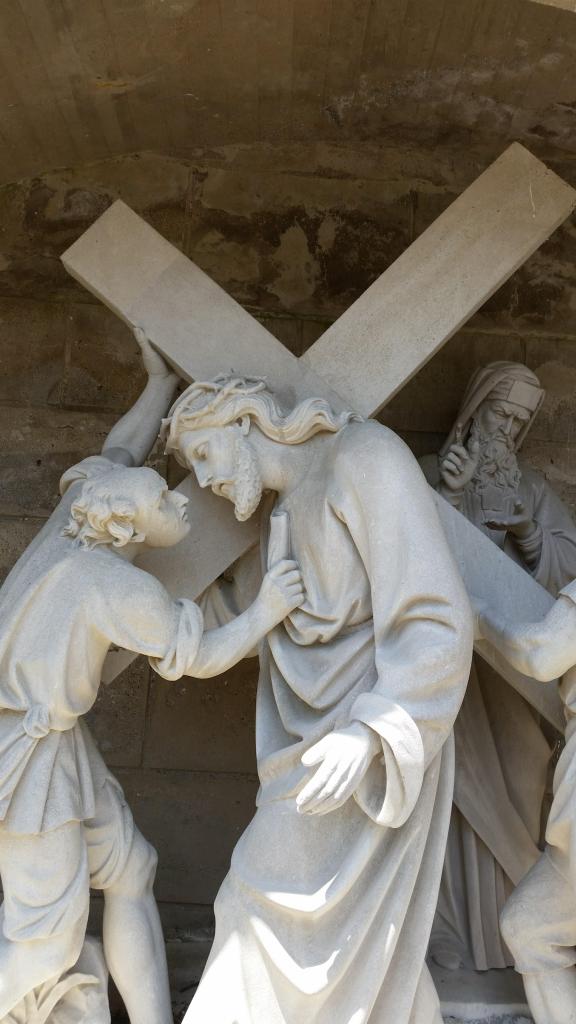
Stations of the Cross at Holy Hill, Hubertus, Wisconsin
When the Messiah arrived, high priest of the superior things of this new covenant, he bypassed the old tent and its trappings in this created world and went straight into heaven’s “tent”—the true Holy Place—once and for all. He also bypassed the sacrifices consisting of goat and calf blood, instead using his own blood as the price to set us free once and for all. If that animal blood and the other rituals of purification were effective in cleaning up certain matters of our religion and behavior, think how much more the blood of Christ cleans up our whole lives, inside and out. Through the Spirit, Christ offered himself as an unblemished sacrifice, freeing us from all those dead-end efforts to make ourselves respectable, so that we can live all out for God. (The Message)
We all have times when we feel guilty. Guilt, in and of itself, is a good thing. Guilt is the response of our conscience telling us we have done something wrong or have not done the good we know we ought to have done. It’s what we do with the guilt that determines the trajectory of our Christian lives. There are several ways we can respond to guilt.
Denial. We can deny and rationalize our guilt by not accepting the truth about what we have done. Using phrases such as, “It’s not my fault,” “It’s only wrong if I get caught,” “I didn’t hurt anybody,” “They deserved it,” and “It’s not that bad,” has the effect of searing our conscience like a hot iron so that we eventually do not feel guilty. The inevitable result of this is hardness of heart.
Shame. Another inappropriate way of dealing with guilt is the opposite of denying guilt; it is to hyper-focus on the guilt by feeling ashamed. Guilt feels bad for actions done or not done. Shame, however, feels bad for who I am, as if I am incapable of being good. Shame believes I do bad things because I am bad and deserve the consequences. In other words, shame is really false guilt.
Inaction. Shame and false guilt may result in despair. We become inactive because of feeling discouraged or defeated. We might reason to ourselves, “What’s the point? I screw up everything I do.” So, we do nothing.
Hyperactive. Some folks become a flurry of activity, working like crazy to feel better in the hope that guilt and shame disappear. It is to impose a penance upon yourself to try and cope with the icky feeling of guilt.
The good news is that we can experience freedom from guilt and a clear conscience because of Jesus Christ.
If we have been victimized in the past, we no longer have to feel ashamed as though we caused or deserved the violence done to us.
If we have said or done some truly egregious things that displease God and damage others, we no longer have to live with the regret and the guilt on our consciences.
If we have failed others and God by not living up to who we ought to be, we no longer have to live day after day with our consciences bound with guilt and shame.
There are three reasons from Hebrews which tell us why we can have freedom from guilt and live with a clear conscience. They all focus on the person and work of Jesus Christ.
Christ has obtained eternal redemption for us by his blood.
Under the old sacrificial system, year after year, the priest offered the same sacrifices which never took away sin. The animal sacrifice was an act of worship in which the worshiper acknowledged guilt before God. The continuous ritual was designed to point forward to a better sacrifice.
The worshiper was purposely led to think, “Wouldn’t it be great if we didn’t have to do this all the time?” The blood of bulls and goats were an annual reminder of sins – such sacrifices never cleansed the conscience of the worshiper. Jesus Christ, however, is the sacrifice to end all sacrifices. Jesus has secured, once and for all, our eternal redemption through his own blood.
The death of Christ, Holy Hill, Hubertus, Wisconsin
Dr. Samuel Weinstein is the chief pediatric cardiac surgeon for a children’s hospital in the New York City. He once traveled to El Salvador to provide life-saving operations for less-fortunate children. Dr. Weinstein and his team operated on an eight year old boy. Twelve hours into the surgery, the procedure took a deadly turn.
Dr. Weinstein said, “The surgery had been going well, but he was bleeding a lot and there were not many medicines we would use to stop the bleeding. After a while, they said they couldn’t give him blood because they were running out and he had a rare type.” The boy’s blood type was B-negative, which is present in only two percent of the population.
The only other person in the room with a blood type of B-negative was Dr. Weinstein. Immediately knowing what he had to do, he stepped down from the operating table. As his colleagues continued their work, Dr. Weinstein set aside his scalpel, took off his gloves, and began washing his hands and forearm. Then, in the corner of an unfamiliar operating room, the prestigious doctor from one of the most advanced hospitals in the world sat down to give away his own blood.
When he had given his pint, Dr. Weinstein drank some bottled water and ate a Pop-Tart. Then—twenty minutes after stepping away from the table—he rejoined his colleagues. After watching his own blood circulating into the boy’s small veins, Dr. Weinstein completed the operation that saved the boy’s heart—and his life.
It is the blood of Jesus Christ which saves us from sin, death, and hell. Our condition is so dire that we can do nothing other than let Jesus deliver us. By faith, we trust Jesus to secure a new life for us free from guilt and shame.
Christ cleanses our consciences.
For some, the greatest prison is not tangible or physical – it is the prison of conscience bound and wracked by guilt and shame. Yet, Jesus has taken care of the problem of a guilty conscience once for all through his blood. Forgiveness comes through Jesus. Christ cleanses us from the inside-out and frees us from being slaves to our guilt.
In 1811, the U.S. government began collecting and storing letters like the following note dated from February 6, 1974: “I am sending ten dollars for blankets I stole while in World War II. My mind could not rest. Sorry I’m late.” It was signed by an ex-GI. And there was this postscript: “I want to be ready to meet with God.” The U.S. government not only collects and stores these letters, but the Treasury Department established a fund and labeled it the “Conscience Fund.” Since its inception, the fund has grown to almost seven million dollars.
A clear conscience is worth a lot. If we try and impose penance upon ourselves, how do we know when it’s enough? In Christ, we are not just outwardly clean, but inwardly clean because of his finished work on the cross.
Accepting this reality, through God’s eternal Spirit, helps us experience forgiveness and cleansing. The Holy Spirit takes the redemptive events of Jesus and applies them to our consciences so that we are assured of forgiveness.
Christ sanctifies our service.
In the Old Testament sacrificial system, the high priest entered the temple/tabernacle to offer animal sacrifices. Once a year, on the Day of Atonement (Yom Kippur) the priest entered the Most Holy Place. He slaughtered a heifer, took some blood, and sprinkled it on the altar.
The priest had bells on his ankles when performing this ritual, along with a rope tied to one ankle. In case the judgment of God broke out on the priest and he was killed, then the other priests could reel him out of the Most Holy Place without entering themselves and being killed, as well.
There were several rituals to perform to access God. And, even then, the sprinkling of blood only outwardly took care of cleansing the people. But when Jesus offered himself once for all, the curtain separating the Most Holy Place from the people was torn from top to bottom. The way has been opened for complete purification, inside and out, a cleansing of the guilty conscience so that we might now serve the living God with freedom and confidence.
Since Christ has obtained redemption for us by his blood, cleansed our consciences, and sanctified our service, here’s how we can live into his finished work:
Confess and forsake known sin.
Those who hide their sins won’t succeed [shame] but those who confess and give them up will receive mercy. (Proverbs 28:13, CEB)
If we confess our sins, God will forgive us. We can trust God to do this. He always does what is right. He will make us clean from all the wrong things we have done. (1 John 1:9, ERV)
Ask forgiveness and be reconciled to anyone you have wronged.
Jesus said, “So if you are offering your gift at the altar and remember there that another believer has something against you, leave your gift at the altar. First go away and make peace with that person. Then come back and offer your gift. (Matthew 5:23-24, GW)
Make restitution to those you have wronged.
If any of you commit a crime against someone, you have sinned against me [God]. You must confess your guilt and pay the victim in full for whatever damage has been done, plus a fine of twenty percent. (Numbers 5:6-7, CEV)
Don’t procrastinate in clearing your wounded conscience.
Paul said he did his best to keep his conscience clear before God and others (Acts 24:16). Some people put off dealing with their guilt, believing their conscience will clear itself in time – but it will not. Procrastination only allows the guilt feelings to fester. Unchecked guilt eventually turns to shame. Today is the day to deal with guilt.
God forgives, not because of the quality of our prayers, but on the basis of Christ’s blood. We can now take advantage of our wonderful situation of freedom to serve the church and the world because God is bigger than a guilty conscience.









 Rev. Tim Ehrhardt