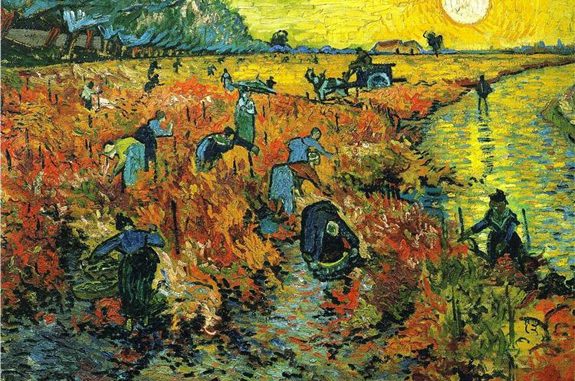
Matthew 20:1-16 – The Parable of the Vineyard Workers

The Red Vineyard by Vincent Van Gogh, 1888

“For the kingdom of heaven is like a landowner who went out early in the morning to hire workers for his vineyard. He agreed to pay them a denarius for the day and sent them into his vineyard.

“About nine in the morning he went out and saw others standing in the marketplace doing nothing. He told them, ‘You also go and work in my vineyard, and I will pay you whatever is right.’ So, they went.

“He went out again about noon and about three in the afternoon and did the same thing. About five in the afternoon he went out and found still others standing around. He asked them, ‘Why have you been standing here all day long doing nothing?’

“‘Because no one has hired us,’ they answered.

“He said to them, ‘You also go and work in my vineyard.’

“When evening came, the owner of the vineyard said to his foreman, ‘Call the workers and pay them their wages, beginning with the last ones hired and going on to the first.’

“The workers who were hired about five in the afternoon came and each received a denarius. So, when those came who were hired first, they expected to receive more. But each one of them also received a denarius. When they received it, they began to grumble against the landowner. ‘These who were hired last worked only one hour,’ they said, ‘and you have made them equal to us who have borne the burden of the work and the heat of the day.’

“But he answered one of them, ‘I am not being unfair to you, friend. Didn’t you agree to work for a denarius? Take your pay and go. I want to give the one who was hired last the same as I gave you. Don’t I have the right to do what I want with my own money? Or are you envious because I am generous?’

“So, the last will be first, and the first will be last.” (NIV)

We as humans have an innate sense of right and wrong, justice and injustice. We want life to be fair. It disturbs us when there is favoritism, discrimination, and preferential treatment. When things seem askew and others seem more privileged, envy can creep in and settle in our bones.

The envy can go even deeper. For example, is it fair that any child should struggle with health issues like cancer, epilepsy, and mental disorders?  Is it fair to have healthcare disparities? Is it fair to have a spouse taken from you before their time?  Is it fair to lose your job because of a pandemic? Is it ever fair to be treated like a second-class citizen?

Pat answers to people’s genuine struggles will not do, such as “Well, you just need to work hard and hope for the best;” “We have to take what is given us and accept these things;” “Think of all those starving children in India;” or the more crass, “Suck it up buttercup; life was never meant to be a rose garden.”  Those statements simply do not help.

At the heart of envy is the belief that others are getting something that I deserve.

Plenty of jerks have healthy grandkids, grow old with their spouses, and retire in comfort with plenty of money. “It isn’t fair!” we cry.

God does not always operate according to our standards of fairness. God’s very nature is to be generous and full of grace. The parable which Jesus told about the vineyard workers is a story not of unfairness, but a story of generosity and grace. It is all in how you look at it.

Parable of the Workers in the Vineyard by Rembrandt, 1637

A normal workday in the ancient world was ten hours, not counting breaks. The workday began at 6:00am. A denarius was a typical day’s wage for laborers. The landowner went out at the third hour, 9:00am; the sixth hour, noon, etc. He kept returning to hire more workers even up to the last hour of the workday. Laborers were always paid at the end of the day. In this parable, the last workers were paid first, which prompted the first workers hired to think they would be getting more, even though they had been promised a denarius. So, they grumbled about not getting more. They thought the landowner was not being fair.

Grumbling. Complaining. Murmuring. It is the bane of our existence. Decades ago, when gas station attendants still filled tanks for customers, I was working at a station and had a lady go berserk on me for not checking her oil and cleaning her windshield, because I did it for the car in front of her. Even though there was a sign right in front of her that said checking oil and cleaning windshields is only done upon request, the lady thought she was getting gypped. 

In truth, the landowner did not cheat or defraud the workers in any way. He paid the agreed upon wage, just like he promised. Should he want to pay everyone the same even though the amount of work was different was his own business. The problem was not with the owner, it was with the worker’s envy of the owner’s generosity toward the others. God distributes gifts because he is gracious, not because we have earned anything.

Our standard of fairness is not the rule of the kingdom of God – grace is.

The founder of Methodism, John Wesley, was physically thrown out of a church one Sunday because of a sermon he was preaching on the grace of God. Afterwards, when Wesley wrote about this to a friend, he said, “There is no Christian Doctrine more repugnant than the affirmation that we are saved by the grace of God through faith.”

Deep down many believe we control our destiny, and that we save ourselves by what we do. We discern that if we serve God all our lives, in the end, God will reward us. We believe that our pious activities, our acts of service and our work for the Lord, will bring us salvation, or, at least a leg up in the kingdom of God over others who have not worked as hard or as long as we have. After all, we do the right thing.

So, what about those who have not figured out Christianity… those who do not have the correct or proper beliefs… or those who have not straightened out their lives? According to a worldview of human fairness, they are out of luck. They should be in church. They should work harder, faster, and better. Then, they could get their lives in order. If they would only understand fairness, we reason, then all would be well.

Parable of the Vineyard Workers from unknown artist in the Middle Ages

But there is a problem, because the parable of the workers told by Jesus seems to be saying that is not how it works, at all.  Jesus seems to be saying that grace and grace alone saves, that God’s amazingly naive and irresponsible grace is available to anyone and everybody. And that troubles the workers to no end. 

Whenever we run headlong into God’s unfair grace and see that God’s way of doing things is so far removed from our way, there is bound to be grumbling.  After all, if God is going to run a vineyard like the one in the gospel lesson and give everybody the same pay regardless of their actual work hours, then what’s the use of getting up early in the morning to work? 

What is the good of sitting in church, listening to sermons from a crazy preacher who is no better than us, if these outsiders, these Johnny-and Jane-come-lately’s can waltz in at the last minute and receive the same treatment as the rest of us?  For many church folks who diligently serve, it is not fair to pay so much attention to outsiders and build ministry around people who aren’t even here, who don’t yet know Jesus.

The conclusion and point of the parable: The last will be first, and the first will be last. In Luke’s prodigal story, the elder brother grumbles and gripes: “All these years I’ve been slaving for you and never disobeyed your orders.  But when this son of yours who has squandered your property with prostitutes comes home, you kill the fatted calf!”  It is the firstborn son that complains. (Luke 15:11-32)

In both the parable of the prodigal son and the parable in today’s lesson, “good” people are the ones who fail to see the heart of the Father and of the landowner. The “firsts” got off track because, over time, they forgot the kingdom hinges on grace, not effort, on not simply doing the right things over a long period of time.

God controls the flow of mercy, not us. 

We will likely be surprised in heaven with those already sitting at God’s banquet table, and equally surprised with who is not there. Resentment can move us away from the table of mercy God is preparing. The problem comes whenever we think we are above other people.  We might be sinners, but we are not as bad as some other people are!  We commit ordinary sins, not mass murder!

Here is the unvarnished truth: God does not owe you or I a thing, and God cares about all kinds of people, not just us and people who think and live like we do. Our hearts need to be big enough to center ministry around other people who are different than us.

If our hearts are small, we easily get jealous when God pays attention to prodigals and profligates. Grace becomes too repugnant a doctrine for us.

The gospel of Jesus Christ is about grace. Life is not all about being decent. It is not all about morality, and it is certainly not about our own goodness. The gospel is about being steeped in and surrounded by the grace of God in Christ, so that we, in turn, can show others grace. Grace is the way God deals with us beyond what we deserve or feel we have earned. 

Grace is unfair; we get what we do not deserve. 

May we allow God’s grace to so permeate our hearts and lives so that we will give it to others as freely as we have received.Praise be to you, almighty and everlasting Father of our Lord Jesus Christ. In Christ, you have given us every spiritual blessing in heaven. In Christ, you chose us before the world was made. You chose us in love to be your holy people—people who could stand before you without any fault. And before the world was made, you decided to make us your own children through Jesus Christ. It pleased you to do it. And this brings praise from us because of your wonderful grace, given to us freely, in Christ, the one you love. We have forgiveness of sins because of this lavishly rich grace. Thank you, O my Father, for your grace extending to me in Christ! Amen

Exodus 15:22-27 – On Grumbling

Then Moses led Israel from the Red Sea and they went into the Desert of Shur. For three days they traveled in the desert without finding water. When they came to Marah, they could not drink its water because it was bitter. (That is why the place is called Marah.) So, the people grumbled against Moses, saying, “What are we to drink?”

Then Moses cried out to the Lord, and the Lord showed him a piece of wood. He threw it into the water, and the water became fit to drink.

There the Lord issued a ruling and instruction for them and put them to the test. He said, “If you listen carefully to the Lord your God and do what is right in his eyes, if you pay attention to his commands and keep all his decrees, I will not bring on you any of the diseases I brought on the Egyptians, for I am the Lord, who heals you.”

Then they came to Elim, where there were twelve springs and seventy palm trees, and they camped there near the water. (NIV)

I like children’s books. I suppose its because I’m still a kid at heart. It’s fun to read to my grandchildren. One of the books I read to them is “Alexander and the Terrible, Horrible, No Good, Very Bad Day.” The book begins with Alexander recounting when he awoke one morning:

“I went to sleep with gum in my mouth and now there’s gum in my hair and when I got out of bed this morning, I tripped on the skateboard and by mistake I dropped my sweater in the sink while the water was running and I could tell it was going to be a terrible, horrible, no good, very bad day…. I think I’ll move to Australia.”

For the remainder of the story, Alexander’s day was a mishap of messes. Nothing seemed to go his way, and no one appeared to notice or even to care.

One of the reasons the book has been read so many times by so many children (and obviously adults, like me) is because we can all relate to the feelings of having a day where nothing seems to go right. In the middle of it we just feel like being somewhere else, like Australia.

In such times, when life is topsy-turvy and upside-down, it is so amazingly easy to grumble and complain. The ancient Israelites were having an Alexander-like day. Unlike having gum in your hair, not having water to drink is a big deal, a vital problem. So, we might understand why there was so much grumbling going on among the people. I am sure they were anxious, nervous, and scared.

Yet, complaining, unlike our emotions, is a volitional response. We choose to grumble. The problem with gripes and complaints is that it sets a person down a dark path. Oh, the criticisms and grievances begin easily and are seemingly harmless, at first. They are, however, anything but innocuous.

A mere grumble under the breath did not stop with finally getting water to drink. If we look ahead in the story of God’s people in the exodus event, the moaning and complaining quickly returned the minute something did not go their way. Then, the people became so disillusioned with their circumstances that they began longing for the “good old days” back in Egypt when they had plenty to eat and drink, forgetting about their cruel bondage in slavery. (Exodus 16:1-3)

The psychological progression continued with beginning to blame their situation on God, as if he were some mean malevolent deity. From that point, it was inevitable that the people would disobey God and eventually succumb to the idolatry of the golden calf. (Exodus 32:1-8)

Despite the grand celebration of leaving Egypt and experiencing a miraculous deliverance through the Red Sea, the people quickly forgot because of their present circumstance of lacking water. It is only logical and makes sense that the mighty God who saved them with incredible acts of power would care for the people in a desert. Yet, for many, there was no faith to be found in a new situation they had not faced before.

Failure of faith begins neither with ignorance nor an egregious sin. It begins with grumbling and complaining. And if allowed to run amok, complaints will bear the fruit of discouragement, disobedience, and eventually a disavowal of God.

The author of the New Testament letter to the Hebrews reflected on the grumbling of their forebears and had this to say in response:

See to it, brothers and sisters, that none of you has a sinful, unbelieving heart that turns away from the living God. But encourage one another daily, as long as it is called “Today,” so that none of you may be hardened by sin’s deceitfulness. We have come to share in Christ, if indeed we hold our original conviction firmly to the very end. As has just been said:

“Today, if you hear his voice,
    do not harden your hearts
    as you did in the rebellion.” (Hebrews 3:12-15, NIV)

Encouragement is the insecticide which eliminates the worm of complaints. If left alone, we stew in our own bitterness over missed expectations. Grumbling bores its way into our soul and eats away at our faith. We need the continual encouragement of one another to remember our collective deliverance and express gratitude for our salvation.

May it be so to the glory of God.

We give you thanks, Lord God, because you give food and drink to all, heal all, create wonders in this world, forge wisdom within us, and give refuge beneath the shadow of your wings. From your wisdom grant us wisdom, from your love grant us love, from your understanding grant us understanding. Feed us when we are hungry, give us strength when we are weak, raise us up when we are bent over, set us free when we are enslaved. Just as our spiritual ancestors were blessed – may you grant us the blessing of peace, strength, and gratitude. Amen.

1 Peter 4:7-11 – Practicing Hospitality

hospitality
“They broke bread in their homes and ate together with glad and sincere hearts.” –Acts 2:46

The end of all things is near. Therefore, be alert and of sober mind so that you may pray. Above all, love each other deeply, because love covers over a multitude of sins. Offer hospitality to one another without grumbling. Each of you should use whatever gift you have received to serve others, as faithful stewards of God’s grace in its various forms. If anyone speaks, they should do so as one who speaks the very words of God. If anyone serves, they should do so with the strength God provides, so that in all things God may be praised through Jesus Christ. To him be the glory and the power for ever and ever. Amen. (NIV)

One of the most practical and biblical ways of demonstrating love is through hospitality. Hospitality, at its heart, is an invitation to come into my home and into my life. It is a ministry of acceptance, encouragement, restoration, and healing.  The loving work of hospitality “covers a multitude of sins” through the power of influence. When we have face-to-face conversations around the table, it prevents us from engaging in sins that would otherwise be committed if left to ourselves.

Because the end of all things is near, we need our wits about us through a determined focus on prayer, love, and hospitality. The word “hospitality” literally means, “love of the stranger.” I invite someone whom I do not know very well into my home and befriend them. This is what Jesus did for us. Although we were all estranged from God and on the outside, Jesus came to eat with us.

“Listen! I stand at the door and knock; if any hear my voice and open the door, I will come into their house and eat with them, and they will eat with me.” (Revelation 3:20, GNT)

Jesus invites us into the life of God; and, we are to invite others into our lives. Jesus has so closely identified with his people that when we practice hospitality, we are inviting Jesus in. In fact, we may not realize that some people we host are angels:

Do not forget to show hospitality to strangers, for by so doing some people have shown hospitality to angels without knowing it. (Hebrews 13:2, NIV). 

Inviting another person into my home and heart takes time and effort. Doing it without grumbling is a necessity. In an ideal world we always receive something back for our work of hospitality – an invitation from the other person, or, at least, a simple thank you. That does not always happen and cannot be the driving reason why we are generous. Hospitality is a work of love which originates from a heart that has been touched by the hospitality of God. Our earthly hospitality is a form of saying “thank you” to God for his grace to us. Complaints break into the house like unwanted burglars when we expect to receive, and do not. If you receive another person as though they were Christ himself, grumbling will likely be far from you. Instead, there will be rejoicing over the opportunity to serve Jesus.

Jesus said, “Anyone who welcomes you welcomes me. And anyone who welcomes me also welcomes the one who sent me.” (Matthew 10:40, CEV).

In the New Testament world, a concrete expression of love to other believers in Jesus was providing food and shelter for Christians traveling throughout the Roman Empire. Often, the traveling strangers were itinerant evangelists spreading the message of the gospel from place to place.

Dear friend, you are faithful in what you are doing for the brothers and sisters, even though they are strangers to you. They have told the church about your love. Please send them on their way in a manner that honors God. It was for the sake of the Name that they went out, receiving no help from the pagans. We ought therefore to show hospitality to such people so that we may work together for the truth. (3 John 5-8, NIV)

At other times, believers were deprived of necessities due to occasional waves of persecution. The people Peter addressed were mostly Jewish Christians. As they faced persecution in Jerusalem, they fled to geographical places dominated by pagan Gentiles. As refugees, they were often poor and needy; and, the townspeople where they went were not hospitable. So, they had to rely on the love and hospitality of those believers they could connect with who had the means to help.

Contribute to the needs of God’s people, and welcome strangers into your home. (Romans 12:13, CEB) 

There is a great need for hospitality in our world.  Many American’s circle of friends is shrinking. According to one study the number of people who said they had no one to talk to about important matters has more than doubled in the past 10 years. 35 million Americans now live alone (which is 28% of all households).  Hospitality cuts both ways for us.  We are to invite the lonely into our hearts and homes; and, the lonely are to invite others into their hearts and homes, instead of waiting for somebody to just show up.

Matthew 25.35

Food is to hospitality what weightlifting is to bodybuilders; you really need food, meals, and the sharing that goes with it to make a difference in another’s life. In biblical times, eating a meal together was a sacred affair.  To have another person in your house, sitting around your table, communicated acceptance, care, and friendship. That is why the religious leaders had such difficulty with Jesus eating with “sinners.” Jesus was unequivocally loving and accepting of such persons.

When we think about our world, it can be a sad place. Can people of different races live in peace?  Can Democrats find common ground with Republicans?  Can a Christian family carry on a civil friendship with neighbors down the street far from Christianity?  Can people worlds apart from each other get along?  The early church did. And they did it without all the stuff we have.  The early believers did it through the simplest tool of the home. No matter our gifts and abilities, each one of us can be hospitable. Something mystical happens at a dinner table that does not happen anywhere else – it opens the door to true community.

While they were eating, Jesus took a loaf of bread, and after blessing it he broke it, gave it to the disciples, and said, “Take, eat; this is my body.” Then he took a cup, and after giving thanks he gave it to them, saying, “Drink from it, all of you; for this is my blood of the covenant, which is poured out for many for the forgiveness of sins. (Matthew 26:26-28, NRSV)

For the Christian, eating and ingesting bread and wine serves as a tangible way of understanding what life is to be like. We take Jesus into the depths of our lives. We ingest him, that is, we engage in an intimate relationship whereby the two of us can never be separated.

We are meant for life together, to enjoy eating and drinking together. True life is sharing both our resources and our hearts with one another.

Loving God, thank you for your generosity. I am a stranger in this world, yet, you invite me to be your guest. You lavishly offer me your hospitality and welcome me into your family. You invite me to share in the abundance of your kingdom. Help me remember that when I offer hospitality to others, I am receiving Christ into my home. Gracious God, I open my heart to those who are wounded; those who have wounded me; those who are outcasts; and to all who are searching. I want my everyday ordinary life to please you. I am grateful that there is always room at your Table; through Jesus, my Lord. Amen.

Numbers 21:4-9 – Being Impatient

grumbling

“From Mount Hor they set out by the way to the Red Sea, to go around the land of Edom; but the people became impatient on the way. The people spoke against God and against Moses, ‘Why have you brought us up out of Egypt to die in the wilderness? For there is no food and no water, and we detest this miserable food.’  Then the Lord sent poisonous serpents among the people, and they bit the people, so that many Israelites died.” (NRSV)

Impatience.  Grumbling.  They go together like a hand in a glove.  The impatient person sticks his hand in the glove of complaints, voicing and animating his missed expectations for all to hear and see.

The ancient Israelites had been delivered with the miraculous and mighty hand of God.  But the celebration soon turned sour.  Out in the desert with millions of people, the Israelites had no food or water.  We have no account of the people reflexively using their spiritual connection with God to ask him for help.  Nope.  They just grumbled against God and his servant Moses.

God had enough of their constant complaints.  He had shown mercy and committed love to them over-and-over again.  Yet, the people still put on their grumpy faces any time something didn’t go their way.  God kept showing patience toward the people, but the people kept demonstrating impatience toward God.

If you stop and think about the pathology of your impatience and complaining (which we all do – come on, admit it) you’ll likely discover that at the heart of it all is a picture in your mind of how you think circumstances ought to go for you to be happy.  The Israelites expected a nice clean break from Egypt with a smooth transition into the Promised Land.  They didn’t sign up for hard circumstances and trouble to get there.

You go to church expecting to be fed and encouraged.  You expect that school will be enjoyable and that you’ll get a good paying job when you graduate.  You expect to go to work and have healthy working relationships and a good boss.  You expect your kids to listen to what you say and do what you tell them.  You expect your spouse to give you focused attention.  You expect the weather to be better.  You expect the little plastic things on the end of your shoelaces to last for the life of your shoes….

You get the picture.  No matter what scenario we posit, its more than likely it isn’t going to go as planned or expected.  The rub comes when those expectations aren’t realized.  Then, what?  In a perfect world we would always respond in a reasoned, wise, and healthy manner.  But if we’re feeling like we’re in an emotional place of insecurity out in the desert, our response is more likely going to be impatience, grumbling, and complaining about things which aren’t going as planned.

A great deal of disobedience, bad behavior and speech, and poor decision-making has its beginnings in impatience.  The minute you become impatient, take a long deep breath before you make your next mental decision.  Check-in with yourself.  Be mindful of what your real expectations are for the circumstance or person in the present moment of becoming upset.  Make the decision not to complain or argue.  Instead, choose to say what you want without grumbling.

It is truly possible to stand for holiness, live for righteousness, and uphold the words and ways of Jesus without being a jerk about it through impatient sighs, annoying facial expressions, and terse words of carping and criticizing another person made in God’s image.

Monitor yourself throughout the day today.  Notice the times you become annoyed.  Stop and take a minute to analyze what it is you are expecting.  Instead of grumbling, ask God how he wants to strengthen your faith through the situation or encounter.  Because God is there to help you, not to pick on you.

Holy God, your patience is incredible in the face of human impatience.  Yet, your boundaries are firm, and you will not put up with our petulant ways forever.  Help me to live into the model of your Son, the Lord Jesus, who with you and the Holy Spirit are attentive to come alongside me to your own glory and honor.  Amen.