Pay Attention to Grief (Genesis 49:29-50:14)

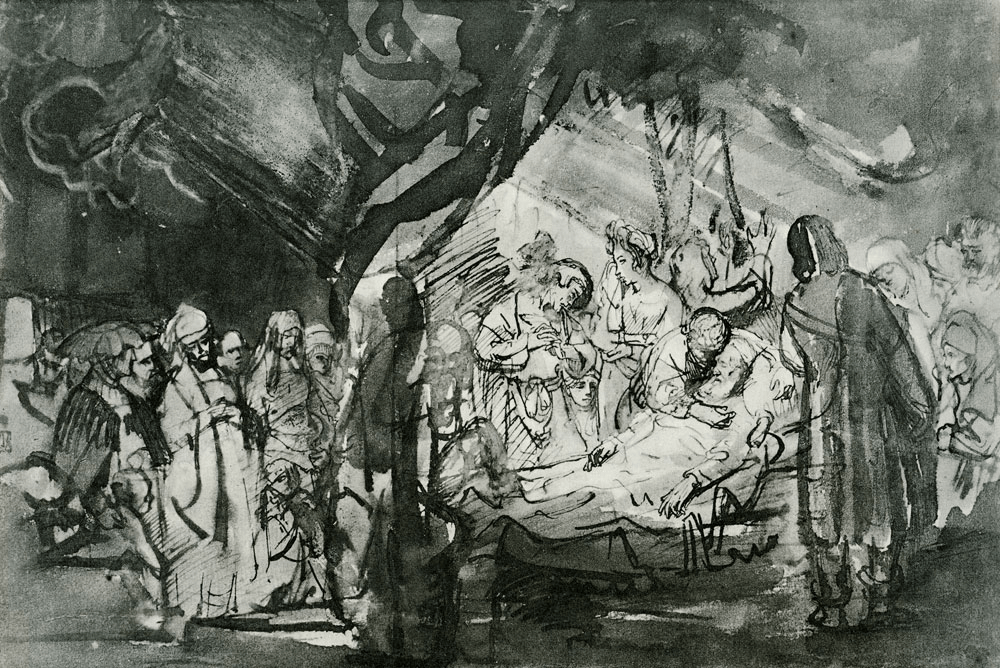
The Death of Jacob, by Rembrandt, c.1640

Jacob told his sons:

Soon I will die, and I want you to bury me in Machpelah Cave. Abraham bought this cave as a burial place from Ephron the Hittite, and it is near the town of Mamre in Canaan. Abraham and Sarah are buried there, and so are Isaac and Rebekah. I buried Leah there too. Both the cave and the land that goes with it were bought from the Hittites.

When Jacob had finished giving these instructions to his sons, he lay down on his bed and died. Joseph started crying, then leaned over to hug and kiss his father.

Joseph gave orders for Jacob’s body to be embalmed, and it took the usual 40 days.

The Egyptians mourned 70 days for Jacob. When the time of mourning was over, Joseph said to the Egyptian leaders, “If you consider me your friend, please speak to the king for me. Just before my father died, he made me promise to bury him in his burial cave in Canaan. If the king will give me permission to go, I will come back here.”

The king answered, “Go to Canaan and keep your promise to your father.”

When Joseph left Goshen with his brothers, his relatives, and his father’s relatives to bury Jacob, many of the king’s highest officials and even his military chariots and cavalry went along. The Israelites left behind only their children, their cattle, and their sheep and goats.

After crossing the Jordan River, Joseph stopped at Atad’s threshing place, where they all mourned and wept seven days for Jacob. The Canaanites saw this and said, “The Egyptians are in great sorrow.” Then they named the place “Egypt in Sorrow.”

So Jacob’s sons did just as their father had instructed. They took him to Mamre in Canaan and buried him in Machpelah Cave, the burial place Abraham had bought from Ephron the Hittite.

After the funeral, Joseph, his brothers, and everyone else returned to Egypt. (Contemporary English Version)

117 days. That’s how long Jacob’s family, along with the people of Egypt, mourned for him after his death. Yes, he was a patriarch. And yes, Joseph was the administrator of an entire nation. Yet this was not unusual behavior; it was normal.

When my mother-in-law was tragically and suddenly killed in a car accident, 30 years ago, I could not take any bereavement time off, because according to company policy, it was not my mother. So, since she lived a thousand miles from us, I had to use vacation time and take a week away. Then, when I returned to work, I was expected to pick up where I left off, as if nothing had happened.

Although I work under better conditions today, and workplaces are getting better at acknowledging the importance of tragic events in the life of employees, we still have a long way to go in dealing with grief, bereavement, mourning, and lament.

The modern funeral industry is a rather recent phenomenon in history. Beginning with, and then following, the American Civil War, death was a prominent specter, affecting every community and nearly every home. People like my second great grandfather became part of a growing business of handling the dead and providing services for grieving families. He became a coffin maker and a chief supplier for the burgeoning funeral parlor (which later morphed into a furniture business which lasted a hundred years).

Even though families needed help after a devastating war, over time, the unintended effect is that we became detached from death. Others could handle bodies and arrangements. We could choose to see or not see the dead. Folks began losing the ability to grieve and mourn their changes in life.

Grief doesn’t just go away with time. If it isn’t acknowledged, faced, accepted, and dealt with, it slowly begins to sit in the soul and rot. Eventually, it becomes spiritual gangrene; the person becomes bitter, without joy and stuck in unwanted emotions.

The point of all this is that grief and bereavement strikes us all; none of us gets off planet earth without having to deal with the loss of significant people in our lives. And when it happens, it’s imperative that individuals and societal structures allow for the time and space to mourn.

The ancients were on to something which we need to recover. They discerned the importance of allowing grief to run it’s course, instead of us trying to master grief, get over it, and move on. Grief will be dealt with when it is dealt with. Trying to tame it is like attempting to bench press 700 pounds; it’s only going to crush you if you try controlling it.

I’m not agitating for a 117 span of days for everyone’s mourning. But I am insisting that we have conversations about grief and confront it, rather than ignore it. Because grieving doesn’t mean you’re imperfect; it means you’re human.

The way we move through our grief is by telling our story – which requires someone to listen. That only happens if we have created the space for it to occur. Expectations of moving-on will leave grief where it is, poisoning us from the inside-out.

The only way to the mountain is through the valley. The only way to make the pain go away is to move through it – not by avoiding it, pretending it’s not there, or trying to go around it. Pain and suffering are inevitable; misery is optional. And letting bereavement and grief have it’s way for a while is the path away from the misery.

You will heal and you will rebuild yourself around the loss you have suffered. You will be whole again, but you will never be the same. And that’s a good thing. It gives us the ability and empathy to extend blessing to others who will eventually face their own terrible loss. They will need someone to listen. And you will be there for them.

Lord, do not abandon us in our desolation. Keep us safe in the midst of trouble, and complete your purpose for us through your steadfast love and faithfulness, in Jesus Christ our Savior. Amen.

Pastoral Care (Ezekiel 34:17-23)

“Now then, my flock, I, the Sovereign Lord, tell you that I will judge each of you and separate the good from the bad, the sheep from the goats. Some of you are not satisfied with eating the best grass; you even trample down what you don’t eat! You drink the clear water and muddy what you don’t drink! My other sheep have to eat the grass you trample down and drink the water you muddy.

“So now, I, the Sovereign Lord, tell you that I will judge between you strong sheep and the weak sheep. You pushed the sick ones aside and butted them away from the flock. But I will rescue my sheep and not let them be mistreated any more. I will judge each of my sheep and separate the good from the bad. I will give them a king like my servant David to be their one shepherd, and he will take care of them. (Good News Translation)

“Only through love can we obtain communion with God.”

Albert Schweitzer

I have a zero tolerance for bullying. And, I believe, this is a conviction which must be shared together with everyone. If not, we will continue to see spiritual abuse in the news, so-called Christians and churches throwing their weight around, and a world enveloped in the darkness of mean-spirited persons who only care about themselves and getting their way.

It is most necessary that spiritual folk let compassionate pastoral care have its way in the world.

Pastoral care, for me, is rooted in the compassion of Jesus Christ. It is my connection and relationship with this living Savior, Teacher, Healer, and Lord which enables me to extend genuine care to others. 

I believe that it is the grace and mercy of God in Christ through the enablement of the Holy Spirit which brings comfort, hope, and encouragement to people in need. My philosophy of pastoral care addresses three significant factors, in this order:

  1. Being in a safe environment is paramount. Building trust and connection is important. The caring relationship needs confidence so that the pastor can compassionately encourage and help the person to pursue being in a secure place – whether that is a physical moving away or out, or finding a safe and sacred place within one’s own soul from which healing and holistic health can begin. Bullying can be physical, verbal, emotional, mental, or personal in talking abusively to oneself; and it must be stood up to and stopped.
  2. Grieving is necessary. Mourning and lamenting a significant change or loss must occur to learn to thrive and flourish again in a new situation. This requires being open about one’s feelings, communing freely with God, and being vulnerable with a pastor, therapist, church group, or some other secure human connection. It is common to get “stuck” in grief and believe our situation can never change. But it can, so we must not remain there. 
  3. Reconnecting with the world is vital. Bullying and belligerent people can take a lot out of us and from us. Therefore, we need to find joy in the simple pleasures of life again; to reach out and relate to others who have gone through similar experiences; and, to regain ordinary rhythms and routines of life are all crucial to being alive. The compassionate pastor gently assists, encourages, exhorts, and walks with others toward relating well with the world once again.

Recovery is not an event, and not even a process; it is a way of life. 

All of us are vulnerable to the brokenness of this fallen world. We must learn to navigate troubled times with someone who cares, and not by ourselves. 

We all struggle to live out our faith commitments in a complex web of various family, work, social, and neighborhood relationships.

“If I were to wish for anything, I should not wish for wealth and power, but for the passionate sense of the potential, for the eye which, ever young and ardent, sees the possible. Pleasure disappoints, possibility never. And what wine is so sparkling, what so fragrant, what so intoxicating as possibility!”

Søren Kierkegaard

I am passionate about a biblical understanding of living in the world for its betterment and blessing as a pastoral minister. The following is a kind of manifesto of what I feel called to be and to do….

With God as my help, and with the Old and New Testaments of the Bible as my guide for grateful living, I seek with all my heart, soul, mind, and strength:

  • To foster, support, and realize spiritual healing in the world
  • To cultivate the human spirit and do the work of soul-craft deliberately, carefully, and patiently
  • To consult and collaborate with others who share a spiritual vision for blessing the world
  • To engage in spiritual practices which strengthen faith, enlarge a compassionate heart, and expand the soul’s capacity for growth
  • To walk in the way of Jesus through engrafting silence, solitude, fasting, giving, and prayer into regular and habitual rhythms of life
  • To wed integration of learning with an alignment of head, heart, and gut.
  • To embrace suffering and adversity as sacred Teachers of the soul
  • To continually pursue self-awareness and utilize that awareness for the common good of all persons
  • To liberally use the spiritual tools of faith, hope, and love; and, to sharpen those implements with great care
  • To weep with those who weep
  • To keep vigilant presence with the dying
  • To extend mercy, respect, and hospitality to those considered by society as the least, the last, and the lost
  • To eradicate loneliness in all its forms
  • To extend basic human dignity and divine grace to all with mental illness, cognitive disorders, soul-sucking addictions, and suicidal ideation
  • To embody the Beatitudes of Jesus and live by Christ’s Sermon on the Mount (Matthew 5-7)
  • To embrace humble service as demonstrated and taught by Jesus in his Upper Room Discourse (John 13-17)
  • To picture a world without poverty, racism, patriarchy, gender bigotry, verbal and physical violence, religious wars, and emotional immaturity
  • To imagine a future with an abundance of the Fruit of the Spirit, clean water, creativity, beauty, and equity of resources
  • To promote an egalitarian spirit and social justice, especially for those without power and/or privilege in the world
  • To see the image of God in persons very different from me
  • To grieve and lament my unwanted changes and losses
  • To express daily affirmations of faith
  • To exercise gratitude in all circumstances
  • To live in a healthy rhythm of receiving and giving
  • To encourage the telling and listening of stories
  • To champion women everywhere and alleviate all barriers to their voice in the world
  • To reform and keep reforming
  • To choose vulnerability and courage in life and leadership
  • To perpetuate, in both word and deed, the ancient Scriptures and ecumenical Creeds, paying attention to the worldwide church’s contribution to scriptural understanding
  • To use Holy Scripture for the encouragement of others and the strengthening of faith, and not as a weapon to damage others and create divisions
  • To observe the Christian Year and conform to its liturgical rhythms.
  • To die well, with no regrets and with a legacy of faith

Tuesday of Holy Week (Psalm 71:1-14)

Station 3 of the Stations of the Cross, along the Via Dolorosa in Jerusalem

In you, O Lord, I take refuge;
    let me never be put to shame.
In your righteousness deliver me and rescue me;
    incline your ear to me and save me.
Be to me a rock of refuge,
    a strong fortress to save me,
    for you are my rock and my fortress.

Rescue me, O my God, from the hand of the wicked,
    from the grasp of the unjust and cruel.
For you, O Lord, are my hope,
    my trust, O Lord, from my youth.
From my birth I have leaned upon you,
    my protector since my mother’s womb.
My praise is continually of you.

I have been like a portent to many,
    but you are my strong refuge.
My mouth is filled with your praise
    and with your glory all day long.
Do not cast me off in the time of old age;
    do not forsake me when my strength is spent.
For my enemies speak concerning me,
    and those who watch for my life consult together.
They say, “Pursue and seize that person
    whom God has forsaken,
    for there is no one to deliver.”

O God do not be far from me;
    O my God, make haste to help me!
Let my accusers be put to shame and consumed;
    let those who seek to hurt me
    be covered with scorn and disgrace.
But I will hope continually
    and will praise you yet more and more. (New Revised Standard Version)

Christians take a decided interpretation of seeing Christ in the psalms. For us, we can envision Jesus saying these words of lament in the last days of his earthly life and ministry.

Why lament?

Lament is a significant piece of Lent, and is especially present in these final days of the season, Holy Week. To lament is to offer a public and passionate expression of grief. And it’s not optional but necessary and vital to the Christian experience, not to mention the human condition.

Without lamenting our great losses, our grief comes out sideways, inevitably harming others with our snarky vitriol. Lament gives expression to our deep grief. It enables us to come to grips with what has happened in the past, or happening to us in the present, and within us.

What does it mean to lament?

  • A lament is an expression of personal grief, due to any significant change or loss; it is the normal emotional, spiritual, physical, and relational reaction to that loss.
  • Lamenting is an intentional process of letting go. Relationships, dreams, plans, and people all die. We cannot get them back. Lament helps us find and live into a new identity after the loss or change.
  • Expressing grief through lament is intensely personal; there is no one-size-fits-all. No one else can do our lamentation for us.

How do I lament?

There are many psalms of lament, including our psalm lesson for today. They all have a typical structure to them, including:

  • Addressing God: Crying out for help. Some psalms of lament expand to include a statement of praise or a recollection of God’s intervention in the past. (Psalm 71:1-3)
  • Complaint: Telling God (said with some flavor!) about our problem or experience through a range and depth of emotional, relational, and spiritual reactions to the change or loss. (Psalm 71:4)
  • Confession of Trust: Remaining confident in God despite the circumstances. Beginning to see problems differently. (Psalm 71:5-8)
  • Petition: Proclaiming confidence in God. Appealing to God for deliverance and intervention. Keep in mind that petitioning is not bargaining with God or a refusal to accept loss. Rather, it is a legitimate seeking of help. (Psalm 71:9-13)
  • Words of Assurance: Expressing certainty that the petition will be heard by God. (Psalm 71:14a)
  • Vow of Praise: Vowing to testify in the future to what God will do with praise. (Psalm 71:14b-24)

I encourage and urge you to consider the following spiritual practice in this Holy Week: Set aside some time and craft your own psalm of lament.

Choose an event from your past which created grief for you. It can be recent or from years ago. Using the structure of lament psalms, thoughtfully write out each element as I have outlined it. Then, read it aloud to God. Perhaps even take another step by reading your lament aloud to a trusted family member, friend, or faith leader.

Our grief needs the outlet of lament. Grief which is not expressed ends up sitting heavily in the soul. Eventually, over time, if not acknowledged and spoken aloud, it can easily become putrid and rancid, poisoning our spirit, and compromising our faith.

Sharing your story through lament is biblical, practical, and I insist, necessary. I regularly craft psalms of lament whenever I have events or people who keep sticking with me in my thoughts and in my heart. Here is one example from a few years ago, after a mass shooting in my city:

Lord, in our shock and confusion, we come before you.

In our grief and despair, in the midst of hate,

in our sense of helplessness in the face of violence,

we lean on you. How long, O Lord, must we keep facing this!?

For the families of those who have been killed, we pray.

For the family of the shooter—help us to pray, Lord.

For the communities that have lost members—their anger, grief, fear—we pray.

For the churches striving to be your light in darkness, beyond our comprehension, we pray.

In the face of hatred, may we claim love, Lord.

May we love those far off and those near.

May we love those who are strangers and those who are friends.

May we love those who we agree with and understand,

and even more so, Lord, those who we consider to be our enemies.

Lord, have mercy. Christ, have mercy. Lord, have mercy.

Heal our sin-sick souls, and grant us your peace.

Make these wounds whole, Lord, for you can do it. Amen.

Expressing Grief (Lamentations 3:55-66)

An engraving of the prophet Jeremiah lamenting, 1937

I called on your name, Lord,
    from the depths of the pit.
You heard my plea: “Do not close your ears
    to my cry for relief.”
You came near when I called you,
    and you said, “Do not fear.”

You, Lord, took up my case;
    you redeemed my life.
Lord, you have seen the wrong done to me.
    Uphold my cause!
You have seen the depth of their vengeance,
    all their plots against me.

Lord, you have heard their insults,
    all their plots against me—
what my enemies whisper and mutter
    against me all day long.
Look at them! Sitting or standing,
    they mock me in their songs.

Pay them back what they deserve, Lord,
    for what their hands have done.
Put a veil over their hearts,
    and may your curse be on them!
Pursue them in anger and destroy them
    from under the heavens of the Lord. (New International Version)

Over the years of ministry, I’ve encountered a host of confessing Christians who did not know the book of Lamentations even existed in the Bible. Even more people, I have discovered, are unfamiliar with the word “lament.”

This anecdotal evidence is quite telling: It tells me that a large chunk of people in society don’t know what to do with themselves whenever they experience or encounter trauma, abuse, unwanted circumstances, death, or overwhelming situations.

It’s no wonder that so many of us are anxious, depressed, and emotionally struggling. To be overwhelmed means that we don’t have enough internal resources to match what’s going on with us externally. Being overwhelmed means being devastated or overpowered by several circumstances at once; and experiencing several emotions at once, including the feeling of estrangement from God and/or others.

The book of Lamentations is the prophet Jeremiah’s public expression of grief over the destruction of his home city of Jerusalem. King Nebuchadnezzar and the Babylonian army invaded the land, broke down the city walls, razed the temple, killed many people, and took most of the rest into captivity. The experience, along with the atrocities committed, were overwhelming.

On top of all that, Jeremiah had proclaimed a message of judgment, prophesying what would happen – and it did. And after the Babylonians took over, the remaining people put much of their misplaced anger and grief on Jeremiah, making his situation even worse.

Lamentations of Jeremiah, by Marc Chagall, 1956

What would you do if you were Jeremiah?

In whatever way you might respond, I believe Jeremiah did precisely what was most needed: He called on the name of the Lord, he expressed his lament, and it was all more than a private affair – because we are able to still read his lamentation all these many centuries later.

To lament is to express our feelings and story of grief to another. Without doing so, we are spiritually and emotionally stuck. And if we remain stuck for too long, our grief comes out sideways, either hurting others or ourselves.

The general populace of the people didn’t deal with their grief, and didn’t lament their loss. Instead, they mocked Jeremiah, plotted against him, and insulted him. That’s what happens when we don’t grieve and lament.

Jeremiah, however, left the people in God’s hands, and didn’t take matters into his own hands. He did what he was supposed to do instead of lashing out on others: Crafted this book of Lamentations, which we have access to, and can read.

So, why don’t we?

There’s lots of reasons we don’t examine the book of Lamentations (and explore our own lament). The primary reason is fear:

  • Fear of our own emotions – getting lost in them and afraid we’ll never get out of them – so we construct elaborate thoughts and words of positivity, believing that it will shoo the difficult feelings away. But the truth is, it won’t. It only makes it worse. We can choose to courageously tell our story, to whomever we want, in as much or as little detail as we want.
  • Fear of getting hurt. We’ve already experienced a level of hurt we never thought was possible. It’s only human to want to keep as far away from hurt as we can. So, we keep tight-lipped, tell others that we’re fine (when we’re not), all in the belief that if we can shut others out, we can keep any more hurt from touching us. The problem is that when we do that, we also keep the love out that could and would come to us.
  • Fear of connection. Examining myself and exploring relationships with others sounds too risky. It’s fraught with emotion. Besides, we might reason, I don’t want to put my burdens onto someone else. So, we don’t face our grief. The feelings get buried and, over time, become gangrene of the soul, poisoning us. Like a nasty boil, our grief needs to be lanced, and plenty of peroxide put on the wound. And the right medicine is doing what Jeremiah did: lament our loss.
  • Fear of losing control. I might cry in front of others. I may get really angry and yell. I could go absolutely ape and do weird stuff around people. If I open up, it will be a Pandora’s box of releasing myself. In reality, this is a fear of vulnerability, of letting others see the true self. And since we may not like our true self to begin with, this makes things quite complicated. However, there is not another way. Yet, if we go down the narrow path of lament, we will find many comforters who are able to empathize with us in our suffering.

“Sometimes you have to get your behind in the past before you can put your past behind you.”

Mit Tdrahrhe

The place to begin is in offering our feelings of grief, and our emotional words of lament, to the God who is always ready and available to hear it. And, from there, we reach out to a trusted friend, relative, or faith leader and tell them our story. Eventually, we discover enough healing that we can then comfort others with the comfort we ourselves have received. (2 Corinthians 1:3-11)

You can do this.

Almighty God, Father of mercies and giver of comfort: Deal graciously, we pray, with all who mourn; that, casting all their care on you, they may know the consolation of your love; through Jesus Christ our Lord. Amen.