Good Grief


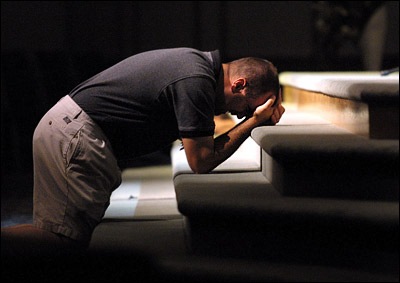
            Sometimes we just need permission to grieve.  In the evangelical church today it is sometimes looked down upon to grieve since we know the reality of heaven.  This is both unfortunate and unbiblical.  Bereavement is Scripture is a reality and recognized as an important part of coming to grips with death.  Far from stuffing his feelings, the Old Testament character David personally expressed his grief and agony over the death of his best friend, Jonathan.
 
            The final chapter of the book of 1 Samuel is the account of a decisive battle in which the Philistines defeated the Israelites.  As a result, both King Saul and his son Jonathan were killed.  Jonathan and David were close – so close that their relationship was as if they were one soul, not two.  So, to have his friend no longer with him was a great loss to David.  The beginning of the book 2 Samuel tells us of David’s response to the news that his friend was gone:  he lamented the loss.  To lament means to have a deep and passionate expression of sorrow over a significant loss.
 
            Here are a few observations about David’s lament (2 Samuel 1:17-27):  it was not only personal, but was voiced publicly, meaning that others were invited to grieve along with him; it affirmed the tragedy of death and its deep impact upon us; it focused on remembering the positive characteristics of the deceased; and, it was verbalized with heartfelt thoughts and emotions.
 
            Grief and lament is as individual as a fingerprint; there is not a fixed process to a person’s bereavement.  Therefore we cannot pigeon-hole ourselves or someone else to fit a certain way of grieving.  But no matter how we grieve, we must do it so that we come to a point of making sense how to live without the person’s presence and relationship.  David was close to the Lord, and God’s presence was the most decisive factor in helping him move on to the demands of serving others as their new king.
 
            There are times when we simply feel stuck.  Not much seems to be happening and nothing apparently makes any difference.  Oftentimes, at the root of such feelings, is some unrecognized and/or unresolved grief underneath.  It causes us to respond to life as if we were moving in slow motion.  There is no quick and easy solution to the reality of a loss; it must be acknowledged and worked-through with some attention and care.  If not, it will inevitably lead to problems down the road, and end-up causing emotional breakdowns over the smallest of issues.
 
            So, let’s take our cues from David.  Let’s do the good work of lamenting losses and grieving significant changes of life.  Otherwise, we will only run into each other in the church like uncaring zombies and avoid the truly important things which God has for us as his people. 


            May you know the comfort and grace of God today through his encouraging Word, his comforting Spirit, and his compassionate people as you do the good and important work of grieving your losses.

2 Samuel 1:4-27

            In the evangelical church today it is sometimes looked down upon to grieve since we know the reality of heaven.  This is both wrongheaded and unbiblical.  Bereavement in Scripture is a reality and recognized as an important part of coming to grips with death.  Far from stuffing his feelings, David personally expressed his grief and agony over the death of his best friend.
 
            Here are a few observations about David’s lament:  it was not only personal, but was voiced publically, meaning that others were invited to grieve along with him; it affirmed the tragedy of death and its deep impact upon us; it focused on remembering the positive characteristics of the deceased; and, it was verbalized with heartfelt thoughts and emotions.
 
            Grief and lament is as individual as a fingerprint; there is not fixed process to a person’s bereavement.  Therefore we cannot pigeon-hole ourselves or someone else to fit a certain way of grieving.  But no matter how we grieve, we must do it so that we come to a point of making sense how to live without the person’s presence and relationship.  David was close to the Lord, and God’s presence was the most decisive factor in helping him move on to the demands of serving others as their new king.


            Compassionate God, you are present with all who grieve and lament this day.  Let your Holy Spirit come alongside and encourage those in bereavement, and enable me to be a conduit of blessing to them.  May your grace be sufficient for us all; through Jesus Christ our Lord.  Amen.

Job 7:1-21


            Few people have ever suffered such agonizing loss as the Old Testament character of Job.  He literally lost everything but his life.  All his kids were killed, and he was so racked with physical pain and ill health that even his closest friends barely recognized him.  Yet the most severe suffering of all came from the grinding silence of God about the whole affair.  Job felt the spiritual pain of a seemingly distant God:  “Why have you made me your mark?  Why have I become a burden to you?”
             Indeed, when one is in the throes of grief, and God does not respond, the suffering seems pathetically senseless.  As I write this, another spate of shootings have this week rocked American towns in the West and Mid-West.  Where is God in all this?  As families grieve and communities reel in shock, how can the loss of life and safety square with a God who is Sovereign over all creation?
             It’s the silence that often hurts so badly.  Groans, laments, and anguish seem to fly up and away with no easy answers and no immediate relief.  Yet, God hears.  God sees.  And God knows.  We have a big picture perspective of the book of Job.  We know the end of the story.  We even know why Job suffered, even when he himself never knew.  But even with such an understanding, there is still a large mystery to the ways and the silence of God.
             It is a great temptation for many Christians to give neatly wrapped answers to life’s most difficult realities.  But the book of Job does not allow for it.  What we have is a man who never understood all that happened in his life, yet held onto his integrity and his faith in the God he never fully understood.  After all, if we understood all there is to understand about God, he would not be God at all.
             Invisible God, you are not only unseen physically, but many times spiritually and emotionally unseen, as well.  Open the eyes of my heart so that I might catch but a glimpse of your working.  Even though I am but a child and know so little, yet I trust in your steadfast love even in the most difficult experiences of life.  Amen.

The Need for Lament, Part 2


We all accumulate a host of losses over the course of a lifetime.  Many of them are small losses; some of them are devastating losses.  The death of children, disability, rape, abuse, cancer, infertility, suicide, and betrayal are all examples of crushing loss – losses that need to experience lament.  All these losses are irreversible; we cannot return to how things once were.  We must push forward by grieving each loss.  And as we lurch ahead we cling to these words from Holy Scripture:  Because of the LORD’s great love we are not consumed, for his compassions never fail.  They are new every morning; great is your faithfulness (Lamentations 3:22-23).
 
            So, how do we lament our losses in a healthy way?  Here is what the prophet Jeremiah did in the book of Lamentations:
  1. Jeremiah remembered his afflictions and his losses.  We need to avoid superficial repentance and forgiveness.  We must own and feel the pain of the loss before we can begin to offer a mature forgiveness.
  2. Jeremiah paid attention to faith, hope, and love.  This can only be done if we are alert to the process of grieving.  Elizabeth Kubler-Ross was the person who identified the famous five stages of grief:  denial, anger, bargaining, depression, and resolution/acceptance.  We rarely move neatly through each stage.  The important thing is that we get to the place of seeing God’s committed love to us not just in spite of the suffering but because of it.
  3. Jeremiah did not minimize his pain and suffering.  We must sit with our pain.  Do not sluff off a loss by saying others have it worse, or that it is nothing.  Year after year many Christians do not confront the losses of life, minimizing their failures and disappointments.  The result is a profound inability to face pain, and has led to shallow spirituality and an acute lack of compassion.
  4. Jeremiah prophesied about how Jesus grieved.  His message predicted what Jesus faced in his passion.  The prophet Isaiah described the Messiah as a man of sorrows and acquainted with grief (Isaiah 53:3).  Peter Scazzero, in his book The Emotionally Healthy Church, points out what Jesus did not say, and what he did say at particular events in his ministry.  At the tomb of Lazarus, Jesus did not say “Come on everyone, stop all this crying” but wept with the people.  When entering Jerusalem, Jesus did not say “too bad guys, I’m moving on without you” but lamented over the city desiring to gather them as a hen does her chicks.  On the cross, Jesus did not say “Lighten up everyone; God is good; he will be victorious!”  But instead said, “My God, my God, why have you forsaken me?”  Hebrews 5:8 tells us that Jesus “learned obedience from what he suffered.”
Grieving is an indispensable part of a full-orbed spirituality and emotional health.  Life does not always make sense.  There is deep mystery to the ways of God.  The Lord is doing patient and careful work inside of each one of us.  While he is busy within our souls, we will likely feel lost and disconnected, not seeing the full tapestry of what he is creating.  Weariness, loneliness, a sense that prayers are not being heard, and a feeling of helplessness are all common experiences of God’s reconstruction of a broken spirit.
 
People who have truly lamented their losses are not hard to spot.  They have a greater capacity to wait on God and be patient toward others.  They are kinder and more compassionate.  They lack pretense and are liberated from trying to impress others.  They are comfortable with mystery, not having to be certain about every theological minutiae.  They are humble, gentle, and meek.  They are able to see God not only in the glorious and victorious, but in the mundane, banal, and lowly.  They are more at home with themselves and with God.  People transformed through the power of lament are equipped to live and love others as Jesus did.


            So, then, the church really ought to be the best place on planet earth for people to be open in their grief, find openness in love, and effectively move through a process of lament so that they become mature disciples able to help others with the comfort they have received.  Let us pray toward that end.