Blessed is the one who comes in the name of the Lord. We bless you from the house of the Lord. The Lord is God, and he has given us light. Bind the festal procession with branches, up to the horns of the altar.
You are my God, and I will give thanks to you; you are my God, I will extol you.
O give thanks to the Lord, for he is good, for his steadfast love endures forever. (New Revised Standard Version)
Today, take some meditative time to connect with the Lord. Allow yourself some space and grace to meaningfully get in touch with God and your own deep spirituality.
Make yourself comfortable… either sit down, stand outdoors, or recline in your favorite easy chair…. whatever posture helps you relax and relate to God.
Take several deep breaths in and out…
Give yourself permission right now to focus on your relationship with the Lord…
Make God and you a priority…
There is nowhere else you need to be…
You are deserving of this time…
If you get distracted by a thought or sound, simply acknowledge that it occurred and release it. Do not allow it to take you away from this time. For the next several minutes, focus on you and your God….
Imagine you are a kernel of corn, snuggled in the ground…
Although you are small, the Lord has given you everything you need within yourself to become a tall stalk with many ears of corn…
Breathe in, feeling your lungs expand as you inhale… and as you breathe out and exhale, stretch your arms slowly over your head, as if you are breaking the ground…
Slowly bring your arms down…
Lift your face toward heaven…
Imagine feeling the warmth of the sun and the light of God upon you… basking in the Lord’s grace for you…
Feel the refreshment of a gentle rain from heaven falling on you… giving you God’s steadfast love…
Sense your created self and all the potential within coming out… growing… lifting toward the immense sky of the Lord’s favor…
See yourself standing as a nine-foot tall stalk with multiple ears of corn…
Bask in the reality that you are a gift to a hungry world… that you are blessed to be on this earth, and to be a blessing to many… know that you are enough and express your gratitude to God using the following practice:
Look around you. Identify and name:
5 things you see…
4 things you feel…
3 things you hear…
2 things you smell…
1 thing you taste…
Express your thanks to the Lord for each of those things you identified.
End your time by slowly saying out loud with flavor:
You are my God, and I will give thanks to you; you are my God, I will extol you.
O give thanks to the Lord, for he is good, for his steadfast love endures forever.
Be very careful, then, how you live—not as unwise but as wise, making the most of every opportunity, because the days are evil. Therefore, do not be foolish, but understand what the Lord’s will is. Do not get drunk on wine, which leads to debauchery. Instead, be filled with the Spirit, speaking to one another with psalms, hymns, and songs from the Spirit. Sing and make music from your heart to the Lord, always giving thanks to God the Father for everything, in the name of our Lord Jesus Christ. (New International Version)
As you likely well know, an inebriated person tends to say and do things that they do not typically say or do when they’re sober. The Apostle Paul’s point about being filled with the Spirit is that, instead of doing and saying stupid things, we are so filled with God that we do things and say things that we would not typically do and say if we were not filled with God – that is, good things.
Apart from being full of God’s Spirit, we tend toward mumbling, not singing; worry, not making music in our hearts; and complaining and arguing, not giving thanks. Half-filled Christians practice a half-hearted Christianity. They’re only half-baked in their service and devotion to Christ.
Why sing?
Because singing is part of being filled with the Spirit of God. Singing happens when we experience God’s overflowing grace in our lives through the blessings of being chosen, adopted, and redeemed into God’s new community. (Ephesians 1:3-11)
Music is powerful. It’s not only a means of expressing praise and commitment to Christ and each other, it is also a powerful means of being impressed. For example, when we first teach kids the alphabet, we teach it in a song. Trying to teach letters in a rote fashion typically doesn’t work well for pre-school kids. Words set to music is why we still remember words from old TV shows, because those words were set to a catchy tune. Music is why an Alzheimer’s patient cannot remember her daughter’s name but can flawlessly sing all four verses of Amazing Grace.
Singing is an offering and a sacrifice of praise to God (Hebrews 13:15). And singing is also a vehicle whereby we are taught, encouraged, and built up in the community of believers. We sing to God, one another, and even ourselves.
Church music, then, is to be both a means of praising God and a practice of encouraging each other. We do it through psalms, hymns, and spiritual songs.
Psalms
The word “psalm” helps us rightly think of the biblical book of Psalms. Singing the psalms is an ancient practice, going all the way back to the Israelites singing psalms in the temple and synagogue. The early church maintained this practice, especially as a means of being faithful to praying without ceasing.
However, over time, medieval congregations began neglecting the practice. In fact, the congregations eventually gave up most singing altogether. Almost all the singing was done by church choirs and professional musicians employed by the state (no separation of church and state) to write, compose, and perform in worship services.
Five-hundred years ago, with the Reformation, Martin Luther reinstituted congregational singing. He gave music back to the people. One of the results of this change was putting the book of psalms to song – the Psalter. For many Protestant denominations, the Psalter became the primary means of singing. The Psalter chiefly set prayers to song. It was both a means of expressing prayer to God and learning Scripture.
Hymns
There have always been hymns in the church. Yet, it was not until the Reformation that hymns began to be written and sung by congregations. For the Reformers, hymns were used to teach sound doctrine and theology, as well as a means of confessing the faith together
Spiritual Songs
Spiritual songs are the present day equivalent of praise and worship choruses, or what some refer to as contemporary songs. These are songs purposefully designed to be emotional expressions of praise to God and to give powerful testimony for what God has done or is doing.
So, what?
Quick review:
Psalms are used to pray and learn Scripture.
Hymns are used to teach us sound doctrine and confess the faith together.
Spiritual songs are an important way of expressing praise to God and being encouraged in the faith.
Therefore, church music is to serve as both a revelation from God, and as a response from God’s people.
There are two important deductions from this verse:
A variety of songs is inferred and expected.
Paul commanded their use.
The reason worship style is such a hot topic in a lot of churches is because we all have our personal preferences. And yet, if we are to be faithful to today’s New Testament lesson, we will not just lock in on what I want.
Truth be told, we are selfish people when it comes to music. We want what we want, and we don’t care what somebody else wants. And we will persist in that self-absorbed spirit until somebody calls us on it. That somebody is the Apostle Paul. The Word of God calls us to encompass psalms, hymns, and spiritual songs – all three of them – in our worship.
I have a good friend who is an accomplished church musician and worship pastor. I once asked him how I can lead a worship service among such a variety of preferences concerning music. He answered my question with a question: “How highly do people, including and especially your musicians, value the unity of the church? Do they love each other so much that they can allow for a wider range of style, and do so without vocally complaining about it?”
My friend went on to say, “When I arrived at one church as their pastor, some people were in a rather bad habit of saying very openly, ‘Oh I hate that song,’ or, ‘If I hear this song one more time I’m walking out.’ What I tried to do was teach people that this is not the most loving or mature approach and does little to build up the rest of the Body of Christ.”
If a group of people are being faithful to Scripture, and doing their best musically, then – if the music seems lifeless, dull, or strange to us – the real issue isn’t style but our hearts.
Is that heart filled with the Spirit of God? If it is, then we will speak to one another using the Psalter, using time-honored hymns, and utilizing fresh contemporary praise songs. And the result will be the Body of Christ, the Church, built up in the faith.
Gracious God, give us grace to take to heart the great dangers we are in by our unhappy divisions about music. Take away all hatred and prejudice, and whatever else may hinder us from godly union and concord; that, as there is but one body and one Spirit, one hope of our calling, one Lord, one faith, one baptism, one God and Father of us all, so we may from this time forward be all of one heart and of one soul, united in one holy bond of peace, and may with one mind and one mouth glorify you, through Jesus Christ our Lord. Amen.
“Surely God is my salvation; I will trust and not be afraid. The Lord, the Lord himself, is my strength and my defense; he has become my salvation.” With joy you will draw water from the wells of salvation.
In that day you will say:
“Give praise to the Lord, proclaim his name; make known among the nations what he has done, and proclaim that his name is exalted. Sing to the Lord, for he has done glorious things; let this be known to all the world. Shout aloud and sing for joy, people of Zion, for great is the Holy One of Israel among you.” (New International Version)
The large Old Testament book of Isaiah is thick with a message of judgment for both Israel and the surrounding nations. The sins of ancient Israel, seven-hundred years before the birth of Christ, were many. The primary offenses were injustice toward the needy; the have’s taking advantage of the have-not’s; and empty worship rituals toward God.
Social and spiritual corruption was rampant. God pleaded with the people through the prophets to stop doing wrong and start doing right by encouraging the oppressed and defending the powerless. (Isaiah 1:10-17)
Although God’s judgment was imminent, via the powerful Assyrian Empire, God would not annihilate the people. God promised a Righteous Branch would grow from the seemingly dead stump of Israel. A child will be born, a Messiah given. There will be hope in Israel. Heartfelt praise, and proclamation of God’s great name, will again fill the air.
For me, what is so remarkable about all this is the grace of God. The Lord made promises to Israel not based upon what they would or would not do; God made promises to the people by God’s own radically free love. This wasn’t a matter of playing Let’s Make a Deal with God saying, “If you get your act together, then I will be good to you.” No, before Israel even had a chance to return to the Lord, God was already choosing to be merciful.
I am absolutely convinced with the firmest conviction possible that the Scriptures of the Old and New Testaments are all about God and God’s own unbounded, unfettered, free, crazy, illogical, and wildly wonderful grace. Because God is love, the Lord constantly goes out of the way to be gracious so that we will be together and enjoy our divine/human relationship.
If we miss the message of God’s grace in the Holy Scriptures, we have missed salvation – because only grace can save us. Without grace, we are lost. Today’s Old Testament lesson is full of praise because it’s a response to the undeserved grace which God freely gives.
Any Christian preacher worth their salt is a preacher of grace. Grace is the very thing that is distinctive about Christianity. Grace is love that seeks you out when you have nothing to give in return. Grace is recklessly generous. Grace does not use carrot sticks, scorecards, or power politics. Grace never demands – it only gives.
Grace is unconditional acceptance given to an undeserving person by an unobligated giver.
That is what God did for Israel… and for us. And when we get a hold of this truth, even a little bit, our hearts become bubblers of praise.
The prophecy of Isaiah is an adventure of God’s reckless love toward unlovable people, which is why it is one of the most quoted books of the Old Testament by Jesus. Jesus came because of grace.
Jesus came to release us from our obsessive need to be right, our compulsion to be rewarded, and our demands to be respected.
Because Jesus came to set sinful captives free, life does not have to be a joyless effort to justify and validate ourselves before others. The grace of God in Christ is a game-changer. And with but a glimpse of it, we are forever undone by its mercy.
Grace causes us to praise God.
There was once a pastor who had a three-year old daughter who was going around the house singing the chorus “We Exalt Thee” except that she kept mispronouncing one of the words: “I exhaust thee, I exhaust thee, I exhaust thee, O Lord!” Perhaps she was right. Maybe too many folks are exhausting God with folded arms instead of hands raised in praise and worship.
Grace causes us to trust God.
Grace alleviates our fears. For, if God is for us, who can be against us? God takes care of us despite our weaknesses and failures.
Grace causes us to have joy in God.
With joy we draw water from the wells of salvation. Jesus is the Living Water we can continually draw from and drink. Grace keeps giving without an end in sight. We get to keep coming to God with an inexhaustible supply of fresh grace.
Grace causes us to give thanks to God in prayer.
Gratitude to God ought to characterize our corporate gatherings. Expressing thanks is more than for the individual in their prayer closet – it is to be offered in the gathered assembly of believers. Grace eliminates self-consciousness altogether because there is nothing to be self-conscious about with God. The Lord has seen you at your worst, and still loves you.
What’s more, we need not be self-conscious about appearing ignorant, looking silly, or not having all the answers in making known among the nations what God has done. If we are influenced by grace, then we can freely speak of God to all kinds of people we encounter.
“God forbid that I should travel with anybody a quarter of an hour without speaking of Christ to them.”
George Whitefield (1714-1770)
Grace causes us to sing together to God.
When grace takes hold of a congregation, there is no mumbling of songs – there are loud shouts and singing for joy because God is good! God wants some noisy worship!
Grace brings such gladness that we don’t care how we appear to other people; we are going to shout, sing, and express our joy! Yes, there is an important place for contemplative, reverent, and reflective worship. And there is also a place for letting go, becoming unhinged, and dancing before Jesus!
The world mostly ignores God. Even some Christians take God’s grace for granted. Israel’s greatest sin was assuming everything was fine. But it wasn’t. There was no grace. And with no grace there is no God. Eventually, Israel found joy in the most unlikely of places – in exile. God’s grace would transform a terrible time of trouble into raising of voices in song.
Isaiah’s prophecy is about returning to the Lord. The season of Advent is all about God’s relentless pursuit of wayward people – the anticipation of grace coming in the form of an infant – and the bringing of grace to a people living in darkness.
Let us, then, return to the Lord. Let us be captivated by grace. Let us renew our love for Jesus. Let us lose ourselves in praise and adoration of the One who gave everything for us. Let us worship Christ the King. Let us proclaim the name of Jesus as exalted over everything.
Great God of grace, be merciful to us as we limp to you with all of our wounds and brokenness. We have made such a mess of our lives with our bad attitudes, ugly words, selfish actions, and our ignoring of you through it all. So, we come to you with nothing but ourselves in all of our sin. Forgive us, cleanse us, renew us, revive us, refresh us, and reform us according to the ways of Jesus Christ. Thank you for your undeserved grace. We give you praise for the lengths you went to secure our forgiveness. With a joy too deep for words, we humbly offer to you our lives so that the name of Jesus will be exalted in us individually and corporately. Amen.
Then King David went in and sat before the Lord, and he said:
“Who am I, Sovereign Lord, and what is my family, that you have brought me this far? And as if this were not enough in your sight, Sovereign Lord, you have also spoken about the future of the house of your servant—and this decree, Sovereign Lord, is for a mere human!
“What more can David say to you? For you know your servant, Sovereign Lord. For the sake of your word and according to your will, you have done this great thing and made it known to your servant.
“How great you are, Sovereign Lord! There is no one like you, and there is no God but you, as we have heard with our own ears. And who is like your people Israel—the one nation on earth that God went out to redeem as a people for himself, and to make a name for himself, and to perform great and awesome wonders by driving out nations and their gods from before your people, whom you redeemed from Egypt? You have established your people Israel as your very own forever, and you, Lord, have become their God.
“And now, Lord God, keep forever the promise you have made concerning your servant and his house. Do as you promised, so that your name will be great forever. Then people will say, ‘The Lord Almighty is God over Israel!’ And the house of your servant David will be established in your sight.
“Lord Almighty, God of Israel, you have revealed this to your servant, saying, ‘I will build a house for you.’ So, your servant has found courage to pray this prayer to you. Sovereign Lord, you are God! Your covenant is trustworthy, and you have promised these good things to your servant. Now be pleased to bless the house of your servant, that it may continue forever in your sight; for you, Sovereign Lord, have spoken, and with your blessing the house of your servant will be blessed forever.” (New International Version)
“The whole reason why we pray is to be united into the vision and contemplation of God to whom we pray.”
Julian of Norwich (1343-1416)
Perhaps you wish you had a better prayer life. To pray, as with most things in life, requires both motivation and how to do it. So, it’s appropriate to find answers about prayer by observing the biblical models of prayer contained in Holy Scripture.
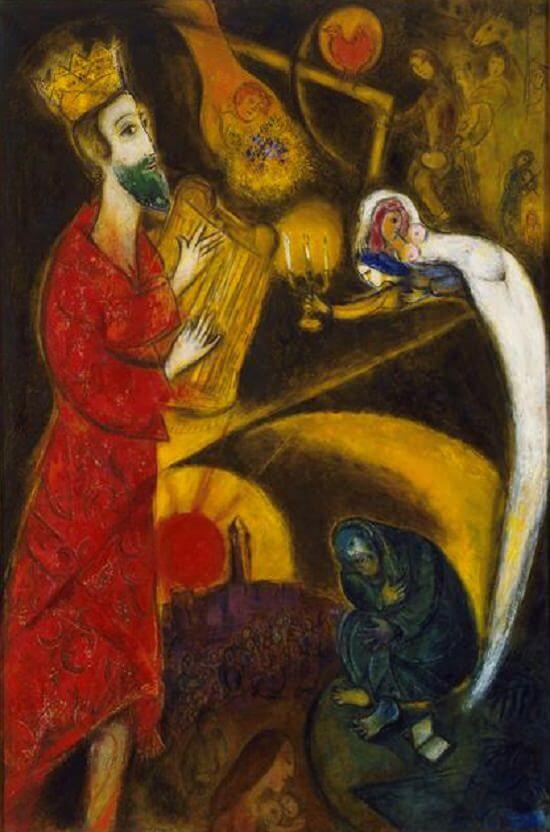
Today’s Old Testament lesson is King David’s prayer in response to God’s revelation to him about fulfilling covenant promises. Looking at David’s prayer, there is a three-fold division which models for us a good way to approach God.
The Present: Gratitude for God’s Grace
David began his prayer with an attitude, posture, and words of humility, recognizing and affirming the relationship between himself and God. Although David is the king over all Israel and Judah, he repeatedly refers to himself as a servant (10 times).
God didn’t have to communicate anything to David about the future. Yet, the Lord graciously made known that it would be through David’s descendants that all of God’s good promises will be fulfilled. And David is overwhelmed with such gracious words. It comes tumbling out of him in a heartfelt prayer of gratitude and thanksgiving.
It is good for us to think about the spiritual blessings we have received from God. Not only can prayers of thanksgiving be uttered at any time to the Lord, but we can also write our gratitude in a journal as a prayer offering to God.
It’s also good to be specific about the circumstances and the praises. In the future, whenever there are discouraging situations, we can look back to what we wrote and remember the ways in which God showed up and encouraged us with very great and precious promises.
The Past: Praise for God’s Actions
David affirms there is no one and no god which can compare to Yahweh, the great I Am. It is the Lord God almighty who displayed divine power and presence in redeeming the Israelites out of Egyptian slavery and into the Promised Land.
Any greatness which arises from humans is the direct result of God’s greatness. Apart from God, there is no distinctive way of living. God’s presence makes all the difference:
Then Moses said to him [Yahweh], “If your Presence does not go with us, do not send us up from here. How will anyone know that you are pleased with me and with your people unless you go with us? What else will distinguish me and your people from all the other people on the face of the earth?” (Exodus 33:15-16, NIV)
The Lord specializes in bending hopeless situations to divine purposes, transforming people to new life, and turning systemic evil on its head so that the humble, meek, and penitent will be first, not last.
The Future: Prayer for God to Fulfill Divine Promises
King David already knew God’s promises to the Israelites. Now, however, David understands how he personally fits into the Lord’s plan.
Courage arises whenever God’s people know God’s promises and then discern how to fit into God’s plan. Confident assurance and settled peace cannot simply be ginned-up through positive thinking; bold faith needs a foundation of truth – a rock solid base which cannot be moved and is always there.
King David found his ultimate motivation in life in God’s revelation. His basis of prayer was God’s Word. Biblical prayers, like David’s, are there for us to model our own prayers.
Accept, O Lord, our thanks and praise for all that you have done for us. We thank you for the splendor of the whole creation, for the beauty of this world, for the wonder of life, and for the mystery of love. We thank you for the blessing of family and friends, and for the loving care which surrounds us on every side. We thank you for setting us at tasks that demand our best efforts, and for leading us to accomplishments that satisfy and delight us. We thank you also for those disappointments and failures that lead us to acknowledge our dependence on you alone.
Above all, we thank you for your Son Jesus Christ; for the truth of his Word and the example of his life; for his steadfast obedience, by which he overcame temptation; for his dying, through which he conquered death; and for his rising to life again, in which we are raised to the life of your kingdom. Grant us the gift of your Spirit, that we may know Christ and make him known; and through him, at all times and in all places, may give thanks to you in all things. Amen.







 Rev. Tim Ehrhardt