Psalm 82 – Help Others, Without Prejudice

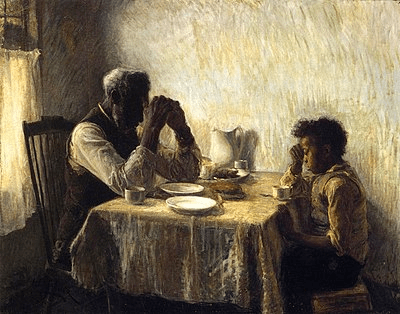
“The Thankful Poor” by Henry Ossawa Tanner, 1894

God takes his place in his own assembly.
He pronounces judgment among the gods:
“How long are you going to judge unfairly?
How long are you going to side with wicked people?”

Defend weak people and orphans.
Protect the rights of the oppressed and the poor.
Rescue weak and needy people.
Help them escape the power of wicked people.

Wicked people do not know or understand anything.
As they walk around in the dark,
all the foundations of the earth shake.
I said, “You are gods.
You are all sons of the Most High.
You will certainly die like humans
and fall like any prince.”

Arise, O God!
Judge the earth, because all the nations belong to you. (God’s Word Translation)

“My dear friends, pay attention. God has given a lot of faith to the poor people in this world. He has also promised them a share in his kingdom that he will give to everyone who loves him.”

James 2:5, CEV

God’s mercy and grace is what makes the world go round. God’s attention to people who possess little to nothing is what upholds the earth from being consumed with judgment.

An absence of grace in people is offensive to God. An uncharitable spirit, indifferent to those in need, will eventually face the crushing weight of God’s glory upon them.

The psalmist is uncompromisingly clear on divine imperatives for humanity: defend the weak; protect the rights of the poor; rescue the needy; and deliver them from unjust power. That’s what God does. And that is what we are to do, without prejudice.

When I was growing up, our family dog was named “Sam.” Sam loved being on the farm. One time he tussled with a skunk. I could barely get close enough to clean him up because he stunk so badly. 

Favoritism toward those with means over those who don’t, stinks, and God has a hard time getting close to us when we show partiality to others. And the Lord is going to clean us up when he smells the stench of discrimination on us. 

Showing favoritism to some over others is evidence that the dog is running away from the bath of grace. In order to develop relationships and interact with people the way God wants us to, we must be free from prejudice.

No matter how you slice the Bible, God cares about persons trapped in poverty. The poor are important to the Lord. 

When Jesus began his earthly ministry, he pointed people to the words of the prophet Isaiah.

“The Spirit of the Lord is upon me, because he has chosen me to bring good news to the poor.” (Isaiah 61:1; Luke 4:18) 

In the Old Testament, there are seven different words for the “poor” because poverty was such a pervasive reality (and still is across the world!). The range of meanings includes those who are poor because of laziness; those born into poverty; being poor because of inhuman oppression or slavery; simple beggars; and the pious humble poor. 

These spiritual poor persons are the Hebrew “anawim.” (pronounced “on-a-wheem”) The anawim are humble persons caught in grinding poverty, having no choice but to put their trust in God.

God has a lot to say about such persons because they are near and dear to the divine heart. Old Testament law was quite clear about how to treat the poor. 

Poor persons will never disappear from the earth. That’s why I’m giving you this command: you must open your hand generously to your fellow Israelites, to the needy among you, and to the poor who live with you in your land. (Deuteronomy 15:11, CEB)

Do not cheat poor and needy hired servants, whether they are Israelites or foreigners living in one of your towns. Each day before sunset pay them for that day’s work; they need the money and have counted on getting it. If you do not pay them, they will cry out against you to the Lord, and you will be guilty of sin. (Deuteronomy 24:14-15, GNT) 

The mistreatment, exploitation, and inattention to the poor, the anawim, was the chief reason God sent prophets to Israel. 

Listen to this, you who rob the poor
    and trample down the needy!
You can’t wait for the Sabbath day to be over
    and the religious festivals to end
    so you can get back to cheating the helpless.
You measure out grain with dishonest measures
    and cheat the buyer with dishonest scales.
And you mix the grain you sell
    with chaff swept from the floor.
Then you enslave poor people
    for one piece of silver or a pair of sandals.

Now the Lord has sworn this oath
    by his own name, the Pride of Israel:
“I will never forget
    the wicked things you have done! (Amos 8:4-7, NLT)

Instead of being generous to the poor and allowing them to forage for grain at harvest behind the harvesters, they kept “those people” away from the fields so that they could turn a profit at every little bit they could. And God thought it all stunk to high heaven.

Bear in mind, only the poor in spirit will enter the kingdom of heaven. The real issue is humility that demonstrates grace to people who cannot offer you something in return. 

It’s easy to be merciful to people who will turn around later and scratch your back. It’s altogether a different thing to be humble, gracious, and generous to those you know cannot give anything back to you.

God cares about the condition of our souls and not the balance of our bank accounts. 

Inattention to the needy only betrays a heart far from the Lord. God does not judge people on face value and the state of their finances, and neither should we.

The only way to rid ourselves of the stench of showing favoritism is to receive the cleansing bath of God’s mercy in Jesus Christ. The shampoo of grace is available, that is, if we will let God apply it. God is the expert in:

  • Turning people from only associating with those they are comfortable with, to lovingly reaching out to people very different from themselves
  • Changing people from the stinking thinking about what they can continually obtain and consume, to people who are loving and generous with their words and their physical resources
  • Putting to death a proud spirit that looks to get ahead and accomplish an agenda by any means possible, to giving new life through humble repentance.

Ministry to the poor is a non-negotiable for the Christian and Christ’s Church. 

Beyond mere dispensing of benevolent funds, the poor also need relationships, connections, resources, and a chance to give back in ways they can contribute. That’s just part of being attentive to them and extending basic human respect and dignity. 

How do you or your church show their concern for the poor in your city and/or region?

Almighty and most merciful God, we remember before you all the poor and neglected persons whom it would be easy for us to forget: the homeless and the destitute, the old and the sick, and all who have none to care for them. Help us to heal those who are broken in body or spirit, and to turn their sorrow into joy. Grant this, gracious Father, for the love of your Son, who for our sake became poor, Jesus Christ our Lord. Amen.

Galatians 4:8-20 – It’s All About Grace

A mosaic of the Apostle Paul in St Isaac’s Cathedral, St. Petersburg, Russia

Formerly, when you did not know God, you were slaves to those who by nature are not gods. But now that you know God—or rather are known by God—how is it that you are turning back to those weak and miserable forces? Do you wish to be enslaved by them all over again? You are observing special days and months and seasons and years!I fear for you, that somehow I have wasted my efforts on you.

I plead with you, brothers and sisters, become like me, for I became like you. You did me no wrong. As you know, it was because of an illness that I first preached the gospel to you, and even though my illness was a trial to you, you did not treat me with contempt or scorn. Instead, you welcomed me as if I were an angel of God, as if I were Christ Jesus himself. Where, then, is your blessing of me now? I can testify that, if you could have done so, you would have torn out your eyes and given them to me. Have I now become your enemy by telling you the truth?

Those people are zealous to win you over, but for no good. What they want is to alienate you from us, so that you may have zeal for them. It is fine to be zealous, provided the purpose is good, and to be so always, not just when I am with you. My dear children, for whom I am again in the pains of childbirth until Christ is formed in you, how I wish I could be with you now and change my tone, because I am perplexed about you! (New International Version)

Grace is the most wonderful spiritual reality of all. It is forgiveness, freedom, faith, acceptance, and love all rolled up in a package given specially to you and me.

Grace is also terribly hard for a lot of folks to wrap both their heads and their hearts around. It is scandalous, subversive, and stupefying.

It was hard for the Galatian Church. Having embraced the grace of God in Christ for their deliverance from guilt and a shameful past, they then set their lives on the law to work out their sanctification. In other words, the Galatian believers did a sort of half-repentance; they turned from useless ways and were saved by grace, then turned around and decided, like a dog returning to it’s vomit, to go back to the law for the governing rule of their Christian lives.

If grace was good enough for salvation (which it was) it’s also good enough for sanctification, to be the chief operating force of the Christian’s life and ministry (which it is).

“Grace fills empty spaces but it can only enter where there is a void to receive it, and it is grace itself which makes this void.”

Simone Weil

A life filled with endless rules and regulations is unable to receive the life-flowing life-giving stream of grace. Grace is even so wondrously powerful that it is the force which breaks all other lesser forces and takes over.

This was the Apostle Paul’s experience. Having been the ultimate rule-keeper and law-abider, he was completely overtaken by a tsunami of grace. It stripped him of all the laws which kept him from Christ and the gospel. Grace changed his mind, his heart, and his life. He would never be the same again.

So, with the confidence of grace behind him, Paul could implore the Galatians to be just like him. I wonder if any of us could say the same.

Paul was a committed follower of Jesus – so much so that he ached and longed for others to embrace a life of grace, just as he had. It was actually painful for Paul to see others held by the cold grip of the law and not the warm embrace of grace. Like a mother about to give birth, he was laboring and working hard to give spiritual birth to those that would become like Jesus.

If you have experienced a transformed life in Jesus Christ, as if you have been born again by grace through the Spirit, then you likely feel and resonate with the travail of Paul. Knowing the elixir of grace, you want everyone to drink it in and be inebriated with its effects. You want it so bad that it hurts. You desire it to the point of exclaiming, “I beg you to be like me!”

You may spend many of your days with family, friends, neighbors, or co-worders who are strangers to grace. Either they are stuck in the clutches of the law and are fearful stick-in-the-muds because of it, or they simply do not know what they are missing. 

It is good to regularly ask ourselves, “What am I afraid of? Will this thing matter in the end? Is it worth holding on to?”

Grace will lead us into our fears and emptiness, and grace alone can fill them up, that is, if we are willing to stay in the void. We must become comfortable with asking questions for which we might never get answers.

People of deep faith develop a high tolerance for ambiguity and find less and less a need for the certainty of rules and regulations. Grace teaches us to swim in the river of mystery and find our home in faith.

Gracious God, may you weave your way into the lives of those who need you the most, so that mercy will be more than a theological idea. Work in me in such a way that I can stand with Paul and encourage others to be like me, through Jesus Christ, in the power of the Holy Spirit. Amen.

Ephesians 2:11-22 – Included

Therefore, remember that formerly you who are Gentiles by birth and called “uncircumcised” by those who call themselves “the circumcision” (which is done in the body by human hands)—remember that at that time you were separate from Christ, excluded from citizenship in Israel and foreigners to the covenants of the promise, without hope and without God in the world. But now in Christ Jesus you who once were far away have been brought near by the blood of Christ.

For he himself is our peace, who has made the two groups one and has destroyed the barrier, the dividing wall of hostility, by setting aside in his flesh the law with its commands and regulations. His purpose was to create in himself one new humanity out of the two, thus making peace, and in one body to reconcile both of them to God through the cross, by which he put to death their hostility. He came and preached peace to you who were far away and peace to those who were near.For through him we both have access to the Father by one Spirit.

Consequently, you are no longer foreigners and strangers, but fellow citizens with God’s people and also members of his household, built on the foundation of the apostles and prophets, with Christ Jesus himself as the chief cornerstone. In him the whole building is joined together and rises to become a holy temple in the Lord. And in him you too are being built together to become a dwelling in which God lives by his Spirit. (New International Version)

There is perhaps no better explanation in the entire New Testament about what the Church truly is than here in today’s lesson.

The redemptive events of Jesus – especially the crucifixion of Christ – has completely changed everything. The cross is the mid-point of history, the fulcrum in which all things in heaven and on earth hinge.

The cross has totally transformed our status from being:

  • in Adam (fallen and separated from God) to being in Christ (now lifted and in union with God)
  • in the flesh (driven by our immoral and unethical impulses) to being in the Spirit (now driven by moral and ethical desires)
  • a Jew or a Gentile (defined by race, ethnicity, etc.) to being one people of God, a new egalitarian society, the community of the redeemed, the Church.

We were once far from God. Now we are brought near through the blood of Christ.

We are included, not excluded; graced and loved, not shamed and shunned.

And our status isn’t based on physical circumcision but on circumcision of the heart, that is, by faith.

There was a time when we were estranged from God, as if we were migrants from another country, or aliens from another world. We were strangers with no visible hope in anything or anyone.

But now, because of Christ’s cross, we have become near to God, gained an inheritance in Christ, and are seated in the heavens as royalty. Everything has mercifully changed. All is incredibly different – a good different.

Jesus Christ himself is our peace. He is the superglue who has bonded us to God and to one another as the one people of God. Because of this gracious union, there is no more anger and malice toward each other. There is, instead, peace.

The Lord Jesus has torn down the walls of separation between people, stripped the armor off of those who used it to keep a distance, and obliterated all obstacles to genuine relational connection – including the obstacle of the Law.

By his crucifixion, death, and resurrection, Christ Jesus fulfilled all the demands of the Law. Therefore, the Law of Moses is no longer needed. Those who love one another and carry one another’s burdens are the ones who fulfill the Law of Christ.

The reason for abolishing all the laws and layers of separation is so that Christ could create one new people from the disparate groups – thus making peace through the cross.

Just as two people come together in marriage and create an entirely new relationship – one new person from the two – so Christ has joined Jew and Gentile together and formed an entirely new society of unity and one-ness.

We are, then, on equal footing with one another. One group is no longer privileged over another. There is no such thing as an underprivileged people-group in God’s new society.

The Church is to be the one place on earth where all are privileged, all are included, and none are left behind.

There is reconciliation. The situation isn’t of people simply not fighting with each other, not at one another’s throats and sitting with a grumpy affect and arms folded. Quite the opposite. It is a restored relationship, harmonious interactions, and working together in loving fellowship.

Christianity is distinct from all other religions and all other ethical systems because everything is based, tethered, and moored in Christ’s crucifixion and resurrection. In Christianity, enmity, hate, and rage aren’t managed; they’re put to death – nailed to the cross and done away with.

Unfettered access to God, through Christ and the Spirit, means that we have an open channel to receiving the faith, hope, and love needed to address the darkness of this world and those still stuck in chaos, disconnection, and shame.

Christ himself is the cornerstone to the superstructure of peace and love which has been erected – the very things we have longed for throughout our personal lives and throughout history.

Jesus is the King who brought radical amnesty and hospitality to the entire country by making us all fellow citizens, enjoying all the rights and privileges thereof.

The Lord Jesus Christ is the Son who welcomed us into God’s family, embracing our adoption and making us full-blooded brothers and sisters, and giving us a prominent place at the Table.

All of these things about Christians and the Church aren’t ideals; they’re reality.

Anytime we are spiteful, ignorant, prejudiced, or unkind, we are not living in reality – we’re living in an old evil world that isn’t ours.

Therefore, we are called to fully live into God’s new society – a community of equals – loving and leading like Jesus, living into his words and ways, embracing our new status as children of God, offering radical mercy and grace because that’s exactly what our Lord did for us.

Creator God, who made us different from one another in myriad ways, yet all made in your image: Fill our hearts with your love and our minds with your wisdom so that we may truly become brothers and sisters of your only Son, our Savior Jesus Christ our Lord; who lives and reigns with you in the unity of the Holy Spirit, one God, now and forever. Amen.

Galatians 3:15-22 – Law and Grace

Brothers and sisters, let me take an example from everyday life. Just as no one can set aside or add to a human covenant that has been duly established, so it is in this case. The promises were spoken to Abraham and to his seed. Scripture does not say “and to seeds,” meaning many people, but “and to your seed,” meaning one person, who is Christ. What I mean is this: The law, introduced 430 years later, does not set aside the covenant previously established by God and thus do away with the promise. For if the inheritance depends on the law, then it no longer depends on the promise; but God in his grace gave it to Abraham through a promise.

Why, then, was the law given at all? It was added because of transgressions until the Seed to whom the promise referred had come. The law was given through angels and entrusted to a mediator. A mediator, however, implies more than one party; but God is one.

Is the law, therefore, opposed to the promises of God? Absolutely not! For if a law had been given that could impart life, then righteousness would certainly have come by the law. But Scripture has locked up everything under the control of sin, so that what was promised, being given through faith in Jesus Christ, might be given to those who believe. (New International Version)

If the Apostle Paul were living in our day, I’m pretty sure he could have his own reality show, if he wanted. Paul is a terribly interesting man. Within church circles, his adventures are legendary. 

One of the most interesting things about Paul is his piercing intellect and flawless rhetoric. Today’s New Testament lesson has Paul taking on a Galatian heresy. Maybe we could call it “Law and Grace: SFU (Special Faith Unit).”  

The folks who were holding to the law were reminded by Paul that the promise to Abraham was a contract or covenant made by God that was binding, permanent, and divinely ratified. The law, on the other hand, was not – it was designed to be in effect for a specific amount of time, temporary, and only bound the people of God until the promise was fulfilled in Christ.

So, why in the world was there a law to begin with if it is no longer in effect? 

Paul said the law was added because of transgressions. It was as if God’s people were precocious and disobedient little children who needed some firm boundaries and rules in order to keep them safe and lead them to the time when they would grow to maturity. 

My friends, stop thinking like children. Think like mature people and be as innocent as tiny babies.

1 Corinthians 14:20, CEV

With the arrival of adulthood, there is no longer any need for the law.

The law was never designed to be permanent. So, when Christians cling to a rules-based faith, they are showing their immaturity. They need to grow up and embrace the permanent reality of living in the Spirit. 

Although you should have been teachers by now, you need someone to teach you an introduction to the basics about God’s message. You have come to the place where you need milk instead of solid food. Everyone who lives on milk is not used to the word of righteousness, because they are babies. But solid food is for the mature, whose senses are trained by practice to distinguish between good and evil. (Hebrews 5:12-14, CEB)

We must press on toward spiritual maturity, not being simpletons who embrace the law as if it were the actual faith itself. Instead, we need to pursue an adult faith – one which is thoroughly permeated and bathed in grace.

Grace is the permanent and pervasive reality that governs everything Christians are to do and say. Grace cannot be earned, only accepted, not achieved, but only given by God. 

Until we can grasp this fundamental truth of Christianity, the Christian life will never make sense. Only until we release our expectations of rules and let go of our orienting around law will we discover the liberation of a grace-filled existence.

Jesus said, “In a word, what I’m saying is, Grow up. You’re kingdom subjects. Now live like it. Live out your God-created identity. Live generously and graciously toward others, the way God lives toward you.” (Matthew 5:48, MSG)

We spread the message about Christ as we instruct and teach everyone with all the wisdom there is. We want to present everyone as mature Christian people.

Colossians 1:28, GW

The believer’s task is to grow in the grace and knowledge of our Lord Jesus. That happens not through the law but by grace – utilizing the God given gifts of faith, hope, and love.

Gracious God, you saved me through Christ alone by faith alone. Now help me to live by grace alone as the highest and greatest truth operative in the universe and in the kingdom of God. Amen.