Healing the Outsiders (Matthew 8:1-13)

Jesus Healing, by Arthur Robins, 2020

When Jesus came down from the mountainside, large crowds followed him. A man with leprosy came and knelt before him and said, “Lord, if you are willing, you can make me clean.”

Jesus reached out his hand and touched the man. “I am willing,” he said. “Be clean!” Immediately he was cleansed of his leprosy. Then Jesus said to him, “See that you don’t tell anyone. But go, show yourself to the priest and offer the gift Moses commanded, as a testimony to them.”

When Jesus had entered Capernaum, a centurion came to him, asking for help. “Lord,” he said, “my servant lies at home paralyzed, suffering terribly.”

Jesus said to him, “Shall I come and heal him?”

The centurion replied, “Lord, I do not deserve to have you come under my roof. But just say the word, and my servant will be healed. For I myself am a man under authority, with soldiers under me. I tell this one, ‘Go,’ and he goes; and that one, ‘Come,’ and he comes. I say to my servant, ‘Do this,’ and he does it.”

When Jesus heard this, he was amazed and said to those following him, “Truly I tell you, I have not found anyone in Israel with such great faith. I say to you that many will come from the east and the west, and will take their places at the feast with Abraham, Isaac and Jacob in the kingdom of heaven. But the subjects of the kingdom will be thrown outside, into the darkness, where there will be weeping and gnashing of teeth.”

Then Jesus said to the centurion, “Go! Let it be done just as you believed it would.” And his servant was healed at that moment. (New International Version)

On a few occasions, my computer picked up a nasty virus that hijacked every file and function I have. The most frustrating thing about those events is that there was nothing I could do by myself to fix it or make it better.

I had to humble myself and ask a computer geek to get into my system and take care of the problem. It’s a weird feeling to look at my screen and have a stranger work inside my personal computer. But if I failed to get help, my computer was worthless – unless I let someone with authority fix the blasted thing.

Kingdom Values

Jesus is Lord of all. Since Christ has authority over everything, we are to live our lives in submission to his will and way. Only through humble resignation to Christ can we experience the healing and deliverance we seek.

Jesus preached his famous Sermon on the Mount (Matthew 5-7) and taught the people as one who had authority. In that Sermon, Jesus laid out the values of God’s kingdom: humility, sorrow over sin, meekness, purity, mercy, and peacemaking. In today’s Gospel lesson, we see the power of those values evidenced and expressed in two stories of healing and deliverance. 

The world needs saving, and that’s exactly what Jesus is up to. Christ’s authority is total – coming from his moral authority – as the very embodiment of the Beatitudes he taught. Grace always has the last word, as Jesus healed showing neither favoritism nor discrimination.  

Healing a Leper

Jesus healing a leper, Cathedral of Santa Maria Nuova, Florence, Italy

In the first story, Jesus used his authority to heal and transform a leper. Leprosy was a feared disease in the ancient world. There was no known cure, and lepers were forced to live apart from everyone else. The Old Testament book of Leviticus says that a leper must wear torn clothes, let his hair be unkempt, cover the lower part of his face and cry out “unclean! unclean!” (Leviticus 13:45-46).  Lepers were the ultimate outsiders.

A leper came to Jesus with a humble profession of faith: “Lord, if you want to, you can make me clean.” It was a clear case of genuine need, and poverty of spirit. Jesus responded by doing the unthinkable: He touched him.  In a great and wonderful reversal, Jesus did not become unclean by touching the leper; but instead, the leper was made clean. 

Still today, the world needs to be touched. It’s an important way of following Jesus and changing the world. This requires us, God’s people, to get up-close and personal with outsiders and marginalized persons and groups. Christian service requires Christian touch.

Authentic Christian ministry communicates love through contact and identification with others. A thousand years after Christ’s earthly ministry, St. Francis of Assisi met a leper on the road:

“Though the leper caused him no small disgust and horror, he nonetheless, got off the horse and prepared to kiss the leper. But when the leper put out his hand as though to receive something, he received money along with a kiss”

Life of St. Francis, by Thomas of Celano

Francis did what seemed humanly impossible because he was filled with the love and compassion of Christ. The love of Jesus allows us to touch others with compassionate care, especially to those who have been rejected and mistreated.

Healing a Roman Officer’s Servant

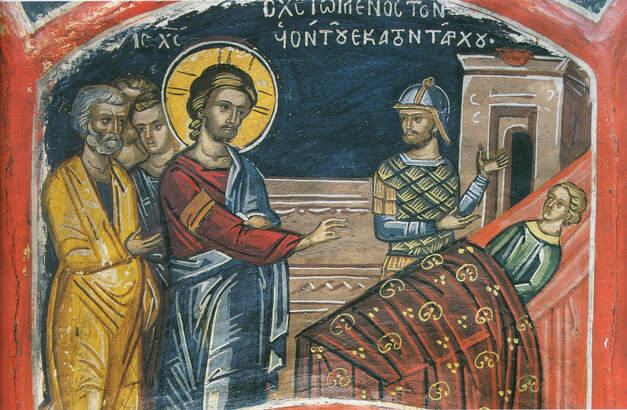
Fresco of Jesus healing the Centurion’s servant, Dionysiou Monastery, Mount Athos, Greece

The second story was equally eye-popping and unbelievable to the people in Christ’s day. Jesus used his authority to heal and transform a Gentile – and what’s more – a hated Roman army officer.

We see the values of the Beatitudes expressed in a Roman Centurion who felt unworthy to even have the Lord Jesus come into his house. The Centurion’s profession of faith amazed even Jesus: “Just say the word,” he said in recognition of Christ’s authority, which is big enough to heal without even being present. 

Although Centurions were the backbone of the Roman military machine and hated by the Jews, yet Jesus responded to the Centurion’s request, and he also affirmed his faith as greater than any Jew.

Grace answers to need, and not to smug self-confidence.

The Roman Centurion requested healing. Jesus listened and answered. The Centurion did not use his position to order Jesus or demand healing; he came in a spirit of humility and asked with confidence that Jesus could heal his servant if he wanted to. The Centurion threw himself on God’s mercy. So, Jesus upheld the Centurion as a model of faith for us all.

Healing Doesn’t Happen with the Independent

In affirming the Roman officer’s faith, Jesus also gave a solemn warning to the self-righteous: Their lack of humility and genuine faith would land them outside the kingdom. In another great reversal, the insiders will become the outsiders, and the outsiders become the insiders.

Independently proud folk do not experience healing and transformation because they don’t even know they are sin sick. They see no need for an intervention by Jesus because they already have their righteous deeds to boast about. Such persons are more concerned about looking good and saving face, than perceiving their own unworthiness. 

The self-righteous and self-sufficient approach to handling problems and difficult situations is to come up with good ideas and clever strategies, relying on sheer personal effort and willpower. Prayer may or may not happen; there is no honest beseeching of God. 

Delusional thoughts of personal autonomy only separate us from the grace of God that we so desperately need. 

There is a spiritual dimension to every situation and trouble we face – including sickness. If we only examine the medical and biological end of physical problems, we may be dealing with symptoms instead of the root issue that plagues us.

Are you hurting? Pray. Do you feel great? Sing. Are you sick? Call the church leaders together to pray and anoint you with oil in the name of the Master. Believing-prayer will heal you, and Jesus will put you on your feet. And if you have sinned, you will be forgiven—healed inside and out. Make this your common practice: Confess your sins to each other and pray for each other so that you can live together whole and healed. (James 5:13-16, MSG)

Conclusion

Jesus healed and transformed outsiders. Followers of Christ, dependent upon God, ask themselves:

  • Who are the outsiders among us?
  • Where are the strangers? 
  • How can we get close enough to touch aliens and immigrants? 
  • Will you help us intercede in prayer for foreigners? 
  • When can we search for and pursue those on the periphery of society? 

Believe that the risen and ascended Jesus can and will heal, deliver, and transform people of all kinds.

Jesus cannot be domesticated into some figurehead that suits our desires and conforms to our ideas about how things ought to be. Jesus is portrayed in these stories as eager to heal, wanting to show grace to the least and the lowly among society.

So, let us participate in the world’s healing, beginning with the Lord’s Prayer:

Our Father in heaven,
    may your name be kept holy.
May your Kingdom come soon.
May your will be done on earth,
    as it is in heaven.
Give us today the food we need,
and forgive us our sins,
    as we have forgiven those who sin against us.
And don’t let us yield to temptation,
    but rescue us from the evil one. Amen. (Matthew 6:9-13, NLT)

Walk on Water? Why? (Matthew 14:22-33)

Jesus Walks on Water, by Konstantin Alexejewitsch Korowin, 1890 

Immediately Jesus made the disciples get into the boat and go on ahead of him to the other side, while he dismissed the crowd. After he had dismissed them, he went up on a mountainside by himself to pray. Later that night, he was there alone,and the boat was already a considerable distance from land, buffeted by the waves because the wind was against it.

Shortly before dawn Jesus went out to them, walking on the lake. When the disciples saw him walking on the lake, they were terrified. “It’s a ghost,” they said, and cried out in fear.

But Jesus immediately said to them: “Take courage! It is I. Don’t be afraid.”

“Lord, if it’s you,” Peter replied, “tell me to come to you on the water.”

“Come,” he said.

Then Peter got down out of the boat, walked on the water and came toward Jesus. But when he saw the wind, he was afraid and, beginning to sink, cried out, “Lord, save me!”

Immediately Jesus reached out his hand and caught him. “You of little faith,” he said, “why did you doubt?”

And when they climbed into the boat, the wind died down. Then those who were in the boat worshiped him, saying, “Truly you are the Son of God.” (New International Version)

In the New Testament Gospels, we see Jesus for who he is – Son of God and true Sovereign of the universe – seeking to reconcile people to God through his life, miracles, and teaching. In the Gospels we also see Christ’s disciples for who they are – a rag-tag bunch who express both belief and doubt, and experience both faith and failure.

The reality of the Christian life is that it is a sort of three-steps-forward and two-steps-backward kind of experience. The expectation that we will “succeed” and have everything go hunky-dory each time we step out in faith, is far from how things actually work in both the world and in God’s kingdom. Doubt and failure are important experiences for the believer in Jesus.

Without failure, there is no Christian life. Why? Because it means we are still in the boat.

It’s evidence that we never left the safety of established routines and responded to God’s command to step out of our comfort zone, and boldly go where we’ve never gone before.

Our failures may, like Peter, be colossal bellyflops. Yet, Jesus is there – extending grace to Peter and helping him, even in his failure of faith. Failure does not define us; it isn’t our identity. Jesus is Lord over everything, including storms, hardship, and trouble. 

Yes, there are a lot of scary things in life. Learning to ride a bike was scary. Driving for the first time on an icy road was scary. Getting married and having kids was scary. Admitting a fault, mistake, or weakness is scary. Being vulnerable with another person is scary.

It can even be scary to be at church. Why? Because we might fail, and it may crush us.

The fear of failure, however, need not control our lives. Why? Because grace overcomes everything.

We all find ourselves, at times, caught midway between faith and doubt. But to know this situation is to experience grace. If the worst scenario you worry about in your head would actually come to pass, it will still never change the reality that God loves you! And it will not stop Jesus from extending his hand to you in a life-saving grip of grace. 

Fear melts away when we keep our eyes on Jesus. So, we must focus on Christ, instead of fixating on the waves around us. The truth sets us free. Therefore, let’s notice five truths about Jesus that help us overcome the fear of failure and embrace a life of faith.

1. Jesus is a person of prayer

Jesus was deeply dependent on his heavenly Father. His life exhibited the necessities of simple prayer and obedience. If Jesus found the need for solitude and prayer for his life and ministry, how much more to we need it!? 

The Lord had his disciples get into the boat and go out on the lake. Jesus knew they were about to face a storm. The boat ended up getting thrown around by the waves. Even though the disciples were doing God’s will by going out on the lake, they were not spared from adversity.  

Jesus wanted his disciples to experience the storm. Why? Because it is through the storm that we learn faith.  

Faith is developed through experience and adversity. Faith that never endures distress, never grows and matures. Faith must be exercised – and if it isn’t, it atrophies and becomes useless. 

Show me a person with great faith, and I’ll show you a person that has gone through a boatload of adversity and hurt, having allowed Jesus to grace them with healing.

2. Jesus is present with us, and this presence brings an end to fear

Being in the middle of a lake during a storm did not prevent Jesus from being present with the disciples – he just walked on the water to be with them. Even though the disciples had just participated in the miracle of Jesus feeding the five thousand, another miracle was not on their radar – which is why they did not recognize Jesus and were afraid when they saw him.

While afraid, we don’t see Jesus, even when he’s right in front of our faces. Why? Because we don’t expect him to be there and mistake him for a ghost.  

When the disciples cried out in fear, Jesus responded. I used to have a factory job, training workers. When the training was completed, I had the trainees evaluate our time together. The top response I received is that my presence helped them to learn their job – the freedom to fail time and time again without judgment. Having me there to rescue them, when things got too much, built confidence that they could do it on their own.

3. Jesus desires those who follow him to imitate him

Jesus walked on water. Jesus invited Peter to walk on water. Peter was not chided by Jesus for getting out of the boat, but for doubting that he could continue in the miracle that was happening. 

Jesus isn’t merely interested in disciples being able to regurgitate his teaching. Why? Because he wants us to exercise our learning through actual deeds of faith.  

Once the command of Jesus was given to Peter, “Come”, then walking on water became only a matter of trust.

“Christianity has not been tried and found wanting. It has been found difficult and left untried.”

G.K. Chesterton

We understandably get nervous when a crazy Jesus and an unpredictable Holy Spirit call us to change by getting out of the friendly confines of the boat. Why? After all, we might fail. 

However, it is at those times that we bank on God’s Word and promises. The Apostle James said that if we find ourselves lacking wisdom to deal with the unpredictable and unknowable, we are to ask God who gives generously to all without finding fault and will be given to us. (James 1:5)

Christ Walking on the Sea, by Natali Fedorova

Peter responded to his predicament by crying out to Jesus, “Lord, save me!” Jesus immediately reached out and saved Peter from his own doubt and lack of faith. Jesus called Peter a “little-faith.”

Many people have lived too long with the notion that God is some stern angry deity who is constantly displeased with sinful people, and that only through perfection will God ever be happy with us. The truth is that Jesus wants us to imitate him; and, when we fail, he is there to pick us up. 

4. Jesus has the authority to settle the storm when he is ready to do it

Jesus is King. Christ is Sovereign of the world. He will bring the crisis to an end according to his own good pleasure and good timing. Rather than spending all our emotional capital by worrying or conniving to get out of a situation, we can trust God and keep our eyes on Jesus.  Our job is to believe; God’s job is everything else.

5. Jesus’ power led the disciples to acknowledge who he is

Worship happens when we see Jesus as he really is, the Son of God. Flat, dull, boring worship comes from flat, dull, boring Christians who are unable to see the power of Jesus in their lives. We discover the power of God when we are in a situation which requires God’s strength to deliver us. Grasping Jesus as the Son of God is more than a verbal confession of faith; it is being able to trust him, like getting out of a boat in the middle of a lake.

We are to live by faith in the Son of God who loved us and gave himself for us (Galatians 2:20). It doesn’t require much faith to pray that Aunt Mable’s bunions will feel better. It only requires a little faith to give a dollar when you have ten dollars. It takes no faith to discuss the weather and steer clear of hard conversations.

But it does require faith:

  • to pray for a miraculous healing every day without giving up for a little boy who is racked by epilepsy, and trust God to spare his life
  • to write a check for $100 to someone in need when you have exactly $100 in your checking account, and trust God to provide for you own necessities. 
  • to go off the grid of the routine schedule to have a difficult discussion about social justice, and trust God to act on Christ’s teachings. 
  • to live as though the mission of God in this world is the most important thing we could ever do, and trust God to step out and do it.

It would be great if we could pray and act without ever doubting or failing, yet the only way to do that is to never step out of the boat. Instead, live life. Trust God. And see what happens.

Holy God, help us, your people, to embrace the life that is truly life by stepping out of the boat.  May Jesus define our lives instead of letting failure define us. May we accept the grace that is ours in Jesus Christ our Lord, in whose name we are bold to pray. Amen.

Develop a Virtuous Ethic (Matthew 7:15-20)

“Beware of false prophets who come disguised as harmless sheep but are really vicious wolves. You can identify them by their fruit, that is, by the way they act. Can you pick grapes from thornbushes, or figs from thistles? A good tree produces good fruit, and a bad tree produces bad fruit. A good tree can’t produce bad fruit, and a bad tree can’t produce good fruit. So every tree that does not produce good fruit is chopped down and thrown into the fire. Yes, just as you can identify a tree by its fruit, so you can identify people by their actions.” (New Living Translation)

God has always been concerned for ethical virtue. And Jesus was always careful to take that ethic and help others identify it and apply it.

Virtuous ethics was well-known in the ancient world, especially thanks to the Greeks and Aristotle – who espoused that a person’s character is the determinative factor in discerning the extent to which that person is a good person.

For Aristotle, ethics includes moral virtues such as courage, temperance, compassion, generosity, honesty, and justice. The person in whom these moral virtues are to be found as steadfast dispositions can be relied on to exhibit a good character, and therefore, is able to make morally correct actions in moral decision-making situations.

For Jesus, religious legalism was a clear outward sign of the lack of inward moral virtue. Bad religion was a result of bad character. Therefore, everyone ought to beware of the religious leaders who exhibited stifling religious legalism.

Nothing can choke the heart and soul out of a person’s true spirituality, and hinder the development of virtue, like the legalist who teaches a precise extra-biblical list of do’s and don’ts.

For many folks, it seems easier to live by the list than to pursue the harder road of developing the character qualities needed for a solid and virtuous religious ethic. Christian discipleship involves growing into spiritual maturity and allowing a seasoned character to shape how we make decisions. 

To do so, we must patiently and consistently follow in the way of Jesus, which is the way of grace and of life.

Today’s Gospel lesson is Christ’s conclusion to his Sermon on the Mount. It is a sermon that sets forth the values of God’s kingdom and devalues the core of legalistic thought. 

I define legalism as a compulsion to spell out, in great detail, how everyone is to live a godly life; purposely going beyond the stated commands of Holy Scripture so that all persons can know exactly what they are supposed to do in any situation.

The problem with this approach to the Christian life is that godliness is merely an outward expression of our ability to hold to the list. It really has nothing to do with cultivating a virtuous ethic of life.

“Do not do what they do, for they do not practice what they preach. They tie up heavy, cumbersome loads and put them on other people’s shoulders, but they themselves are not willing to lift a finger to move them. Everything they do is done for people to see.”

Jesus on the legalist (Matthew 23:3-5, NIV)

The legalistic way of life and religion feeds human pride and boasting; it goes against the inner heart values of humility and meekness in Christ’s Beatitudes. The teaching of Jesus ends up getting lost in trying to do everything right or perfect.

Jesus, through the Sermon on the Mount, led the crowd to a point of decision, letting them know they are at a crossroads. There are two alternatives: Choose the way of life as expressed in Christ’s teaching, or else choose the way of destruction through the legalistic list. In order to press the crowd toward the necessity of choosing wisely, Jesus used metaphors to make his point.

False teaching in the form of legalism is like a wolf in sheep’s clothing. Be wary of people who seem pious and sincere, yet who do not quite pass the smell test. After all, Satan himself, the Apostle Paul once said, masquerades as an angel of light, appearing righteous, yet, is intent on deceiving many. (2 Corinthians 11:13-15)

So, how do we recognize a wolf who spiritually and emotionally devours people, and has no intention of helping but harming? Look at the fruit of the tree. 

Jesus is the good tree. Christ advocates for a searching of the heart. This leads to the result of righteous fruit. The bad tree is also seen by its fruit. Anyone who fails to live the Beatitudes of Jesus will be seen by the rotten fruit of boasting and pride.

False teachers tend to believe they are above others. After all, they are experts at keeping the list of do’s and don’ts! Yet, a false disciple will always be shown by their profound lack of grace, gentleness, and genuine humility. They inevitably advocate for holding to their brand of religion and keeping the unscriptural list. The absence of true righteousness and justice in their lives eventually results in their being cut down and thrown into the fire.

For Jesus, there is no riding the fence between the two alternatives presented – and it is a matter for him of life and death. The way of Jesus leads to life, good fruit, entrance into the kingdom of heaven, and stability. The other alternative ends in destruction, bad fruit and fire, exclusion from the kingdom, and being ruined.

The sobering reality of Christ’s teaching is that many people can be deceived with a devil’s bargain: “Take the nice handy legalistic list and you will become godly. Here are twelve principles to change your life. Follow these rules, pray this prayer, give your money to this, and all will be well.” It is, however, a highway to the grave.

The false teacher proclaims himself a “fruit inspector” and then goes on to judge everyone by his own contrived legalistic list. So then, there is a need to repent of religious lists, political agendas, and teachings which ignore and demean Christ’s Sermon on the Mount.

One of the telltale signs of holding to a conjured list is when we are not honest with one another about our struggles. The bald fact of list-living is that we cannot fulfill it. So, when we know we are not measuring up to the list, the temptation is to keep up appearances as if we are doing just fine. 

List-living eschews showing any weakness or imperfection:

  • I cannot admit my sin to anyone because the list pronounces me a failure if I do. 
  • I cannot enter a deep and prolonged grief over my loss because the list says I need to stay strong. 
  • I cannot profess my doubts about God because the list says if I doubt, I am not a real Christian.

My response and recommendation to legalistic list-living is this: To hell with the list! 

Instead, give praise to Jesus Christ who has given us the way of grace! For it is grace which transforms hearts, turns lives around, and provides genuine joy and satisfaction. If grace is not the answer, we are not asking the right question. The tree of life has an abundant supply of gracious fruit.

The greatest anti-legalistic prayer we can pray is the tried and true ancient prayer of the Church: “Lord Jesus Christ, Son of God, have mercy on me a sinner.”

People Are a Bundle of Contradictions (Romans 7:7-20)

“Contradictions” by Michael Lang, 2015

But I can hear you say, “If the law code was as bad as all that, it’s no better than sin itself.” That’s certainly not true. The law code had a perfectly legitimate function. Without its clear guidelines for right and wrong, moral behavior would be mostly guesswork. Apart from the succinct, surgical command, “You shall not covet,” I could have dressed covetousness up to look like a virtue and ruined my life with it.

Don’t you remember how it was? I do, perfectly well. The law code started out as an excellent piece of work. What happened, though, was that sin found a way to pervert the command into a temptation, making a piece of “forbidden fruit” out of it. The law code, instead of being used to guide me, was used to seduce me. Without all the paraphernalia of the law code, sin looked pretty dull and lifeless, and I went along without paying much attention to it. But once sin got its hands on the law code and decked itself out in all that finery, I was fooled, and fell for it. The very command that was supposed to guide me into life was cleverly used to trip me up, throwing me headlong. So sin was plenty alive, and I was stone dead. But the law code itself is God’s good and common sense, each command sane and holy counsel.

I can already hear your next question: “Does that mean I can’t even trust what is good [that is, the law]? Is good just as dangerous as evil?” No again! Sin simply did what sin is so famous for doing: using the good as a cover to tempt me to do what would finally destroy me. By hiding within God’s good commandment, sin did far more mischief than it could ever have accomplished on its own.

I can anticipate the response that is coming: “I know that all God’s commands are spiritual, but I’m not. Isn’t this also your experience?” Yes. I’m full of myself—after all, I’ve spent a long time in sin’s prison. What I don’t understand about myself is that I decide one way, but then I act another, doing things I absolutely despise. So if I can’t be trusted to figure out what is best for myself and then do it, it becomes obvious that God’s command is necessary.

But I need something more! For if I know the law but still can’t keep it, and if the power of sin within me keeps sabotaging my best intentions, I obviously need help! I realize that I don’t have what it takes. I can will it, but I can’t do it. I decide to do good, but I don’t really do it; I decide not to do bad, but then I do it anyway. My decisions, such as they are, don’t result in actions. Something has gone wrong deep within me and gets the better of me every time. (The Message)

“Contradictions in human character are one of its most consistent notes.”

Muriel Sparks, “Loitering with Intent”

The Apostle Paul’s vulnerable expression of his dilemma resonates deeply with many people. There are times when we say things to ourselves such as:

“I told myself I wasn’t going to be like my mother, and here I am responding just like she would.”

“I know better than to drive by the liquor store on my way home and pick up a pint of vodka, yet, I still did it.”

“I don’t want to die, but my thoughts keep racing about a plan for suicide.”

There are many situations in which we are both frustrated and befuddled by doing the things we do not want to do, and not doing the things we want to do.

Yes, indeed, Paul’s existential angst is a timeless description of our common human condition. We all can relate to the seeming inability to do what is right in so many situations. It can drive us nuts, even to a constant and never-ending low-level discouragement that underlies almost everything we do.

Paul’s prescription for dealing with this does not rely on law. He understood that putting our willpower and effort into obeying commands gets us nowhere, because we will eventually fail. Neither our brains nor our spirits work that way. Our willpower was never designed to be the driver of what we do and do not do. If anything, willpower, and the lack thereof, demonstrates just how much we are climbing the ladder on the wrong wall.

People are a bundle of contradictions, doing good, then bad, and flip-flopping back and forth with great frustration.

God’s law was not crafted to transform us from the inside-out. The law has three solid purposes, none of which are meant to bring deep personal transformation:

  1. Attention to the law works to restrain sin in the world
  2. Use of the law provides us with a helpful guide for grateful living in response to divine grace
  3. Reflection on the laws show us how bad off we really are in this world, and how much we are in need of forgiveness

We need a change of habits, and this is different than adopting a list of laws.

Habits are developed from our desires, our affections. In other words, we do what we love – more specifically, our ultimate love(s) drive us to do what we want. To put it in a more straightforward way:

We sin because we like it. And the path to overcoming any besetting sin is to have an ultimate love surpass the lesser sin which we like.

For example, I have developed daily habits or rituals of faith which enable me to commune with God. I love God with all my heart, soul, mind, and strength, and this ultimate love enables me to push out all competing gods who want my devotion. I also love my wife with all my heart. We work on developing habits of a marital relationship which reinforce our love for each other. Love is what drives me to do right and good by her.

So, what do we do when we mess up? For the Christian, no matter what the question is, the answer is always grace.

God’s grace in the finished work of Jesus Christ applied to us by the Holy Spirit is the operative power that changes lives. The law has no power to do that kind of work. Freedom from the tyranny of our misplaced desires and disordered loves comes from Christ’s forgiveness through the cross. Like a lover enamored with his beloved, our desires become oriented toward Jesus for his indescribable gift to us. That is the strength of grace.

Saving God, I thank you for delivering me from sin, death, and hell through your Son, the Lord Jesus. May your Holy Spirit apply the work of grace to my life every day so that I can realize spiritual healing and practical freedom from all that is damaging and destructive in my soul. Amen.