Remember Jesus Christ, who was raised from the dead and descended from David. This is my good news. This is the reason I’m suffering to the point that I’m in prison like a common criminal. But God’s word cannot be imprisoned. This is why I endure everything for the sake of those who are chosen by God so that they too may experience salvation in Christ Jesus with eternal glory. This saying is reliable:
“If we have died together, we will also live together. If we endure, we will also rule together. If we deny him, he will also deny us. If we are disloyal, he stays faithful” because he can’t be anything else than what he is. (Common English Bible)
C.S. Lewis once described God as the Hound of Heaven. By that phrase he meant that God doggedly pursued him and would not let go. Lewis came into Christian faith, in his own words, “kicking and screaming” as God’s faithful pursuit won out in his life.
The Apostle Paul reminded his young protégé Timothy of some basic theology to keep him on track and encouraged in a tough ministry. Paul gave Timothy a trustworthy saying that he could easily remember and say to himself day after day, especially when the going got tough:
If we died with Christ, we will live with him. If we don’t give up, we will rule with him. If we deny that we know him, he will deny that he knows us. If we are not faithful, he will still be faithful. Christ cannot deny who he is. (CEV)
The beauty, wonder, and distinction of God is his amazing grace. There is no ambiguity with God. The Lord is not fickle but loves and holds tight even when we are unlovely and practice avoidance. When God pursues, God finds; when God holds on, there is no letting go.
This trustworthy saying of Scripture is a good, short, solid expression of theological truth to memorize, meditate upon, and say to ourselves repeatedly. We belong to Jesus Christ. God is with us. The Hound of Heaven will always sniff us out and bring us to himself.
Lewis likely got his phrase “Hound of Heaven” from an English poem of the same name by Francis Thompson (1859-1907). Thompson was a tortured soul who flirted in and out of depression, opium addiction, and suicidal thoughts for much of his adult life. Yet, he understood, perhaps better than most, that a loving God never stops pursuing a wayward heart. The poem’s beginning and end says this:
I fled Him, down the nights and down the days; I fled Him, down the arches of the years; I fled Him, down the labyrinthine ways Of my own mind; and in the mist of tears I hid from Him, and under running laughter….
How hast thou merited— Of all man’s clotted clay the dingiest clot? Alack, thou knowest not How little worthy of any love thou art! Whom wilt thou find to love ignoble thee, Save Me, save only Me? All which I took from thee I did but take, Not for thy harms, But just that thou might’st seek it in My arms. All which thy child’s mistake Fancies as lost, I have stored for thee at home: Rise, clasp My hand, and come.” Halts by me that footfall: Is my gloom, after all, Shade of His hand, outstretched caressingly? “Ah, fondest, blindest, weakest, I am He Whom thou seekest! Thou dravest love from thee, who dravest Me.
Theology is not an impersonal affair. Personal religion still exists. The individual’s wax and wane between faith and faithlessness shall never negate divine grace.
The Lord of the universe loves you. There is a deep Divine desire to shower grace on you, to shelter and protect you. There is no need to run. Yet, if you do, God remains steadfast in his dogged pursuit. The hunt will continue….
Thank you, O God, for your great faithfulness, even to me. I believe. Help me in my unbelief! I give unceasing praise and undying devotion to you for your grace of being the One who never lets up, through Jesus Christ my Lord. Amen.
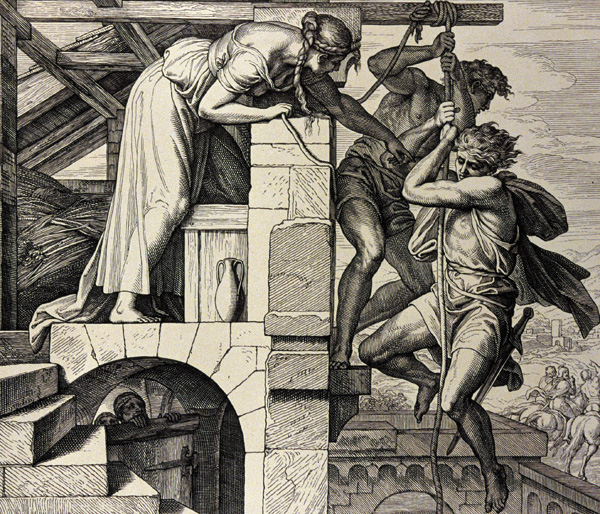
So she [Rahab] let them [the Israelite spies] down by a rope through the window, for the house she lived in was part of the city wall [of Jericho]. She said to them, “Go to the hills so the pursuers will not find you. Hide yourselves there three days until they return, and then go on your way.”
Now the men had said to her, “This oath you made us swear will not be binding on us unless, when we enter the land, you have tied this scarlet cord in the window through which you let us down, and unless you have brought your father and mother, your brothers and all your family into your house. If any of them go outside your house into the street, their blood will be on their own heads; we will not be responsible. As for those who are in the house with you, their blood will be on our head if a hand is laid on them. But if you tell what we are doing, we will be released from the oath you made us swear.”
“Agreed,” she replied. “Let it be as you say.”
So she sent them away, and they departed. And she tied the scarlet cord in the window.
When they left, they went into the hills and stayed there three days, until the pursuers had searched all along the road and returned without finding them. Then the two men started back. They went down out of the hills, forded the river and came to Joshua son of Nun and told him everything that had happened to them. They said to Joshua, “The Lord has surely given the whole land into our hands; all the people are melting in fear because of us.” (New International Version)
A drama unfolded as the Israelites began entering and taking the Promised Land. Joshua, their leader, secretly sent two men as spies to look over the land and check out the prominent city of Jericho. The spies left and ended up in the house of a harlot named Rahab. They hid there because it had been found out they were in the city.
Rahab was able to divert and send away the pursuers who were looking for the spies, telling them that the men left, and that they should leave and go catch them. But she had actually hid them on the roof of her house.
Rahab took the spies into her home because she realized and affirmed that God was giving the land to the Israelites. Everyone in the city had heard the stories of how the Lord brought them out of Egyptian slavery and into the land of Canaan. In an insightful and beautiful confession of faith, Rahab told them:
“I know that God has given you the land. We’re all afraid. Everyone in the country feels hopeless. We heard how God dried up the waters of the Red Sea before you when you left Egypt, and what he did to the two Amorite kings east of the Jordan, Sihon and Og, whom you put under a holy curse and destroyed. We heard it and our hearts sank. We all had the wind knocked out of us. And all because of you, you and God, your God, God of the heavens above and God of the earth below.” (Joshua 2:8-11, MSG)
The men promised to show Rahab and her family mercy when they came to take the city, just as she had shown them grace in the face of trouble. So, today’s Old Testament lesson picks up the story from that point, as she sends the spies safely on their way.
That Rahab, a prostitute, is the heroine of the story is no accident or anomaly. Her profession of faith is central to the drama. She was living in the city wall, which is reflective of her status as being on the margins of society. And having strange men in her home would not have been weird in her neighborhood. It also made it rather easy to get the spies out of the city when trouble was brewing.
Most importantly, however, Rahab – the ultimate outsider in society – becomes the consummate insider. It is astonishing that a Gentile woman of disrepute has a story about her, and even told from her perspective – and not from the point of view of an Israelite man.
Rahab’s bold assertion of faith is both sincere and linked to God’s promise that the Israelites would take the land. Rahab is Exhibit A of the kind of person that inherits the kingdom of God. Rahab’s faith, not her works or reputation, is what spared her life and spared her from judgment.
Please ponder and consider that truth for a bit. Sit with it if you must – the reality that Rahab was judged neither by the spies nor God.
In far too many quarters of the Christian (and broadly religious world) judgment instead of mercy is levied to persons like Rahab. If there is anyone who should have a non-judgmental presence toward “sinners” it is Christians. And, if there is any institution which ought to consistently, both personally and through policy, display unflagging grace and forsake judgment, it is the Church.
Yet, unfortunately, as many have experienced, the Church has often fallen short of the glory of God’s grace in Christ by condemning people of ill repute. Perhaps we all need to rethink what faith truly is: not a checklist of doctrinal beliefs to sign-off on but a confident and bold action based solidly in the promises of God.
Knowing what those promises are, and living our lives appropriately in consideration of them, is the kind of faith that pleases God. Those who attempt to be judge, jury, and executioner need not apply as followers of God.
Genuine righteousness is never earned; it is given by the compassionate grace of God. So, lay hold of God’s promise of grace and mercy with gusto! Let the gracious God, who is full of steadfast love, affect the way we live our lives. Believe with a bold biblical belief that God always does what God has decreed and proclaimed to do.
Lord God, the gracious, almighty, and Holy One of all: I may have not always lived my life well, yet I trust you today that you can and will deliver me from all my troubles because you are with me. May your Holy Spirit give me the gift of faith to believe in such a way that forever impacts how I live my life in service to you and for the common good of all persons – no matter who they are. Amen.
O give thanks to the Lord, for he is good, for his steadfast love endures forever. Let the redeemed of the Lord say so, those he redeemed from trouble and gathered in from the lands, from the east and from the west, from the north and from the south.
Some wandered in desert wastes, finding no way to an inhabited town; hungry and thirsty, their soul fainted within them. Then they cried to the Lord in their trouble, and he delivered them from their distress; he led them by a straight way, until they reached an inhabited town…
He turns rivers into a desert, springs of water into thirsty ground, a fruitful land into a salty waste, because of the wickedness of its inhabitants. He turns a desert into pools of water, a parched land into springs of water. And there he lets the hungry live, and they establish a town to live in; they sow fields and plant vineyards and get a fruitful yield. (New Revised Standard Version)
The responsive spirit
A soul full of spiritual abundance responds freely and organically to God with offerings of gratitude for divine rescue and redemption.
The spiritually responsive person is at peace, content, and able to love with a sensitivity to God because they have had their needs for safety, satisfaction, and relational connection fulfilled. So, as a result, they are able to:
worship joyfully and praise God
speak words of thanksgiving
be attentive to self-care and personal well-being
use their resources wisely, feeling capable and confident of making good decisions that bless both the church and the world
know they are secure in the loving hands of God
The reactive spirit
Conversely, a soul that is empty from spiritual deprivation reacts predictably and robotically to others with frustration and fear.
The spiritually reactive person seems perpetually upset and in chronic emotional pain, feeling rattled and worried most of the time. They do not reflexively look to the Lord. Their needs for safety, satisfaction, and relational connection have not been met. So, as a result, they are:
hypervigilant, on the lookout for the bad, which they are convinced is coming
focused narrowly with tunnel vision, having lost sight of the big picture
prone to overgeneralizing their negative experiences as being the only experiences they ever have
searching for continual stimulation, just to seem alive and feel something
insecure, wanting constant validation from others because they cannot give themselves any encouragement
So, what do you do when always feeling between a rock and a hard place, experiencing racing thoughts, being anxious more than not, feeling like an abandoned town in the Old West with nothing but tumbleweed moving down the street?
A redeemed soul
In your desperation, call out to God. The Lord can:
get you out in the nick of time and deliver you soul from trouble so that you can be grateful for divine love
put your feet walking on a wonderful road of grace that leads to a good place of transformation
meet your needs for freedom, contentment, and loving relational networks, so that your spirit is full of right relationships, purity, mercy, and peace
You can once again, or maybe for the first time, feel like:
A flowing river, instead of sunbaked mud
A fruitful orchard, instead of dry dead tree
A farmer with much grain and many animals, instead of a homeless person sitting on a pile of dung
A person loved and valued by God, instead of a waste of space, breathing air that others could have
A sheep who knows the shepherd is watching over them, instead of an insect that everyone steps on
Keep in mind, that the experience of blessing, the encounter of abundance, and the feeling of peace, is not like a simple math equation – as if God were a divine genie that you happened to find and got three wishes.
Rather, the fulfilling spiritual life involves a persistent faith, confident hope, and constant love. These come from God, and are accessed through humility. The proud person will not realize a life of faith, hope, and love, because they believe they already know what is best.
The humble admit their ignorance, their failings, their shame, their guilt, and their desperation.
Approaching God with humility doesn’t mean to heap deprecation and curses on oneself. It just means to be honest with where you are spiritually, emotionally, mentally, and physically. And to cry out for help, knowing you have nothing to offer in return.
In God’s economy, the currency is grace – and not some give-and-take, I’ll-scratch-your-back-if-you-scratch-mine sort of mentality. God’s steadfast love endures forever. God’s kingdom spins on the axis of grace.
The Lord is not a reactive God but a responsive God. The Lord responded to Israel’s cry for deliverance not just with food and drink, but with a city. God did not only meet the immediate needs of the ancient Israelites, for whom the psalmist is one, along with the original recipients; the Lord took care of their larger, long term needs.
The people needed a place where they could settle down, raise their own crops and tend their own livestock, and have a dependable means of making a living. God satisfied this, and more, by giving them a city where they could settle, be safe, secure, and content.
God can do anything, you know—far more than you could ever imagine or guess or request in your wildest dreams. God does it not by pushing us around, but by working within us, the Spirit deeply and gently providing us with our deepest and greatest needs.
Blessed heavenly Father, you have filled the world with divine beauty: Open our eyes to behold your gracious hand in everything you have done, so that, rejoicing in all your creation, we may learn to serve you with gladness; for the sake of him through whom all things were made, your Son Jesus Christ, our Lord, who with you and the Holy Spirit are one God, now and forever. Amen.
I will praise the Lord at all times; my mouth will continually praise him. I will boast in the Lord; let the oppressed hear and rejoice. Magnify the Lord with me. Let us praise his name together. I sought the Lord’s help and he answered me; he delivered me from all my fears. Look to him and be radiant; do not let your faces be ashamed. This oppressed man cried out and the Lord heard; he saved him from all his troubles. The angel of the Lord camps around the Lord’s loyal followers and delivers them. Taste and see that the Lord is good. How blessed is the one who takes shelter in him. Fear the Lord, you chosen people of his, for those who fear him lack nothing. Even young lions sometimes lack food and are hungry, but those who seek the Lord lack no good thing…
The Lord rescues his servants; all who take shelter in him escape punishment. (New English Translation)
In all times and every place throughout history God has specialized in taking imperfect and broken people and transforming their lives. On the Christian Calendar, November 1 is the day each year to remember the saints who have gone before us. This day is meant to be an intentional way of not forgetting the people, friends, and family – as well as long-dead historical saints – who made a significant impact in our spiritual lives.
All Saints Day is more than a focus on extraordinary persons; it highlights the work of ordinary Christians who faithfully lived their lives. We give thanks for the gift of how they lived their faith every day. We also remember that all believers in Jesus are united and connected through the cross.
Remembering is a prominent theme in Holy Scripture. Over one-hundred times we are told to remember God’s covenant and actions on behalf of people; to remember the needy and those less fortunate; and to remember the important people who influenced us in our journey of faith.
Remember your leaders, who spoke the word of God to you. Consider the outcome of their way of life and imitate their faith. (Hebrews 13:7, NIV)
We are to be inspired now in the present with the actions of faithful saints of the past. They serve as a model of faithfulness, so that we will persevere in our Christian lives and not give up. Through biblical stories of very human persons being used of God, as well as reading biographies of godly people, we can gain motivation for patience and perseverance until Jesus returns.
Who were the people in your life that went out of their way to communicate God’s love to you with both words and actions? Who were those persons who labored behind the scenes in prayer so that you and others would know Jesus?
If any of those persons are still around, and you know where they are, remember them. Drop them a note. Express to them a simple thank you for their influence in your life. You will not only encourage that person – it will help you remember and re-engage with something in your life you may have forgotten or have just taken for granted for too long.
We are not to live our Christian lives in isolation from others, as if we do not need them. You and I are here today because someone influenced us in the way of Jesus. And we will continue to persevere and thrive in the faith when we remember those who have gone before us and allow those here in the present to journey with us along this road of faith.
Today is all about remembrance. We remember answered prayer and salvation. We recollect the people who gave us the life-giving gospel message in both word and deed. We remember the death of Christ and recall that he said he is coming back.
The psalmist recalled his rescue and pulled it forward into the present so that all God’s worshipers could taste and see that the Lord is good. This is exactly what the Apostle Peter did for a church which needed to recall and remember the mighty acts of God:
Like newborn babies, crave pure spiritual milk, so that by it you may grow up in your salvation, now that you have tasted that the Lord is good. As you come to him, the living Stone—rejected by humans but chosen by God and precious to him—you also, like living stones, are being built into a spiritual house to be a holy priesthood, offering spiritual sacrifices acceptable to God through Jesus Christ. (1 Peter 2:2-5, NIV)
Our memories are accessed through symbols and with taste and sight. God uses symbols to reveal himself to us. For example, when God wanted to show us the ugliness of sin and the cost of forgiveness, the Lord told the Israelites to kill an animal and sprinkle its blood on their clothing and on the altar.
That sounds awful. Yet, worshipers never walked away from the experience scratching their heads and wondering what it was all about. That’s because they encountered and tasted the drama of sin and redemption. Their senses saw it, felt it, smelled it, and tasted the meat from it.
Symbols have power. We cannot know God with only our minds; we’re more than brains on a stick. People need ordinary events, like shared meals, that include symbols and rituals.
Every year faithful Jews gather to remember and re-enact the Passover – the story of how they were enslaved in Egypt, oppressed by Pharaoh, and set free by God. To this day pious Jews still remember the Passover by eating and drinking together and telling stories.
We need both words and sacraments. Therefore, holidays like Thanksgiving and Christmas involve both verbal expressions of gratitude and love, and particular actions of love in giving gifts and sharing food. Together, it all connects us to God, to one another, and to a history of God’s people.
Jesus met his disciples in the Upper Room to celebrate Passover together. Jesus energized their time together by filling it with words and symbols of love and redemption. Christ told the disciples about his upcoming death and acted symbolically. “Take and eat – this is my body…. Take this cup – drink from it, all of you.” (Luke 22:7-20)
Rather than sitting around, analyzing the bread, and discussing the wine’s vintage, the disciples ate and drank. They tasted real food and drink. They also tasted real spiritual food. It’s one thing to speak of God’s presence, and it’s another thing to experience that presence through an ordinary shared ritual of bread and cup.
God is good. Jesus is our Emmanuel, God with us. Christ is present with us through our ritual of fellowship and food. When the sixteenth-century Reformer John Calvin was asked how Jesus is present to us at the Lord’s Supper he explained: “Now if anyone asks me how this takes place I shall not be ashamed to confess that it is a secret too lofty for either the mind to comprehend or my words to declare…. I rather experience it than understand it.”
The taste of bread reminds us of the incarnation of Christ, and Christ’s humiliation and death. The taste of drinking the cup reminds us of the sacrifice of Christ, the drops of blood which Jesus sweated in Gethsemane, and the beatings, floggings, nails, and crown of thorns that caused the bleeding.
Tasting the bread and cup when we celebrate communion reminds us that our sins are forgiven, we are united to Christ, and we are united together.
There are historical events which are just that. Then, there are past actions which linger with continual results into the present. The incarnation, life, death, resurrection, ascension, and glorification of the Lord Jesus are past redemptive events which continue to exert powerful force into the here and now.
Saints throughout church history have moved the message of Christ along and demonstrated for us that the past lives in the person of Jesus Christ.
Along with them, we proclaim that Christ has died, Christ has risen, Christ is coming again. And God has something planned for those who have gone before us, along with us, so that together we will experience the perfect righteousness of Christ forever. (Hebrews 11:39-40)
We are encouraged through word and sacrament to proclaim the good news of Jesus Christ until he comes again. Let us respond to God’s wooing invitation to eat and drink, to taste and see that the Lord is good through faith, hope, and love. Let us find in God our refuge and strength, our ever-present help.