
Good News for All (Acts 8:26-40)

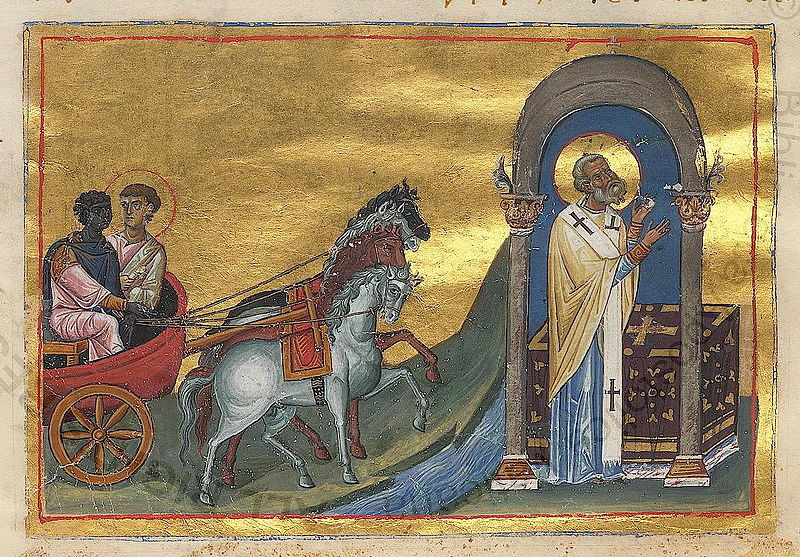
11th century Byzantine depiction of Philip and the Ethiopian eunuch

An angel from the Lord said to Philip, “Get up, and take the desert road that goes south from Jerusalem to Gaza.” So Philip went.

An Ethiopian man who had come to Jerusalem to worship was on his way home. The man was a eunuch, a high-ranking official in charge of all the treasures of Queen Candace of Ethiopia. As the official rode along in his carriage, he was reading the prophet Isaiah out loud.

The Spirit said to Philip, “Go to that carriage, and stay close to it.”

Philip ran to the carriage and could hear the official reading the prophet Isaiah out loud. Philip asked him, “Do you understand what you’re reading?”

The official answered, “How can I understand unless someone guides me?” So he invited Philip to sit with him in his carriage.

This was the part of the Scriptures that the official was reading:

“He was led like a lamb to the slaughter.
He was like a sheep that is silent
when its wool is cut off.
He didn’t open his mouth.
When he humbled himself,
he was not judged fairly.
Who from his generation
will talk about his life on earth being cut short?”

The official said to Philip, “I would like to know who the prophet is talking about. Is he talking about himself or someone else?” Then Philip spoke. Starting with that passage, Philip told the official the Good News about Jesus.

As they were going along the road, they came to some water. The official said to Philip, “Look, there’s some water. What can keep me from being baptized?”  The official ordered the carriage to stop. He and Philip stepped into the water, and Philip baptized him. When they had stepped out of the water, the Spirit of the Lord suddenly took Philip away. The official joyfully continued on his way and didn’t see Philip again.

Philip found himself in the city of Azotus. He traveled through all the cities and spread the Good News until he came to the city of Caesarea. (God’s Word Translation)

We are in the Christian season of Epiphany – a time of celebrating that the light of the Lord has been given not only to Jews but to Gentiles, as well. The good news of mercy, forgiveness, salvation, and peace in Jesus Christ is for everyone, and not just some.

So, we have a very appropriate story in today’s New Testament lesson illustrating God’s grace for those who have been typically the “outsiders” when it comes to the worship of God.

God’s grace is really a merciful divine intervention into another’s life, providing something a person or group needs, yet cannot obtain on their own.

Philip, one of the original twelve disciples of Jesus, received instructions from the angel of the Lord. Take a certain road. That’s it. No other explanation. The command is, however, full of grace. Most of us don’t do all that well with multiple instructions given at once. We do much better with a single imperative at a time.

And so, the next piece of guidance came as Philip was taking the road from Jerusalem south to Gaza. Go hang out around a certain carriage. Philip needed no more direction after that; he took to what was happening.
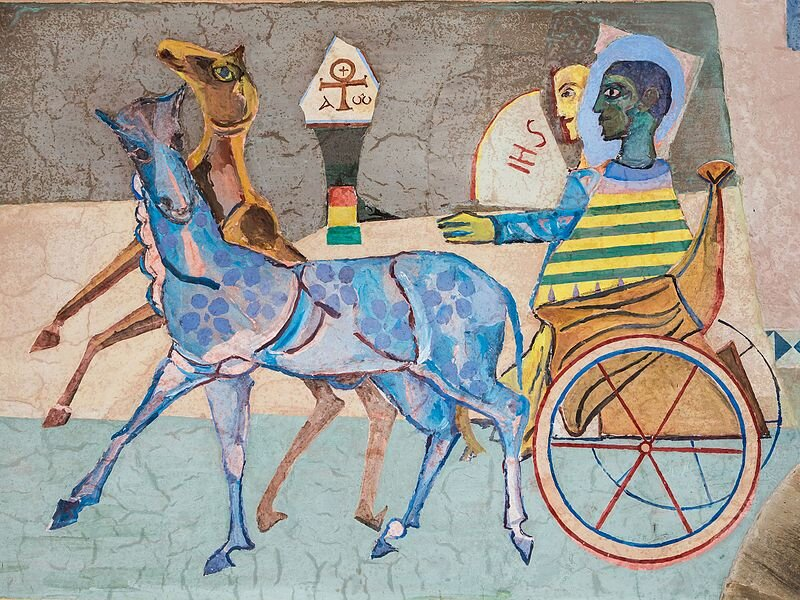
Philip and the Ethiopian Eunuch by Herbert Boeckl

Maybe reading the story from our contemporary perspective hinders us from seeing just how scandalous and unthinkable the story was for people in the first century. Jews and Gentiles didn’t hang out with each other; and, if they did, there were all sorts of rules regulating how the interaction would go.

We really don’t have any of this with Philip. He simply emulates his Lord and ignores societal and cultural mores to meet the need of someone very different than himself.

An Ethiopian man was in Jerusalem and heading back home. He was an official in the Queen of Ethiopia’s court, and a eunuch (a castrated official). He was a person of color with a mutilated body and could have very well been of a different gender than Philip was used to. In other words, he was about as foreign from Philip as one can get.

Yet, what better way to communicate that the gospel is for everyone? Philip had learned from Jesus not to adopt the divisions of race, religion, and gender that others did. See, instead, with spiritual eyes to the heart of a person.

And this Ethiopian eunuch had a heart curious about God, a mind trying to understand God’s words, and a gut that told him this guy approaching me for whom I don’t know and isn’t from my country is perhaps God’s messenger to me.

That’s what I call a divine appointment.

Those divine encounters always result in changed lives. I believe both the Ethiopian and Philip were changed that day. The only way that any of us truly changes is through the interaction with others different from ourselves.

The good news of Jesus is for all. If, however, we remain in a closed system which is not open to others of differing cultures and communities, then we harden into believing the gospel is for us, and not them.

Christianity is not, therefore, an exclusive club made up of insiders who demonize outsiders as not looking, acting, or thinking like we do. We already have plenty of that insidious junk in the world. At its inception, Christianity was different. And, I believe, it needs to keep that edge of reaching out to all persons with a life-giving message of salvation and peace – not a death-dealing sermon of Christian cultural hegemony.

Good news for all people everywhere means that proclamation of the gospel of Jesus Christ needs to occur for all nations and ethnic peoples. It’s a message of grace, not judgment; of mercy, not threats; of open love, not closed hate.

Philip and the Ethiopian show us the way through their sensitivity to the divine, their open dialogue with one another, and their shared commitment to doing what is right and serving the Lord. Philip was a guide, not a conqueror. And the Ethiopian became a follower of Jesus, not Philip.

Let’s make sure to keep it straight; and to keep reaching out.

Lord God, thank you that in love and mercy, you reached out to us – and that when we were dead in our sins, you sent Jesus to make us alive. Thank you that you have a heart that seeks the lost. Thank you for saving us.

Give us hearts that care for the people who are in darkness and need the light of Christ. Teach us to care for them as you do. Grow us to care for the common good of all humanity. 

Help your Church everywhere to know and love you; and to invite others into your divine dance. May our conversations with others be seasoned with salt and full of grace; may our relationships show people the love of Jesus. May our hearts reflect your own heart, through Jesus Christ our Lord, in the strength of the Holy Spirit. Amen.

You Have What You Need (1 Corinthians 1:1-9)

Paul, called to be an apostle of Christ Jesus by the will of God, and our brother Sosthenes,

To the church of God in Corinth, to those sanctified in Christ Jesus and called to be his holy people, together with all those everywhere who call on the name of our Lord Jesus Christ—their Lord and ours:

Grace and peace to you from God our Father and the Lord Jesus Christ.

I always thank my God for you because of his grace given you in Christ Jesus. For in him you have been enriched in every way—with all kinds of speech and with all knowledge—God thus confirming our testimony about Christ among you. Therefore you do not lack any spiritual gift as you eagerly wait for our Lord Jesus Christ to be revealed. He will also keep you firm to the end, so that you will be blameless on the day of our Lord Jesus Christ. God is faithful, who has called you into fellowship with his Son, Jesus Christ our Lord. (New International Version)

God has already provided for us everything we need to live the Christian life. We lack nothing in Jesus Christ; and possess the following five gifts….

God’s Light

Every year, after the 12 Days of Christmas, beginning on January 6 and going to Ash Wednesday, is the season of Epiphany. It is a celebration and recognition that Christ’s coming to this earth as a child is much more than a baby in a manger. Epiphany brings a vision and understanding of God’s glory to all kinds of people of the world.

Epiphany means “manifestation” or “appearance.” The focus of these weeks is that salvation is not limited to Israel but extends to the Gentiles, as well. In other words, the gospel is for everyone.

Epiphany illumines one of the most scandalous truths of Christianity: God gives the light of Christ to common ordinary people who seem far from God with the gift of Jesus. God grants repentance that leads to life for all kinds of people – no matter their race, ethnicity, class, gender, or background – even pagan astrologers like the Magi. It’s a glorious truth that God’s merciful concern is not limited to a certain type of person or a particular group of people.

This old broken world is wrapped in darkness. All kinds of people have no light at the end of the tunnel of their lives for hope and new life. The good news is that Christ brings light to those walking around with no ability to see. Jesus, in his teaching ministry in the Sermon on the Mount, exhorted his followers not to hide their light but to let it shine for all to see.

Oftentimes, the best way to bring resolution to our own troubles and problems is through helping others make sense of their lives through the gracious light of Christ so that they can see an appearance, an epiphany, of what their lives can be in the gracious rule of the kingdom of God. 

God’s Grace

The Church has struggled throughout its history to uphold this basic message of the gospel of grace for everyone. From the Council of Jerusalem in the book of Acts that met to decide whether one ought to become a Jew first in order to be a Christian; to the with-holding of membership to African Americans in many churches in the twentieth century; to ignoring the poor and least among us; we must be intentional and deliberate about reaching and ministering to all people.

The joy of salvation is that I do not need to jump through certain spiritual hoops to enter into Christianity, nor be a certain kind of person. The Church is not an exclusive club of people based in a particular spiritual pedigree or preferences. Through repentance and faith in Jesus, all may come to God.

In him we have redemption through his blood, the forgiveness of sins, in accordance with the riches of God’s grace that he lavished on us.

Ephesians 1:7, NIV

Everyone has intrinsic worth as individuals created in the image of God; and therefore need the attention of Christians in bringing the gospel to them. It is easy to ignore people we do not understand and who are different from us; or to look down on those who do not agree with me on disputable matters. To intentionally reach and minister to a different class or generation or race requires much love and many resources. It requires grace.

Jesus had a big enough inner space to accommodate prostitutes, drunkards, tax collectors, and a whole variety of “sinners.” How big is your inner space? Is it big enough to allow people in your life who are not like you without you feeling threatened and insecure?

In Christ’s day, some feared being contaminated if having table fellowship with such people; religious leaders were afraid of losing their power over people if the status quo was changed in ministering to such low life’s; and others feared continued Roman domination if Jesus kept up spending his time in graciousness to all kinds of sinners. So, all the religious people killed him.

God’s Peace

Because of Christ, we have wholeness and integrity; we have peace.

Therefore, since we have been justified through faith, we have peace with God through our Lord Jesus Christ (Romans 5:1, NIV)

Peace is a gift. Yet, we must unpack the gift in order to enjoy it – which is why we get encouragements to seek peace and pursue it – not because we don’t have it, but because we need to use it.

Finally, all of you, be like-minded, be sympathetic, love one another, be compassionate and humble. Do not repay evil with evil or insult with insult. On the contrary, repay evil with blessing, because to this you were called so that you may inherit a blessing. For,

“Whoever would love life
    and see good days
must keep their tongue from evil
    and their lips from deceitful speech.
They must turn from evil and do good;
    they must seek peace and pursue it.
For the eyes of the Lord are on the righteous
    and his ears are attentive to their prayer,
but the face of the Lord is against those who do evil.” (1 Peter 3:8-12, NIV)

God’s spiritual gifts of speaking and serving

We also need to unpack our spiritual gift(s). We have them. They’re there inside us. But we must let it out!

Each of you should use whatever gift you have received to serve others, as faithful stewards of God’s grace in its various forms. If anyone speaks, they should do so as one who speaks the very words of God. If anyone serves, they should do so with the strength God provides, so that in all things God may be praised through Jesus Christ. To him be the glory and the power for ever and ever. Amen. (1 Peter 4:10-11, NIV)

God’s eternal security

God will keep us firm till the end.

“I give them eternal life, and they shall never perish; no one will snatch them out of my hand. My Father, who has given them to me, is greater than all; no one can snatch them out of my Father’s hand.”

Jesus (John 10:28-29, NIV)

We might jump from finger to finger, but we aren’t getting out of God’s hand! The Lord has us in his loving and gracious grip. God’s faithfulness is what makes all the difference.

Insecurity comes from us trying to be our own Security Officer. We simply don’t know everything, or why some people say or do what they say and do. A believer’s security comes solely from the Good Shepherd, Jesus, taking ownership of the flock and protecting it from harm.

Conclusion

You already have what you need for the Christian life. Jesus is the Light of the World. The good news is the gospel of grace and peace. The Holy Spirit is within us. And the Father has us in his good strong hand.

Our triune God has given us provision to live life to the full. We need to affirm what we have in Jesus Christ:

  • No matter what gets done and how much is left undone, I am enough.
  • I am worthy of love and belonging.
  • I am brave and resilient.
  • I am blessed on this earth to be a blessing to others.
  • I am not my mistakes nor my successes, my illness nor my health, my idleness nor my work.
  • I am loved by God.

These are all things we already true of us. We cannot try and obtain any of them because we presently now possess them by a merciful God.

May the strength of God sustain us.

May the power of God preserve us.

May the hands of God protect us.

May the way of God direct us.

May the love of God surround us.

Now and forever. Amen.

The Church Playground (Galatians 1:6-12)

I’m surprised that you’re so quickly deserting Christ, who called you in his kindness, to follow a different kind of good news. But what some people are calling good news is not really good news at all. They are confusing you. They want to distort the Good News about Christ. Whoever tells you good news that is different from the Good News we gave you should be condemned to hell, even if he is one of us or an angel from heaven. I’m now telling you again what we’ve told you in the past: If anyone tells you good news that is different from the Good News you received, that person should be condemned to hell.

Am I saying this now to win the approval of people or God? Am I trying to please people? If I were still trying to please people, I would not be Christ’s servant.

I want you to know, brothers and sisters, that the Good News I have spread is not a human message. I didn’t receive it from any person. I wasn’t taught it, but Jesus Christ revealed it to me. (God’s Word Translation)

At first glance, driving by any school at recess, the whole thing looks like a bunch of random kids descending into chaos bordered by a fence to keep it all from spilling out into the streets. But there’s more going on than the quick peek tells you. There are all kinds of petty little groups that make up the playground. 

It kind of reminds me of church.

The Presbyterians head outside to recess and cannot believe the lack of order going on. They try their darnedest to get some organized games happening.

But the Baptists aren’t having it. They’re too far separated from all the other kids to care about playing with any of them. Besides, nobody is playing by the rules and if there’s one thing Baptists can’t stand, it’s a lack of legalism. 

The Pentecostals all seem completely oblivious to anything that’s going on. They’re just having too much fun going as fast as they can on the merry-go-round to see that the Catholics are totally aghast at their lack of guilt feelings over hogging the equipment.

The little group of Episcopalians are lost in some morbid inferiority complex and retreat into their liturgical games.

Meanwhile the popular kids, the Non-denominational group, break out singing Chris Tomlin songs so loud that the Methodists go scrambling for their Book of Discipline to see what to do about it. 

The Lutheran kids are so busy fighting each other about who is the true Lutheran that they don’t hear any of the kids anyway. 

And the Reformed are those annoying kids who keep acting like the teacher instead of just enjoying being a kid on the playground.

The Church playground includes:

  • Groups of kids who don’t seem to play very well together; they all think they’re better than the other group.
  • Cliques who believe they’re the only playground in town; they don’t realize there are other playgrounds with all kinds of other kids.

How we interact with others in the world is going to determine if the school gets shut down, with no more playground. After all, what parent wants to send their kid to the school where nobody gets along with each other?

How we interact with each other on the playground of Christianity says a lot about our view of God. For many, God is the high and lofty Principal who’s only seen when something goes wrong, not realizing that God is really the encouraging teacher who’s daily in the classroom offering kind words and self-sacrifice that changes your life forever.

Instead of lamenting that Christendom has vanished from its grand position in society and that the moral fabric of our country is down the toilet along with the janitor’s cigarette butt, maybe we should stop giving the other kid a swirlie long enough to see that our bullying and belligerent ways are anything but the words and ways of Jesus to a world who needs spiritual care, not spiritual abuse.

I’d suggest we use our detention time to think about what we’ve done. And the Apostle Paul is here to help us do just that.

Paul was willing to tolerate a lot, but when it came to taking good news and twisting it into bad news, he was downright beside himself with shock and anger about the entire situation.

The Apostle had absolutely no tolerance for a bunch of honyocks who take spiritual deliverance and turn it back into spiritual bondage. It’s as if a group of immigrant refugees have been rescued from their terrible plight of homelessness and poverty to another gracious country; and then are deceitfully convinced to return to that previous state and leave the good confines of their new home.

It’s so appalling to Paul that he pronounced a severe curse upon them for doing such a thing. To emphasize his point, he belches out the curse a second time.

The good news of Jesus Christ is that there is forgiveness and deliverance from sin, death, and hell. It’s a gospel of grace that mercifully gives to us – a spiritual amnesty declaring us new citizens of God’s benevolent country of love.

Yet, many people are deceived with the legalist’s bargain from the devil: Take a nice handy list of do’s and don’ts and you will become godly. he false teacher is quite glad to provide the list so that there’s no guessing about what to do. And, for some reason, it seems it’s that teacher who always has playground duty at recess.

The list is presented as either principles to change your life; or rules to follow; or particular prayers to pray; or an approved list of things to give your money to. In other words, check off the items on the list and all will be well.

In reality, however, it’s a highway to the grave. And those who lead the way to death with their accursed legalistic ways will find themselves condemned by their own words and actions. In the end, the teacher will be dismissed to a very different school.

There is a need to repent of religious lists, political agendas, and teachings which ignore and demean the gracious good news of Christ’s person and work.

One telltale sign of holding to a conjured list is not being honest with one another about our struggles. The bald fact of list-living is that we cannot fulfill it. So, when we know we are not measuring up to the list, the temptation is to keep up appearances as if we are.

List-living eschews showing any weakness or imperfection and creates unholy disconnections between people:

  • I cannot admit my sin to anyone because the list pronounces me a failure if I do. 
  • I cannot enter a deep and prolonged grief over my loss because the list says I need to stay strong. 
  • I cannot profess my doubts about God because the list says if I doubt, I am not a real Christian.

The Apostle Paul’s (and mine, too!) response to the legalistic list-living is this: To hell with the list! 

Instead, give praise to Jesus Christ who has given us the way of freedom and peace! It’s grace which transforms hearts, turns lives around, and provides genuine joy and satisfaction. If grace is not the answer, we aren’t asking the right question.

I’ll take Jesus the Teacher any day over the list-loving false teacher.

A Divine Calling (Jeremiah 1:4-10)

The Prophet Jeremiah by Marc Chagall, 1960

The Lord gave me this message:

“I knew you before I formed you in your mother’s womb.
    Before you were born I set you apart
    and appointed you as my prophet to the nations.”

“O Sovereign Lord,” I said, “I can’t speak for you! I’m too young!”

The Lord replied, “Don’t say, ‘I’m too young,’ for you must go wherever I send you and say whatever I tell you. And don’t be afraid of the people, for I will be with you and will protect you. I, the Lord, have spoken!” Then the Lord reached out and touched my mouth and said,

“Look, I have put my words in your mouth!

Today I appoint you to stand up
    against nations and kingdoms.
Some you must uproot and tear down,
    destroy and overthrow.
Others you must build up
    and plant.” (New Living Translation)

“Don’t let anyone think less of you because you are young. Be an example to all believers in what you say, in the way you live, in your love, your faith, and your purity.”

St. Paul to St. Timothy (1 Timothy 4:12, NLT)

I write to you, young people,
    because you are strong
    and the word of God abides in you,
        and you have overcome the evil one. (1 John 2:14, NRSV)

Young Jeremiah had an unusual calling from the Lord. It wasn’t to reach thousands with a life-giving message of hope and encouragement; the call was to declare destruction to an unjust people who believed they were fine, thank you very much.

It was a calling that would have been a huge challenge for the most seasoned of veteran prophets. But God called the young Jeremiah. This was his first crack at being a prophet of the Lord; and it was a doozy of a call!

Yet, when it comes to God’s call, age really means nothing. That’s because the Lord equips whomever the Lord wants to empower. Young or old makes no difference. All that’s needed is a willingness to submit to the voice of divine calling.

And to Jeremiah’s credit, the lengthy prophecy bearing his name in the Bible is a testament to his sense of call and straightforward obedience to it.

There is, and always has been, a divine/human cooperative in the world. God, of course, could do everything without humanity’s assistance. But it’s never been that way. Throughout the entirety of Holy Scripture, the Lord calls and empowers people for service.

On the one hand, this may seem like some strange convergence which, on the surface, is sure to end in some screw-ups and failure. Yet, on the other hand, this cooperation between Creator and creature gives people, at the least, a sense of ownership in the world; and, at the most, a powerful opportunity to bless the world with divine gifts of speaking and service.

Although Jeremiah was called to (mostly) pronounce doom, it’s first and foremost a message of justice. The Lord is concerned for the common good of all persons, not just some. Yahweh is not about to be forever idle whenever certain segments of humanity go rogue and harm their fellow sisters and brothers with unjust ways.

The Prophet Jeremiah by Marc Chagall, 1968

What’s more, the Lord delights in using people whom society at large might deem less than usable.

Now remember what you were, my friends, when God called you. From the human point of view few of you were wise or powerful or of high social standing. God purposely chose what the world considers nonsense in order to shame the wise, and he chose what the world considers weak in order to shame the powerful. He chose what the world looks down on and despises and thinks is nothing, in order to destroy what the world thinks is important. (1 Corinthians 1:26-28, GNT)

If God can use a donkey to communicate a message, then it’s likely that the Lord can enable any person on earth to speak words of justice – no matter if they’re young, uneducated, or underprivileged – and make the older, educated, and privileged look like jack asses. (Numbers 22:22-35)

For Christians everywhere, every believer has been called by God to proclaim the gospel of grace. The Word has come to us in Christ, in the flesh (John 1:14). Jesus is the primary and ultimate revelation of God’s Word to us.

God has also set the Church apart to serve as proclaimers of God’s Word to the nations. The Great Commission and the Great Commandment summarize our call to ministry. (Matthew 22:37-40; 28:19-20)

Yahweh’s intentional purpose was for Jeremiah to proclaim God’s word. That’s also God’s intentional purpose for the Church; the Lord puts God’s words in the church’s mouth. Christians proclaim the Word, which we know most fully and experience most personally in Jesus Christ.

With our words, perspectives, attitudes, relationships, and actions, God’s Word flows through us to the world. As believers, we know that gospel proclamation will accomplish God’s purposes.

We trust that God is empowering us to effectively proclaim God’s words with effectiveness so that all the earth may be renewed and blessed.

Most High God, you knew each of us before we were ever born. And so, you know us better than we know ourselves. Your divine power is already there, deep within us. As you call forth that power, enable us to respond with submission, obedience, and willingness to speak words of justice, love, and grace to a world in need of hope and betterment, through Jesus Christ, the Word made flesh, in the strength of the Holy Spirit. Amen.