

Living Water and Real Food (John 4:5-42)

Jesus and the Samaritan Woman, by He Qi

So he came to a town in Samaria called Sychar, near the plot of ground Jacob had given to his son Joseph. Jacob’s well was there, and Jesus, tired as he was from the journey, sat down by the well. It was about noon.

When a Samaritan woman came to draw water, Jesus said to her, “Will you give me a drink?” (His disciples had gone into the town to buy food.)

The Samaritan woman said to him, “You are a Jew and I am a Samaritan woman. How can you ask me for a drink?” (For Jews do not associate with Samaritans.)

Jesus answered her, “If you knew the gift of God and who it is that asks you for a drink, you would have asked him and he would have given you living water.”

“Sir,” the woman said, “you have nothing to draw with and the well is deep. Where can you get this living water? Are you greater than our father Jacob, who gave us the well and drank from it himself, as did also his sons and his livestock?”

Jesus answered, “Everyone who drinks this water will be thirsty again, but whoever drinks the water I give them will never thirst. Indeed, the water I give them will become in them a spring of water welling up to eternal life.”

The woman said to him, “Sir, give me this water so that I won’t get thirsty and have to keep coming here to draw water.”

He told her, “Go, call your husband and come back.”

“I have no husband,” she replied.

Jesus said to her, “You are right when you say you have no husband. The fact is, you have had five husbands, and the man you now have is not your husband. What you have just said is quite true.”

“Sir,” the woman said, “I can see that you are a prophet. Our ancestors worshiped on this mountain, but you Jews claim that the place where we must worship is in Jerusalem.”

“Woman,” Jesus replied, “believe me, a time is coming when you will worship the Father neither on this mountain nor in Jerusalem. You Samaritans worship what you do not know; we worship what we do know, for salvation is from the Jews. Yet a time is coming and has now come when the true worshipers will worship the Father in the Spirit and in truth, for they are the kind of worshipers the Father seeks. God is spirit, and his worshipers must worship in the Spirit and in truth.”

The woman said, “I know that Messiah” (called Christ) “is coming. When he comes, he will explain everything to us.”

Then Jesus declared, “I, the one speaking to you—I am he.”

Just then his disciples returned and were surprised to find him talking with a woman. But no one asked, “What do you want?” or “Why are you talking with her?”

Then, leaving her water jar, the woman went back to the town and said to the people, “Come, see a man who told me everything I ever did. Could this be the Messiah?” They came out of the town and made their way toward him.

Meanwhile his disciples urged him, “Rabbi, eat something.”

 But he said to them, “I have food to eat that you know nothing about.”

Then his disciples said to each other, “Could someone have brought him food?”

“My food,” said Jesus, “is to do the will of him who sent me and to finish his work. Don’t you have a saying, ‘It’s still four months until harvest’? I tell you, open your eyes and look at the fields! They are ripe for harvest. Even now the one who reaps draws a wage and harvests a crop for eternal life, so that the sower and the reaper may be glad together. Thus the saying ‘One sows and another reaps’ is true. I sent you to reap what you have not worked for. Others have done the hard work, and you have reaped the benefits of their labor.”

Many of the Samaritans from that town believed in him because of the woman’s testimony, “He told me everything I ever did.” So when the Samaritans came to him, they urged him to stay with them, and he stayed two days. And because of his words many more became believers.

They said to the woman, “We no longer believe just because of what you said; now we have heard for ourselves, and we know that this man really is the Savior of the world.” (New International Version)
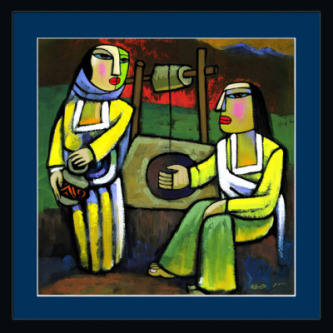
Samaritan Woman and Jesus at the Well, by He Qi

Samaria, back in Christ’s day, was viewed by many as an infamous place, full of untrustworthy people who were a mongrel mix of Jewish and ancient Assyrian blood. And their religion was most suspect of all – an unholy blend of Jewish and Gentile practices. So, no respectable Jewish person ever got near Samaria or even talked with a Samaritan.

Jesus, however, saw things differently. He did not avoid the territory but confidently walked through Samaria. Christ had no problem stopping to rest on his journey in a foreign area. That’s because Jesus didn’t class people into groups, nor did he attach adjectives to people, such as “those” Samaritans. He had no obstacles between himself and others.

Which is why an organic conversation happened between Jesus and a Samaritan woman. Christ simply saw a human being who happened to be a woman and a Samaritan. He acknowledged both her gender and her ethnicity without those being a problem. Not even Christ’s knowledge of her string of husbands was an issue in conversing with her.

Every time I read this narrative of Jesus interacting with the Samaritan woman, I imagine what all the non-verbal communication was like. I’m sure the conversation was as much about Christ’s affect, gestures, and tone of voice, as it was his well-placed words. I fully believe both his verbal and non-verbal communication was perfectly congruent with each other, giving the woman a compelling sense that her ultimate needs could be met with the living well of a person in front of her.

Water gives life. And Jesus, as living water, gives new life. A bunch of failed relationships testified to the woman’s dissatisfaction. Even though we hear no more about her after this story in the Bible, we as readers get the overwhelming sense that the woman finally found satisfaction. The love which kept slipping through her fingers now had staying power.

Jesus stood and said in a loud voice, “Let anyone who is thirsty come to me and drink. Whoever believes in me, as Scripture has said, rivers of living water will flow from within them.” (John 7:37-38, NIV)

We need the living water of Jesus as a river flowing straight from him to us — replenishing, renewing, sustaining, and breaking through every barrier in its path like a mighty flood overcoming and pushing everything out of the way that blocks its path so that our love can overflow onto all sorts of people, like a Samaritan woman.

The disciples come along, seemingly confused about this scene of Jesus and a Samaritan woman. So they blurt out something like the stereotypical mother concerned for her son saying, “Sit down and eat some of Mama’s pasta. You need some food!” As if preparing and serving a meal will make everything better.

Food has both the power to bring us together, as well as separate us. A meal can create the conditions for fellowship, acceptance, and enjoyment. On the other hand, sitting down to eat can also be a way to avoid painful emotions, and so, becomes an obstacle, keeping love at bay.

The disciples were uncomfortable and maybe a bit stressed. Looking to fill up with food instead of with God, their sense of unfulfillment was coming out sideways by opening the pantry and looking for comfort food. Jesus saw through the situation and put the focus on the disciples’ spiritual hunger.

Paying attention to our vocation and discovering humble work in the service of God, rather than a vacation to the fridge to cover unwanted feelings, is the essence of Christ’s interaction with his disciples.

People are much more ready for the gospel than we think. There are times we can become insular, lost within our own heads, that we are then unable to see the world as ripe for a harvest of people who are eager to be gathered into a community of redemption and love.

Jesus had a significant interaction with the Samaritan woman – despite the social prohibitions of the time. Shenanigans like this, by Christ, got a lot of people’s  undies in a bundle. The disciples, having a front seat to most of Christ’s ways, did a few too many palms to the forehead, believing their Rabbi’s behavior was going to make him unpopular. They feared no one would follow him.

Looks like the disciples didn’t quite get that one right.

The Samaritan woman received Jesus as Living Water, having her ultimate needs met by the Lord of all. The disciples hadn’t quite caught up to this, so fell back on their old ways of physical food and drink to assuage the awkward uncomfortable feelings happening inside them.

The woman became a wellspring of good news to her community. Whereas the disciples eventually became a fountain of the gospel after Christ’s death and resurrection, they are here only an annoying drip from the kitchen faucet. A non-descript ethnically suspect woman of dubious character coming to faith was meant by Jesus to open the disciples’ eyes to a new reality:

The good news of Christ is meant for the world, not just Jewish men.

The disciples were given the opportunity to participate a mission of bringing the love of God where love wasn’t present, of helping all kinds of people awaken to the deep spirituality within them, of lifting their downcast faces of guilt and shame to see the Living God bless the world with the body and blood of Jesus.

All of our work, no matter how big or small, is made possible by God, the great Chef of the universe. God has done all the preparations of chopping the onions, mincing the garlic, slicing the carrots, and peeling the potatoes so that we, his followers, can make a savory stew of diverse people sharing a common pot of God’s love and hospitality. It is, therefore, our privilege to be the wait staff who serves the meal to a whole host of persons.

O God, you made us in your own image, and you have redeemed us through your Son Jesus Christ: Look with compassion on the whole human family; take away the arrogance and hatred which infect our hearts; break down the walls that separate us; unite us in bonds of love; and work through our struggle and confusion to accomplish your purposes on earth; that, in your good time, all nations and races may serve you in harmony around your heavenly throne; through Jesus Christ our Lord. Amen.


How To Deal with Temptation (James 1:12-16)

Eve reaching for the forbidden fruit, by S.J. Grove, 1995

Blessed is the one who perseveres under trial because, having stood the test, that person will receive the crown of life that the Lord has promised to those who love him.

When tempted, no one should say, “God is tempting me.” For God cannot be tempted by evil, nor does he tempt anyone; but each person is tempted when they are dragged away by their own evil desire and enticed. Then, after desire has conceived, it gives birth to sin; and sin, when it is full-grown, gives birth to death.

Don’t be deceived, my dear brothers and sisters. (New International Version)

The slow slog of uphill adversity, at various times, is a common experience of us all. We must deal with circumstances we didn’t choose, and situations that are out of our control. Throw into the mix that many people have few resources, and you have a feeling of being totally overwhelmed.

In this state of being, it’s challenging to maintain solid decision-making, emotional stability, and spiritual support. We need both encouragement and warning so that we can be strengthened in faith.

The Apostle James sought to encourage and warn a small struggling church who were enduring difficult and unwanted situations. He reminded the believers that the person who perseveres under a time of trial and testing of faith is blessed. 

To be “blessed” is to have God’s stamp of approval. God approves of learning, enduring, and maturing through hardship. For such people, God has promised to give “the crown of life.” All the hard lessons we have under our belts, puts us in the position to connect with Jesus and enjoy God.

Don’t blame others

Sometimes, however, we face suffering not because of the circumstances which God brings in our lives, but because of our own unwise response to difficulty. 

Problems are compounded whenever we blame our troubles on others, and refuse to learn what God is trying to teach us. This sort of response has it’s origins in the Garden.  

Adam said to God, “The woman whom you gave to be with me, she gave me fruit of the tree, and I ate.” (Genesis 3:12) The implication of Adam is that he would have remained innocent, if God had not put Eve in the Garden with him. 

Ever since, blame-shifting has been a staple of human behavior. Our bruised hearts and damaged egos send us desperately looking for someone else to blame when we are confronted with our own trouble. 

“There are two eras in American history: the passing of the buffalo and the passing of the buck.”

Will Rogers

Some folks can be so desperate to justify themselves, they end up saying illogical things, such as: 

  • “I wouldn’t lose my temper if my co-workers were easier to get along with, my kids behaved better, and my spouse were more considerate.” 
  • “I would be a patient person if I didn’t have so many things to do, and if the people around me weren’t so slow and incompetent!” 
  • “I would have a pure mind if there were not so many sexual images in our culture.”
  • “I wouldn’t worry about the future if I had more money, and no health problems.”
  • “My spiritual life would be much better if the pastor did a better job.”
  • “I would follow if there were some decent leadership around here.”
  • “I could never forgive that person [or God].”
  • “My neighbor is an incredible cook; I can’t lose weight with such good food.”
  • “I’ll never be happy, as long as that person is in my life.”

So, I ask us, “What will it take?”…

  1. To stop making excuses? 
  2. To quit blame-shifting onto others? 
  3. To trust God and step out in faith?
  4. To cease worrying about what other people think and start doing what God thinks? 
  5. To look at faith as a dynamic relationship with the Lord, instead of just a static thing you possess? 
  6. To read Holy Scripture as if your life depended on it? 
  7. To minister with initiative and confidence? 
  8. To be humble, do justice, and act with mercy? 
  9. To spiritually grow?
  10. To truly enjoy life?

Don’t blame God

It seems that to err is human; to blame it on the divine is even more human.

God cannot be tempted; it’s not an option. God hates sin and disobedience; the Lord has no appeal for it, at all. It’s a moral impossibility for God to even consider attempting to do evil. Therefore, since God cannot be tempted by evil, God cannot tempt people toward evil.

Then why in the Sam Hill would we ever blame anything on God? Because it’s a cheap easy (and pathetic) way of absolving ourselves from responsibility for our own unwise choices, words, and actions. 

Certainly, God tests us, in order to improve our character, and to bring us toward greater spiritual maturity. Yet, God never forces us to make bad, immoral, or evil choices. God may have brought the trial and testing into our lives; but how we respond to it is up to us.

Take responsibility for yourself

The real culprit behind temptation is one’s own personal and strong desire. It’s the intense motive to have-to-do-it, have-to-say-it, and have-to-have-it, which are at the root of temptation. 

We all have legitimate needs, wants, and desires for love, security, companionship, and to make a difference in the world. Yet we may seek illegitimate means to satisfy those needs. We are lured to the hook by the enticing bait of temptation, and if we bite, that’s on us. Our own temptations lure us to satisfy our legitimate needs in illegitimate ways. 

And when we get ourselves in a pickle because of following our own temptations, the internal push to blame others and/or God becomes strong. It doesn’t help that blame-shifting feels good; it gets the monkey off my back – at least for a time. 

But like a bad addiction, blame-shifting needs to occur in a bigger dose, after a shorter duration of time. Before you know it, we’re caught in a destructive cycle. The temptation has enticed us and we have taken the bait.  Like a fish-eyed follower of evil, we succumb to the lust for ambition, revenge, sex, power, fame, or money.

Know the consequences of blaming others

Temptation, like a smooth operator, comes along and gives a slick pitch about how our troubles can be managed or taken away through blaming others, even God. Then, all of sudden, like a star-struck fan seeking to be satisfied, we take the bait and go to bed with the idea. 

We let sin’s temptation have its way with us. Now, it’s inside us. Like a fetus, the small sin grows within. Eventually, this pregnancy will come to full term. But instead of giving birth to life, there is the terrible agony of death.

Conclusion

Everyone struggles in some way with some sort of temptation. We don’t all wrestle with the same demons, but we’re all tempted in some manner. However, the cycle of guilt and separation from God can be broken. The glory of the gospel is that it breaks the power of sin.

So, hear the good news: 

Don’t let anyone fool you by using senseless arguments [blame-shifting]. These arguments may sound wise, but they are only human teachings. They come from the powers of this world and not from Christ… Christ has taken away your selfish desires… God let Christ make you alive when he forgave all our sins.

God wiped out the charges that were against us for disobeying. He took them away and nailed them to the cross. There Christ defeated all powers and forces… Now the forces of the universe don’t have any power over you….

Kill every selfish desire. Don’t be immoral or indecent or have evil thoughts. Don’t be greedy, which is the same as worshiping idols….  You must quit being angry, hateful, and evil. You must no longer say insulting or cruel things about others. And stop lying to each other. You have given up your old way of life with its habits….

God loves you and has chosen you as his own special people. So be gentle, kind, humble, meek, and patient. Put up with each other, and forgive anyone who does you wrong, just as Christ has forgiven you. Love is more important than anything else. It is what ties everything completely together.

Let the peace that comes from Christ control your thoughts. And be grateful. Let the message about Christ completely fill your lives, while you use all your wisdom to teach and instruct each other. With thankful hearts, sing psalms, hymns, and spiritual songs to God. Whatever you say or do should be done in the name of the Lord Jesus, as you give thanks to God the Father because of him. (Colossians 2:8-3:17, CEV)

Amen.

Keep the Main Thing the Main Thing (Galatians 2:1-10)

Fourteen years after that first visit, Barnabas and I went up to Jerusalem and took Titus with us. I went to clarify with them what had been revealed to me. At that time I placed before them exactly what I was preaching to the non-Jews. I did this in private with the leaders, those held in esteem by the church, so that our concern would not become a controversial public issue, marred by ethnic tensions, exposing my years of work to denigration and endangering my present ministry.

Significantly, Titus, non-Jewish though he was, was not required to be circumcised. While we were in conference we were infiltrated by spies pretending to be Christians, who slipped in to find out just how free true Christians are. Their ulterior motive was to reduce us to their brand of servitude. We didn’t give them the time of day. We were determined to preserve the truth of the Message for you.

As for those who were considered important in the church, their reputation doesn’t concern me. God isn’t impressed with mere appearances, and neither am I. And of course these leaders were able to add nothing to the message I had been preaching. It was soon evident that God had entrusted me with the same message to the non-Jews as Peter had been preaching to the Jews.

Recognizing that my calling had been given by God, James, Peter, and John—the pillars of the church—shook hands with me and Barnabas, assigning us to a ministry to the non-Jews, while they continued to be responsible for reaching out to the Jews. The only additional thing they asked was that we remember the poor, and I was already eager to do that. (The Message)

The former devout Jew, Saul, had become the Christian apostle and missionary, Paul. His ministry was as radical and dramatic as his conversion to Christianity was.

The Struggle

Keep in mind that the earliest church was predominantly made up of Jewish Christians. They had to struggle with the relationship between their historic Judaism and their newfound Christianity. For many of them, Paul was doing the unthinkable; he not only purposely sought to reach Gentiles (non-Jewish people) with the message of Jesus Christ, but he also did not require them to be circumcised. For Paul, one did not have to first become Jewish before becoming Christian.

Paul doggedly sought to preserve the core essence and spirit of Christ’s message, that is, to proclaim the good news of forgiveness and new life through the person and work of Jesus – and not by means of retaining Jewish customs or laws, including circumcision.

The Main Thing

Christianity is more than set of beliefs and practices; it’s a way of life which can be summed up in three important words: faith, hope, and love. 

Both new believers in Jesus and veterans in the faith know from experience how difficult it can be to live the Christian life. One reason for this difficulty, even when we want to please the Lord, is due to the confusion that occurs between our inner feelings and our outer actions.

The Confusion

The confusion starts with the creation and fall of humanity. In the beginning, God created humans as persons with a divine/human relationship as central to daily life. (Genesis 1:26; 2:16-25) 

What’s more, God created people with the capacity to receive divine revelation through our ability to think and reason. (Ephesians 4:24; Colossians 3:10) 

Before disobedience entered the world, in the original state before humanity’s fall, all human functions were under complete control with an inner experience of unity and harmony with one another and God. (Genesis 1:31; 2:7, 16-25) 

It is imperative for us to recognize the distinction between our personal being and our personal functions. (Romans 1:21-32; 6:16-22; 1 Corinthians 9:27; Ephesians 4:21-32)

If we don’t grasp how cataclysmic the fall of humanity was, we are going to have big struggles with living the Christian life – illustrated in the way that Paul needed to fend off a bunch of professing Christians who still seemed spiritually stuck. 

The Disobedience

In Adam and Eve’s original disobedience to God, the authority for life was transferred from God to us so that our sinful bent is to call our own shots without God. The source of authority also got whacky, transferred from a holistic and synergistic approach of body, mind, emotions, and spirit to a one-dimensional approach of simply how we feel at any given moment.

If we fail to understand this dynamic, we will be continually frustrated with people because they do irrational things. For example, many church pastors are flabbergasted that parishioners do not simply take what they teach them and go and do it. Yet, if it were that simple, there would be no place for the Holy Spirit!

Unfortunately, there’s more. In humanity’s fall, we lost control of our capacity to function well. We are all now vulnerable to manipulation, too easily swayed by the surrounding culture, and, of course, Satan. (Ephesians 2:2-3; Galatians 5:16-21) 

As a result, our inner conscience has become confused. We are not always certain of right and wrong. We misunderstand what life is really supposed to be all about. 

We lose sight of the main thing. And, in that state, there’s no way we can keep the main thing the main thing.

Instead, we become obsessed with feeling comfortable and secure; so, we pursue false gods – leaving usdisappointed and with a lack of fulfillment in life.

The Good News

However, the good news is that through the redeeming work of Jesus Christ, new life emerges; the bondage of sin is broken in our lives, and we are legally reinstated in a relationship with God in which the Lord is central in our daily life and the final authority. 

In this new relationship we can again receive truth through the Holy Spirit and the Holy Scriptures. We regain control of our functions. 

Yet, unless we learn the Scriptures and growin a daily walk with Jesus, the practical experience of this relationship with all its freedom, joy, assurance,  power, and fruitfulness may be greatly limited. (Romans 7:14-25; 1 Corinthians 3:1-4)

Even though we have redemption and faith, it is still possible to regress and give in to our old ways of functioning. This is a big reason why Christians can experience conflict, doubt, fear, anxiety, frustration, disappointment, and confusion.

To live keeping the main thing the main thing means to grow in the experience and application Christ’s centrality and authority in our lives. 

The Awareness

We must, therefore, make daily decisions of faith, hope, and love based in who we are in Christ and recognize his authority in our lives. The following seven recognitions and awareness may be helpful for you in experiencing Christian freedom and unity:

  1. You are a person with the ability to function in faith, hope, and love as God’s beloved child in Christ (2 Corinthians 7:1; Romans 8:14-17)
  2. There is a difference between who you are and what you do (or don’t do).  Evil thoughts and emotions do not make you evil, anymore than fantasizing about being a unicorn makes you a unicorn.
  3. You can take charge of your actions and your life (Galatians 5:22-23)
  4. The key is the use of your will through living in harmony with revealed biblical truth. In other words, you really can make choices of faith, hope, and love, no matter the situation. (Romans 4:17-21; Psalm 56:3; Psalm 43:5-11)  
  5. Reject whatever is contrary to Scripture, reason, and conscience. Listen to your whole self. Unhealthy patterns of acting and speaking must be broken in Jesus’ name. (Ephesians 4:22; Colossians 3:5-9; Titus 2:11-12)
  6. Choose to obey the Holy Spirit and the Holy Scriptures. Learn to think and act on the basis of truth. (Acts 27:25)
  7. Practicing the truth results in freedom, a re-patterning of thinking and functions, as well as the fruit of the Spirit. (John 8:32; Titus 2:11-14; Philippians 2:12-16)

The church is intended to be a supportive community of fellow redeemed people who worship and love Jesus together. 

Without sharing our collective learning of the Scriptures and daily struggles of faith, hope, and love, believers will inevitably be spiritually immature over the long haul. Instead, talk about your shared experiences of worship, Scripture reading, and Christian living. 

In doing so, God is glorified, the church is strengthened, and the cranky circumcisers are seen as the legalistic lunkheads they really are.

A Changed Life (Galatians 1:11-24)

A mosaic of the Apostle Paul in St Isaac’s Cathedral, St. Petersburg, Russia

I want you to know, brothers and sisters, that the gospel I preached is not of human origin. I did not receive it from any man, nor was I taught it; rather, I received it by revelation from Jesus Christ.

For you have heard of my previous way of life in Judaism, how intensely I persecuted the church of God and tried to destroy it. I was advancing in Judaism beyond many of my own age among my people and was extremely zealous for the traditions of my fathers. But when God, who set me apart from my mother’s womb and called me by his grace, was pleased to reveal his Son in me so that I might preach him among the Gentiles, my immediate response was not to consult any human being. I did not go up to Jerusalem to see those who were apostles before I was, but I went into Arabia. Later I returned to Damascus.

Then after three years, I went up to Jerusalem to get acquainted with Cephas and stayed with him fifteen days. I saw none of the other apostles—only James, the Lord’s brother. I assure you before God that what I am writing you is no lie.

Then I went to Syria and Cilicia. I was personally unknown to the churches of Judea that are in Christ. They only heard the report: “The man who formerly persecuted us is now preaching the faith he once tried to destroy.” And they praised God because of me. (New International Version)

I didn’t ask God for this

Saul wasn’t looking to change anything – except maybe to keep those confounded Christians, the group known as “The Way,” out of his beloved religion. He didn’t wake up one morning, sit on the edge of his bed and say, “Well, now, gee-whillikers, I think I’ll become the Apostle Paul, follow Jesus, and rankle a bunch of my fellow Jews with establishing churches all over the place.”

The only well-thought out plan Saul had was to ensure that Christians stayed away by any means possible. He had quite the turn around by actually joining the Christian movement. (Acts 9:1-19)

From the very get-go of his conversion, the new Paul faced skepticism, doubts, and opposition from both church and synagogue. Christians knew how Saul breathed all kinds of threats against them; so, understandably, they were reticent to receive him, perhaps wondering if it were some sort of ruse to topple the church. If it were not for the insight and encouragement of Barnabas, Paul may not have ever entered the ranks of the church. (Acts 9:26-27)

Paul’s fellow devout Jews were so upset with him for becoming a turncoat that they sought to kill him – which became a theme of Paul’s life – getting rocks thrown at him, whipped, beaten, and left for dead more than once. (Acts 9:23-24; 2 Corinthians 11:24-29)

Although Paul never asked for a dramatic conversion to Christianity, a missionary life, and continual suffering at the hands of others, he nevertheless embraced it with all the gusto of faith God gave him.

So, the gospel that the Apostle Paul proclaimed wasn’t something he sought; it was given to him. God graciously revealed the good news to Paul. For three years, he received it. Considering Paul’s background and former life, we can see why it might not be a good idea for him to hang out in Jerusalem and learn about Jesus.

Arabia is a desert. That is precisely where Paul needed to be in his early life as a Christian. Eventually, the churches and believers came around to seeing the authenticity of Paul’s faith and embraced him as a disciple. Paul is considered an Apostle because he had direct contact with Jesus himself in the Arabian desert.

God called me through the grace of Jesus

That phrase is Paul’s spiritual autobiography in a nutshell. It represents his dramatic transformation — from persecutor to preacher — and gives evidence of the hand of God at work in his life.

The fundamental conviction of being called by God, anchors Paul’s faith story. He tells that story in order to remind the Galatian Church of their own experience of being called by God’s grace.

Paul wrote his letter to the Church to help keep them on the track of grace; they were saved by grace, so therefore, they needed to also be sanctified by grace (and not law). He feared they were being led astray by believers who twisted the gospel for their own ends in order to avoid suffering. (Galatians 6:12)

The question Paul tackled head on was: Do the Gentiles have to become Jewish in order to be Christians? “Absolutely not!” Paul insisted. Neither circumcision nor uncircumcision counts for anything; the only thing that counts is faith working through love. (Galatians 5:6)

I connected with God, and you can, too

Paul was arguably the most influential Christian who ever lived. He shared his faith story in order to encourage the Galatians to examine their own experiences for signs of God’s call.

How has God called you?

It matters little whether it’s a dramatic call, like Paul’s, or whether it seems mundane, as if you don’t remember a time that you didn’t believe. And everything in between.

The important point is that we all need moments, events, and experiences of life transformation; and God’s grace must be the defining center of our personal and collective narratives.

Grace makes all the difference and is what leads to a changed life.

Once you were separated from God. The evil things you did showed your hostile attitude. But now Christ has brought you back to God by dying in his physical body. He did this so that you could come into God’s presence without sin, fault, or blame. (Colossians 1:21-22, GW)

Almighty God, transform us – not for our benefit, but for the benefit of the world. Do your work in changing us to be the new creation you have called us to be in Jesus Christ.  

Holy Spirit of God, do your sanctifying work in the church and help us to be the Body of Christ – engaged in mission, testifying to our faith, and bearing witness to the presence of our Savior, Jesus Christ. 

Lord Jesus, enable us to surrender the church back to you. It is yours, not ours. Help us lay aside our personal agendas and preferences so we can be fully committed to your calling for us. 

Blessed Holy Trinity – Father, Son, and Spirit – the God whom we serve: Do your work in our world and give to us a vision of transformed lives, renewed neighborhoods, and restored communities – bringing blessings and redemption for the glory of God. Amen.