Dealing with a Clash of Belief (Acts 3:17-4:4)

“And now, friends, I know you had no idea what you were doing when you killed Jesus, and neither did your leaders. But God, who through the preaching of all the prophets had said all along that his Messiah would be killed, knew exactly what you were doing and used it to fulfill his plans.

“Now it’s time to change your ways! Turn to face God so he can wipe away your sins, pour out showers of blessing to refresh you, and send you the Messiah he prepared for you, namely, Jesus. For the time being he must remain out of sight in heaven until everything is restored to order again just the way God, through the preaching of his holy prophets of old, said it would be. Moses, for instance, said, ‘Your God will raise up for you a prophet just like me from your family. Listen to every word he speaks to you. Every last living soul who refuses to listen to that prophet will be wiped out from the people.’

“All the prophets from Samuel on down said the same thing, said most emphatically that these days would come. These prophets, along with the covenant God made with your ancestors, are your family tree. God’s covenant-word to Abraham provides the text: ‘By your offspring all the families of the earth will be blessed.’ But you are first in line: God, having raised up his Son, sent him to bless you as you turn, one by one, from your evil ways.”

While Peter and John were addressing the people, the priests, the chief of the Temple police, and some Sadducees came up, indignant that these upstart apostles were instructing the people and proclaiming that the resurrection from the dead had taken place in Jesus. They arrested them and threw them in jail until morning, for by now it was late in the evening. But many of those who listened had already believed the Message—in round numbers about five thousand! (The Message)

I believe a lack of self-awareness is at the middle of a great many sins in this world. A lot of folks just simply do not realize how they come across to others; what impact their words and actions have upon others; and their illogical and nonsensical forms of thinking.

It’s frustrating and maddening for those who can see the blind spots in another’s life. And, keep in mind, it’s the same for others concerning some area of thought or dogmatic belief we may hold to, as well.

Recently, I had one of those surreal conversations. I had made a statement, quoting a verse from one of the New Testament Gospels about what Jesus said. Later in the day, a person who heard me say it, approached me and emphatically stated, “Jesus never said that.”

Even though I went directly to the verse and read it, the person then stated, “But that’s not from the King James or New King James Version.” So, I went to the New King James and read it. “You have to go to the King James because that’s the most reliable.” And then, after reading it there, the person dogmatically stated, “Well, that was added by a scribe. Jesus didn’t really say that.”

Even after all this, and pointing the person toward the field of textual criticism and how languages get translated, they still refused to consider the evidence right in front of their face. Yes, indeed, it is maddening! (Note: The person went so far as to begin attacking my biblical hermeneutic and my faith, because well, if you cannot accept the evidence, then you must go the ad hominem route of discrediting the person. *Sigh*)

People generally do not like their beliefs challenged nor upended. And some persons will do just about anything to maintain those beliefs – including verbal attacks against someone’s very personhood.
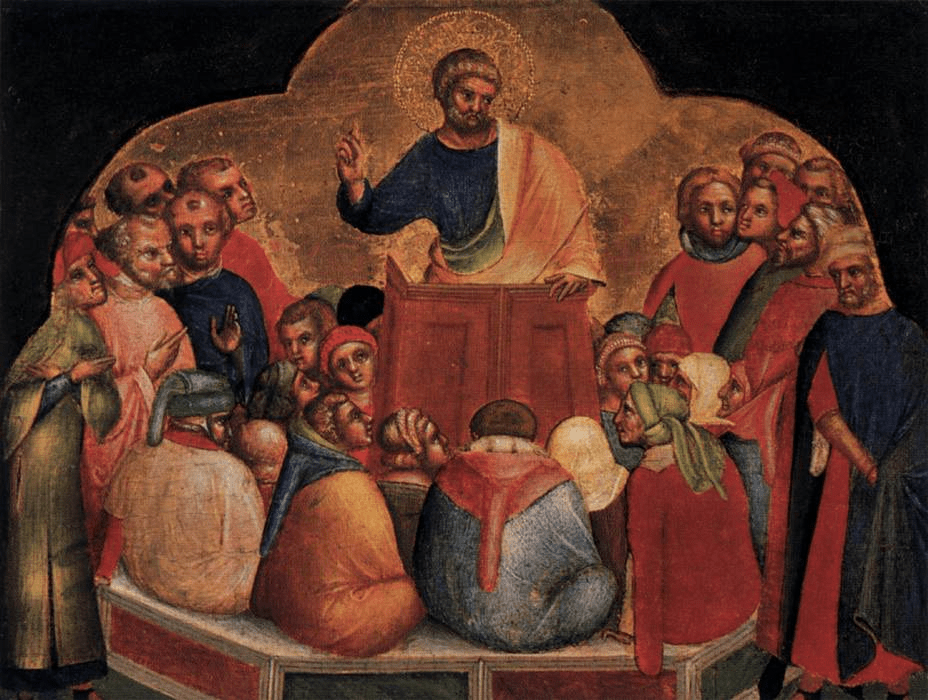
Apostle Peter preaching, by Lorenzo Veneziano, c.1370

And that is exactly what happened with the Apostles Peter and John. Their proclamation of Christ and his resurrection struck a nerve with the Jewish Sadducees who were the keepers of proper worship and liturgy amongst the temple. The Apostles’ teaching was so scandalous and threatening to their own beliefs, that they used their authority to throw Peter and John in jail – just for proclaiming a message the Sadducees didn’t like.

It never feels good getting toasted by those who claim insight and knowledge but are, in reality, a bunch of ignorant simpletons who don’t want to change and will hold onto their sense of power and superiority at all costs.

Yet, the consolation to all of this, is that there are others who are open-minded enough to listen well and adjust their belief systems to match the truthful evidence given to them. And so, despite the efforts of the Sadducees to suppress apostolic preaching, the fledgling group of Christ followers were being added by the thousands.

It turns out that nobody can resist the Holy Spirit of God, no matter how much earthly pull and power they possess.

Today’s New Testament lesson reminds us and teaches us that:

  • Self-awareness of why we hold to our particular beliefs, matters. We ought to hold our dogmatism very loosely.
  • Proclamation of the gospel, that is, the good news of Christ’s crucifixion and resurrection, makes a difference in lot of people’s lives.
  • Opposition is to be expected. There are some who view the good news of grace as the bad news of judgment against themselves; they will oppose it by any means possible.
  • Humility will always serve us well in the spiritual life, whereas condescending arrogance will never help anybody. For God’s sake, please have enough humility to listen and learn, even if (and especially) you don’t like what you’re hearing – no matter which end of the discussion you are on.

If we want the world to be different, then the change begins with you and me. Christians have the opportunity, if they will take up the mantle, of being the most calm, humble, and attentive people in the room. In this time of the year, no other stance and skill can be more important amongst family, friends, and others during the holidays.

O Lord, you have told us what is good, and what you require of us: To do what is right, to love mercy, and to walk humbly. Help us walk together in love and compassion towards the cross, humbly with you and one another. Let your Holy Spirit guide us on the right path to truth and reconciliation with humility; and enable us to hear each other, for we do not want to walk by pride or self-sufficiency, through Jesus Christ our Lord. Amen.


Prepare the Way (Mark 1:1-8)

The beginning of the good news about Jesus the Messiah, the Son of God,as it is written in Isaiah the prophet:

“I will send my messenger ahead of you,
    who will prepare your way”—
“a voice of one calling in the wilderness,
‘Prepare the way for the Lord,
    make straight paths for him.’”

And so John the Baptist appeared in the wilderness, preaching a baptism of repentance for the forgiveness of sins. The whole Judean countryside and all the people of Jerusalem went out to him. Confessing their sins, they were baptized by him in the Jordan River. John wore clothing made of camel’s hair, with a leather belt around his waist, and he ate locusts and wild honey. And this was his message:

“After me comes the one more powerful than I, the straps of whose sandals I am not worthy to stoop down and untie. I baptize you with water, but he will baptize you with the Holy Spirit.” (New International Version)

The beginning of Mark’s Gospel lets us know what the entire account is all about: The good news of Jesus Christ, the Son of God. And, from the get-go, Mark embeds this beginning in a much older beginning, from the prophet Isaiah. None of this stuff was made up; it’s been there all along, for those with the spiritual eyes to see it.

It could be that it seems you aren’t seeing anything happen in your life that’s good right now. You know you’re now into this Christian Advent season, but not feeling at all as if it’s a time of good news – because all you have been hearing is bad news stacked on top of bad news. Devastation and despair, destruction and depression, are not only with those experiencing the harrowing circumstances of war or disease, but perhaps with you, as well.

Just because you can always point to someone else, or some other people group around the world, that has it worse than you, doesn’t mean that your own situation is necessarily good. The worst sort of grief is the grief that you yourself are experiencing. It’s likely that you may have your own unique brand of hopelessness, and might feel guilty for not being more happy or grateful in this time of year.

We all need good news – not just the ones with daily terrible and traumatic encounters. Maybe we could all tap into our collective humanity and realize our spiritual connection with everyone else in this topsy-turvy world. If we share bad news together, then it seems to me that we can also share the good news with one another, as well.

And there is always good news, if we have the spiritual ears to hear it: God is here. God knows. God cares. God loves. God is the Victor. Specifically, for Mark and for Christians everywhere, the incarnation, life, death, resurrection, and ascension of Jesus the Messiah is the dynamic proclamation of deliverance from all the guilt, shame, anxiety, and devastation that happens around us and even to us.

The consistent witness of the New Testament Gospels is nothing less than the Evangelists saying to us, “Look! God is here in the person of Jesus.”

Christ did not come to this earth in order to bring us some nice distractions from the crap we are enduring; but instead turns toward the crud and faces it down with divine power.

John the Baptist, by Anikitos Giannoudes

We possess good news of great joy for all the nations. And there is, I believe, no better messenger to let us know this than John the Baptist – a quirky man whose clothes look like they don’t fit right (or are even fit for a person to wear) and whose daily lunch makes all the girls squeal.

If a guy like John – on the margins of society – can help point us to good news, then we, too, have an important place in this world of making a difference with our own social eccentricities, spiritual foibles, mental disorders, and funny looks.

It appears obvious that John only cared about one thing: making sure everyone knew who the true and ultimate Messenger was, because this Messenger Messiah had the true message of good news that the whole world desperately needs.

The good news of God brings hope to those who find themselves in dire straits, on the peripheries of our world, and of wondering if things will ever get better, or not. God’s good news of grace announces God’s presence in all of our wonderings, in every place, and with each situation we find ourselves in.

God’s love goes wherever we are. Jesus is our Immanuel, God with us. In the person of Christ, we discover that God is for us; and if everyone else is against us, the Lord’s divine presence is enough for us. Thanks be to God!

A Great Number of People Believe (Acts 11:19-26)

Now those who had been scattered by the persecution that broke out when Stephen was killed traveled as far as Phoenicia, Cyprus and Antioch, spreading the word only among Jews. Some of them, however, men from Cyprus and Cyrene, went to Antioch and began to speak to Greeks also, telling them the good news about the Lord Jesus. The Lord’s hand was with them, and a great number of people believed and turned to the Lord.

News of this reached the church in Jerusalem, and they sent Barnabas to Antioch. When he arrived and saw what the grace of God had done, he was glad and encouraged them all to remain true to the Lord with all their hearts. He was a good man, full of the Holy Spirit and faith, and a great number of people were brought to the Lord.

Then Barnabas went to Tarsus to look for Saul, and when he found him, he brought him to Antioch. So for a whole year Barnabas and Saul met with the church and taught great numbers of people. The disciples were called Christians first at Antioch. (New International Version)

The earliest of believers in Jesus Christ were Jews. Jewish converts to Christianity were not typically received well amongst their families, communities, and culture. So, when Stephen, one of those converts, retold Jewish history emphasizing a stubborn lack of awareness amongst their ancestors – and then connected it with present day attitudes – a full fledged persecution of Christians broke out.

As a result, the Church – located almost exclusively in Jerusalem – was scattered throughout Judea and across the Roman Empire in a Christian diaspora. In Christ’s ascension, he told the disciples that they would be witnesses beginning at Jerusalem, and then to Judea and outside the Middle East. Little did the small band of believers know, at the time, how that plan would come about.

As it turns out, although life was hard being a Christian refugee in a strange location, the believers spread the good news of Jesus wherever they went. Thus, gospel seeds were planted all across the land.

There is no place we can go where God is not already there.

And so, the displaced Christians discovered God was with them in their sojourning. Their faithful proclamation of good news was the impetus to bringing about many more converts to Jesus Christ.

What was happening in Judea and the Empire came back to the church leaders in Jerusalem. They then, smartly, sent one of their own, Barnabas, to Antioch in order to check out the scene and bring the new believers some encouragement. Since Barnabas was the consummate encourager, the church was emboldened, with even more converts entering into faith in Christ.

Barnabas, as an encourager, had the knack for knowing what he could do and not do; he also knew someone who could supply what he couldn’t do. He was so sure that Saul (Paul) was the right person for the job that he went to Tarsus – which was about 400 miles from Antioch – in order to find him and get him to the new believers as soon as possible. The result was an explosion of fresh converts coming to faith and into the church.

It’s no coincidence that the man with the biggest heart in the church is described in today’s text as a good man who was filled with the Holy Spirit. The Spirit is the One who makes all the difference with the growth of Christianity and the establishment of the Church.

Barnabas could see the evidence of God’s grace in the city of Antioch because he was filled to the full, with God’s own Spirit. He observed people with changed lives; an incredibly diverse and connected international community of believers; and so, encouraged them all in this good work brought about by the Spirit of God.

More and more people were added to the fellowship because of the robust spiritual dynamic that took place. This was not a matter of people using slick marketing strategies to make the name of Jesus Christ known; instead, the adding was all God. The Lord added to the Lord, and not people adding people to the Church. In other words, God is both the subject and the object, the source and the goal, of all good Christian ministry.

Then, when the Lord connected Barnabas together with Saul (Paul) who was also filled with the Holy Spirit and many spiritual gifts from God, the result was nothing less than large numbers of persons coming to faith in Christ and being added to the Church.

The believers in Antioch were so chatty about their faith that the first reference of being called “Christians” were to these converted Jewish believers in Jesus. Even though the moniker of “Christian” was probably a term of derision and meant to mock the Antiochene Church, it stuck, and was held up proudly by the believers. They were completely okay with being called “little Christ’s.”

After all, since they were truly Christ-centered in all they did, it was a fitting title for the fledging and growing Church. It clearly identified them as the people who serve and follow Christ. We, too, these many centuries later, have the very same Spirit of God that they did – and therefore, the same opportunity to speak of Jesus and see the Holy Spirit do the work of adding to the Church.

We pray, almighty God, that all who confess your Name may
be united in your truth, live together in your love, and reveal
your glory in the world.

Guide people everywhere, and of all the nations, in the
ways of justice and peace; that we may honor one another
and serve the common good.

Give us all a reverence for the earth as your own creation,
that we may use its resources rightly in the service of others
and to your honor and glory.

Bless all whose lives are closely linked with ours, and grant
that we may serve Christ in them, and love one another as he
loves us.

Comfort and heal all those who suffer in body, mind, or
spirit; give them courage and hope in their troubles, and
bring them the joy of your salvation.

Lord, in your mercy, hear our prayer. Amen.

The Hound of Heaven (2 Timothy 2:8-13)

Remember Jesus Christ, who was raised from the dead and descended from David. This is my good news. This is the reason I’m suffering to the point that I’m in prison like a common criminal. But God’s word cannot be imprisoned. This is why I endure everything for the sake of those who are chosen by God so that they too may experience salvation in Christ Jesus with eternal glory. This saying is reliable:

“If we have died together, we will also live together.
        If we endure, we will also rule together.
        If we deny him, he will also deny us.
If we are disloyal, he stays faithful”
    because he can’t be anything else than what he is. (Common English Bible)

C.S. Lewis once described God as the Hound of Heaven. By that phrase he meant that God doggedly pursued him and would not let go. Lewis came into Christian faith, in his own words, “kicking and screaming” as God’s faithful pursuit won out in his life. 

The Apostle Paul reminded his young protégé Timothy of some basic theology to keep him on track and encouraged in a tough ministry. Paul gave Timothy a trustworthy saying that he could easily remember and say to himself day after day, especially when the going got tough: 

If we died with Christ,
    we will live with him.
If we don’t give up,
    we will rule with him.
If we deny
    that we know him,
he will deny
    that he knows us.
If we are not faithful,
    he will still be faithful.
Christ cannot deny
    who he is. (CEV)

The beauty, wonder, and distinction of God is his amazing grace. There is no ambiguity with God. The Lord is not fickle but loves and holds tight even when we are unlovely and practice avoidance. When God pursues, God finds; when God holds on, there is no letting go.

This trustworthy saying of Scripture is a good, short, solid expression of theological truth to memorize, meditate upon, and say to ourselves repeatedly. We belong to Jesus Christ. God is with us. The Hound of Heaven will always sniff us out and bring us to himself.

Lewis likely got his phrase “Hound of Heaven” from an English poem of the same name by Francis Thompson (1859-1907). Thompson was a tortured soul who flirted in and out of depression, opium addiction, and suicidal thoughts for much of his adult life. Yet, he understood, perhaps better than most, that a loving God never stops pursuing a wayward heart. The poem’s beginning and end says this:

I fled Him, down the nights and down the days;
I fled Him, down the arches of the years;
I fled Him, down the labyrinthine ways
Of my own mind; and in the mist of tears
I hid from Him, and under running laughter….

How hast thou merited—
Of all man’s clotted clay the dingiest clot?
Alack, thou knowest not
How little worthy of any love thou art!
Whom wilt thou find to love ignoble thee,
Save Me, save only Me?
All which I took from thee I did but take,
Not for thy harms,
But just that thou might’st seek it in My arms.
All which thy child’s mistake
Fancies as lost, I have stored for thee at home:
Rise, clasp My hand, and come.”
Halts by me that footfall:
Is my gloom, after all,
Shade of His hand, outstretched caressingly?
“Ah, fondest, blindest, weakest,
I am He Whom thou seekest!
Thou dravest love from thee, who dravest Me.

Theology is not an impersonal affair. Personal religion still exists. The individual’s wax and wane between faith and faithlessness shall never negate divine grace.

The Lord of the universe loves you. There is a deep Divine desire to shower grace on you, to shelter and protect you. There is no need to run. Yet, if you do, God remains steadfast in his dogged pursuit. The hunt will continue….

Thank you, O God, for your great faithfulness, even to me. I believe. Help me in my unbelief! I give unceasing praise and undying devotion to you for your grace of being the One who never lets up, through Jesus Christ my Lord. Amen.