Philippians 1:3-11 – Better Together

I thank my God every time I remember you. In all my prayers for all of you, I always pray with joybecause of your partnership in the gospel from the first day until now, being confident of this, that he who began a good work in you will carry it on to completion until the day of Christ Jesus.

It is right for me to feel this way about all of you, since I have you in my heart and, whether I am in chains or defending and confirming the gospel, all of you share in God’s grace with me. God can testify how I long for all of you with the affection of Christ Jesus.

And this is my prayer: that your love may abound more and more in knowledge and depth of insight, so that you may be able to discern what is best and may be pure and blameless for the day of Christ, filled with the fruit of righteousness that comes through Jesus Christ—to the glory and praise of God. (New International Version)

The need for a medical intervention means there is ill health in the body. And the need for a spiritual intervention means there is ill health in the Body. Physical health does not just happen. Care of the body is necessary through eating well, exercising, and coping adequately with stress. Bodily sickness prevents us from doing normal activities. Illness causes us to need care and to have an inability in caregiving to others.

Spiritual health in the Body of Christ occurs when we put every effort into keeping the unity of the Spirit through the bond of peace (Ephesians 4:3). When spiritual health breaks down in the Body of Christ there is an inability for service and mission, a lack of unity, and an absence of joy. It was in such a situation that the Apostle Paul wrote his letter to the Philippians as a spiritual intervention meant to help restore their spiritual health.

In our New Testament lesson for today, the Apostle Paul begins his letter with emphasizing that the Body of Christ realizes unity, joy, and fellowship through a shared purpose of embracing the good news of Jesus Christ and proclaiming it to others. Paul emphasizes throughout his letter that the church is to be a common community, sharing life together, working on supporting one another and reaching out to others.

“We are only as strong as we are united, and as weak as we are divided.” 

J.K. Rowling

Every pronoun, “you,” used in these verses is not singular but plural. We are meant to establish our common life together around a shared mission of gospel proclamation: The kingdom of God is near. Through repentance and faith in the person and work of Jesus there is forgiveness of sins, new life, and participation in the life of God. The mission is not for larger church attendance, although that is nice and may happen; it isn’t to do more, or to get other people to stop swearing, avoid tattoos, or vote Republican.

The Apostle Paul knew without a focus on mission, on encouraging one another with the good news and sharing the gospel with others, the lack of purpose would create spiritual sickness. Apart from a deliberate focus on centering life and mission around the person and work of Christ, a group of people will nit-pick one another to death with their various opinions and wants. Wherever there is an absence of shared purpose, there you will find complaining, arguing, and a bunch of crotchety curmudgeons who nobody wants to be around.

Conversely, with a polestar on mission, the community of the redeemed work together in close fellowship with the result being joy. Happy people are a breath of fresh air to be around. A good healthy spirit is a delight to others. In fact, folks will find hope and healing through a common purpose of life together which imbibes liberally from the redemptive events of Jesus.

Good news is fun to share. It is joyful. The gospel of Jesus Christ is wonderful news, worthy of exuberant celebration. The Apostle Paul had fond memories of his partnership in the gospel with the Philippian believers. Although he had been jailed and beaten, Paul joyously sang in the prison – to the point where the jailer took notice and listened to the gospel of new life in Christ. The jailer and his entire family became followers of Jesus. (Acts 16:16-34)

“The celebration of Advent is possible only to those who are troubled in soul, who know themselves to be poor and imperfect, and who look forward to something greater to come.”

Dietrich Bonhoeffer

The Philippians were Paul’s spiritual children. They had sacrificed with Paul toward the shared vision of proclaiming good news. So, Paul wanted them to remember their own significant events of coming to faith, enjoying fellowship together, and working toward common objectives. In reminding the Philippian believers, Paul hoped to help get their heads screwed on straight again. He was confident this would happen, having an unshakable belief that God would continue the good work started within them.

This confidence was the basis of Paul’s prayers for the church. He beseeched God to unleash the Philippians’ collective love in a grand experiential knowledge of the divine so that they might discern well, making solid decisions which place the gospel as central to all of life.

There is an incredible depth to human need – a deep spiritual longing for what is good and beautiful. Relational unity brings out the beauty and majesty of humanity. Sometimes, when we are facing hard circumstances, we need to recall past days when this was true of us and remember why we were joyful.

In difficult times of injustice, we need a vision of humanity which locks arms in unity without vilifying one another. When we place priority on the good news, I believe we will again discover the joy of life, of knowing Christ. Perhaps, with a watching world observing basic human kindness and joyful relations, we will find ways of being better together and working toward the common good of all persons. And methinks, Jesus wants to help with this, if we will only let him.

May the hope of Advent and the anticipation of Christ’s coming, give us a way to understand our past and order our steps in the present so that the rule and reign of God is planted in our hearts and spread throughout the world.

O God, the Father of our Lord Jesus Christ, our only Savior, the Prince of Peace: Give us grace to set aside our cranky unhappiness and divisive spirits. Take away all hatred and prejudice, and everything which hinders us from godly union and connection: that, as there is but one Body, and one Spirit, and one hope of our calling, one Lord, one faith, one baptism, one God and Father of us all; so we may be all of one heart, and of one soul, united in one holy bond of truth and peace, of faith and love, and with one mind and one mouth to glorify you, through Jesus Christ our Lord, and in the strength of the Holy Spirit. Amen.

Philippians 1:18-26 – Do What’s Most Important

A mosaic of the Apostle Paul, Ravenna, Italy, 5th century C.E.

But what does it matter? The important thing is that in every way, whether from false motives or true, Christ is preached. And because of this I rejoice.

Yes, and I will continue to rejoice, for I know that through your prayers and God’s provision of the Spirit of Jesus Christ what has happened to me will turn out for my deliverance. I eagerly expect and hope that I will in no way be ashamed but will have sufficient courage so that now as always Christ will be exalted in my body, whether by life or by death. For to me, to live is Christ and to die is gain. If I am to go on living in the body, this will mean fruitful labor for me. Yet what shall I choose? I do not know! I am torn between the two: I desire to depart and be with Christ, which is better by far; but it is more necessary for you that I remain in the body. Convinced of this, I know that I will remain, and I will continue with all of you for your progress and joy in the faith, so that through my being with you again your boasting in Christ Jesus will abound on account of me. (New International Version)

So, what do you think leads to disunity in any group, whether in a church or elsewhere?….

Yes, unfortunately, there are many things which can divide a group of people. Chances are that discord comes from a lack of listening and love. And behind that lack is a spirit that desires attention and accolades. In other words, there cannot be unity whenever everyone wants to take credit for what’s good and blame others for what’s bad.

The Apostle Paul, writer of the letter to the Philippian Church, had a humble self-effacing approach to ministry. Paul knew exactly what was important to him and the advancement of the Church, namely, that Jesus Christ is proclaimed, that the good news of grace and forgiveness in Christ is given to people.

“The two most important days in your life are the day you are born and the day you find out why.”

Mark Twain

And so, for Paul, his purpose was crystal clear. Although he really didn’t like bad attitudes and impure motives, if the message of Christ was preached, that was of upmost significance. It didn’t matter to him if people took credit for his work, or not. Not a lot of people can say that.

The Apostle focused on himself. Ultimately, we cannot control anyone; we can only practice self-control. And that is exactly what Paul did. Notice that in today’s New Testament lesson, Paul expressed his own desire to live a life of hope, courage, and selfless ministry. He understood that all the troubles he had experienced up to this point, would likely keep happening in this earthly life.

Paul could have started a new apostles’ retirement community, stepped out of the fray, and simply studied Torah all day. It’s probably what he really wanted to do. But Paul knew better. He knew it was better for all the churches he planted that he keep laboring on their behalf.

Even though Paul was ready to die and be with his Savior forever, he wasn’t going to grab control that wasn’t his. Someday he would die, or Christ will return before that time. Until then, he was going to do his darndest to ensure the gospel of Jesus is spread far and wide.

A spiritually healthy believer in Jesus both longs for heaven and Christ, and also puts their head down and faithfully plugs away with listening to others and loving them to Jesus with gracious words of forgiveness and merciful acts of kindness.

I imagine when Paul wrote this letter, he was downright tired. I can relate. Laboring day after day as a hospital chaplain and a church pastor often leaves me with little rest and carrying the emotional burdens of both places. There are so many people who need basic human kindness, common decency, and focused encouragement. And they don’t get it because there are far too many people far too absorbed in maintaining mastery of their very small worlds.

“The unexamined life is not worth living.”

Socrates

There are days I’d like nothing more than retreat to the Northwoods of Wisconsin, read and write in a small cabin, and catch fresh walleye for my supper. Maybe that will happen someday, but not today. Today is all we have. Today is the day of salvation. There will not always be Today. Christ is coming. Then it will be tomorrow. And tomorrow is too late for too many people.

So, I continue, working with all the energy (or lack thereof) which the good Lord gives me. After all, we are not God. Everyone on this planet has only a finite amount of energy and life. The question then becomes, How will you spend your energy and your finite resources?

I suggest we take our cues from good old Apostle Paul and not bad old Jacob Marley, who didn’t get the picture until it was too late. I’d rather live right, die well, and enjoy eternity – instead of living like a peacock, dying kicking and screaming, and having a miserable eternity.

In this Advent season, we have the opportunity to focus on what’s most important, then live with those priorities in the next year.

May it be so, to the glory of God.

John 4:31-38 – Real Food

Meanwhile his disciples urged him, “Rabbi, eat something.”

But he said to them, “I have food to eat that you know nothing about.”

Then his disciples said to each other, “Could someone have brought him food?”

“My food,” said Jesus, “is to do the will of him who sent me and to finish his work. Don’t you have a saying, ‘It’s still four months until harvest’? I tell you, open your eyes and look at the fields! They are ripe for harvest. Even now the one who reaps draws a wage and harvests a crop for eternal life, so that the sower and the reaper may be glad together. Thus, the saying ‘One sows, and another reaps’ is true. I sent you to reap what you have not worked for. Others have done the hard work, and you have reaped the benefits of their labor.” (New International Version)

Today’s Gospel narrative reads something like the stereotypical mother concerned for her son saying, “Sit down and eat some of Mama’s pasta. You need some food!” As if preparing and serving a meal will make everything better.

Food has both the power to bring us together, as well as separate us. A meal can create the conditions for fellowship, acceptance, and enjoyment. Eating can bond people together through hospitable love. On the other hand, sitting down to eat can also be a way to avoid painful emotions. In this manner, eating becomes an obstacle to giving and receiving love.

It seems Christ’s disciples were doing the latter. They were uncomfortable and perhaps a bit stressed. Looking to fill up with food instead of with God, the disciples’ sense of unfulfillment was coming out sideways by opening the refrigerator, poking through the meager leftovers, and putting the emphasis on feeling better.

I know we can be hard on the disciples in the Gospels. Their ups and downs from faith to fear and back to faith again can be weird. Yet, through it all, I believe their hearts (excepting Judas Iscariot) were in the right place.

Jesus could see through the entire scenario and put the focus off eating. He addressed the disciples’ soul hunger through putting the spotlight on doing the will of God. Deep within they were hungering and thirsting for righteousness.

Paying attention to our vocation and discovering our humble work in the service of God, rather than a vacation to the pantry to cover our unwanted feelings, is the essence of Christ’s interaction with his disciples.

People are much more ready for the gospel of Jesus than we think. There are times we can become so insular, and lost within our own heads, that we are then unable to see the world as ripe for a harvest of people who are actually eager to be gathered into the community of the redeemed.

Jesus just had a significant interaction with the Samaritan woman. Back in that day, you just didn’t have dialogues with half-breed Samaritans – an unholy mix of Jewish and hated ancient Assyrian Gentile blood – let alone a man talking with a woman of disrepute who experienced several failed marriages.

Christ had a way of doing the will of God, despite conventional thinking of the time. And a lot of people got their undies in a bundle from it. The disciples, having a front seat to most of Christ’s shenanigans, did a few too many palms to the forehead, believing their Rabbi’s un-orthopraxis was going to make him unpopular. They feared no one would follow him.

Looks like the disciples didn’t quite get that one right.

The Samaritan woman received Jesus as Living Water, having her ultimate needs met by the penultimate Lord of all. The disciples hadn’t quite caught up to this, so fell back on their old ways of physical food and drink to assuage the weirdness happening inside them.

The woman was gushing over with Living Water, becoming a wellspring of good news to her community. Whereas the disciples (eventually becoming an incredible fountain of the gospel after Christ’s death and resurrection) are here nothing but an annoying drip from the kitchen faucet.

A non-descript ethnically suspect woman of dubious character coming to faith was meant by Jesus to open the disciples’ eyes to a new reality: The good news of Christ is meant for the world, not just Jewish men.

The disciples were given the opportunity to participate in the world’s takeover – a mission of bringing the love of God where love wasn’t present, of helping all kinds of people awaken to the deep spirituality within them, of lifting their downcast faces of guilt and shame to see the Living God wanting to bless the world with the body and blood of Jesus.

For this is real food and real drink.

Many believers in Jesus today think they are working hard for the Lord by seeking people for their churches. Yet, the real work is being done by the triune God – the heavenly Father who scans the world and seeks spiritual misfits to bless; the gracious and truthful Son who put hands and feet to that blessing; and the wild Holy Spirit who moves in unpredictable ways – are working infinitely harder for our churches, our families, our neighborhoods, and our world.

All of our work, no matter how big or small, is made possible by the pre-work of the Holy Trinity. The great Three-in-One has done all the preparations of chopping the onions, mincing the garlic, slicing the carrots, and peeling the potatoes so that we, his followers, can make a savory stew of diverse people sharing a common pot of God’s love and hospitality.

This is the food we know nothing about, and that God knows intimately.

O God, you made us in your own image, and you have redeemed us through your Son Jesus Christ: Look with compassion on the whole human family; take away the arrogance and hatred which infect our hearts; break down the walls that separate us; unite us in bonds of love; and work through our struggle and confusion to accomplish your purposes on earth; that, in your good time, all nations and races may serve you in harmony around your heavenly throne; through Jesus Christ our Lord. Amen.

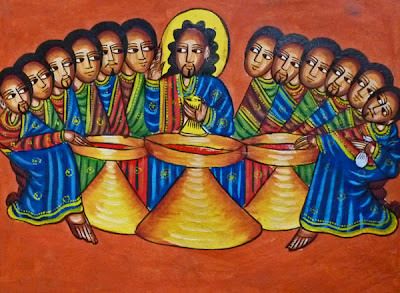
*Above painting: Ethiopian Orthodox Church depiction of the Last Supper

Acts 17:16-31 – How to Effectively Communicate

While Paul was waiting for them in Athens, he was greatly distressed to see that the city was full of idols. So, he reasoned in the synagogue with both Jews and God-fearing Greeks, as well as in the marketplace day by day with those who happened to be there. A group of Epicurean and Stoic philosophers began to debate with him. Some of them asked, “What is this babbler trying to say?” Others remarked, “He seems to be advocating foreign gods.” They said this because Paul was preaching the good news about Jesus and the resurrection. Then they took him and brought him to a meeting of the Areopagus, where they said to him, “May we know what this new teaching is that you are presenting? You are bringing some strange ideas to our ears, and we would like to know what they mean.” (All the Athenians and the foreigners who lived there spent their time doing nothing but talking about and listening to the latest ideas.)

Paul then stood up in the meeting of the Areopagus and said: “People of Athens! I see that in every way you are deeply religious. For as I walked around and looked carefully at your objects of worship, I even found an altar with this inscription: to an unknown god. So, you are ignorant of the very thing you worship—and this is what I am going to proclaim to you.

“The God who made the world and everything in it is the Lord of heaven and earth and does not live in temples built by human hands. And he is not served by human hands, as if he needed anything. Rather, he himself gives everyone life and breath and everything else. From one man he made all the nations, that they should inhabit the whole earth; and he marked out their appointed times in history and the boundaries of their lands. God did this so that they would seek him and perhaps reach out for him and find him, though he is not far from any one of us. ‘For in him we live and move and have our being.’ As some of your own poets have said, ‘We are his offspring.’

“Therefore, since we are God’s offspring, we should not think that the divine being is like gold or silver or stone—an image made by human design and skill. In the past God overlooked such ignorance, but now he commands all people everywhere to repent. For he has set a day when he will judge the world with justice by the man he has appointed. He has given proof of this to everyone by raising him from the dead.” (New International Version)

“Focus on clarifying what is being observed, felt, and needed rather than on diagnosing and judging,”

Marshall Rosenberg

The city of Athens was a major intellectual center in the ancient world. Ideas, philosophy, reason, rhetoric, and debate were standard fare amongst the citizens. At the time of the Apostle Paul’s arrival in the city, Greece knew next to nothing about Christianity. Paul’s response to what he saw and felt, dictated what he did and said; it was both wise and deeply impactful to the people of Athens. It’s almost akin to a seminar in how to communicate with folks who believe and live very differently than ourselves.

Observation

Paul entered the city and made a simple observation: Athens is full of idols. Out of all the observations Paul could have made, this one would not likely be made by most people visiting the city. Athens was a glorious place with its unparalleled architecture. The Acropolis and the Agora were resplendent with the arts and democracy.

For all its physical beauty and brilliance, the one thing Paul homed-in on was the idols. This would have struck many folks as odd – something like focusing on the dog collar instead of the dog. Yet, Paul was using more than his physical eyes – his spiritual sight was making a big observation – that Athens was very much a religious place.

Feeling

The Apostle felt upset and distressed. Paul was disturbed down deep in his gut with the spiritual state of this renowned city-state. The sheer volume of idols and the practice of idolatry created an overwhelming sense of both pity and anger.

Paul handled his emotions well. By freely acknowledging them, he was then able to choose his response. Had he not done so, it is likely Paul might have just gone on some frustrating tirade, thereby never truly connecting relationally with the people. There’s nothing wrong with being irritated or exasperated; its what we do with those feelings which are important.

Need

It is our emotions, not our thoughts, which move us to act. Paul knew why he was feeling disturbed and decided not to stuff those feelings but step out and address the great need he was observing. He decided to meet the Athenians on their turf and on their level by reasoning with them every day in the great buildings and open spaces of the city.

While in Athens, it seems Paul understandably utilized the Socratic method of dialogue – involving questions and answers. Its impressive that throughout the Acts of the Apostles, Paul demonstrated a deft ability to communicate and connect with a broad range of people.

Appeal

Paul wasn’t interacting and dialoging just for the fun of it; he wanted to make an appeal, a request to seriously consider the Christian good news of Jesus Christ’s resurrection as a viable philosophy of life. He made his appeal with Jews, Greeks, and passers-by, as well as philosophers.

Since the massive intellect of Paul could handle any reasoned debate, he was invited to the Areopagus, which was the place where the best-of-the-best carried-on their discussions.

Paul’s address to them was incredibly cogent and well-reasoned – finding common ground from which to debate and maintaining outward grace amidst his inward disturbance.

Conclusion

The late British exegete, John R.W. Stott, reflected on today’s New Testament lesson and gave us words which are still relevant:

“Why is it that, in spite of the great needs and opportunities of our day, the church slumbers peacefully on, and that so many Christians are deaf to Christ’s commission, and dumb with tongues-tied in testimony? The major reason is this: We do not speak as Paul spoke because we do not feel as Paul felt. We have never had his indignation. Divine jealousy has not stirred within us. We constantly pray, ‘Hallowed be Thy Name,’ yet we do not seem to mean it… Paul saw people created in the image and likeness of God giving to idols the homage which was due to God alone… and he was deeply pained by it.”

John R.W. Stott

May the good news be so pressed into our minds, hearts, and guts that what comes out of us is deep compassion, wise dialogue, and effective ministry for the sake of our Lord. Amen.

*Above picture: ruins of the Greek Acropolis in Athens where the Apostle Paul addressed the Areopagus.